The study adds to ‘overwhelming evidence’ that air pollution is harming children, it is claimed.
Air pollution may be responsible for nearly 40% of childhood asthma cases in a northern city that was at the centre of the Industrial Revolution, a study has found.
The new research puts Bradford on the map – but not in a good way.
International scientists used computer simulations to assess the impact of exposure to irritant gases called nitrogen oxides in the West Yorkshire city.
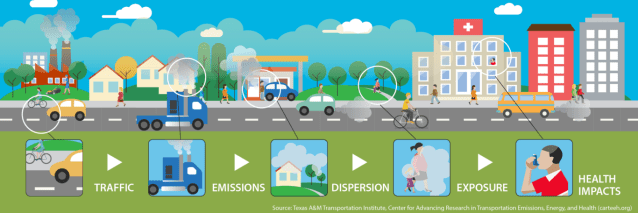
Graphic charting the impact of air pollution. (Center for Advancing Research in Transportation Emissions, Energy, and Health http://www.carteeh.org/PA)
They found that up to 38% of all annual cases of childhood asthma in Bradford may be attributable to air pollution.
Pollution from road vehicles alone was linked to 24% of cases.
Dr Haneen Khreis, who led the research while working at the University of Leeds’ Institute for Transport Studies, said: “Overall rates of childhood asthma cases in Bradford are higher than the national average as were emergency hospital admissions for asthmatic children under 16 years of age.
“Traffic-related air pollution is a real concern to the community.
“Our team’s previous research has shown that children exposed to high levels of traffic-related air pollution have a higher risk of developing asthma.
“Quantifying the number of childhood asthma cases that are directly attributable to traffic-related air pollution has not been done in the past and as we show now, a significant portion of cases is largely preventable.”
The computer models in the study allowed the team to chart how much air pollution was present in the city and how much of it could be traced to road traffic.
The findings, reported in the journal Environment International, shed light on the reasons why rates of childhood asthma have soared in the UK since the 1950s.
Britain has one of the highest rates of childhood asthma in the world, with an estimated one in 11 children suffering from the lung condition.
Asthma facts
Asthma affects one in 11 individuals and one in five households in the UK, a total of 5.4 million people.
Every 10 seconds someone in the UK has a potentially life-threatening asthma attack.
A total of 1.1 million children in the UK – one in 11 – suffer from asthma.
On average, three people in the UK die every day from asthma.
In 2016, a total of 1,410 people were killed by the condition.
The NHS spends around £1 billion a year treating and caring for people with asthma.
Asthma UK
Around 5.4 million people in the UK are living with asthma, including 1.1 million children, according to the charity Asthma UK.
In 2016, a total of 1,410 people in Britain died from asthma.
Overall, asthma rates in the UK are thought to have plateaued since the 1990s.
Professor John Wright, director of the Bradford Institute for Health Research, said: “This important study adds to the overwhelming evidence that air pollution is harming our children.
“The good news is that we can all save lives by driving less and using cleaner fuels.”
Bradford was at the heart of the Industrial Revolution, which saw the city become a textile boom town in the 19th century, largely thanks to easy access to coal for fuel.
Major sources of air pollution in the Bradford area include traffic, industry, domestic and commercial heating, and to a lesser extent diesel trains and aircraft, said the researchers.
Simon Bowens, from the environmental group Friends Of The Earth, said: “Bradford’s rates of childhood asthma are a chilling reminder that air pollution is a public health crisis, and it is our children that are bearing the brunt of it. Swift action is needed to clean up Bradford’s air, with the wellbeing of residents depending on it.”
Sweden’s towns will soon be allowed to ban old diesel engines from their town centres in an effort to improve the environment and combat air pollution, the government announced on Friday.
Sweden’s centre-left Social Democrat-Green coalition government did not impose such rules itself, but left the decision up to local authorities.
From the start of year 2020, cities and municipalities will be allowed to create environmental zones regulating the cars in the zones. Diesel cars meeting the emission standards of Euro 5 and Euro 6 will be permitted in the zones, but from July 1st 2022 only Euro 6 diesel cars will be allowed.
Cars running on petrol will be allowed in the zones if they meet the Euro 5 emission standards.
The EU’s emission standards Euro 5 and Euro 6 came into force on September 1st 2009 and September 1st 2014, respectively. The new rules therefore affect cars older than that.
In Sweden around 1.3 diesel cars would be affected by the new rules, reports the TT newswire. In Stockholm alone around 50,000 car owners would be squeezed out, according to official estimates.
Councils will also be allowed to create a separate category of even more tightly regulated zones allowing access only to electric cars, fuel cell vehicles and cars running on Euro 6 natural gas.
However, the decision for imposing the environmental zones is left up to local authorities. The ruling parties in Malmö are against it; in Gothenburg even parties on the same side are split.
“Our air is so clean we don’t think we need it,” said Malmö councillor Andreas Schönström.
In Stockholm, opinion on whether to go ahead with environmental zones as early as 2022 is divided, and even then is likely it would only affect certain streets, not the entire city centre.
In any case, Sweden is not the only country to propose such rules amid a raging debate about diesel engines. In Germany, a top court ruled last month that cities can impose diesel driving bans.
Yesterday I went running with my Respro® Ultralight™ mask. I had heard that runners and cyclists use the mask to warm up their lungs while training in cold temperatures so I thought I’d try it for myself. It was snowing slightly at minus 1 degree with a wind chill factor that made it feel even colder and the path along the river where I run is exposed to the elements.
I started my jog with my mask on and had no problem keeping to my normal jogging
pace. At first it felt a bit odd to have my mouth and nose covered but as it wasn’t impeding my breathing I continued. My face also felt warmer in the biting wind. After 1.5 km my lungs felt warm so I decided to take the mask off to see if there was any noticeable difference. Initially, I had a burst of energy feeling freer but that soon changed as my lungs started to feel tighter very quickly in the cold air. I ran for 1km and my pace slowed down to under my usual steady jog pace 5:30Min/km. The air temperature seemed to be making it harder for my lungs to stay open and I was having to work harder to keep up my pace. For my last 1km I stopped briefly and put the mask back on and my pace started to improve. I settled back into a steady jog no problem at all.
I repeated this the next day. It was another cold day and the results were the pretty much the same, usual steady pace with mask on, slower pace with mask off.
What surprised me was how my initial thoughts of the mask being restrictive changed to seeing the mask as being beneficial and enabling, which made it easier to wear it the second time round; in fact I wanted to wear it!
Whilst I mostly run in an environment which is not heavily polluted, I will definitely wear my mask while running in cold temperatures regardless of air quality. I could feel the benefit and my performance was not impacted in anyway.
Note: mask in picture: I ‘pimped’ my Sand coloured Respro® Ultralight™ mask with multi-coloured cotton thread easy to do back-stitch.
The Bangladesh’s capital scored 218 in Air Quality Index
Bangladesh’s capital Dhaka remains as the second most polluted city in the world.
Dhaka scored 218 in the US Air Quality Index (AQI) around 9am on Thursday. The air was classified as “very unhealthy.”
On Wednesday, the city ranked second on the index with a score of 238.
The index was developed by the Environmental Protection Agency for reporting daily air quality of any city or country.
Kathmandu topped the list with a score of 264, according to data obtained from AirVisual, a smartphone application that shows real-time air pollution index of any city.
Bangladesh, one of the most densely-populated countries in the world, has been struggling with air pollution for a long time while Dhaka has continued to rank among the most polluted cities.
Brick kilns, vehicles run by fuels with higher level sulphur, as well as construction works have been identified as major sources of air pollution.
The air quality further declines during the dry months – from October to April – but improves in the monsoon.
The situation is very serious, experts say, pointing out that five of the top 10 causes of deaths in Bangladesh are related to air pollution.
The South Korean government will apply stricter guideline levels for health-threatening particulate matter (PM) to fight back the country’s worsening air pollution.
Particulate matter, or fine dust dubbed as PM 2.5, is composed of a mixture of solid and liquid particles of organic and inorganic substances such as sulfate, nitrates, black carbon and mineral dust with aerodynamic diameters of less than 2.5 micrometers (㎛), according to World Health Organization (WHO). Exposure to such pollutants, which can penetrate the cardiovascular system, poses great health risks.
The Korean Ministry of Environment said Tuesday that the enforcement decree of tightening air quality guideline for fine dust was passed at the cabinet meeting. Under the changed rules, the standards for PM 2.5 fine dust will be revised to daily average of 35 micrograms per square meters (㎍/㎥) from current 50㎍/㎥ and yearly average to 15㎍/㎥ from 25㎍/㎥, the same as those of Japan and the United States. The new PM 2.5 standards will come into effect from March 27.
The ministry plans to further push up the regulatory level on PM 2.5 to be on par with the WHO’s standards. The WHO has the strictest guideline limits on PM 2.5 level with 25 ㎍/㎥ for daily average and 10㎍/㎥ for an annual average.
Following the changes in PM 2.5 guideline values, the reference standard for issuing fine dust warnings will also be modified. Air quality with PM 2.5 level under 15㎍/㎥ will be labeled as ‘good,’ kept the same as before, but the level of ‘moderate’ will be changed to 16~35㎍/㎥ from 16~50㎍/㎥, ‘unhealthy’ to 36~75㎍/㎥ from 51~100㎍/㎥, and ‘very unhealthy’ to above 76㎍/㎥ from above 101㎍/㎥.
Under the stricter standard, the number of days with ‘unhealthy’ air quality would more than quadruple to 57 days around the capital from previous 12 days based on the 2017 record, whereas the number of days with ‘moderate’ air quality would fall to 210 days from previous 257 days.
The environment ministry also plans to modify enforcement rules under the Clean Air Conservation Act to strengthen the standards for fine dust watch and warning.
The air quality in Korea has been rapidly deteriorating with growing PM concentrations. The government has introduced a number of measures to clean the air, but so far has not made much progress.
Blacks often have higher exposure to air pollution than whites, which may partially explain their higher risk heart disease and death compared to whites, according to new research in Arteriosclerosis, Thrombosis and Vascular Biology, an American Heart Association journal.
Exposure to air pollution is associated with elevated blood sugar levels, poorly functioning blood vessels, heart disease events and death.
“Previous studies showed chronic exposure to fine particulate matter (PM2.5) — a component of air pollution emitted from vehicles, factories, power plants, fires and second-hand smoke — is associated with increased cardiovascular risk and death,” said Sebhat Erqou, M.D., Ph.D., study lead author and fellow in cardiovascular disease at the University of Pittsburgh in Pennsylvania.
“Data also indicates that minorities are more likely to live in areas close to pollution sources, including heavy roadway traffic areas,” Erqou said. “However, racial differences in the exposure to air pollution and their role in disparities in cardiovascular risk and death have not been fully explained.”
Researchers merged data on fine particulate matter (PM2.5) and black carbon — a component of ultrafine particulate matter — from a Pittsburgh-area monitoring and modeling campaign, with data from the Heart Strategies Concentrating on Risk Evaluation (HeartSCORE), an ongoing community-based study that included 1,717 participants (66 percent women, 45 percent black, average age 59) in western Pennsylvania. Participants were assessed by questionnaires and during annual follow-up study visits for heart-related hospitalizations, heart attacks, acute coronary syndrome, stroke, coronary revascularization or cardiac death.
Researchers found fine particulate matter (PM2.5) air pollution exposure was associated with elevated blood glucose, worse blood vessel function, cardiovascular events and death from all causes. In addition, blacks compared to whites had:
higher average exposures to fine particulate matter air pollutants;
higher average exposures to black carbon air pollutants; and
45 percent higher risk of cardiovascular events and death from any cause, after considering traditional cardiovascular disease risk factors.
Researchers said about 25 percent of the association between race and cardiovascular events and death may be explained by exposure to fine particulate matter pollutants. However, greater income and education lessened the impact of air pollution.
The study has limitations including that it was conducted at a single institution in one city, so the range of exposure might have been narrower when compared to other localities.
“Further larger-sized, multicenter studies can help to better understand the role and mechanisms of environmental pollution exposures in racial differences in cardiovascular risk and clinical outcomes,” Erqou said.
Particle pollution increases as the wind slows down and chilly weather prompts the lighting of more wood fires
The last days of the “beast from the east” cold spell caused air pollution problems across large parts of the UK, Germany, Belgium and the Netherlands. Within the UK particle pollution reached between five and 10 on the UK government’s 10-point scale over parts of south Wales and areas of England south of a Merseyside to Tyneside line, except the far south-west.
Pollution from industry, traffic and home wood and coal burning can stay in the air for a week or up to 10 days. This means that pollution emitted in one part of Europe can cause problems hundreds of miles away. If the wind slows down then particle pollution can build up over a whole region.
The particle pollution itself has been coming from many sources, including from coal burning in eastern Europe (Poland) and domestic heating in the UK and in other parts of western Europe.
Normally wood smoke is measured during the evenings, but many people choose to keep warm in that cold period in front of a wood fire at home during the day. Wood smoke particles were measured throughout day-time hours across southern England from 1 March into the weekend.
Over a timescale of hours and days wood smoke can undergo chemical reactions and produce more particle pollution. There is evidence that this added to the air pollution over England. A change of wind direction bought milder and fresher air on 4 March.
Smog will linger in Beijing and nearby regions from Tuesday night to Wednesday, China’s national observatory forecast Tuesday.
Moderate to heavy smog will be seen in central and southern parts of Beijing, Tianjin, Hebei and nearby areas, with severe smog in parts of Hebei and Tianjin, the National Meteorological Center (NMC) said.
In Beijing, authorities issued an orange alert, the second highest level, for air pollution from Monday to Wednesday, advising children and the elderly to stay indoors.
From Tuesday night to Wednesday morning, heavy fog will blanket parts of Beijing, Tianjin, Hebei, Liaoning, Henan, Sichuan and Shandong. Visibility could be reduced to below 500 meters in some areas.
The smog and fog will disperse gradually from Thursday morning due to rainfall and the arrival of cold air, according to the NMC.
Pollution Masks since 1993 - The 'Original' and still the best - Made in the UK - respro.com
THE AIR WE BREATHE
The Respro® Bulletin Board is designed to keep you up to date with current views and issues relating to Air Pollution and its health implications in our daily lives.









 Respro® Masks are reusable
 Respro® Bulletin Board