Polluted air may pollute our morality

Exposure to air pollution, even imagining exposure to air pollution, may lead to unethical behavior, according to findings published in Psychological Science, a journal of the Association for Psychological Science. A combination of archival and experimental studies indicates that exposure to air pollution, either physically or mentally, is linked with unethical behavior such as crime and cheating. The experimental findings suggest that this association may be due, at least in part, to increased anxiety.

“This research reveals that air pollution may have potential ethical costs that go beyond its well-known toll on health and the environment,” says behavioral scientist Jackson G. Lu of Columbia Business School, the first author of the research. “This is important because air pollution is a serious global issue that affects billions of people—even in the United States, about 142 million people still reside in counties with dangerously polluted air.”

Previous studies have indicated that exposure to air pollution elevates individuals’ feelings of anxiety. Anxiety is known to correlate with a range of unethical behaviors. Lu and colleagues hypothesized that pollution may ultimately increase criminal activity and unethical behavior by increasing anxiety.

In one study, the researchers examined air pollution and crime data for 9,360 US cities collected over a 9-year period. The air pollution data, maintained by the Environmental Protection Agency, included information about six major pollutants, including particulate matter, carbon monoxide, nitrogen dioxide, and sulfur dioxide. The crime data, maintained by the US Federal Bureau of Investigation, included information about offenses in seven major categories, including murder, aggravated assault, and robbery.

The researchers found that cities with higher levels of air pollution also tended to have higher levels of crime. This association held even after the researchers accounted for other potential factors, including total population, number of law enforcement employees, median age, gender distribution, race distribution, poverty rate, unemployment rate, unobserved heterogeneity among cities (e.g., city area, legal system), and unobserved time-varying effects (e.g., macroeconomic conditions).

To establish a direct, causal link between the experience of air pollution and unethical behavior, the researchers also conducted a series of experiments. Because they could not randomly assign participants to physically experience different levels of air pollution, the researchers manipulated whether participants imagined experiencing air pollution.

In one experiment, 256 participants saw a photo featuring either a polluted scene or a clean scene. They imagined living in that location and reflected on how they would feel as they walked around and breathed the air.

On a supposedly unrelated task, they saw a set of cue words (e.g., sore, shoulder, sweat) and had to identify another word that was linked with each of the cue words (e.g., cold); each correct answer earned them $0.50. Due to a supposed computer glitch, the correct answer popped up if the participants hovered their mouse over the answer box, which the researchers asked them not to do. Unbeknownst to the participants, the researchers recorded how many times the participants peeked at the answer.

The results showed that participants who thought about living in a polluted area cheated more often than did those who thought about living in a clean area.

In two additional experiments, participants saw photos of either polluted or clean scenes taken in the exact same locations in Beijing, and they wrote about what it would be like to live there. Independent coders rated the essays according to how much anxiety the participants expressed.

In one of the experiments conducted with university students in the US, the researchers measured how often participants cheated in reporting the outcome of a die roll; in the other experiment with adults in India, they measured participants’ willingness to use unethical negotiation strategies.

Again, participants who wrote about living in a polluted location engaged in more unethical behavior than did those who wrote about living in a clean location; they also expressed more anxiety in their writing. As the researchers hypothesized, anxiety level mediated the link between imagining exposure to air pollution and unethical behavior.

Together, the archival and experimental findings suggest that exposure to air pollution, whether physical or mental, is linked with transgressive behavior through increased levels of anxiety.

Lu and colleagues note that there may be other mechanisms besides anxiety that link air pollution and unethical behavior. They also acknowledge that imagining experiencing air pollution is not equivalent to experiencing actual air pollution. They highlight these limitations as avenues for further research.

Ultimately, the research reveals another pathway through which a person’s surroundings can affect his or her behavior:

“Our findings suggest that air pollution not only corrupts people’s health, but also can contaminate their morality,” Lu concludes.
via Polluted air may pollute our morality

Posted in Air Quality, Health Effects of Air Pollution, Medical Studies | Tagged , , , | Leave a comment

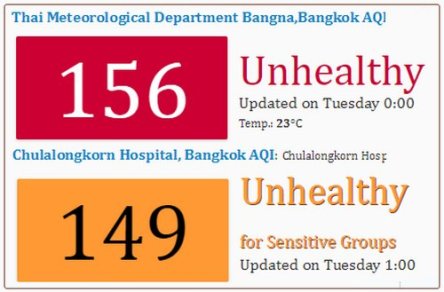
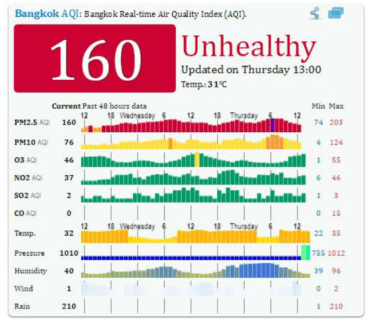
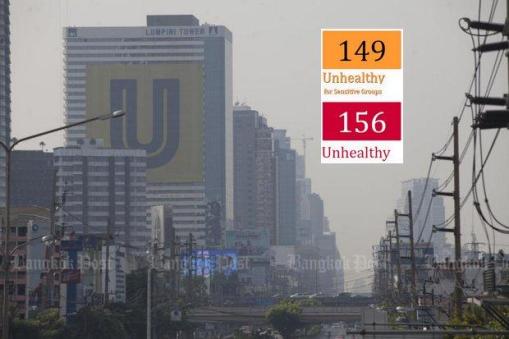
Bangkok’s air pollution level remains high

The Pollution Control Department warned on Thursday that unhealthy levels of particulate matter would continue to make life uncomfortable in Bangkok for a few more days, blaming it on weather conditions.

The department reported the noon levels of particulate matter 2.5 microns or less in diameter (PM2.5) ranged between 72 and 95 microgrammes per cubic metre of air. This was up from 69-94mcg on Thursday morning. The safe level is no more than 50mcg.

The department said fine-particle pollution was rising throughout the capital.

Director-general Sunee Piyapanpong said the cold weather caused particulate matter to accumulate in the air and, based on weather forecasts, Bangkok’s air was likely to remain highly unhealthy for a few more days.

She advised people with health problems, especially respiratory issues, to avoid areas of traffic congestion but she did not warn against outdoor activities at this time.

The city’s air has been polluted since late last month. Officials blamed it on still air, which was normal during the seasonal transition from winter to summer and does not ventilate the capital.

Screen Shot 2018-02-08 at 09.03.00

via Bangkok’s air pollution level remains high | Bangkok Post: news

Posted in Air Quality, Asia, Thailand | Tagged , , | Leave a comment

Bangkok chokes again on hazardous haze

c1_1407994_180206043733_620x413

Haze in Bangkok containing dust particles reached 82 microgrammes per cubic metre Monday, exceeding safe limits, according to the Pollution Control Department.

The department on Monday reported four locations in the city affected by airborne particulates that exceeded the safe limit of of 50 μg/m3.

Levels of dust were measured at 82 μg/m3 along Intharaphithak Road, 68 μg/m3 in Wang Thonglang district and 63 μg/m3 along Rama IV and Lat Phrao Roads.

The airborne particulates tended to increase as a result of gusty winds and temperatures dropping to 19C-20C, the department said. Patients suffering from respiratory and cardiovascular diseases were advised to wear masks if they head outdoors.

2641550

Also Monday, the Public Health Ministry intensified preventive measures against annual haze across the upper North to reduce health risks caused by air pollution.

Health Department director-general Wachira Pengchan said the measures would be implemented in eight northern provinces.

They are Chiang Mai, Chiang Rai, Mae Hong Son, Lampang, as well as Lamphun, Phayao, Prae, and Nan.

Local public health agencies were told to work closely with the public in the provinces which tend to face air pollution caused by slash-and-burn activities by farmers from January to April every year.

People’s health can be badly affected by harmful haze, Mr Wachira said.

He was speaking at a meeting discussing public health policy against haze in Phayao on Monday.

The meeting was also attended by over 100 officials attached to local public health agencies from the eight provinces.

Health risk assessments must be conducted to provide proper healthcare and preventive measures, he said. Public awareness about haze must be also improved, he added.

Kraisook Phetcharaburanin, a doctor at the Phayao Provincial Public Health Office, said the eight provinces have suffered from haze related air pollution since 2002.

According to the Chiang Mai-based Office of Disease Prevention and Control 1, the upper North saw the highest number of cardiovascular diseases and respiratory illness cases caused by dust particles.

via Bangkok chokes again on hazardous haze | Bangkok Post: news

Posted in Air Quality, Asia, Thailand | Tagged , , , , | Leave a comment

High pollution shuts schools in Tehran

Primary schools will be closed on Monday in Tehran as thick fog caused by pollution smothers the Iranian capital and most of the surrounding province, local authorities said.

They also announced Sunday they would impose traffic restrictions in Tehran, home to 8.5 million inhabitants, allowing cars onto the streets in alternating shifts, depending on their number plates.

Similar measures were taken in December when primary schools in Tehran and most of its province were forced to close for several days because of the pollution.

Average concentrations of the finest and most hazardous airborne particles hit 144 microgrammes per cubic metre in Tehran on Sunday and peaked at 169 in some areas, municipal authorities said.

That is far above the World Health Organization’s recommended maximum of 25 microgrammes per cubic metre on average over a 24-hour period.

The microscopic particles lodge deep in the lungs and are harmful to human health.

Local authorities urged the most vulnerable people—children, pregnant women, the elderly and those suffering from heart problems—to remain indoors.

Every year, Iran’s sprawling capital suffers some of the worst pollution in the world when cool temperatures cause an effect known as temperature inversion.

The phenomenon creates a layer of warm air above the city that traps in the pollution produced by more than eight million cars and motorbikes.

This year the situation has been exacerbated as the country has seen very little rainfall.

Iranian media reports say 80 percent of the pollution in Tehran is caused by fumes from vehicle exhaust pipes.

via High pollution shuts schools in Tehran

Posted in Iran, Middle East | Tagged , , | Leave a comment

Farms in the U.S. Contain Chemical-Filled Soil Responsible for a Shocking Amount of Air Pollution

Air pollution was responsible for one in eight deaths across the world in 2012. But most likely associate this smoggy mess with smokestacks, cars spitting out black smoke, or massive cities. There is, however, an unlikely source of pollution coming from right beneath your feet. A new study in California revealed that more air pollution than we previously thought is emanating from the soil.

The study, published Wednesday in Science Advances, found that between 25 and 41 percent of nitrogen oxide is coming from agricultural lands in California. “We were sort of blown away by the number at first because California has always thought of emissions from soils as being very low,” Maya Almaraz, postdoctoral fellow at University of California, Davis, told Newsweek.

Smog-filled skies in California aren’t only within the haze that sits over Los Angeles on a hot summer day—agricultural lands in the Central Valley are also emitting air pollution due to a combination of excess fertilizer, hot and dry climate conditions and the geographical conditions. Fertilizers are food for crops, but only half of the nitrogen in fertilizers is eaten up by the plants. The remainder sinks into the soil, where microbes digest nitrogen and spark the release of a waste product in the form of nitrogen oxide, or NOx.

Nitrogen oxide on its own is only dangerous at high concentrations. The reason it becomes deadly for humans is the way it contributes to smog, or a form of pollution called ground level ozone. Ground level ozone is associated with heart disease, asthma and other respiratory illnesses.

“We don’t know in our study how much of this NOx is converted into smog, and we’re working on that question right now,” Ben Houlton, senior author and director of UC Davis’s John Muir Institute of the Environment, told Newsweek. While scientists understand the deadly impacts of air pollution from smog, ozone and other pollutants, this odd source is more difficult to grasp.

“Since you can’t see it coming from the soils, it’s very easy to miss,” Houlton said. “It’s very easy to say, ‘Well, I don’t imagine these soils and systems are producing pollution because I always think that pollution comes from vehicles or fossil fuel combustion or smokestacks.’”

Despite the seemingly strange source, fertilized soils create the “perfect storm of conditions” to produce the nitrogen oxide. In valleys where many California crops are grown, air gets stuck in what Houlton described as a “bathtub,” after sweeping over the mountain ranges from the West. The air sits in the valley low to the ground, where hot and dry conditions mixed with increased amounts of pollution from fertilized soils can result in smog formation.

Reducing this previously underestimated source of air pollution is a challenge, as we need fertilizer to grow food. “We absolutely need to grow food, and California does a great job of doing that,” Almaraz said. Half of fruits and nuts produced in the U.S. are grown in the Central valley, according to researchers, and that includes much of the nation’s almonds, walnuts, raisins, avocados and tomatoes. The fertilizer used for that food, however, is largely wasted. Only half of the fertilizer is processed by plants—the rest sinks into soils and water sources.

“Improving that number is really important, and that can really help farmers because it saves them money,” Almaraz said. Technologies to improve fertilizer management, such as slow-release fertilizers or agricultural practices to improve water and fertilizer efficiencies could help, according to researchers.

“Smog from soil might be bad news to people,” Almaraz said. “It’s also an opportunity to deal with some of these air quality issues that [exist] in California.”

via Farms in the U.S. Contain Chemical-Filled Soil Responsible for a Shocking Amount of Air Pollution

Posted in Air Quality, USA, USA & Canada | Tagged , , , , | Leave a comment

Air pollution in Turkey’s Bursa reaches alarming levels

Air pollution in the western province of Bursa has reached alarming levels, posing risks to human health, the latest data from the Environment and Urbanization Ministry’s Air Quality Index has shown.

The rising consumption of coal due to winter plays an important role in the deterioration of air quality in Bursa, one of Turkey’s industrial centers.

Air pollution makes it difficult for residents to breathe in downtown Bursa.

Polluted air also poses various health risks to city residents.

Latest tests run throughout the city showed that the PM10 (particulate matter 10) level increased to 167 from a previously recorded level of 70. This qualifies the city’s air as “unhealthy.”

An index level at 200 indicates “poor” and an index value at 300 points to “dangerous” air quality.

The Environment and Urbanization Ministry warns that poor air quality poses health risks to the wider population but particularly to vulnerable groups.

Air pollution in the city has reached alarming levels due to hazardous emissions as a result of unsupervised activities of industrial facilities, said Dr. Ramazan Köylü, a pulmonologist at Medicalpark Hospital, adding that the sharp rise in lung cancer, COPD (Chronic obstructive pulmonary disease) and asthma cases in the city is related to the polluted air.

Air pollution in the city poses risks particularly to elderly, children and people with respiratory diseases, Köylü said.

When the thermal power plant to be built in the Demirtaş Organized Zone comes online, people in Bursa may have to wear masks to breathe, he added.

via Air pollution in Turkey’s Bursa reaches alarming levels

Posted in Air Quality, Europe | Tagged , , | Leave a comment

Interactive map shows which San Diego areas have the worst air quality

Areas of Alpine, Borrego Springs and Warner Springs have the highest levels of ozone pollution in San Diego County, according to state data that indicate the level of air pollution in a given neighborhood.

Ozone is the main ingredient of smog, which makes it among the most widespread and significant air pollution health threats in California. Studies show it can cause lung irritation and inflammation, and even low levels of exposure can worsen existing chronic health conditions.

Data from the California Environmental Protection Agency show the average daily maximum ozone concentration in central and northern Alpine is .057 parts per million, the highest in San Diego County.

Several areas of San Bernardino, including Highland, Loma Linda and Redlands, top the statewide list with an average daily maximum of .068.

Borrego Springs and Warner Springs fall at No. 2 in the county with .055 parts per million. The measurements reflect the average 8-hour maximum during 2012 and 2013.

If the map is not displaying on your device, click here »

Ozone is created when pollutants from trucks, cars, factories and farms chemically react in the presence of sunlight. Concentrations are collected by the California Air Resources Board, which has several monitoring stations throughout the state.

CalEnviroScreen 3.0 incorporates ozone levels, as well as diesel emissions, groundwater quality, hazardous waste and pesticide levels, into one interactive tool that state officials say helps identify environmentally-disadvantaged communities.

The tool was created to prioritize funding for grants and other programs after Gov. Jerry Brown passed legislation in 2012 that required 25 percent of cap-and-trade auction proceeds to go to projects located in communities particularly vulnerable to pollution and its effects.

According to state research, ozone levels are typically highest in the afternoon and on hot days. Children are the most sensitive to ozone exposure, but it can also affect the elderly and people who spend a lot of time outdoors.

There are different ways of measuring the rate of asthma in California, including the number of people living with asthma, the number of emergency room visits for asthma symptoms and asthma-related deaths.

The asthma data in the map represent the number of emergency room visits for asthma symptoms per 10,000 people from 2011 through 2013. That is currently the best available way to compare differences in asthma prevalence across California at the census tract level. Other methods include asthma-related deaths and the number of people living with asthma.

via Interactive map shows which San Diego areas have the worst air quality – The San Diego Union-Tribune

Posted in Air Quality, USA, USA & Canada | Tagged , , , | Leave a comment

London reaches legal air pollution limit just one month into the new year

Timing is a significant improvement, due in part to mayor’s measures, but campaigners say national government must ‘get a grip’ on toxic air

Air pollution in London has reached the legal limit for the whole of 2018 less than a month into the year, prompting calls for the government to “get a grip and show they’re serious about protecting health”.

Toxic air has been at illegal levels in the capital and most urban areas in the UK since 2010 and results in around 40,000 early deaths a year.

The date of this year’s reaching of the limit, at Brixton Road in Lambeth, is actually a significant improvement on previous years: for the last decade air pollution has reached illegal levels no later than six days into the year.

The improvement is partly the result of action taken by the mayor of London, Sadiq Khan, who introduced cleaner buses on routes through pollution blackspots and charges to deter dirty vehicles from central London. “But I have one hand tied behind my back due to government policies and inaction,” he told the Guardian.

Clean air plans put forward by ministers have already twice been declared illegal at the high court for failing to cut air pollution in the “shortest time possible”, as EU law requires. The government is now awaiting the verdict in a third case brought by environmental lawyers ClientEarth, after a hearing earlier in January.

“Londoners are still breathing filthy air on a daily basis,” said Simon Alcock at ClientEarth. “There’s much more to do. But the mayor can’t solve this problem alone. Ministers have to get a grip and show they’re serious about protecting our health by committing to real action to tackle our toxic air.”

Modern air pollution records for London began 18 years ago and Khan said this is the first time London went almost a month before reaching the legal limits: “This shows the measures we have already taken in the capital are beginning to take effect. I am using all the powers I have to their fullest extent to tackle this health crisis. But it’s about time the government recognised the true scale of this issue.”

The law requires that the hourly measurement of toxic nitrogen dioxide (NO2) must not exceed 200 micrograms per cubic metre (µg/m3) more than 18 times in a whole year. But Brixton Road has now recorded 18 breaches and is expected to break the limit in the next day or two.

Over the year, the most polluted places have vastly exceeded this in the past. In 2016 Putney high street broke the hourly limit more than 1,200 times. Khan’s cleaner bus plan is now in place in both Brixton and Putney.

Air quality has also improved on Oxford Street, which broke the annual limit in just five days in 2015. But following changes to bus routes, there have been no breaches so far in 2018. Initial hourly readings are checked and very occasionally recalibration means a result is corrected to a level below the legal limit, but even if this happens Brixton Road is certain to break the annual limit very soon.

The government’s own analysis shows charging zones to deter dirty cars from urban centres are by far the most effective policy, but ministers have told councils they should only be the option of last resort. The government has already spent £370,000 of taxpayers’ money in failed attempts to fight lawsuits aimed at forcing stronger action.

Nitrogen dioxide pollution, mostly produced by diesel vehicles, has been illegally high in most urban parts of Britain since 2010. The government’s latest plan, produced in July, was condemned as “woefully inadequate” by city leaders and “inexcusable” by doctors.

Particulate pollution is also a serious health hazard and, while levels are generally under existing legal limits, research released in October showed every person in the capital is breathing air that exceeds World Health Organisation guidelines.

Khan is introducing a wide ultra-low emissions zone in London in 2019 and planning to limit the use of wood-burning stoves in future. “The government also urgently needs to set out plans for a vehicle scrappage scheme that removes the filthiest cars off our roads,” he said.

“We need clean air action and that is what the government are delivering,” environment minister Thérèse Coffey told parliament last Thursday: “The government will continue to improve air quality, supported by the new comprehensive clean air strategy that we are developing and will publish later this year. We have already put in place a £3.5bn plan to improve air quality, with a particular focus on transport.” Coffey is meeting EU environment commissioner, Karmenu Vella, to discuss the UK’s illegal pollution on Tuesday.

Oliver Hayes, at Friends of the Earth, said: “The frequency and severity of these pollution spikes shows we’ve still got a long way to go in cleaning up our air. It’s high time we reimagined our cities so that people – not cars – come first. Our health, our sense of community, and our wellbeing depend on it.”

In September, the UN’s special rapporteur on pollution said the government was “flouting” its duty to protect the lives and health of its citizens and the problem was declared a public health emergency by a cross-party committee of MPs in April 2016.

via London reaches legal air pollution limit just one month into the new year | UK news | The Guardian

Posted in Air Quality, Europe, London, UK | Tagged , , , , , , | Leave a comment