Beijing’s Air Pollution is Frightening. This Video Shows Just How Bad It Gets 

Winters in Beijing are grim. It’s not just the subzero temperatures and shortened days that feel so oppressive; the year-end chill means even more coal is burned for heating, blanketing the Chinese capital in thick smog.

City authorities this week issued their first pollution “red alert” of 2016 — the highest level of warning. It is forecast to last five days. Some of the city’s busiest roads have been closed and at least 273 flights were grounded at Beijing Capital International Airport, according to state media.

Those planes that did depart were packed, as Beijing’s more affluent residents fled the “airpocolypse” for China’s warmer, thus less smoggy, south. The unlucky majority who remained were forced to breath air clogged with more than 500 destructive PM2.5 particles per cubic meter. (The WHO ranks safe level as under 25.)

“I could hardly see the building opposite mine this morning,” Zhang Lin, 32, a stay-at-home mom with a 4-year-old girl, tells TIME. “My daughter often coughs this winter for no reason. The doctor said it’s because of the air pollution.”

Things were even worse in industrial zones outside the capital. On Monday, average PM2.5 levels in the steel-producing city of Handan reached 780. According to the environmental group Greenpeace, more than 460 million people across northern China experienced “heavy” or “hazardous” pollution — equivalent to the populations of the U.S., Canada and Mexico combined. Hospitals were packed with people suffering from breathing problems.

“The scale of the red-alert measures show that the Chinese government is taking air pollution seriously,” says Greenpeace climate and energy campaigner Dong Liansai. “However, the ongoing ‘airpocalypse’ is further evidence that China must implement far stricter limitations on coal consumption and accelerate the restructuring of the economy away from the heavily polluting sectors.”

There is also a political dimension to the “red alert,” evidenced by extensive domestic media coverage of efforts to curb its excesses (measures range from banning charcoal barbecues to prohibiting the use of spray paint). Officials walk a tightrope between playing down the problem and reassuring the public that it is being tackled.

Earlier this month, antipollution protesters staged a demonstration in the central Chinese city of Chengdu, gathering in the busy shopping district and hanging pollution face masks on statues. Riot police eventually shut down the city center and several people were detained.

The World Health Organization says China is the world’s deadliest country for air pollution, a scourge estimated to claim a million lives across the nation each year. Although the ruling Chinese Communist Party (CCP) has declared war on the issue, overcapacity in state industries such as coal and steel is the primary cause.

For the CCP, the unrest caused by pollution must be weighed against the potential strife sparked by millions of unemployed state workers. Many see the “red alert” as the authorities’ way of preempting further protests while giving the impression the problem is being addressed.

“My friends always make jokes about the air pollution, but I think it’s sad, it’s not right to get used to it,” adds Zhang. “I wish our government would be more concerned about people’s health rather than just economic growth.”

Source: Beijing’s Air Pollution is Frightening. This Video Shows Just How Bad It Gets | TIME

Posted in Air Quality, Asia, China | Tagged , , , , , | Leave a comment

Northern China suffocates under blanket of hazardous air pollution

Air pollution in northern China including the capital city of Beijing reached hazardous levels for the fourth straight day on Tuesday, highlighting the fallout from resurgent coal production and related demand in the world’s second largest economy.

The world’s largest coal consumer, Beijing declared a “war on pollution” in 2014, but still faces hurdles in improving air quality after decades of breakneck growth.

“China was making very impressive progress towards cleaner air in 2014 and 2015 after it issued a national air pollution action plan to reduce coal consumption …. But unfortunately over the past nine months, government economic policies shifted toward stimulating some of the heavy industry sectors that are responsible for the heavy pollution in Beijing,” said Greenpeace’s senior global coal campaigner, Lauri Myllyvirta.

Myllyvirta said the current episode is the worst on record with some 460 million in China exposed to heavy or hazardous pollution from smog-causing coal used in power generation.

By Sunday, 24 cities in northern China had issued “red alerts” for pollution, China’s environment ministry said on its website. There were no further updates as of Tuesday in Asia.

Air pollution in China is a thorny social and political issue for the government as three decades of explosive industrial growth have contributed to the problem.

But China is moving to a consumption-led economy and authorities have acted to trim heavy industry overcapacity, including shutting down small coal boilers among other factories. But the loss of jobs and business opportunities has stirred social unrest.

China’s coal production fell 10.7 percent from a year ago in the first 10 months of the year, Goldman Sachs noted in a report on Friday, contributing to a price increase of 80 percent as domestic supplies tightened.

The price spike spurred the government to roll back on production curbs temporarily to help steelmakers deal with higher coal prices and also to secure winter power and heating supply. The move led to a 9 percent increase in coal production in November over October, according to official statistics.

“The transition both away from coal and to cleaner coal are both slow processes and also subject to briefer periods of interruption (such as now) which have been put in place to simulate the coal industry … (as) the price of coal got to unacceptable levels both economically and politically in China,” said CEF Holdings chairman and CEO, Warren Gilman.

“Such a vast number of people owe their livelihoods to coal and production of domestic coal (production) was falling too quickly for the government’s taste, so they have reversed the policy in the short-term to quickly bring consumption back, so it’s having a significant impact on air quality ,” he told CNBC’s Squawk Box.

Efforts towards cleaner coal—made through improved production processes—are so far modest, he added.

China’s environment ministry has put in emergency restrictions to deal with the current rash of air pollution, but some power plants and chemical producers in the region have not scaled back operations to meet the curbs, the ministry said in a post on its website. Some drivers in Beijing have also flouted traffic restrictions.

Current air quality is so bad in some cities that flights have been cancelled and schools closed, local media reported.

Source: Northern China suffocates under blanket of hazardous air pollution

Posted in Air Quality, Asia, China | Tagged , , | 1 Comment

Air pollution costs trillions and holds back poor countries, says World Bank

Study finds dirty air takes huge economic toll on poor countries and costs the world more than $5tn annually in lost work days and welfare costs

Air pollution costs the world trillions of dollars a year and severely impedes development in many countries, according to the World Bank.

In a major study (pdf) of the economic costs of indoor and outdoor pollution, the bank found that in 2013 – the year from which the latest available estimates date – China lost nearly 10% of its GDP, India 7.69% and Sri Lanka and Cambodia roughly 8%.

Rich countries are also losing tens of billions of dollars a year through lost work days and welfare costs from premature deaths. Dirty air was found to cost the UK $7.6bn (£5.6bn) a year, the US $45bn and Germany $18bn.

Zimbawe, Malawi and Central African Republic were among the world’s least polluted countries, but Liberia had the lowest lost labour costs among developing countries ($25m).

Uruguay lost just 0.03% of its GDP, costing it $17m, but Iceland – with only 400,000 people, little industry and costs of just $3m – emerged as the cleanest country in the world overall.

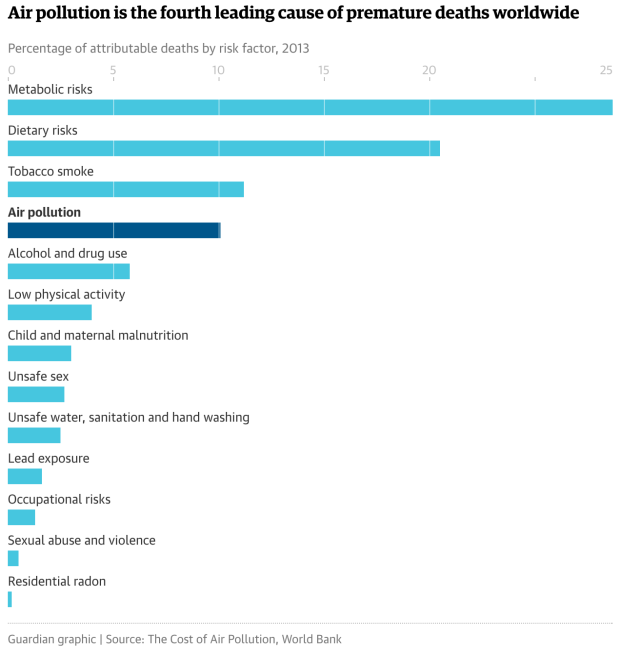
Drawing on data from the Institute for Health Metrics and Evaluation, the bank said that air pollution now kills 5.5m people a year prematurely, or one in 10 people worldwide.

It is the fourth leading cause of premature deaths worldwide behind smoking, diet and obesity, and is known to lead to cancers and heart, lung and respiratory diseases. Air pollution is responsible for more than six times the number of deaths caused by malaria.

screen-shot-2016-12-20-at-08-13-26

Without including the costs of treating illnesses linked to pollution, the bank calculated that in 2013 premature deaths alone cost the global economy about $225bn in lost work days.

But the cost to the world economy rose to more than $5tn when welfare costs, which are based on what people were prepared to pay to avoid dying from air pollution, were calculated.

Even these figures may not reflect the full cost of air pollution, said the bank.

“The figure could be very much more if it included health costs. We did not include the costs of [morbitity] illnesses caused by pollution,” said lead author Urvashi Narain, a senior environmental economist for the institution. “The scale of the problem is truly daunting. The poor are more likely to live in polluted areas and are less able to access healthcare.”

The report, entitled The Cost of Air Pollution: Strengthening the Economic Case for Action, stressed the toll on poor countries. “The health risk posed by air pollution is the greatest in developing countries,” said the authors. “In 2013 about 93% of deaths and non-fatal illnesses attributed to air pollution worldwide occurred in these countries, where 90% of the population was exposed to dangerous levels of air pollution.”

Outdoor air pollution was growing in many countries, said the report, reflecting the massive rise in car numbers. But it said billions of people in developing countries continue to depend on burning solid fuels such as wood, charcoal, coal and dung in their homes for cooking and heating.

“Air pollution is not just a health risk but also a drag on development. By causing illness and premature death, [it] reduces the quality of life. By causing a loss of productive labor, it also reduces incomes in these countries,” said the authors.

The study drew a link between economic development and air pollution. From 1990 to 2013, welfare losses nearly doubled and labour income losses increased by 40%, despite countries having made great gains in economic development and health outcomes.

In low-income countries, declining death rates were more than offset by population growth and greater total exposure to polluted air.

“Ambient air pollution is becoming a greater challenge,” said the report. “Since the 1990s, exposure to [it] has grown in most countries with some of the greatest increases in the heavily populated, fastest-growing regions, including south Asia and east Asia and the Pacific.”

screen-shot-2016-12-20-at-08-12-37

By 2013, about 87% of the world’s population was living in areas that exceeded safe levels recommended by the World Health Organisation, added the authors, who warned that the poorest were most affected.

“Apart from the sheer magnitude of the costs, the disproportionate impacts on the poorest segments of the population make air pollution a threat to shared and inclusive prosperity. The poor are more likely to live and work in polluted environments, but they are less able to avoid exposure or self-protect,” said the report.

“In the US, research dating back to the 1970s has documented how toxic facilities and sources of air pollution have tended to be sited near poor minority communities.”

While pollution-related deaths mainly strike young children and the elderly, premature deaths also result in lost income for working-age men and women. The report found that annual work income losses cost the equivalent of almost 1% of GDP in south Asia. In east Asia and the Pacific, where the population is ageing, labour income losses represent 0.25% of GDP, while in sub-Saharan Africa, where air pollution impairs the earning potential of younger populations, such losses represent the equivalent of 0.61% of GDP.

When looking at fatalities across all age groups through the lens of “welfare losses” – an approach commonly used to evaluate the costs and benefits of environmental regulations in a given country context – the aggregate worldwide cost of premature deaths in 2013 was more than $5tn. In east and south Asia, welfare losses related to air pollution were the equivalent of about 7.5% of GDP.

“Air pollution is a challenge that threatens basic human welfare, damages natural and physical capital, and constrains economic growth,” said Laura Tuck, vice-president for sustainable development at the World Bank.

Source: Air pollution costs trillions and holds back poor countries, says World Bank | Global development | The Guardian

Posted in Africa, Air Quality, Asia, China, India, Latin America, World News | Tagged , , | Leave a comment

Air pollution dogs North Pole as residents get on with life 

Idling vehicles puffed out exhaust, and a haze lingered around the Safeway grocery store parking lot Tuesday. Jan Kreischer, who sells crafts, held her breath as she dashed through the parking lot to get into the adjacent mall.

It was her only concession to polluted air in North Pole, where the official air quality monitor is reporting the nation’s highest episodic levels of fine particulate matter, more commonly referred to as PM 2.5.

During last week’s cold snap, North Pole had six uninterrupted days where the air was deemed unhealthy — a new record for consecutive bad air days, according to the Fairbanks North Star Borough air quality office.

Residents interviewed about the pollution Tuesday said they don’t dwell on it.

People were approached at random by the News-Miner in various parts of the city, and no one said they change their habits on bad air days. Seeing someone wearing breathing protection is uncommon, they said.  When the air is bad in North Pole, life goes on like normal, they noted.

“I wake up. I get in my car. I drive to work,” said Kim Marie Hunter, a professional cook. “I choose to live here. It’s not something that I am overly stressed about.”

Decades of scientific research and hundreds of studies show a link between particulate pollution and a variety of heart and lungs illnesses, but for most, it’s a slow erosion of health from a nearly invisible threat.

The pollution is intermittent, usually occurring on cold winter days when the air is stagnant.

Theresa Katsaitis, director of Klondike Kids, a day care center, said she feels more affected by the cold than by the air pollution. She pays light attention to air quality alerts. It’s not something  she hears people talking about around North Pole, she said.

“People just get on with their lives,” she said. “To me, the summers are worse when the fires are bad.”

She thinks too much attention is paid to wood smoke and too little attention is paid to vehicle exhaust. Either way, she has little hope the government can control it.

Jacque McKeown, who owns hair salon Head 2 Toe, said she notices air quality alerts when she passes the borough’s electronic message board parked by the Sourdough Fuel on Badger Road. She said she smells pockets of bad air as she drives from her home off Nordale Road to her salon in the city.

“There are certain areas off of Badger Road that are worse than others,” she said. “When I drive by certain areas off of Badger, it hurts to breathe.”

But she said she rarely notices bad air once she crosses the highway into the city of North Pole.

“I don’t really hear people talking about it,” McKeown said. “The wildfire smoke — people definitely talk more about that.”

Kayla Mountain, who suffers from asthma, lives kitty-corner from the North Pole air quality monitor on Hurst Road. She moved there from Fairbanks about a year ago.

Mountain described the air as “a little thick” sometimes but said it hasn’t aggravated her asthma.

“I don’t go outside a lot,” she said. “If I was out there, working, it would probably be bad.”

Brandon Phillips, who sells real estate, said he travels to Fairbanks from North Pole pretty much daily. The air he breathes in North Pole doesn’t seem any different than the air he breathes in Fairbanks, he said.

“I just don’t think it is as bad as what they are saying it is,” he said.

Phillips said he smells pockets of bad air around the borough — not just North Pole — but said that’s inevitable with low-lying areas in cold temperatures.

“Anywhere you have a low-lying area and it’s cold, you are going to see pockets of haze,” Phillips said. “In the Goldstream Valley, you see a lot out there.”

The real estate agent said he has never seen anyone in North Pole don a face mask for protection from air pollution. He doesn’t think people pay attention to regulations on wood burning.

Phillips said he thinks particulate pollution regulations are a form of government overreach.

“I think that PM 2.5 and the issues with controlling it are just another way for the government to control how I live my life on a regular basis,” he said.

Kreischer, the crafter who holds her breath while walking through parking lots, said she hears Phillips’ point of view often in North Pole.

“I have never heard anyone say it’s nice that they are worried about us,” she said. “It’s mostly complaints that they are controlling us.”

Source: Air pollution dogs North Pole as residents get on with life | Local News | newsminer.com

Posted in Air Quality, USA & Canada | Tagged , , , , , | Leave a comment

China: 40 cities reel under heavy smog, air pollution for third day 

The ministry has sent 13 inspection teams to check whether local governments have taken appropriate measures to address heavy pollution and sanction illegal factory emissions.

Heavy smog continued to engulf 40 Chinese cities for the third day on Sunday, with many of them under red alert for severe air pollution, as China’s environmental watchdog said the situation is likely to worsen further due to unfavourable weather conditions.

While 23 cities in north China, including Beijing and Tianjin, have activated red alerts as the air began to turn hazy starting Friday, 17 other cities declared orange alerts, the second highest alert invoking emergency measures, state- run CCTV said.

As many as 35 flights in Tianjin, east of here, were delayed or cancelled and highways into the city of 7.5 million people were closed due to “extremely low visibility”, according to state-run Xinhua news agency.

Beijing and other local governments have imposed odd-even car restrictions on roads and cut emissions for factories.

The heavy smog came a bit later than previously forecast as efforts paid off, and pollutant density in the air has somewhat been reduced in these cities, Chinese Ministry of Environmental Protection said.

However, further observation is needed to confirm the actual effects of these measures, and air pollution is still likely to worsen as weather conditions continue to be unfavourable, the ministry said in a statement.

Pollution levels are likely to peak between today and tomorrow, it said, adding there will be another peak on Wednesday, Xinhua reported citing the statement.

In Beijing, the air quality index (AQI) reading reached 253 indicating heavily polluted air, according to the Beijing Municipal Environmental Monitoring Centre.

China’s National Meteorological Centre (NMC) maintained an orange alert for smog today for north China, warning that air pollution will be the most severe from tomorrow evening to Wednesday.

Some regions will see PM2.5 density levels exceeding 500, the NMC said, adding the smog is expected to disperse from Wednesday night.

China has a four-tier warning system for severe weather, with red being the most serious, followed by orange, yellow and blue.

Source: China: 40 cities reel under heavy smog, air pollution for third day | Latest News & Updates at Daily News & Analysis

Posted in Air Quality, Asia, China | Tagged , , , , , | Leave a comment

Poor air quality hits central and southern Taiwan 

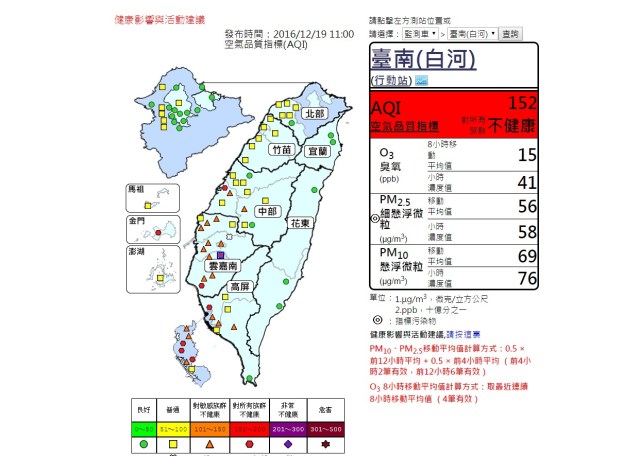
According to the EPA standards, AQI levels above 150 are considered “unhealthy for everyone.”

Environmental Protection Administration (EPA) on Monday warned the residents in central and southern Taiwan of poor air quality as the Air Quality Index (AQI) readings at some of the region’s monitoring stations have reached “code red” levels.

In some areas of central and southern Taiwan, including Changhua, Nantou, Yunlin, Chiayi, Tainan, Kaohsiung and Pingtung, as well as offshore islands of Kinmen, code red levels were observed, meaning the AQI index readings were between 151 and 200, a “moderately polluted” level.

According to the EPA standards, AQI levels above 150 are considered “unhealthy for everyone.”

The EPA uses a six-color air pollution warning system, in which a maroon alert is the highest and most severe warning, which indicates “hazardous” air quality, and is followed by purple, red, orange, yellow, and green alerts.

Advisories have been made for residents in the regions, especially for the elderly, children, those with respiratory illnesses and heart conditions to limit outdoor activities and wear masks when going out to reduce negative respiratory effects from the bad air.

Source: Poor air quality hits central and southern Taiwan | Taiwan News

Posted in Air Quality, Asia, Taiwan | Tagged , , , | Leave a comment

Beijing issues red alert for severely high air pollution due to incoming smog

Beijing city government has issued a red alert for severely high levels of air pollution in the city for three days from December 17 to 21, according to a post on the Beijing environmental protection bureau’s official Weibo account.

china-smog

Beijing city government has issued a red alert for severely high levels of air pollution in the city for three days from December 17 to 21, according to a post on the Beijing environmental protection bureau’s official Weibo account.

The incoming smog was due to an accumulation of air pollution in Beijing and surrounding areas, including Tianjin city and Hebei, Shandong and Hunan provinces, the post said, citing forecasts from the China Environmental Monitoring Center.

A colour-graded warning system of alerts was introduced in China’s capital city last year as part of the government vow to crackdown on environmental degradation following decades of unbridled economic growth.

Beijing’s first ever red alert was issued in December last year, temporarily closing schools and halting construction in the city.

The government has since been tweaking the system, raising in February the threshold of issuance to a higher average daily air quality index reading.

Source: Beijing issues red alert for severely high air pollution due to incoming smog | The Independent

Posted in Air Quality, Asia, China | Tagged , , | Leave a comment

Public transport in Warsaw free today amid pollution worries 

Warsaw City Hall on Thursday for the first time gave residents free access to public transport across the capital in a bid to reduce high air pollution.

Warsaw Deputy Mayor Michał Olszewski said: “We urge residents to leave their cars at home and use the public transport system. We ask them not to use their fireplaces.”

He added: “Residents should also limit the time they spend outside, especially in the eastern districts of Warsaw, where the level of pollution might be especially high.”

Anna Dworakowska-Guła, from a grass-roots movement called Kraków Smog Alert, which aims to educate residents in Kraków, southern Poland, about the dangers of pollution, said: “It’s very good that the problem of smog is being noticed in our capital too.

“Maybe this will force politicians to take the necessary action and legislative changes in order to improve air quality in the whole country.”

She added that making public transport free would have an “educational and public awareness impact”, but would not significantly improve air quality.

Source: Public transport in Warsaw free today amid pollution worries – National

Posted in Air Quality, Europe, Poland | Tagged , , | Leave a comment