Many Turkish cities hit air pollution limits, warns Greenpeace

Noting that many Turkish provinces have reached the “air pollution limits of 2022” in just four months, independent global environmental network Greenpeace said, “human lives could be in danger.”

The organization highlighted that the duration for PM10 pollution should not last for more than 35 days a year. “However, many cities reached this 35-day annual limit in the first few months of the year.”

PM10 is any particulate matter in the air with a diameter of 10 micrometers or less, including smoke, dust, soot, salts, acids, and metals.

When asked what this situation means, Gökhan Ersoy, Greenpeace Mediterranean Climate and Energy Project coordinator, said, “Authorities should immediately stop all activities causing pollution in these provinces.”

According to the report published by daily Milliyet on May 12, Doğubeyazıt district of the eastern province of Ağrı was the first region that “hit the polluted days limit” on Feb. 9.

The northwestern province of Edirne surpassed the limit on Feb. 10, the Aegean province of Denizli and the southeastern province of Batman reached the limit on Feb. 13.

Feb. 14 was the day the eastern province of Iğdır and the Altındağ district of the capital Ankara had more than 35 days of air pollution.

They were followed by the western province of İzmir’s Alsancak district on Feb. 18.

Mecidiyeköy neighborhood, one of Istanbul’s business centers, entered the list on Feb. 27.

Greenpeace, in 2021, has declared a list of 10 cities that are face-to-face with big air pollution risks.

“However, in the first four months of this year, new cities, such as, İzmir, [the Black Sea provinces of] Zonguldak, Düzce, Karabük and [the northwestern province of] Çanakkale have already surpassed the 35-day limit,” Ersoy added.

Many Turkish cities hit air pollution limits, warns Greenpeace – Turkey News
Posted in Air Quality, Europe | Tagged , , | Leave a comment

Air pollution continues to threaten health of people in Southeast Europe

Air pollution continues to be a leading health concern in Southeast Europe, where PM2.5 concentrations are well above the World Health Organization (WHO) annual guideline value of 5 μg/m3. This is highlighted in the new report created by the Health Effects Institute. 

Up to 99% of the population in this region lives in areas above the WHO annual guideline value of 5 μg/m3 for PM2.5.

According to the analysis “A state of Global Air special report: Trends in Air Quality and Health in SouthEast Europe” published by the Health Effects Institute (HEI), air pollution is ranked among the top 10 risk factors for ill health in every country in Southeast Europe.

Almost 12 percent of total deaths in Southeast Europe (56,300 premature deaths) were linked to air pollution in 2019

Almost 12 percent of total deaths in Southeast Europe (56,300 premature deaths) were linked to air pollution in 2019. Outdoor PM2.5 accounted for the most air pollution-related deaths (46,600, or 9.7% of the total). Romania had the highest number of air pollution–attributable deaths (17,100) in the region while Montenegro had the lowest (700).

Long-term exposures to air pollution contribute to an increased risk of illness and premature death from chronic noncommunicable diseases, such as ischemic heart disease, lung cancer, chronic obstructive pulmonary disease (COPD), stroke, and type 2 diabetes as well as lower respiratory infections (e.g., pneumonia), especially in children under 5 years of age.

Exposure to PM2.5 also puts mothers at risk of delivering babies too early

Exposure to PM2.5 also puts mothers at risk of delivering babies too early and smaller than average, and these babies are more susceptible to dying from a range of diseases or are considered to be at increased risk for diseases later in life. There is also emerging evidence on the role of air pollution in cognitive disorders, including dementia.

PM2.5-linked death rates exceed the global rate of 53.5 deaths per 100,000 population in eight out of nine countries — Slovenia is the only exception

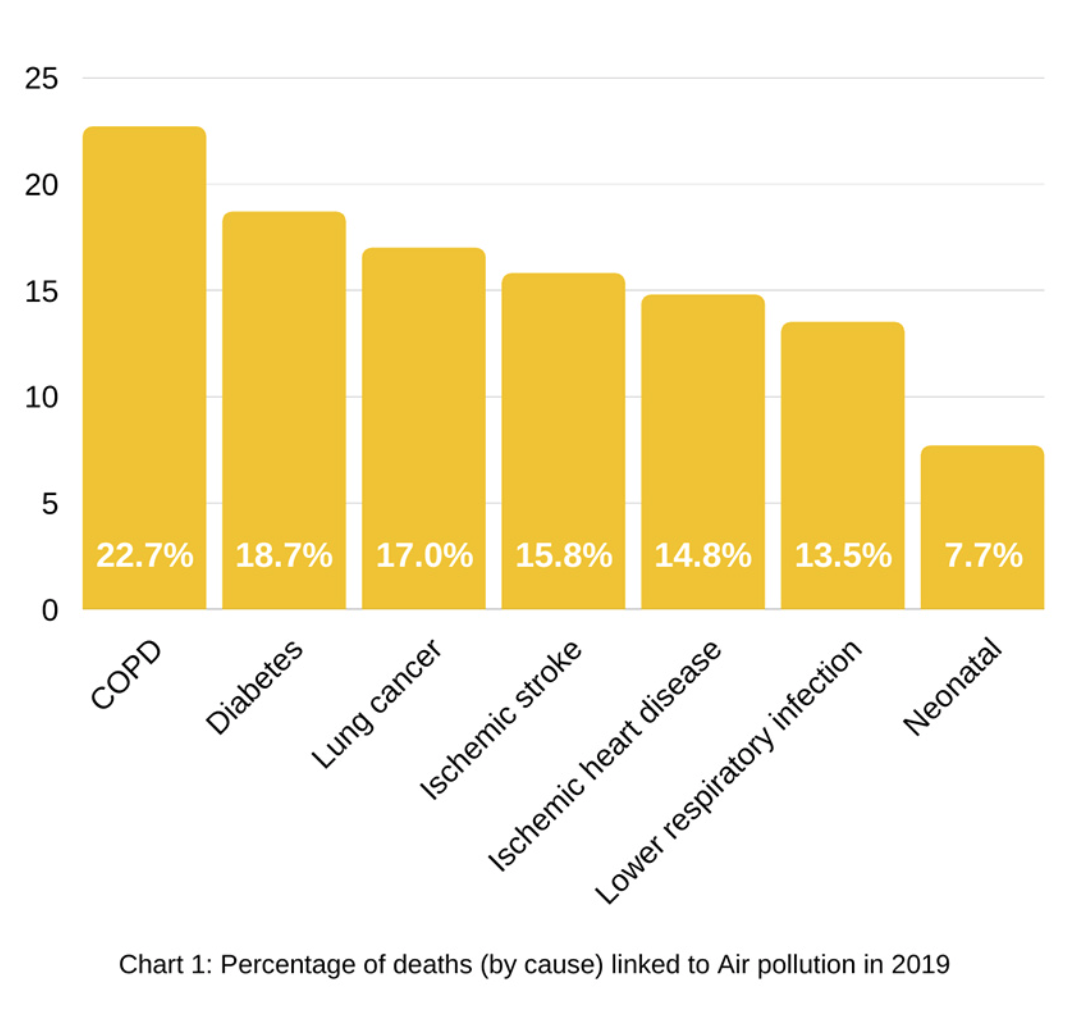
On average, nearly 23% of all COPD-related deaths were attributed to air pollution. The largest impacts were seen in Bosnia and Herzegovina (30%), North Macedonia, and Montenegro (each 26%), while the lowest such burden was estimated for Romania (14%). These numbers come from global atmospheric modeling and are to some extent relying on the data from the monitoring stations in the countries, but might not represent exact real-world monitoring data.

Srdjan Kukolj, Consultant for the Balkan region at the Health and Environment Alliance (HEAL) highlights that Western Balkan countries are very much dependent on fossil fuels. “We see that extreme levels of air pollution are still present in the region so we call on decision-makers to put health at the center of environmental policies and to set more ambitious plans towards healthier and sustainable ways of living. The link between the damaging effects of poor air quality and humans is very well established. Air pollution threatens human lives in two primary ways: causing an increase in non-communicable disease cases and leading to premature deaths. Not only does it affect people’s lives, but it also contributes to the downfall of public health, the economy, the environment and makes the climate more extreme,’’ Kukolj elaborated.

How have pollutant exposures changed between 2010 and 2019

PM2.5 annual average exposures have decreased for every country in the region over the last decade, with the largest decrease in Serbia, where levels of PM2.5 in 2019 were 19.1% lower compared to 2010.

The highest annual average PM2.5 exposure in 2019 was observed in North Macedonia (30.3 μg/m3), while Romania had the lowest exposure (15.7 μg/m3).

PM2.5 (presented as population-weighted annual average concentration) has been lower in 2019 (19.1 μg/m³) than in 2010 (25.5 μg/m³) but still higher than the EU-28 average (11.4 μg/m³). Household air pollution (percentage of the population relying on solid fuels for cooking) is lower in 2019 (23.0%) than in 2010 (27.7%). Ozone (presented as poulation-weighted seasonal average concentration) has been lower in 2019 (82.0 μg/m³) than in 2010 (87.9 μg/m³), and lower than the EU-28 average (83.5 μg/m³).

Highest impacts of air pollution on the young and the old

Across Southeast Europe, the largest number of deaths occur in people aged 70 or older. Exposure to air pollution accounted for 7.7% of neonatal deaths, with most premature deaths attributed to ambient PM2.5. The percentage of neonatal deaths linked to air pollution in 2019 was largest in Bosnia and Herzegovina (11%) and North Macedonia (10%).

Key sources of PM2.5 in Southeast Europe

Important fuel contributors to PM2.5 exposures in the region include coal, liquid fuel and natural gas, and solid biofuels. As individual sources, residential sources contributed the most (20%) to PM2.5 attributable deaths in 2019, followed by energy production (18%), windblown dust (13%), agriculture (13%), and transport (7%).

Vlatka Matković, Senior Policy Officer at the Health and Environment Alliance (HEAL) has raised concerns about the long-term exposure to air pollution across the region: “Europe’s South-Eastern region has long been an air pollution hotspot, with coal-burning as the main contributor. This report confirms the urgency to act for clean air for health. A swift phase-out of the region’s chronic coal pollution is needed to protect health and help tackle climate change. Ending coal dependence will bring many benefits, including reduced rates of cancer, heart and lung disease, and the healthier development of children.” 

Strengthened political commitment and efforts overdue

Establishing cooperation between the countries of the Western Balkans should lead to strengthening the health response toward stopping pollution, experts underline. They are united in the opinion that ministries of health, public health institutes, and academia must play a more participatory role in decision-making relevant to public health, energy, climate change, and the environment.

Regional cooperation is essential to achieving a healthier and more sustainable future. Leading organizations in the field of air pollution and its impact on health recommend to the leaders of this region to urgently move away from polluting practices, especially from burning fossil fuels and commit to integrated, effective measures that will lead to a significant reduction in the health burden due to air pollution in the region, which has so far left an unacceptably large burden for public health, the environment and economy.

Air pollution continues to threaten health of people in Southeast Europe

Posted in Air Quality, Europe | Tagged , , , , , , , , , , , , | Leave a comment

Micro- and nanoplastic from the atmosphere is polluting the ocean

In a new study, an international team of researchers investigates the atmosphere as a relevant source of plastic pollution in our planet’s waters

According to estimates, by 2040 the level of plastic pollution could reach 80 million metric tons per year. Plastic particles have now been detected in virtually all spheres of the environment, e.g. in water bodies, the soil and the air. Via ocean currents and rivers, the tiny plastic particles can even reach the Arctic, Antarctic or ocean depths. A new overview study has now shown that wind, too, can transport these particles great distances – and much faster than water can: in the atmosphere, they can travel from their point of origin to the most remote corners of the planet in a matter of days. In the journal Nature Reviews Earth and Environment, an international team of researchers – including experts from the Alfred Wegener Institute, the Institute for Advanced Sustainability Studies in Potsdam, and the GEOMAR Helmholtz Centre for Ocean Research in Kiel – describes how microplastic finds its way into the atmosphere and how it is subsequently transported.

Today, between 0.013 and 25 million metric tons of micro- and nanoplastic per year are transported up to thousands of kilometres by ocean air, snow, sea spray and fog, crossing countries, continents and oceans in the process. This estimate was arrived at by an international team of 33 researchers, including experts from the Alfred Wegener Institute, Helmholtz Centre for Polar and Marine Research (AWI), the Institute for Advanced Sustainability Studies in Potsdam (IASS) and the GEOMAR Helmholtz Centre for Ocean Research in Kiel.

“Air is a much more dynamic medium than water,” says co-author Dr Melanie Bergmann from the AWI. “As a result, micro- and nanoplastic can much more quickly penetrate those regions of our planet that are most remote and still largely untouched.” Once there, the particles could affect the surface climate and the health of local ecosystems. For example, when these darker particles are deposited on snow and ice, they affect the ice-albedo feedback, reducing their ability to reflect sunlight and promoting melting. Similarly, darker patches of seawater absorb more solar energy, further warming the ocean. And in the atmosphere, microplastic particles can serve as condensation nuclei for water vapour, producing effects on cloud formation and, in the long term, the climate.

How do plastic particles get into the atmosphere?

First of all, through human activities. Particles produced by tyres and brakes in road traffic, or by the exhaust gases from industrial processes, rise into the atmosphere, where they are transported by winds. However, according to the overview study, there is also evidence suggesting that a substantial number of these particles are transported by the marine environment. Initial analyses indicate that microplastic from the coastal zone also finds its way into the ocean through eroded beach sand. The combination of sea spray, wind and waves forms air bubbles in the water containing microplastic. When the bubbles burst, the particles find their way into the atmosphere. As such, transport to remote and even polar regions could be due to the combination of atmospheric and marine transport.

Consequently, it is important to understand interactions between the atmosphere and ocean, so as to determine which particle sizes are transported, and in which quantities. The atmosphere predominantly transports small microplastic particles, which makes it a much faster transport route that can lead to substantial deposits in a broad range of ecosystems. As Melanie Bergmann explains: “We need to integrate micro- and nanoplastic in our measurements of air pollution, ideally on an international scale as part of global networks.” For this purpose, in a first step, first author Deonie Allen and Bergmann began collecting samples of microplastic in the air, seawater and ice during a Polarstern expedition to the Arctic last year.

Joining forces to grasp the microplastic cycle

Understanding and characterising the microplastic cycles between the ocean and atmosphere will require joint efforts. In this regard, in the study, the team of researchers led by first authors Deonie Allen and Steve Allen from the University of Strathclyde, Glasgow, outlines a global strategy for creating a seamless, intercomparable database on the flow of micro- and nanoplastic between the ocean and atmosphere. “There are so many aspects of the emissions, transport and effects of microplastic in the atmosphere that we still don’t fully understand,” says co-author Prof Tim Butler from the IASS. “This publication reveals the gaps in our knowledge – and presents a roadmap for the future.”

Two dedicated working groups from the Joint Group of Experts on the Scientific Aspects of Marine Environmental Protection (GESAMP) prepared the study. According to study co-author and GESAMP member Prof Sylvia Sander from GEOMAR: “The study makes it clear that a comprehensive grasp of the ocean, and of the effects of human influences on it, can only be achieved by networking researchers and their data. The great challenges of our time are at the global scale. Accordingly, we have to pursue answers to pressing questions with expertise that is as comprehensive and international as possible. That can only be done by working together.” GESAMP is a conglomerate of eleven organisations belonging to the United Nations. Its goal is to arrive at a multidisciplinary, science-based understanding of the marine environment. To date, the network has already collaborated with more than 500 experts from countries around the globe on a range of questions.

Micro- and nanoplastic in the air is also relevant for human health. In a recently released British study, microplastic was detected in the lungs of 11 of 13 living human beings. “This is yet another reason why we need to integrate plastic into monitoring programmes for air quality,” Bergmann stresses. In order to reduce environmental pollution from plastic, the production of new plastic would also need to be successively reduced on the basis of an international treaty, as Bergmann and other experts recently called for in a letter to the journal Science.

Original publication

Deonie Allen et al.: Micro- and nanoplastics in the marine-atmospheric environment. Nature Reviews Earth & Environment (2022). DOI: https://doi.org/10.1038/s43017-022-00292-x

Micro- and nanoplastic from the atmosphere is | EurekAlert!
Posted in Air Quality | Leave a comment

Exposure to wildfires increases risk of cancer

Living near regions prone to wildfires may boost risk of developing lung cancer and brain tumors

A new study from McGill University finds higher incidence of lung cancer and brain tumors in people exposed to wildfires. The study, which tracks over two million Canadians over a period of 20 years, is the first to examine how proximity to forest fires may influence cancer risk.

“Wildfires tend to happen in the same locations each year, but we know very little about the long-term health effects of these events. Our study shows that living in close proximity to wildfires may increase the risk of certain cancers,” says Scott Weichenthal, an Associate Professor in the Department of Epidemiology, Biostatistics, and Occupational Health at McGill University.

Published in The Lancet Planetary Health, the study shows that people living within 50-kilometer of wildfires over the past 10 years had a 10 per cent higher incidence of brain tumors and 4.9 per cent higher incidence of lung cancer, compared to people living further away.

Impacts of climate change on human health

With the changing climate, wildfires are predicted to become more prevalent, severe, and longer in duration in the future – and they are increasingly recognized as a global health problem. “Many of the pollutants emitted by wildfires are known human carcinogens, suggesting that exposure could increase cancer risk in humans,” says Jill Korsiak, a PhD student in Professor Weichenthal’s lab who led the analysis.

Wildfires typically occur in similar regions each year, and as a result, people living in nearby communities might be exposed to carcinogenic wildfire pollutants on a chronic basis, warn the researchers.

Lingering harmful pollutants

In addition to impacts on air quality, wildfires also pollute aquatic, soil, and indoor environments. While some pollutants return to normal concentrations shortly after the fire has stopped burning, other chemicals might persist in the environment for long periods of time, including heavy metals and hydrocarbons. “Exposure to harmful environmental pollutants might continue beyond the period of active burning through several routes of exposure,” adds Professor Weichenthal.

Still, more research is necessary to understand the complex mixture of environmental pollutants released during wildfires, note the researchers. They also note that further work is needed to develop more long-term estimates of the chronic health effects of wildfires.

About this study

“Long-term exposure to wildfires and cancer incidence in Canada: a population-based observational cohort study” by Jill Korsiak, Lauren Pinault, Tanya Christidis, Richard Burnett, Michal Abrahamowicz, and Scott Weichenthal was published in The Lancet Planetary Health.

DOI: https://doi.org/10.1016/S2542-5196(22)00067-5

Exposure to wildfires increases risk of cance | EurekAlert!
Posted in Air Quality, Canada, Health Effects of Air Pollution, Medical Studies, USA & Canada | Tagged , , , , , | Leave a comment

Schools Shut in Tehran Due to Air Pollution

The province of Tehran’s local officials made a belated decision to close kindergartens and elementary schools on Sunday morning to protect children from a thick smog of pollution hanging in the air.  

“High school students should be prevented from outdoor physical activities … considering the ‘very unhealthy’ air quality index,” Abed Maleki, a senior member of the governor-general’s office, was quoted as saying by ISNA. 

The overdue decision, announced at 8 am in the morning, triggered public backlash as parents scrambled to plan for their children’s day. It is not clear whether schools will be shut on Monday. 

“The decision for tomorrow will be announced in coming hours after reviewing the air quality index,” Maleki pointed out. 

Dusts and particles from sources inside and outside Iran have contributed to the pollution crisis as Tehran ranked first in worst air quality among major cities across the world on Sunday.

Data released by Tehran Air Quality Control Company showed that average PM2.5 readings, which are hazardous airborne particles, were at 201 micrograms per cubic meter, “very unhealthy” for all age groups. 

Children, the elderly, and those suffering from respiratory illness should not leave home and everyone should refrain from long and high-intensity exercise outdoors in such conditions.  

Other Cities 

Head of the national center for forecast and management of crisis in air quality, Sadeq Ziayian, said the hazardous particles will linger in Tehran until Monday noon but the circumstances vary for different cities. 

“Cities located in central Iran will experience this air quality over the next three days,” he said, adding that air quality in cities in western and southwestern Iran is set to exacerbate starting Tuesday. 

Ziayian noted that the Iran Meteorological Organization had issued four warnings prior to Sunday, which were widely ignored by officials until they finally held a meeting on Sunday morning to close down schools. 

Pointing to the ramifications of drought across the country, Ziayian said, “There’s been an over 27% drop in rains this year.”

Droughts play a huge role in creating new sources of dust and particles as deserts and degraded dry lands increase in number and square meter in areas near cities that subsequently increase pollutants in the air.   

Air pollution episodes have surged in intensity and frequency in Iran and the Middle East as the effects of poor environmental policies and lack of investment on the issue start to reveal themselves.  

Schools Shut in Tehran Due to Air Pollution | Financial Tribune
Posted in Air Quality, Iran, Middle East | Tagged , , , | Leave a comment

EU citizens may sue countries for health-damaging dirty air, top court adviser says

Citizens in European Union countries may be able to sue their governments for financial compensation if illegal levels of air pollution damage their health, an adviser to Europe’s top court said on Thursday.

The adviser’s opinion follows a string of rulings at the Luxembourg-based Court of Justice of the EU in recent years, with around 10 EU countries including France, Poland, Italy and Romania found guilty of illegal air pollution.

“An infringement of the limit values for the protection of air quality under EU law may give rise to entitlement to compensation from the State,” the court said in a statement.

Advocate General Juliane Kokott noted that it is often poorer communities that live and work in highly polluted areas and particularly need judicial protection.

Individuals claiming compensation would need to prove that the damage to their health had been directly caused by the air pollution, she said. A government may also avoid liability if it could prove the pollution limits would still have been breached if it had a sufficient air quality plan in place.

“This legal confirmation that there are routes to hold those in power to account is a major breakthrough in the fight for clean and healthy air,” said Irmina Kotiuk, lawyer at environmental law firm ClientEarth.

EU court opinions are non-binding, but the court typically agrees with them in the ruling that follows in the coming months.

The opinion concerns a case brought by a Paris resident seeking 21 million euros in compensation from the French government, on the grounds that air pollution damaged his health and the government failed to ensure compliance with EU limits.

A Versailles court hearing the Paris dispute asked the EU court to clarify whether individuals can claim such compensation.

Paris breached the EU’s legal limits for nitrogen dioxide pollution between 2010 and 2020.

In a bid to reduce premature deaths associated with dirty air, the EU will propose an upgrade of its pollution limits this year to better align them with stricter World Health Organization rules.

EU citizens may sue countries for health-damaging dirty air, top court adviser says | Reuters
Posted in Air Quality, Europe, France, Italy, Poland | Tagged , , , , , , | Leave a comment

Kampala pollution way over recommended levels – data

Pollution levels in Uganda’s capital, Kampala, are five to seven times higher than the Word Health Organization (WHO) recommends. 

This is according to air quality data gathered from monitoring systems in the country in the last seven months and released to mark the global Air Quality Awareness week.

The data also showed that pollution levels during the period of study peaked countrywide in January 2022.

In a joint statement, the country’s National Management Environment Authority, Kampala Capital City Authority and air quality research initiative AirQo, based at Makerere University, called for joint action to reduce air pollution.

Kampala Capital City Authority officials say dust from unpaved roads, emissions from vehicles and industries as well as the open burning of solid waste are responsible for the poor air quality.

The 2021 World Air Quality report ranked Kampala as one of the most polluted cities in the world.

Kampala pollution way over recommended levels – data | The New Times | Rwanda
Posted in Africa, Air Quality | Tagged , , , , | Leave a comment

Anti-idling campaign reduces idling time at elementary schools: ‘Nerdmobile’ sampled air quality in pick-up/drop-off line during the study

An anti-idling campaign at two elementary schools was effective in reducing idling time by 38%, and an air monitoring experiment found that air quality around schools can vary over short distances. These findings, published in the journal Atmosphere, can help schools and school districts plan to protect students, staff and the community from unhealthy air pollution both indoors and outdoors.

“Idling at schools during drop-off and pick-up times is a substantial problem,” says study lead author Daniel Mendoza, a research assistant professor in the University of Utah’s Department of Atmospheric Sciences and visiting assistant professor in the Department of City & Metropolitan Planning. “The anti-idling campaign was effective in reducing not only the number of vehicles idling but also the length of idling.”

Mendoza and colleagues, including Tabitha Benney, an associate professor of political science, are studying the sources and impacts of air pollution along the Wasatch Front, a region with bowl-like geography that leads to air quality issues. U scientists have developed mobile tools to monitor air quality, including a van filled with research-grade air sensors that’s been affectionately named the “Nerdmobile.” For this study, the Nerdmobile was parked outside Willow Springs Elementary and Bonneville Elementary for a week at a time in each school’s pick-up/drop-off zone. The measurements at the van were then compared with air quality measurements inside the school and near the school’s playground.

They’re also interested in the social impacts of air quality. For this study, they partnered with researchers at Westminster College who used the U.S. Environmental Protection Agency’s Idle-Free Schools Toolkit to conduct an intensive three-month anti-idling campaign involving teachers and parents. “It was extremely important to us that the campaign involved the school community every step of the way,” says Rachel Forrest, adjunct professor in the Public Health Program, School of Nursing and Health Sciences, Westminster College. “Community members helped shape the look and feel of the campaign and donated their time and expertise to implement it. Without their support, this wouldn’t have been possible.”

And it worked. The researchers found 38% less idling time and 11% fewer cars idling after the campaign than before.

The researchers intended to follow up several months later to see how well the effects of the campaign persisted, but unfortunately, school closures due to the COVID-19 pandemic abruptly ended the study in March 2020.”

Reduced idling has numerous advantages,” Mendoza says. “The most important one is the substantial reduction of concentrated pollution in a relatively small area.” Recent research from Mendoza, Benney and colleagues found that indoor air quality in two Salt Lake City high schools was impacted by outdoor air quality.

Idling can also unnecessarily burn fuel — a fact that becomes more relevant as gas prices have risen in recent months.

Why do parents idle when dropping off or picking up? It’s usually to maintain a comfortable temperature in the car, but studies have found that it takes 10-15 minutes for in-car temperatures to change enough to be uncomfortable.

What did the team learn about air pollution from idling? Another unfortunate setback, a winter inversion, which traps emissions in the cold valley under a lid of warm air and impairs air quality, set in during the study period, confounding the measurements and making the effect of reduced idling on air quality unclear.

“However, what the inversion helped us see more clearly was the lasting effects of idling around schools as there were marked pollution spikes following drop-off and pick-up times,” Mendoza says. The researchers also noticed that the amount of particulate matter air pollution dropped off between the van parked in the pickup lane and the school playgrounds, highlighting the localized air pollution caused by car emissions.

“It is not only parents but also school buses that have been culprits of localized pollution hotspots around schools,” Mendoza says. Many school districts, he says, have already enacted idling bans for buses. “However, parents are a completely different story.”

Anti-idling campaign reduces idling time at elementary schools: ‘Nerdmobile’ sampled air quality in pick-up/drop-off line during the study — ScienceDaily
Posted in Air Quality | Leave a comment