Wood burners emit more particle pollution than traffic, UK data shows

Revised government data estimates a lower proportion of pollution comes from wood stoves but they remain a ‘major contributor’

Wood burning in homes produces more small particle pollution than all road traffic in the UK, according to revised government data.

The new data significantly cuts the estimated proportion of small particle pollution that comes from wood burners from 38% to 17%. But wood burning pollution remains a “major contributor” to particle pollution, another government report said. Road transport is responsible for 13% of particle pollution.

The data shows tiny particle pollution, called PM2.5, produced by wood burning rose by a third from 2010 to 2020, when it reached 13,900 tonnes a year. This all comes from the 8% of homes that have wood burners, 95% of which have other sources of heating. The data revision was made after a survey of 50,000 homes provided updated information on the use of wood stoves.

Particle pollution is well known to damage health and cause early deaths. “These toxins may enter the bloodstream and be transported around the body, lodging in the heart, brain and other organs,” the report said. “Therefore, exposure can result in serious impacts to health.”

The report also found that since the late 2000s, significant decreases in particle pollution from coal burning, industry and vehicles have been “largely offset by increases in emissions from wood burning in domestic settings and [biomass] burning by industry”.

“Even after this revision, home use of solid fuel is one of the top two sources of particle pollution in the UK, coming from just 8% of UK homes,” said Gary Fuller, at Imperial College London and a member of the Air Quality Expert Group that advises the government.

“My in-box is filled with people who are concerned about the wood smoke that is filling the bedroom of their asthmatic child or ill elderly relative.”

The government data on wood burning pollution is based on laboratory tests of stoves. Fuller said: “We need to remember the lessons from VW and dieselgate, where the air pollution produced in the real world was much greater than those in official tests. Data from New Zealand tells us that the same applies to wood burners, with the way that we light fires and the fuels that we use tending to lead to more air pollution than we expect from official tests.”

“What is staggering is the increase between 2010 and 2020,” said Simon Birkett, of the campaign group Clean Air in London. “There’s still a really big problem. It’s a public health catastrophe, so wood-burning stoves need to be banned urgently. The first step should be to stop the sale or installation of them.”

Other recent research has shown that wood-burning stoves in urban areas are responsible for almost half of people’s exposure to the cancer-causing chemicals found in air pollution particles. Even wood-burning stoves meeting the new “ecodesign” standard still emit 750 times more tiny particles than a modern HGV truck, another study found, while wood burners also triple the level of harmful pollution inside homes and should be sold with a health warning, according to scientists.

The data revision was made after the government conducted a new survey of wood burning in 50,000 homes, the biggest to date. Its estimate of domestic wood consumption was substantially lower than the previous survey.

The government said the reasons for the different results were likely to include previous assumptions that may be wrong, including that most new stoves were not replacements for old stoves and that users did not sometimes mix coal with their wood. Another factor was that the previous estimate included the “Beast from the East” cold period, which the new estimate did not. “However, it is clear that UK residential emissions from domestic combustion will continue to be a major contributor to the UK emissions of particulate matter,” the survey report concluded.

The sector producing the biggest proportion of PM2.5 is manufacturing industries and construction, which is responsible for 27%. But Fuller said: “Lots of people live closer to home chimneys than they do to industrial sources and major motorways. This leads to greater exposure to wood burning pollution than we find for many other sources.”

Wood burners emit more particle pollution than traffic, UK data shows | Air pollution | The Guardian
Posted in Air Quality | Leave a comment

Study links air pollution, adverse ovarian function in female mice

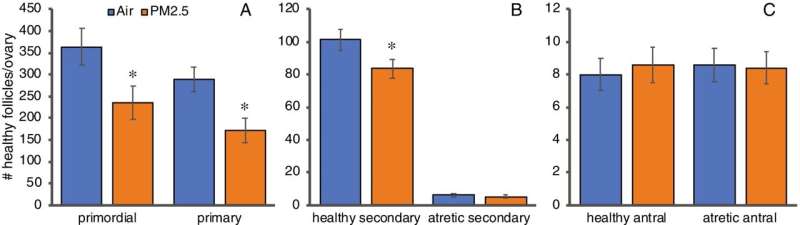
A type of air pollution known as fine particulate matter or PM2.5, can cause loss of ovarian function in female mice, due to depleted primordial, primary and secondary follicles, according to a recent study led by Ulrike Luderer, MD, Ph.D., UCI professor of environmental and occupational health and corresponding author. Premature ovarian failure, often called premature menopause, is associated with an increased risk of negative health outcomes in women, including osteoporosis, cardiovascular disease and Alzheimer’s disease.

The team’s findings, published online in the journal Particle and Fibre Toxicology, showed that PM2.5 exposure in mice disrupts ovarian follicle growth, a cellular process essential to development of the female reproductive system. “Up until this point, there’s been very little research in this area on the links between air pollution exposure and ovarian function, which is linked to other adverse health effects in women,” Luderer says. “Our team aims to fill gaps in the literature and bring visibility to the subject.”

Study links air pollution, adverse ovarian function in female mice
Posted in Air Quality, Health Effects of Air Pollution, Medical Studies | Tagged , , , | Leave a comment

Even low levels of air pollution can increase heart, lung risks in older adults

Long-term exposure to air pollution, even at low levels, can increase the risk for heart and lung disease in older adults, new research shows.

The study, published Monday in the American Heart Association journal Circulation, found exposure to three types of air pollutants was responsible for thousands of hospitalizations in the U.S. each year. Even at levels below national safety standards, the exposure was linked to an increased risk for heart and lung problems such as heart attacks, strokes, irregular heartbeats and pneumonia in people 65 or older.

“People should be conscious of the air quality in the region where they live to avoid harmful exposure over long periods of time, if possible,” said lead study author Mahdieh Danesh Yazdi in a news release. He is a postdoctoral research fellow at the Harvard T.H. Chan School of Public Health in Boston. Because the harmful effects were found at levels below what’s federally acceptable, he said policymakers should reconsider those standards and doctors should consider air pollution a risk factor for cardiovascular and respiratory disease.

Air pollutants can harm the heart and lungs by causing inflammation, previous studies show. More recent studies have focused on the long-term and cumulative effects of multiple pollutants on people’s health.

In the new study, researchers analyzed hospitalization records from 2000 to 2016 for more than 63 million Medicare recipients, comparing them against air pollution measures by ZIP code for the same period. They looked at three kinds of air pollution: fine particulate matter, which is made up of tiny bits of dust, soot, smoke or liquid so small it can go deep into the lungs; nitrogen dioxide, a poisonous gas that forms when fossil fuels such as coal, oil or gas are burned; and ozone, or smog.

Exposure to fine particulate matter increased the risk for heart attacks, strokes, pneumonia and rapid and irregular heartbeats. As exposure levels rose, so did hospitalizations. For example, hospital admissions for stroke increased by 2,536 for each one-unit increase in fine particulate matter each year.

Long-term exposure to nitrogen dioxide increased the risk for stroke and atrial fibrillation, an irregular heartbeat also called AFib. And long-term exposure to ozone increased pneumonia risk.

“More than half of the study population is exposed to low levels of these pollutants, according to U.S. benchmarks,” Danesh Yazdi said. “Therefore, the long-term health impact of these pollutants should be a serious concern for all, including policymakers, clinicians and patients.”

Even low levels of air pollution can increase heart, lung risks in older adults | American Heart Association
Posted in Air Quality, Health Effects of Air Pollution, Medical Studies | Tagged , , , , | Leave a comment

Pollutionwatch: ultrafine particles from aircraft engines endanger lives

Growing evidence suggests tiny particles can affect the heart, lungs, blood pressure and risk foetal growth

The clear blue skies of the first lockdown are being crisscrossed by contrails once again. These white lines are caused by ice crystals that form on the huge numbers of tiny, ultrafine particles that come from aircraft engines. Ultrafine particles are far smaller than the wavelength of light, but contrails are a rare example of them being made visible.

Ultrafine particles are not just a problem in the skies above us. Airports are a large source, and my latest research has been searching for these tiny particles close to Gatwick. They were not hard to find. The number of ultrafine particles 500 metres downwind of the airport was greater than those at the kerb of London’s busiest roads. They mostly came from aircraft during takeoff and landing, but traffic, car parks and a large catering facility used to cook airline food all added to the problem.

In 2021, the Dutch Health Council and the World Health Organization (WHO) highlighted the growing evidence that ultrafine particles are damaging our health. This includes 75 studies; mostly relating to lung inflammation, blood pressure and heart problems, along with risks to foetal growth. However, technical differences between the studies meant that the WHO has not set a standard.

We are yet to understand the spread of ultrafine particles from Gatwick, but we do know they can travel a long way. Ultrafine particles from aircraft have been found across the Los Angeles suburbs. We have found ultrafine particles from Heathrow across large areas of west London, and they can be detected more than 12 miles (20km) away in the city centre. It is a similar situation in several European cities, meaning millions of people are exposed.

More than 10 years ago I was part of a study that found day to day changes in ultrafine particles in London matched the number of people dying or going to hospital with heart problems. Since then, I have tracked reductions in ultrafine particles in our cities as a side-effect of regulations to tackle other air pollutants. These include removing sulphur impurities from diesel fuel and requiring particle filters on the exhausts of new vehicles.

Researchers have suggested that sulphur is removed from aircraft fuel too, to match the tight limits on sulphur in diesel and petrol. This would be a possible solution for ultrafine particles.

In the meantime, Bristol airport’s expansion was approved earlier this month and Gatwick is applying to increase capacity by bringing its emergency runway into regular use. Ultrafine particles are not included in the environmental assessments, putting us at risk of increased air pollution for decades to come.

Pollutionwatch: ultrafine particles from aircraft engines endanger lives | Air pollution | The Guardian
Posted in Air Quality | Leave a comment

Babies in bike trailers exposed to higher levels of pollutants than their parents, study finds

Babies and children sitting in bicycle trailers breathe in more polluted air than the adults riding the bikes that pull them—but trailer covers can help halve air pollution levels, according to research from the University of Surrey.

In research published in the Journal of Hazardous Materials Advances, Surrey’s Global Center for Clean Air Research (GCARE) found that on journeys typical of school or nursery runs, the average concentration of coarse air pollution particles in a bike trailer is 14% higher than at cyclist height and 18% higher than cyclist height in the afternoons when parents or carers typically collect children.

The researchers found that young children were exposed to even higher concentrations of air pollution during peak morning periods at urban pollution hotspots, such as traffic lights.

Air pollution is a leading cause of death in children under the age of five.

Professor Prashant Kumar, Founding Director of GCARE at the University of Surrey, said:

“It’s unfortunate that the very people who help minimize pollution by cycling rather than driving can be exposing their children to higher levels of pollution, and I’d encourage adults pulling bike trailers to use covers in heavy traffic. With the use of electric-assisted cargo bikes growing rapidly in Europe, it’s crucial traffic planners ensure road infrastructure is designed to enable safe use of sustainable transport options.”

In their peer-reviewed study, the GCARE researchers detailed how they simulated the exposure profiles of an adult cyclist and young children sitting in a bike trailer attached to it for multiple air pollutants during the school runs in the morning and afternoon hours. Taking measurements on over 80 runs covering 176km, the researchers assessed the differences in exposure concentrations on the bike compared within the trailer.

The researchers compared pollution in bike trailers with and without covers, finding that concerned parents and carers can reduce their children’s exposure to pollutants by using a trailer cover. Covers halved the levels of fine particles in trailers during peak morning hours.

The study also discussed the impact of lockdown restrictions. When schools were closed and vehicle journeys limited to essential travel at the start of last year, bike trailer concentrations of fine pollution particles were reduced by up to 91% compared with the eased lockdown period when schools re-opened in March 2021.

In future, the researchers hope to secure funding to continue their research so they can build an exposure profile database in a variety of bike trailers under diverse traffic and built environmental conditions.

Indoor and outdoor air pollution is estimated by the World Health Organization to be a leading cause of one in ten deaths in children under the age of five years, a group particularly vulnerable to the negative health impacts of air pollution. In 2016 alone, exposure to outdoor air pollution led to nearly 543,000 premature deaths of children worldwide under the age of five.

Babies in bike trailers exposed to higher levels of pollutants than their parents, study finds
Posted in Air Quality | Leave a comment

Improving air quality associated with slower

Women in areas where air is getting cleaner scored up to 1.5 years younger on cognitive tests

Improvements in air quality are associated with slower cognitive decline in women, according to a new study led by Diana Younan, of the University of Southern California publishing February 3rd in the journal PLOS Medicine.

Some studies have shown that late-in-life exposure to outdoor air pollution is a risk factor for dementia. However, it was not known whether improving air quality could stave off dementia by slowing the cognitive decline associated with aging. Younan and her colleagues investigated this question using a cohort of 2,232 older women who were free of dementia when they entered the study. The researchers followed the women for up to 20 years, giving them two different cognitive tests annually. They also estimated local changes in air quality and used statistical tests to see if a reduction in air pollution was associated with slower cognitive decline.

The analysis revealed that women living in areas with greater improvements in air quality tended to have a slower decline, as indicated by the results on both cognitive tests. The reduced rate of decline was equivalent to being about one or one and a half years younger, depending on the test.

The new findings reinforce previous studies suggesting that outdoor air pollution contributes to cognitive decline. Cleaner air is already known to improve heart and respiratory health and reduce a person’s overall risk of death. But the new work highlights the potential benefits of reducing air pollution levels to maintain brain health as well. Dementia is estimated to cost the U.S. economy $159–$215 billion annually.

Younan adds, “We found that reducing air pollution exposure can promote healthier brain aging in older women by slowing cognitive decline. These benefits were seen in older women of all ages, levels of education, geographic regions of residence, and cardiovascular histories.”

Improving air quality associated with slower | EurekAlert!
Posted in Air Quality, Health Effects of Air Pollution, Medical Studies | Tagged , , | Leave a comment

Bangkok air unsafe, again

Smog blanketed Greater Bangkok on Tuesday morning with the worst pollution in Wang Thonglang district of the capital city.

The Pollution Control Department reported that levels of particulate matter 2.5 micrometers and less in diameter ranged from 39 to 73 microgrammes per cubic metre of air over the past 24 hours. The local safe threshold is set at 50mcg.

The worst pollution was detected on Soi Lat Phrao 95 and Lat Phrao Road in Wang Thonglang.

Other areas in Bangkok with unsafe PM2.5 levels were in Thon Buri, Bang Khunthian, Bang Na, Pathumwan, Thon Buri, Din Daeng, Bung Kum, Klong Sam Wa, Chom Thong, Phra Khanong, Rat Burana, Bang Phlad, Bang Khae, Dusit, Pomprap Satruphai, Samphanthawong, Phaya Thai, Bang Rak, Sathon, Bang Kho Laem, Don Muang, Bang Kapi, Lat Krabang, Phasi Charoen, Thawi Wattana, Taling Chan, Nong Khaem, Khlong Toei and Bang Sue.

Similar readings were detected in adjacent areas – Phra Pradaeng and Muang districts of Samut Prakan; Klong Luang district of Pathum Thani; Muang and Krathum Baen districts of Samut Sakhon; and Muang district of Nakhon Pathom.

The Pollution Control Department advised people in these areas to reduce their outdoor activities.

Air quality was expected to improve from Feb 9 to 15 as winds picked up.

Bangkok air unsafe, again
Posted in Air Quality | Leave a comment

Forest fires in Amazonian region trigger environmental alert in Colombia’s capital

An environmental alert has been issued in the Colombian capital, Bogota, threatened by smoke from active forest fires affecting an area the size of Paris in the country’s Amazon region, local authorities announced on Saturday.

Winds have blown smoke from the fires as far as the Colombian capital, about 350 km to the northwest, Belga news agency reports.

“The city is now on an environmental alert,” Bogota Mayor Claudia Lopez tweeted on Saturday.

Over half of the capital’s air-quality monitoring stations had continuously reported high levels of pollution over the previous 48 hours, the mayor said, calling on the capital’s eight million inhabitants to refrain from any open-air activity for the next few days, Belga reported.

Colombia’s National Unit for Disaster Risk Management (UNGRD – Spanish acronym) reported on Saturday in its latest information bulletin that a total of 301 forest fires had broken out between 16 December and 4 February, affecting a combined area of 86,800 hectares. Thus far, 291 fires have been extinguished, according to the UNGRD, which blamed the fires on extremely dry weather and “criminal hands.”

The Colombian Government feels the fires have been set by former rebels who decided to stop complying with the historic 2016 peace agreement that led to the disarmament of the Revolutionary Armed Forces of Colombia, FARC, a Marxist guerilla group, Belga reported.

The dissidents, as they are called in Colombia, plan to grab land and illegally practice extensive cattle farming, according to Defence Minister Diego Molando, who published a list of 17 presumed culprits.

Due to the fires, 597 municipalities are now on varying phases of alert, according to the UNGRD: 550 are on red alert – the highest level – while 38 are on orange and 9 on yellow.

Some of the municipalities on red alert are in the southeastern department of Guaviare, whose governor, Heydeer Palacio, said “10,000 hectares,” – almost the size of Paris (10,500 ha) had been consumed by fire. The affected area includes the Parque Nacional Natural Serrania del Chiribiquete, located between Guaviare and neighbouring Caqueta Department, both of which are located in the country’s Amazon region.

The Parque Nacional Natural Serrania del Chiribiquete is the world’s largest tropical rainforest national park and a UNESCO world heritage site.

The Colombian Government on Saturday announced the launch, in the park, of the latest phase of Artemisa, a campaign linking the Ministries of Defence and Environment and aimed at protecting the country’s biodiversity by going after groups that threaten it.

“There are gangs of delinquents trying to grab land,” the Buenos Aires based news service, Infobae, quoted Environment Minister Carlos Eduardo Correa as saying in its Sunday edition. “They have been cutting down and burning trees, and we can see fires in various areas of the national park,” he said.

Phase 14 of the Artemisa Campaign is aimed at stopping the illegal destruction of the park by capturing those responsible and having them prosecuted, Infobae reported.

Forest fires in Amazonian region trigger environmental alert in Colombia’s capital
Posted in Air Quality | Leave a comment