A costly mistake

Energy subsidies do not just gobble money. They help cook the planet too
BIG mistakes in economic policymaking abound. But it would be hard to find a worse one than energy subsidies. Recent research has shown that they enrich middlemen, depress economic output and help the rich, who use lots of energy, more than they do the poor.

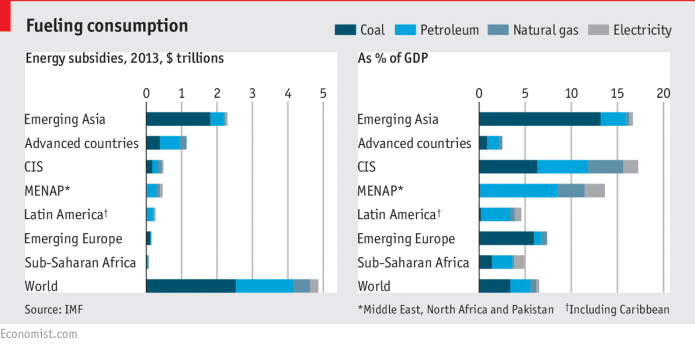
But now a new working paper by the International Monetary Fund highlights another cost too: damage to the environment. Including this, the authors reckon that the total drag on the global economy caused by fuel subsidies now amounts to a stonking $5.3 trillion each year, or 6% of global GDP—more than world spends on health care. Poorer countries dole out the largest amount of subsidies; some spend up to 18% of their GDP a year on them. The lion’s share goes to coal, the most polluting fuel. By contrast renewable-energy subsidies, mainly given out in the rich world, amount to a mere $120 billion. And they would vanish if fossil fuels were taxed properly.

Defining subsidies is tricky. The simplest measure is the amount of taxpayers’ money used directly to keep a price artificially low. A broader one includes the costs borne by others, such as pollution, and exemptions from taxes. The IMF uses the wider definition to reach its $5.3 trillion figure. Seen more narrowly, the cost would be $333 billion. But this is only lower than last year because of falling oil prices.

previous study in 2013 reckoned that the overall damage, including environmental costs, was $2 trillion. The much higher estimate released this week reflects more thorough study of the other health and environmental costs of subsidising fossil fuels. These include the costs of congestion and premature deaths caused by poor air quality, the long-term impact of global warming and the effects of extreme weather such as floods and storms. It estimates the long-term damage done by a tonne of CO2, for example, at $42. Many green-minded people think that figure (borrowed from the American government) is too low. But some economists argue that the inclusion of hypothetical climate-change costs is too sweeping.

Abrupt change is unlikely—making coal users pay its full cost would mean doubling prices. Subsidies attract a tenacious and vocal lobby. But the fall in the oil-price has provided a chance to cut subsidies. India, for example, has recently stopped using handouts to reduce the price of diesel. Egypt, Indonesia and Thailand are also reforming their subsidies. Ending them altogether, and taxing fossil fuels properly, the IMF reckons, would halve the number of deaths from outdoor air pollution, cut carbon-dioxide emissions by a fifth and save up to $2.9 trillion. It would also leave governments with lots of room to cut taxes, or increase spending on more useful things. 

via A costly mistake | The Economist.

Posted in Africa, Air Quality, Asia, Europe, Latin America, World News | Tagged , , | Leave a comment

The Air We Breathe

When you think of air pollution you may imagine smog filled cities from bygone times, but today our air quality has reached dangerous levels. Much of this pollution is from the dash for diesel and it’s now landed our Government in court.

Tonight Fiona Foster investigates why levels are so high and what’s being done to protect the nation’s health from the air we breathe.

Today our skies may appear cleaner than ever but in reality we are breathing in more harmful pollutants than we realise. And if you live in a big town or city, the quality of air can be so poisonous that it’s sending thousands of Britons to an early grave each year. The reason? Tiny invisible particulates and gases such as nitrogen dioxide that don’t darken our skies but leave a huge cloud over the nation’s health…
And where’s it all coming from? Well the main culprit pumping out these pollutants are lining the streets and motorways up and down the land is the diesel vehicle. Diesel produces fewer C02 emissions than petrol – so is contributing less to climate change. However, diesel vehicles can produce 22 times the amount of microscopic Particulate Matter and 4 times the amount of Nitrogen Dioxide – both a big concern for health as they can damage lungs and blood vessels and are a cause of heart disease and strokes.

And in East London, parents concerned about the effects of air pollution on their children’s health are out campaigning to raise awareness of this little known public health crisis. Leading the campaign is mum of three Shazia Ali-Webber who noticed effects to her family’s health when they moved from the Midlands to East London. She decided to find out just how bad levels in her area were by using tubes to capture the nitrogen dioxide in the air. Upon seeing how bad the levels were Shazia took to the streets to raise awareness and even included getting London based music group Navan to write a campaign song for school children to sing.
But just how at risk are you and your family up and down the country? We asked Professor Frank Kelly of King’s College London if he could help us find out levels of pollution with 4 willing volunteers around the UK. The 3 volunteers along with presenter Fiona Foster each carried a personal air quality measuring device with them for a 48 hour period. Manchester Cyclist Andy, Full time nurse and mum of three Davida from Wolverhampton, Leeds DJ Connor and our very own Fiona Foster, who is London based, get their pollution results back with some very intriguing results.

Dr Jennifer Quint is a respiratory specialist from London School of Hygiene & Tropical Medicine and University College London NHS foundation. Dr Quint is heavily involved in studying the relationship between health and air pollution.
Over the past few years there have been a number of observational studies done both in this country and abroad which is suggested that people who are exposed to high levels of air pollution are at increased risk of death… that they are at increased risk of having heart attacks and strokes and that they are at increased risk of developing certain respiratory diseases such as COPD.” – DR JENNIFER QUINT

So concerned about the affect on our nation’s health Lawyer Alan Andrew, with Green law firm Client Earth, have brought a landmark case against our Government in a bid to force down levels of dirty air. On 29th April this year, in a unanimous decision, the UK Supreme Court has ordered the government to deliver plans to tackle air pollution by the end of the year.

via Tonight: The Air We Breathe – ITV News.

Posted in Air Quality, London, UK | Tagged , , , , | Leave a comment

Weak EU air pollution standards risk thousands of lives, says report

Weak draft EU rules for coal plant emissions could result in 71,000 deaths and €52bn (£37bn) of health costs across Europe in the decade to come, according to new research published on Wednesday.

A Greenpeace investigation earlier this year found that the coal standards would be more lax than those in China, and the Guardian was able to corroborate claims by the green group that industry had helped to write the pollution rules.

The new study commissioned by Greenpeace and the European Environment Bureau analysed the impacts of the watered-down rules, and found that nearly 1,000 deaths and £500m of health costs a year are likely in the UK alone. But it said they could be prevented with technologies such as selective catalytic convertors.

Without these, thousands more cases of cardiac and respiratory illness that disproportionately affect children are foreseen by the study.

The paper forecasts a surge in asthmatic symptoms affecting over 2m children aged between five and 19, as well as 200,000 new cases of acute bronchitis among 6-12 year olds.

Christian Schaible, a policy manager for the European Environmental Bureau said: “The commission is opting for the cheapest techniques to reduce emissions but the health effects alone will be far more costly than the money saved by coal plant operators. These effects will also be felt by many thousands of European citizens, particularly children, in ways that money cannot quantify.”

The cost of installing plant technologies such as activated carbon injections to abate mercury emissions – associated with IQ loss in children – would be less than €0.02 per kilowatt hour, Schaible said.

The report’s findings emerged from a modelling study by an independent consultant to the European Environment Agency, which was then combined with emissions data.

The paper compared draft European commission emissions standards for pollutants such as nitrogen oxide (NOx), sulphur dioxide (SO2), particulate matter (PM2.5) and mercury against the best available techniques.

The EU’s proposed new limits are currently awaiting examination by an EU working group later this year. After that, they are expected to be formally adopted within the bloc’s industrial emissions directive in 2016.

The updated directive would cut NOx and SO2 emissions by around 70% and 50% respectively. But the most effective technologies could deliver more than twice as much, according to the study.

“Proposed emission limits for mercury are so lenient that an estimated 85% of European plants are already in compliance and will not have to invest in retrofitting,” the report says.

The Guardian has previously revealed that despite claims by the UK to the contrary, energy industry representatives repeatedly and forcefully pushed for weaker pollution limits at meetings in Brussels.

Doug Parr, Greenpeace UK’s chief scientist, said: “EU leaders have completely failed to stand up to the energy industry’s pervasive lobbying for weak air pollution limits. If these lax rules are adopted, hundreds of thousands of UK and European citizens will pay the consequences for their political leaders letting polluting industries off the hook.”

via Weak EU air pollution standards risk thousands of lives, says report | Environment | The Guardian.

Posted in Air Quality, Europe, UK | Tagged , , , , , , , , , | Leave a comment

Respro® Masks FAQ: How do I stop my glasses from misting up?

NOSE CLIPHow do I stop my glasses from misting up?

When using a mask with glasses, it is best to fit the mask first to get the correct fit with no seal leakage, then place the glasses in front of the nose clip on the mask. It is really dependent on the seal of the mask. Having adjustable nose pads facilitates a better fit than plastic moulded rims. A good seal around the nose and cheekbone will mean no leakage in that region which equals no misting. This is how/why glasses get misted up on the inside of the lens. In our experience most glasses wearers manage to figure a way of fitting glasses with a mask without them getting misted up.

For more frequently asked questions, go to Respro® Masks FAQ

Posted in Air Quality | Tagged | Leave a comment

Air pollution code gets revamped first time since 1975

Mayor Bill de Blasio signed seven different pieces of legislation into law last week, including a law updating New York City’s air pollution control code that was sponsored by Councilman Donovan Richards (D-Laurelton).

Richards, also the chairman of the Environmental Protection Committee, pushed forth Intro 271-A, which codifies revisions to the original Air Code, updating the law first introduced in 1975. Co-authored by Richards, the legislation would “introduce new requirements to limit emissions from certain unregulated sectors, while promoting the adoption of cost-effective air pollution controls.”

Intro 271-A, the new air pollution control code, targets commercial char broilers, outdoor boilers, mobile food trucks and fireplaces, which will be required “to use only natural gas or renewable fuels in order to reduce the amount of pollutants.”

“This bill will help us to improve air quality by bringing the code into the 21st century with a series of important changes, including regulating additional sources of emissions like motorcycles, boilers, and generators,” de Blasio said. “Our goal for New York City – we said it in our OneNYC plan – is to have the best quality air of any major city in this nation by 2030. We’re very proud of that commitment, and we intend to keep it, and enforcing a stronger air code will help us to get there.”

According to city data, stricter regulation of commercial and residential buildings burning No. 6 and No. 4 heating oil, as well as the NYC Clean Heat Program, has resulted in a 69 percent reduction in pollution from sulfur dioxide, a colorless pungent toxic gas formed by burning sulfur in air, since 2008. In addition, particulate matter – a complex mixture of extremely small particles and liquid droplets made up of a number of components, including acids, organic chemicals, metals, and soil or dust particles – is down 23 percent since 2007.

The revisions of the code over the last 43 years have been limited primarily to the reduction of particulate matter from large sources, including residential and commercial fuel combustion, as well as non-road and on-road diesel emissions. For example, in 2011, more than 5,200 buildings burned No. 6 heating oil, the dirtiest grade of fuel oil. According to city data, more than 3,000 buildings have made the conversion and no longer burn No. 6.

Neighborhoods with the highest density of emissions reductions from boiler conversions – such as northern Manhattan, northern Queens, and the South Bronx – have seen some improvements in air quality.

via Air pollution code gets revamped first time since 1975 • TimesLedger.

Posted in Air Quality, USA & Canada | Tagged , , , , , | Leave a comment

AIR POLLUTION: Study links La Niña, high-ozone days in West

La Niña could be driving spring ozone levels in the West, according to new research that has major implications for the Obama administration’s proposed tightening of the federal ozone standard.

Analyzing air quality and meteorological data from 1990 to 2012, researchers found the frequency of high-ozone events increased after strong La Niña winters. The polar jet stream at that time creates upper-atmosphere intrusions that funnel ozone toward the ground in the western United States.

The finding is significant in light of U.S. EPA’s proposal to toughen the national ozone standard, the researchers said, because it may allow regulatory entities to better predict and document when high-ozone days occur as a result of background concentrations.

The EPA proposal would tighten the standard from 75 parts per billion to between 65 and 70 ppb — a range that approaches background levels of ozone in some high-elevation areas in the Intermountain West.

“The linkage between La Niña and western U.S. stratospheric intrusions can be exploited” the scientists wrote, “to provide a few months of lead time during which preparations could be made to deploy targeted measurements aimed at identifying these exceptional events.”

The study was published last week in the journal Nature Communications.

Meyun Lin, a research scientist at the National Oceanic and Atmospheric Administration and Princeton University’s Cooperative Institute for Climate Science, led the study. Researchers from NOAA, Columbia University, the Meteorological Service of Canada and the University of Graz in Austria collaborated.

Background ozone is defined as the ground-level ozone pollution that would occur if all man-made sources of pollution in North America were switched off. In some high-elevation areas of the United States, a substantial proportion of total ozone is background.

Previous studies have found stratospheric intrusions — tongues of ozone that make their way from the upper atmosphere to ground level — are a key component of background levels in the West. Although ozone is beneficial in the upper atmosphere, shielding the Earth from most of the sun’s ultraviolet rays, at the Earth’s surface it helps create smog and can damage human health (Greenwire, Nov. 17, 2014).

But until recently, scientists understood little about the factors that drive stratospheric intrusions and their frequency.

In the current study, the researchers said they analyzed hourly ozone data from 1990 to 2012 at 22 sites in the high-elevation Intermountain West. They found that both the level and frequency of high ozone measurements increased in the springs that followed the strong La Niña winters of 1998-99, 2007-08 and 2010-11.

La Niña appeared to produce spikes of high ozone in late spring lasting two to three days at high-elevation sites in the West, according to the results. The intrusions of ozone from the stratosphere increase ground-level ozone concentrations by between 20 and 40 ppb, they found.

“Ozone in the stratosphere, located 6 to 30 miles [10 to 48 kilometers] above the ground, typically stays in the stratosphere,” Lin said in a statement on the study. “But not on some days in late spring following a strong La Niña winter. That’s when the polar jet stream meanders southward over the western U.S. and facilitates intrusions of stratospheric ozone to ground level where people live.”

On the other hand, the researchers found that the level and frequency of high-ozone events in the West fell in the two springs after the massive eruption of Mount Pinatubo, a volcano in the Philippines, in 1991. The volcano, they said, led to fewer and weaker upper-atmospheric intrusions.

The researchers also found that El Niño had very little effect on the frequency and strength of stratospheric intrusions.

In the spring following the strong 1998-99 La Niña event, 3 percent of measurements exceeded the 75 ppb EPA ozone limit. The spring following the extreme El Niño event of the winter of 1997-98, on the other hand, produced 1 percent of measurements above the 75-ppb standard.

“While El Niño leads to enhancements of upper tropospheric ozone, we find this influence does not reach surface air,” the researchers wrote.

Industry and GOP critics of EPA have raised the issue of background as one of their main arguments against tightening the ozone standard. They’ve argued that a tighter standard would be difficult to achieve for Western states because a high proportion of background means there’s only a small margin for emissions controls to work.

Aside for stratospheric intrusions, other documented causes of high background ozone levels in the Intermountain West include pollution from Asia and wildfires. EPA has a process to excuse “exceptional” pollution events that occur out of states’ control, but some experts believe that the process is not up to the task of dealing with frequent high-ozone events caused by background under a tighter standard.

In their study, the researchers said that their study could make it easier to predict and prove that high-ozone days occur as a result of background, helping states avoid costly “nonattainment” designations under a tighter standard.

The knowledge that high ozone days occur after strong La Niña winters could also benefit public health, said Arlene Fiore, a study author and an atmospheric scientist at Columbia University.

“Regardless of whether these events count toward nonattainment,” she said, “people are living in these regions, and the possibility of predicting a high-ozone season might allow for public education to minimize adverse health effects.”

via AIR POLLUTION: Study links La Niña, high-ozone days in West — Monday, May 18, 2015 — www.eenews.net.

Posted in Air Quality, USA & Canada | Tagged , , , , | Leave a comment

New research will help forecast bad ozone days over the Western US

A strong connection between high ozone days in the western US during late spring and La Nina, an ocean-atmosphere phenomena that affects global weather patterns, has been identified by researchers. Recognizing this link offers insight for public health and air quality managers.

The contribution of stratospheric ozone to US surface ozone peaks in the western Rockies during late spring. This map shows mean contribution in parts per billion by volume (ppbv) for May to June.

New research published in Nature Communications led by Meiyun Lin of NOAA’s Geophysical Fluid Dynamics Laboratory and NOAA’s cooperative institute at Princeton University, reveals a strong connection between high ozone days in the western U.S. during late spring and La Niña, an ocean-atmosphere phenomena that affects global weather patterns.

Recognizing this link offers an opportunity to forecast ozone several months in advance, which could improve public education to reduce health effects. It would also help western U.S. air quality managers prepare to track these events, which can have implications for attaining the national ozone standard.

Exposure to ozone is harmful to human health, can cause breathing difficulty, coughing, scratchy and sore throats, and asthma attacks, and can damage sensitive plants.

“Ozone in the stratosphere, located 6 to 30 miles (10 to 48 kilometers) above the ground, typically stays in the stratosphere,” said Lin. “But not on some days in late spring following a strong La Niña winter. That’s when the polar jet stream meanders southward over the western U.S. and facilitates intrusions of stratospheric ozone to ground level where people live.”

Over the last two decades, there have been three La Niña events — 1998-1999, 2007-2008 and 2010-2011. After these events, scientists saw spikes in ground level ozone for periods of two to three days at a time during late spring in high altitude locations of the U.S. West.

While high ozone typically occurs on muggy summer days when pollution from cars and power plants fuels the formation of regional ozone pollution, high-altitude regions of the U.S. West sometimes have a different source of high ozone levels in late spring. On these days, strong gusts of cold dry air associated with downward transport of ozone from the stratosphere pose a risk to these communities.

Lin and her colleagues found that these deep intrusions of stratospheric ozone could add 20 to 40 parts per billion of ozone to the ground-level ozone concentration, which can provide over half the ozone needed to exceed the standard set by the U.S. Environmental Protection Agency. The EPA has proposed tightening that standard currently set at 75 parts per billion for an eight-hour average to between 65 and 70 parts per billion.

Under the Clean Air Act, these deep stratospheric ozone intrusions can be classified as “exceptional events” that are not counted towards EPA attainment determinations. As our national ozone standard becomes more stringent, the relative importance of these stratospheric intrusions grows, leaving less room for human-caused emissions to contribute to ozone pollution prior to exceeding the level set by the U.S. EPA.

“Regardless of whether these events count towards non-attainment, people are living in these regions and the possibility of predicting a high-ozone season might allow for public education to minimize adverse health effects,” said Arlene Fiore, an atmospheric scientist at Columbia University and a co-author of the research.

Predicting where and when stratospheric ozone intrusions may occur would also provide time to deploy air sensors to obtain evidence as to how much of ground-level ozone can be attributed to these naturally occurring intrusions and how much is due to human-caused emissions.

The study involved collaboration across two NOAA laboratories, NOAA’s cooperative institutes at Princeton and the University of Colorado Boulder, and scientists at partner institutions in the U.S., Canada and Austria. It was also supported in part by the NASA Air Quality Applied Sciences Team whose mission is to apply earth science data to help address air quality management needs.

“This study brings together observations and chemistry-climate modeling to help understand the processes that contribute to springtime high-ozone events in the western U.S.,” said Andrew Langford, an atmospheric scientist at NOAA’s Earth System Research Laboratory in Boulder, Colorado, whose teams measure ozone concentrations using lidar and balloon-borne sensors.

“You’ve heard about good ozone, the kind found high in the stratosphere that protects Earth from harmful ultraviolet radiation,” said Langford. “And you’ve heard about bad ozone at ground level. This study looks at the factors that cause good ozone to go bad.”

via New research will help forecast bad ozone days over the Western US — ScienceDaily.

Posted in Air Quality, USA & Canada | Tagged , , , , , | Leave a comment

Richmond has highest pollen and air pollution: study

Pollen- and pollution-ravaged Richmond, Memphis and Oklahoma City are the three “sneeziest and wheeziest” cities in the U.S., a new study says.

New York City didn’t even make the Natural Resources Defense Council’s list of the 35 worst cities for allergy and asthma sufferers. And smoggy Los Angeles was way down at No. 32.

To get their numbers, the researchers compared their findings with the Asthma and Allergy Foundation’s annual Allergy Capitals report, which also omited the Big Apple.

“It doesn’t mean there are no issues in New York,” said study author Juan Declet-Barreto, a Climate and Health Research Fellow at the NRDC. “When we look at our data and the Asthma and Allergy Foundation report, New York doesn’t (rank) heavily.”

The NRDC report is the first to chart how pollen and air pollution work together to undermine the health of more than 100 million Americans living in NRDC’s 35 worst cities.

The researchers called on the Environmental Protection Agency to bolster ozone pollution standards and cut pollution from power plants.

“Americans deserve to breathe clean air, but today millions of us are sneezing and wheezing from allergies and asthma worsened by climate change-fueled ragweed pollen and ozone smog pollution,” Declet-Barreto said in a release.

Things are only getting worse: nine out of the 10 warmest years on record have occurred since 2000. Warm weather exascerbates ozone pollution and increases the production of pollen. Both scenarios damage the lungs.

More than 50 million Americans have allergies, and 26 million have asthma.

via Richmond has highest pollen and air pollution: study – NY Daily News.

Posted in Air Quality, USA & Canada | Tagged , , , , , , , , , , | Leave a comment