US supreme court’s pollution ruling ‘a victory for Obama administration’

The US supreme court endorsed the Environmental Protection Agency’s efforts to deal with air pollution blowing across state lines on Tuesday, in an important victory for the Obama administration as well as downwind states.

The court’s 6-2 decision unblocks a 2011 rule requiring 28 eastern states to reduce power-plant emissions that carry smog and soot particles across state lines, hurting the air quality in downwind states.

Justice Ruth Bader Ginsburg, writing the court’s majority opinion, said the EPA’s formula for dealing with cross-state air pollution was “permissable, workable and equitable”.

Justice Samuel Alito recused himself, and justices Antonin Scalia and Clarence Thomas dissented.

The decision delivers an important victory to the EPA which has wrestled for years with trying to regulate air pollution as it moves beyond smokestacks and tailpipes. It is also a win for states such as Connecticut, where 93% of air pollution is from out-of-state sources.

Major power companies, such as Southern Company and American Electric Power Company, and states such as Texas, Michigan and Ohio had sued to block the rule. The Washington DC court of appeals put the rule on hold in 2012.

The reversal of that ruling now means that about 1,000 power plants, mainly in the eastern half of the country, will have to adopt new pollution controls to limit emissions of nitrogen oxide and sulfur dioxide.

Air pollution remains a growing problem in America despite decades of environmental protection –and Ginsburg acknowledged the complexities of putting a regulatory regime in place.

“Pollutants do not emerge from the smokestacks of an upwind state and uniformly migrate downwind. Some pollutants stay with­ in upwind states’ borders, the wind carries others to downwind states, and some subset of that group drifts to states without air quality problems,” Ginsburg wrote, going on to quote a phrase from the Bible. “In craft­ing a solution to the problem of interstate air pollution, regulators must account for the vagaries of the wind.”

Regulators also had to take into account that emissions are transformed into different pollutants as they travel downwind, Ginsburg wrote.

Under the EPA rule, each upwind state was allocated a budget for total amount of pollution they could produce in a year. The dissenting states had argued they should be allowed to create their own plans to cut emissions to solve the problem.

However, the supreme court disagreed, arguing that would lead to “costly over-regulation”.

“[The] EPA’s cost-effective allocation of emission reductions among upwind States, we hold, is a permissible, workable, and equitable interpretation of the Good Neighbor Provision,” the court said.

Justice Scalia in his Dissent said the EPA rule was an “undemocratic revision” of the clean air act. “Today’s decision feeds the uncontrolled growth of the administrative state at the expense of government by the people,” he said in a statement read from the bench.

The EPA had tried three times over the last two decades to control air pollution wafting across state lines, the court said. Congress has also weighed in dozens of times.

The EPA argued when the rule was originally adopted in 2011 smog and particle pollution from power plants caused 34,000 premature deaths every year, and triggered more than 400,000 asthma attacks.

Environmental groups cheered the decision.

The EPA administrator, Gina McCarthy, said the decision was “a resounding victory for public health.”

The American Lung Association, which had joined the lawsuit, said on Tuesday the court decision was a “life-saving standard”. “The people in these 28 states needed the EPA to enforce the law and protect them from pollution,” it said in a statement.

Opponents said the decision departed from the intent of the clean air act – that the EPA and states work together to cut pollution.

“The Supreme Court majority has refused to allow the states to have any voice in the practicalities of determining the impact of their emissions on neighboring states,” said Richard Faulk, director of the energy and law centre at George Mason University and a partner in a corporate law firm.

via US supreme court’s pollution ruling ‘a victory for Obama administration’ | Environment | theguardian.com.

Posted in Air Quality, USA & Canada | Tagged , , | Leave a comment

Diesel engine pollution linked to early deaths and costs NHS billions

Diesel engines in buses, vans, cars and trains may be responsible for thousands of premature deaths a year and cost the NHS billions of pounds, say air pollution health experts.

With government figures for 2008 showing 29,000 people dying prematurely from air pollution each year, diesel fuel burned in vehicles could be responsible for around one in four of all air pollution deaths, said Frank Kelly, professor of environmental health at King’s College, London.

“We have walked blindly into a situation where we have a high percentage of diesels in the transport sector. All taxis and buses are diesel. From one in 10 private cars being diesel in 2000 it is now nearly half today. A lot of the minute particulate matter [emitted from exhausts] comes from diesels in cities. It is estimated that 50% of the particulate matter in London is from transport and that diesel makes up about half of all the transport,” he said.

The new estimate follows preliminary analysis of the very high air pollution levels recorded this month across much of southern Britain when fine dust blown up from the Sahara desert mixed with heavily polluted air from British and mainland European cities to produce a dangerous smog.

Researchers at King’s College London have suggested about 70% of the minute particles of dust in the air could have come from outside Britain, with around 20% composed of Saharan dust. “But this pollution episode was not a natural phenomenon as was suggested in some media. The bulk of the pollution was man-generated, said Martin Williams, professor of air quality research at King’s.

Diesel vehicles have been popular with motorists and encouraged by government because they do better mileage and cut CO2 emissions, but the scale of the air pollution health problem they present is only now becoming clear as new research shows how their exhaust emissions are linked to cancers, and heart and lung diseases.

Air pollution can be compared to cigarette smoking and may worsen symptoms of heart failure, said Jeremy Langrish, lecturer in cardiology at the University of Edinburgh. “The predominate cause of death associated with air pollution appears to be cardiovascular disease. It’s clear from some work that was done that acute exposure to high levels of air pollution may actually be able to trigger acute cardiac events in patients that are at risk of such, so it may bring forward the onset of a heart attack.

“From a heart point of view it is difficult not to draw a correlation with the similar effects that we see with cigarette smoke and on an organ-level these effects are very similar to the effects of smoking cigarettes, which we all recognise are bad for us,” he said.

Children are particularly at risk from air pollution, said Jonathan Grigg, professor of paediatric respiratory and environmental medicine at Queen Mary University of London. “The danger comes not just from peaks in pollution, like we saw earlier this month, but also from long-term exposure. Britain has some of the highest levels of such pollutants in Europe. There is already strong evidence for diesel pollutants having an effect on cognitive function in kids.

Grigg, who works in London’s East End where air pollution is some of the worst in Britain, said air pollution was now a major global threat to children. “Long-term exposure to air pollution suppresses lung function and leads to vulnerability through life. It’s a major concern. We are setting up children to sub optimal conditions in later life.”

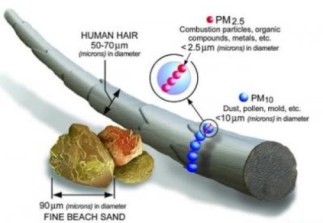
“People in large cities have lower life expectancy because of pollution. It seemed far fetched 20 years ago but now it is clear that the air we breathe has an impact on life expectancy. Air pollution alone does not kill you. But we think up to 200,000 people are having their health affected by PM2.5s [particulates with a diameter of 2.5 microns],” said Frank Kelly.

via Diesel engine pollution linked to early deaths and costs NHS billions | Environment | theguardian.com.

Posted in Air Quality, Europe, London, UK | Tagged , , | Leave a comment

Air Quality Awareness Week helps you prepare

AQI

This final week of April has been designated as “Air Quality Awareness Week” to better educate people about the effects of ozone and pollution in our air.

The Northeast Ohio Areawide Coordinating Agency is the local organization that monitors Northeast Ohio’s air quality and issues advisories when the air is expected to become a health hazard to those with breathing problems.

Ozone and particle pollution are two of the most common air pollutants in the United States. While ozone is the greatest concern during the summer months, particle pollution can occur anytime during the year.

What is the difference between ozone and particle pollution?

Ground level-ozone pollution forms through through a reaction of heat and sunlight with volatile organic compounds (VOC) and nitrogen oxides. These substances come from such things as gas fumes, industrial processes, car exhaust and power plant emissions.

Particle pollution is a mixture of small solids and liquid droplets in the air that come from smoke, exhaust, dust, pollen, gas and other sources. These fine particles are so small they can not be seen by the naked eye. In fact, they are about 1/30th the diameter of a human hair.

Our friends at Earthguage.net have several tips to help prevent air pollution and where to find useful information about today’s air quality.

You can help protect air quality where you live. Saving energy at home, tuning up your car, taking public transit and filling your gas tank in the evening are easy ways get started. Learn more about reducing your contribution to air pollution.

· Air quality is important at every age. Are you at risk for health problems from ozone (sometimes called smog) and particle pollution? Children, people with asthma or another lung disease, healthy adults who are active outdoors, people with cardiovascular disease and people middle-aged and older may be at increased risk. Learn more about the health risks you may face.

· You can protect your health with simple changes. When the Air Quality Index (AQI) forecast reaches Code Orange (unhealthy for sensitive groups) make some simple changes to your exercise plans. Try walking instead of running, and exercise away from busy roads to reduce the amount of pollution you breathe in. Learn more about air quality and your health.

· The Air Quality Index (AQI) helps you plan outdoor activities. Visit airnow.gov, download the AIRNow app, or listen to the local weather forecast to check the AQI in your area and plan outdoor activities accordingly. You can also sign up for AirNow EnviroFlash, a free service that sends air quality info to your e-mail.

· Don’t forget to check the AQI when you’re on the move. When you go on vacation or travel, check the air quality forecast for your destination. TheAirCompare tool can tell you what time of year an area has the best air quality. It also allows you to compare air quality between counties, based on specific health concerns or activity level.

via Air Quality Awareness Week helps you prepare.

Posted in Air Quality, USA & Canada | Tagged , , , , | Leave a comment

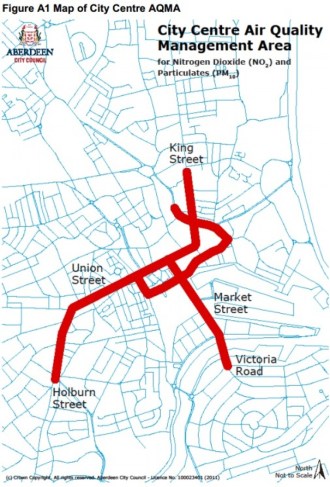
Aberdeen’s Market Street first in Scotland to break air pollution laws

Aberdeen

Air quality monitoring data has revealed that the Aberdeen thoroughfare has become the first street in Scotland to smash through legal limits for air pollution in 2014.

Each day, automatic monitors check the air for tiny dust particles that are harmful to health, known as PM10s.

Legal pollution limits are breached when the amount of these PM10 particles in the air exceeds a specified threshold more than seven times per year.

On Aberdeen’s Market Street that legal threshold has already been crossed more than 20 times this year.

Only one other street in the whole of Scotland has also broken the same limit: Salamander Street, in Edinburgh.

The news follows a report released last week which estimates that 80 people die each year in the Aberdeen City Council area, from conditions such as asthma and lung disease, which are exacerbated by air pollution.

Emilia Hannah, Air Pollution Campaigner at Friends of the Scotland, likened the impact of the pollution problem on Market Street to the effects of passive smoking.

She said: “Air pollution kills more than 80 people each year in Aberdeen, with people dying from asthma attacks, strokes, heart attacks and lung cancers.

“This silent killer is like passive smoking because people cannot control what they breathe in.

“Traffic fumes are the main cause of air pollution, so we need to see the council working together with the government to clean up transport. We need better provision for pedestrians, cyclists, and cheaper public transport. People deserve to breathe clean air rather than being forced to inhale toxic fumes.”

via Aberdeen’s Market Street first in Scotland to break air pollution laws | Feed | Aberdeen.

Posted in Air Quality, Europe, UK | Tagged , , , | Leave a comment

China to finish analysis of air pollutant around Beijing

An analysis of the sources of air pollution in Beijing, Tianjin and Shijiazhuang will be finished by the end of June, an official with China’s environmental authority said on Sunday.

The environmental authorities are working with the Chinese Academy of Sciences and the Chinese Academy of Engineering to conduct the research and will jointly release reports on the results in the research, said Zhao Yingmin, director of the pollution control and management department of the Ministry of Environmental Protection.

Zhao made the remarks when giving a report on air pollution in China to the Environment and Resources Protection Committee of the National People’s Congress, China’s top legislature.

The analysis of the sources of air pollution in Beijing has already been finished and published earlier this month and the result revealed that about 64 percent to 72 percent of the air pollutants in Beijing are locally generated, Zhao said.

The official said the yearly average density of fine particular matter, or PM2.5, in Beijing last year was 89.5 micrograms per cubic meter, far beyond the pollution control cap target of 60.

via China to finish analysis of air pollutant around Beijing | Shanghai Daily.

Posted in Air Quality, Asia, China | Tagged , , , , | Leave a comment

China Takes On Pollution With Biggest Changes in 25 Years

China passed the biggest changes to its environmental protection laws in 25 years, outlining plans to punish polluters more severely as leaders work to limit contaminated water, air and soil linked to economic growth.

The amended law “sets environmental protection as the country’s basic policy,” according to a copy posted on the government’s website. The rules hadn’t been changed since first enacted in 1989 as China began consuming more energy and the world’s most-populous country transformed into a global manufacturing hub.

Now the world’s biggest carbon emitter, China has moved to address the environmental damage that has been a byproduct of its breakneck economic growth and become a leading cause of social unrest. Government reports and recent comments from top officials about pollution have revealed the extent of the damage and raised new concern about its health effects.

The amendments give the public and government “powerful new tools” to cut pollution, Barbara Finamore, senior attorney and Asia director at the Natural Resources and Defense Council in New York, said in an interview. “The pollution is now impossible to ignore,” she said. “This is very big news.”

‘Strong Incentive’

The changes provide “a strong incentive for polluters to come into compliance” as violators can be fined on a daily basis, Finamore said.

Beijing’s air quality failed to meet government standards on 52 percent of the days… Read More

The amendments become effective from Jan. 1, according to the revised law, which was passed on yesterday by the Standing Committee of National People’s Congress, China’s top legislature. It allows for consecutive daily fines on polluters if they don’t get better and offers channels for whistle-blowers to make environment-related appeals. Non-government groups can also file lawsuits for environmental damage under certain conditions, it says.

The prominence given to open information and public participation is the biggest improvement in the revision, according to Alex Wang, assistant law professor at the University of California Los Angeles School of Law. Wang cautioned that it’s too soon to hail the amended law as anything beyond a signal of intent and aspiration, he said.

“If citizens truly ’supervise’ polluters as the law encourages, China will begin to make progress in turning its environmental crisis around,” Wang said in an e-mail. “But the proof is of course in the pudding. Given China’s history of weak environmental enforcement, the burden is on regulators to show that they now mean business.”

Global Investor

While China is currently the top global investor in clean energy, it will still be reliant on coal for most of its electricity in 2030 — by when its power needs will have more than doubled, according to a report by Bloomberg New Energy Finance.

One major reason for the worsening environment has been the political weakness of the Ministry of Environmental protection, Dai Qing, a Beijing-based environmental campaigner, said in a telephone interview.

“If Premier Li Keqiang was head of a environment ministry small group or President Xi Jinping himself then I would have some hope,” she said.

New measures such as heavier fines, naming and shaming of companies and the demotion, dismissal or criminal prosecution of local government officials who don’t enforce regulation or manipulate data are expected to be more effective, the official Xinhua News Agency said yesterday.

Pay Less

Previously, polluters could often pay less in fines than it cost to install and operate pollution controls, lawmakers said during discussions on the legislation, according to Xinhua.

Company officials can be detained for as much as 15 days if they haven’t done an environmental impact assessment, ignore orders to stop construction, or continue to pollute after being asked to stop, the revised law says.

The legislation was passed after the Ministry of Land and Resources said almost 60 percent of the groundwater at 4,778 sites monitored across China was of poor or extremely poor quality with excessive amount of pollutants. A nine-year government survey found unacceptable levels of mercury, arsenic and other pollutants in 16 percent of the land tested, the ministry said.

“We’re seeing encouraging signs of progress in Chinese environmental policies in response to growing concerns around air pollution problems, including major reforms in several provinces to stop the growth of coal consumption,” said Gabe Wisniewski, Greenpeace USA’s climate campaign director.

“It’s good news for just about everyone except U.S. coal mining companies that were counting on the Chinese market to support increased coal exports in the face of declining U.S. demand,” Wisniewski said in an e-mail.

Beijing’s air quality in 2013 failed to meet government standards on 52 percent of the days due to smog and pollution, the Ministry of Environmental Protection said last month.

via China Takes On Pollution With Biggest Changes in 25 Years – Bloomberg.

Posted in Air Quality, Asia, China | Tagged , , | Leave a comment

Respro® Masks FAQ: These bendy nose things, how far should I bend them?

These bendy nose things, how far should I bend them?

The malleable nose clip deforms easily so that a good fit can be formed around the bridge of the nose. Continuous or exaggerated deformation will eventually cause failure in the metal – it will snap. Once a good fit has been found, it is best to maintain the shape, rather than folding it flat when storing it or when not in use.

For more FAQs,  go to Respro® Mask FAQ

Posted in Air Quality | Tagged | Leave a comment

U.S. clean-air efforts stay on target

National efforts in the last decade to clear the air of dangerous particulate matter have been so successful that most urban areas have already attained the next benchmark, according to new research by Rice University.

Atmospheric researchers at Rice studied the state implementation plans (SIPs) from 23 regions mandated by the Environmental Protection Agency to reduce particulate matter (PM) smaller than 2.5 microns (PM 2.5) to less than 15 micrograms per cubic meter by 2009.

The Rice analysis appears this week in the Journal of the Air and Waste Management Association.

All but one of the regions studied reported they had met the goal by deadline. States with regions that met the deadline included Connecticut, Georgia, Illinois, Indiana, Kentucky, Maryland, Michigan, Missouri, New Jersey, New York, North Carolina, Ohio, Pennsylvania, Tennessee and West Virginia, as well as the District of Columbia. The final region, Alabama, reported attainment in 2010.

PM 2.5 concentrations in the nonattainment regions that filed SIPs to attain the standard by 2009 declined by an average 2.6 micrograms per cubic meter — significantly greater improvement than in regions that had attained the standard from its inception. The study showed PM reductions in the SIP regions were broadly spread, rather than pinpointed at the most polluted monitors.

“One of the things we were most interested in looking at was to see if states were cherry-picking their measures to meet the standard by reducing pollution at their worst monitors, compared with how much they were doing to bring down levels all across the region so that people were breathing cleaner air,” said Daniel Cohan, an associate professor of civil and environmental engineering at Rice.

“It was encouraging to find that across the country, we have seen overall particulate-matter levels come down. We found very slight extra improvement at monitors that were targeted the most, but regions that had to develop plans achieved pretty solid controls that didn’t just pinpoint the worst monitors. And the large populations of these regions benefited.”

Cohan and Rice alumna Ran Chen also documented that air pollution continued to decline even after the 2009 standards were met. The majority of the SIP regions had already attained the mandated 2014 goal of 12 micrograms per cubic meter by 2012.

“We’ve been on a good trajectory,” Cohan said. “This demonstrates that the combination of state and federal controls has been substantially improving air quality in the U.S.”

Recent stories about the ongoing crisis in Beijing, where PM has reached hazardous levels, and in rapidly industrializing countries such as India set the U.S. efforts in sharp relief, Cohan said. The World Health Organization announced this month that about 7 million people die each year as a result of air pollution exposure.

Particulate matter consists of microscopic particles spewed into the air by vehicles and industry, as well as particles that form from pollutant gases. “Particulate matter is not a chemical, like ozone; it’s a category, and it’s a real challenge to figure out the origin of those particles,” Cohan said. “Are they sulfates or carbons or nitrates? Each of these needs vastly different control approaches to make a difference.”

PM also includes natural emissions from plants, volcanoes, forest fires and desert dust and can be blown across states or even continents.

The health community, Cohan said, has long expressed concerns about particulate matter in the atmosphere and determined in the 1990s that PM 2.5 particles can penetrate deeply into the lungs and cause heart attacks, decrease lung function and even cause premature death. The EPA found healthy people could experience symptoms from exposure to elevated levels of particulate matter and set mandates for regions deemed in 1997 to be in “nonattainment” to file cleanup plans and follow through by 2009.

The study was the first to take a comprehensive, retrospective look at the overall effectiveness of SIPs for PM. A previous study by Cohan and alumnus Andrew Pegues conducted similar analysis of progress by states in achieving ozone standards.

via U.S. clean-air efforts stay on target — ScienceDaily.

Posted in Air Quality, USA & Canada | Tagged , , , , | Leave a comment