Air pollution is slashing years off the lives of billions, report finds

Dirty air is a far greater killer than smoking, car crashes or HIV/Aids, with coal burning the leading cause

Air pollution is cutting short the lives of billions of people by up to six years, according to a new report, making it a far greater killer than smoking, car crashes or HIV/Aids.

Coal burning is the principal culprit, the researchers said, and India is worst affected, with the average citizen dying six years early. China has slashed air pollution in the last seven years, but dirty air is still cutting 2.6 years from its people’s lifespan.

Fossil fuel burning is causing air pollution and the climate crisis, but nations have much greater power to cut dirty air within their own borders. The climate crisis is now also adding to air pollution by driving wildfires, completing a vicious circle, the scientists said.

The team said recent events had illustrated the different futures possible depending on whether governments act or not. Coronavirus lockdowns cut pollution, revealing the Himalayas to some Indian city dwellers, while wildfires in the western US caused serious pollution on the other side of the continent in New York City.

“Air pollution is the greatest external threat to human health on the planet, and that is not widely recognised, or not recognised with the force and vigour that one might expect,” said Prof Michael Greenstone at the University of Chicago. Greenstone and colleagues developed the Air Quality Life Index (AQLI), which converts air pollution levels into their impact on life expectancy.
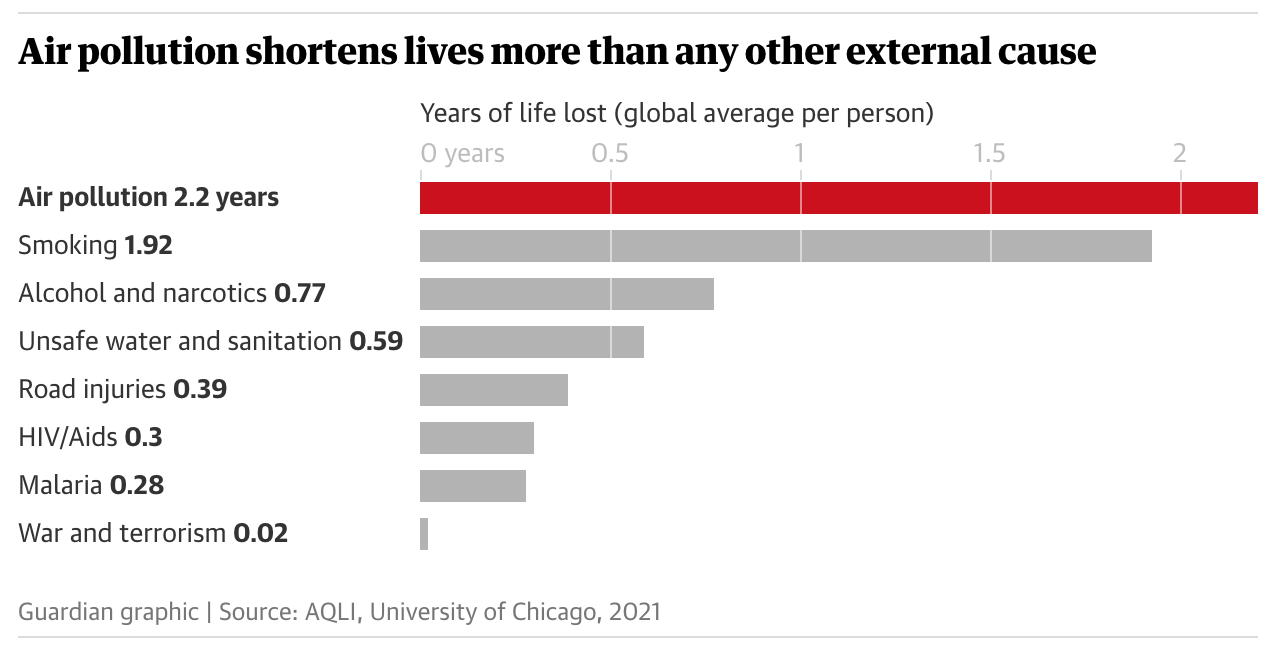
The average global citizen loses 2.2 years of life with today’s levels of air pollution and, if nothing changes, that adds up to 17bn lost years, Greenstone said. “What else on the planet is causing people to lose 17bn years of life?”

“Furthermore, we’re not just letting it happen, we’re actually causing it,” he said. “The most striking thing is that there are big countries where, effectively, a combination of the government and [societal] norms are choosing to allow people to live really dramatically shorter and sicker lives.” He said switching to cleaner energy and enforcing air quality measures on existing power plants have cut pollution in many countries.

The report estimated the number of additional years of life people would gain if air pollution levels in their country were reduced to World Health Organization guidelines. In India, the figure is 5.9 years – in the north of the country 480 million people breathe pollution that is 10 times higher than anywhere else in the world, the scientists said. Cutting pollution would add 5.4 years in Bangladesh and Nepal, and 3.9 years in Pakistan.

In central and west Africa, the impacts of particulate pollution on life expectancy are comparable to HIV/Aids and malaria, but receive far less attention, the report said. For example, the average person in the Niger delta stands to lose nearly six years of life, with 3.4 years lost by the average Nigerian.

China began a “war against pollution” in 2013 and has reduced levels by 29%. This is adding an average of 1.5 years on to lives, assuming the cuts are sustained, the scientists said, and shows rapid action is possible.

“Coal is the source of the problem in most parts of the world,” said Greenstone. “If these [health] costs were embedded in prices, coal would be uncompetitive in almost all parts of the world.”

Fossil gas is significantly less polluting than coal and Japan said in June that it would offer $10bn in aid for energy decarbonisation projects in southeast Asia, including gas power stations. But gas burning still drives global heating and Christiana Figueres, former UN climate chief, said on Sunday: “Let’s be clear, gas is not an alternative to coal and nor is it a transition fuel. Investments in new gas must stop immediately if carbon neutrality is to be reached by 2050.”

The AQLI report is based on research comparing the death rates of people living in more and less polluted places, with heart and lung problems being the largest source of early deaths. The analysis is based on small particle pollution, but is likely to include the effects of other air pollutants as these all tend to be high in the same locations. The estimates of air pollution around the world were derived from satellite data at 3.7-mile (6km) resolution.

Air pollution is slashing years off the lives of billions, report finds | Air pollution | The Guardian

Posted in Africa, Air Quality, Asia, China, Health Effects of Air Pollution, India, World News | Tagged , , , , , , , , , , | Leave a comment

How people respond to wildfire smoke

As wildfires become commonplace in the western U.S. and around the world, checking the daily air quality warning has become as routine as checking the weather. But what people do with that data — whether it drives them to slip on a mask before stepping outside or seal up their homes against smoke — is not always straightforward or rational, according to new Stanford research.

In a case study of Northern California residents, Stanford researchers explored the psychological factors and social processes that drive responses to wildfire smoke. The research, which ultimately aims to uncover approaches for helping people better protect themselves, shows that social norms and social support are essential for understanding protective health actions during wildfire smoke events. The findings appeared this month in the journal Climate Risk Management.

“It’s important to understand how people behave so that public health communications professionals can potentially intervene and promote safer behavior that mitigates risk,” said lead study author Francisca Santana, a PhD student in the Emmett Interdisciplinary Program in Environment and Resources (E-IPER). “This kind of qualitative work is a first step so that we can learn how people are using information and interacting to make decisions. We can then look at where there might be leverage points or opportunities to promote more protective behavior.”

Exposure to wildfire smoke can irritate the lungs, cause inflammation, impact the immune system and increase susceptibility to lung infections, including the virus that causes COVID-19, according to the Centers for Disease Control and Prevention. While other studies have examined how people respond to evacuation orders, little has been done to understand what’s happening with wildfire smoke exposure if people don’t — or can’t — leave the area, according to senior study author Gabrielle Wong-Parodi, an assistant professor of Earth system science at Stanford’s School of Earth, Energy & Environmental Sciences (Stanford Earth).

“It resonated with me, the things that people were doing to try to protect themselves in the absence of access to effective ways to reduce their wildfire smoke exposure,” Wong-Parodi said, referring to a resident who breathed through a wet bandana in an attempt to filter out toxic smoke particles. “It’s urgent that we come up with strategies that are realistic for what people are going through.”

Study authors Santana and David Gonzalez, who worked on the study as a PhD student at Stanford, interviewed residents across age, race and income demographics who were affected by wildfire smoke from the 2018 Camp Fire that destroyed Paradise, California, and subsequent fires in 2019 in Fresno, Santa Clara and Sacramento counties.

They found that individuals responded to wildfire smoke events in three main ways: interpreting information together, protecting vulnerable others and questioning protective actions. Their responses were influenced not only by the Air Quality Index (AQI) but also by what they were personally experiencing — whether they smelled, saw or tasted smoke in the air.

Just as important were the social factors at play, the researchers found. “Social norms and social support were really influencing how people chose to act on their perceptions of threat,” Santana said. “For example, a lot of people talked about observing others wearing masks, and in some cases that observation was enough for them to act by wearing a mask themselves.”

Their discussions revealed that the shared rules or standards of behavior within a social group — social norms — were a common pathway driving behavior change, in addition to the act of assisting or comforting others within your social group — social support.

“There were only a handful of people who described looking at the AQI and then changing their behavior based on just that — it was almost always a conversation they were having with one another,” Santana said. “It was very much a social exercise of making sense of limited information or information that was not at the right scale for their community.”

The study provides a framework for better understanding wildfire smoke responses by examining social processes while acknowledging that cultural and political contexts, as well as factors like demographics, health status and previous exposure to smoke and air pollution, may also influence individual behaviors.

In the western U.S., climate change has contributed to the risk and extent of wildfires, bringing smoke to regions like the Bay Area, which has historically been less affected than the rest of the state. In some cases, the researchers found that residents were unable to protect themselves because they couldn’t access N95 masks or air purifiers or properly seal their homes.

“This research is also important for epidemiologists trying to understand how wildfire smoke affects health,” said Gonzalez, who is now a postdoctoral researcher at the University of California, Berkeley. “This can help us to look at disparities in who’s exposed to smoke and whether that leads to poorer health for some populations.”

As these events become more common, there could be an opportunity to find policy synergies that help prepare communities for future smoke events, according to the co-authors. For example, programs that are designed to improve household comfort and increase energy efficiency could also include measures to reduce smoke intrusion during wildfire smoke events, Wong-Parodi suggested.

Some of the interviews revealed that residents simply didn’t know what to do while experiencing a novel extreme event. But even that revealed how processing uncertainty is a social exercise, not just a cognitive one.”

This piece shows that social norms may be an effective lever for encouraging the pro-health change that we’d like to see,” Wong-Parodi said. “That is actually a really promising sign for thinking about how to adapt and mitigate our risk as we’re facing increasing threats from climate change.”

Story Source:Materials provided by Stanford University. Original written by Danielle Torrent Tucker. Note: Content may be edited for style and length.

How people respond to wildfire smoke — ScienceDaily
Posted in Air Quality, USA, USA & Canada | Tagged , , , , , | Leave a comment

Air pollution linked to more severe mental illness – study

Exclusive: research finds small rise in exposure to air pollution leads to higher risk of needing treatment

Exposure to air pollution is linked to an increased severity of mental illness, according to the most comprehensive study of its kind.

The research, involving 13,000 people in London, found that a relatively small increase in exposure to nitrogen dioxide led to a 32% increase in the risk of needing community-based treatment and an 18% increase in the risk of being admitted to hospital.

The researchers said the findings were likely to apply to most cities in developed nations, and cutting air pollution could benefit millions of people.

“Air pollution is modifiable, and on a big scale as well, reducing population-level exposure,” said Joanne Newbury, of the University of Bristol, who led the research. “We know there are interventions that can be used, such as expanding low-emission zones. Mental health interventions at the individual level are actually quite difficult.”

The study used the frequency of admission to hospital or visits to community doctors and nurses as a measure of severity. The researchers calculated that a small reduction in one pollutant alone could reduce illness and save the NHS tens of millions a year.

Levels of air pollution in London have fallen in recent years but there is no safe level, said Ioannis Bakolis, of King’s College London, who was part of the research team. “Even at low levels of air pollution, you can observe this kind of very important effect.”

Recent research has shown that small increases in air pollution are linked to significant rises in depression and anxiety. It has also linked dirty air to increased suicides and indicated that growing up in polluted places increases the risk of mental disorders. Other research has found that air pollution causes a “huge” reduction in intelligence and is linked to dementia. A global review in 2019 concluded that air pollution may be damaging every organ in the human body.

The new study, published in the British Journal of Psychiatry, tracked patients in south London from their first contact with mental health services and used high-resolution estimates of air pollution at their homes.

The quarterly average NO2 levels in the study area varied by between 18 and 96 micrograms per cubic metre (µg/m³). The researchers found that people exposed to 15µg/m³ higher levels of pollution had an 18% higher risk of being admitted to hospital and a 32% higher risk of needing outpatient treatment after a year.

The link was strongest for NO2, which is largely emitted by diesel vehicles, but was also significant for small particle pollution, which is produced by burning all fossil fuels. The small particle levels varied from 9 to 25 µg/m³ and an increased exposure of 3 units increased hospital admission risk by 11% and outpatient treatment risk by 7%.

The scientists assessed the patient data again seven years after the first treatment and found the link to air pollution was still apparent. The findings were not explained by a range of possible other factors including age, sex, ethnicity, deprivation or population density, although unidentified factors might still play an important role.

“Identifying modifiable risk factors for illness severity and relapse could inform early intervention efforts and reduce the human suffering and high economic costs caused by long-term chronic mental illness,” the researchers said.

The study was not designed to prove a causal link between air pollution and the severity of mental illness – that requires difficult experimental work. But the link is “biologically plausible”, the researchers said, as air pollutants are known to have potent inflammatory properties and inflammation is believed to be a factor in psychotic and mood disorders.

The World Bank has estimated that air pollution costs the global economy $5tn a year, but this includes only the well-known damage caused to heart and lungs.

“Cost evaluations currently only factor in physical health, but we’re seeing more studies demonstrating links with mental health,” said Newbury. “We think it can be important to include these, because it could tip the scales and make it clearer that investing in reducing air pollution is cost-effective.”

The researchers estimated that reducing the exposure of the UK’s urban population to small particle pollution alone by just a few units, to the World Health Organization’s annual limit of 10µg/m³, would cut the use of mental health services by about 2% and save tens of millions of pounds each year.

Prof Kevin McConway of the Open University, who was not part of the study team, said: “This is a good study. The statistical analysis is generally appropriate [and] does increase confidence that there’s at least some element of cause and effect in the association between pollution and mental health.

“But it’s not easy for people to avoid pollution. Reducing air pollution in cities needs communal action on a broad scale.”

A separate new study has shown that heart attacks rise as the level of air pollution rises. The research examined data from southern Lombardy in Italy, an area with 1.5 million inhabitants.

Francesca Gentile, of the IRCCS Policlinico San Matteo Foundation in Pavia, said: “The results could be used to predict the incidence of this life-threatening condition [and] improve health service efficiency by being factored into ambulance forecasting models and warning systems.” The study was presented at the European Society of Cardiology 2021 congress.

Air pollution linked to more severe mental illness – study | Air pollution | The Guardian
Posted in Air Quality, Europe, Health Effects of Air Pollution, London, Medical Studies, Research on Air Pollution in the UK, UK | Tagged , , , , | Leave a comment

The health and climate benefits of reducing air pollution

Air pollution is linked to more than 4 million deaths around the globe every year, according to the World Health Organization. Atmospheric pollutants like aerosols and ozone affect not only human health but also the global climate—though they stay in the atmosphere for significantly shorter time periods than carbon dioxide. Their short atmospheric life span makes aerosols, ozone, and methane—so-called short-lived climate forcers (SLCFs)—prime targets for rapid mitigation. But until now, there was little consensus on what impact SLCF mitigation might have on either the environment or human health.

In a new study published in GeoHealth, Zheng and Unger used a global Earth system model to simulate the impact of a 50% reduction in SLCFs on premature deaths linked to PM2.5 (particulate matter smaller than 2.5 micrometers, which includes sulfate, nitrate, black carbon, organic carbon, clay, and other particles) pollution and global mean surface air temperatures. The authors couple the NASA ModelE2 global chemistry-climate model with the Yale Interactive Terrestrial Biosphere model, and they break down the atmospheric effects of reducing SLCF by sector, including agriculture, agricultural waste burning, domestic, energy, industry, transportation, waste management, and shipping.

The study shows that the benefits of SLCF mitigation vary by sector: for example, a 50% emission reduction in the energy sector had the largest impact on human health, avoiding some 4 million premature deaths over 20 years. Meanwhile, from a climate perspective, reductions in the domestic, agriculture, and waste management sectors had the largest impact, though the temperature reductions were modest (−0.085, −0.034, and −0.033 K, respectively). For the first time, the study shows that weather-driven variability in air pollution levels plays an important role in human health risk assessment.

Although the study has uncertainties in the climate impacts of aerosol pollutants and the sensitivity of health conditions to air pollution exposure, it provides insights that could help policymakers prioritize SLFC mitigation efforts. Reducing emissions in the agriculture and domestic sectors, for example, may have the most benefits for both climate and human health.

The health and climate benefits of reducing air pollution
Posted in Air Quality, Health Effects of Air Pollution, Medical Studies | Tagged , , , , | Leave a comment

Breathing wildfire smoke during pregnancy raises risk of premature birth, study finds

Stanford University research estimates that smoky California air may have resulted in as many as 7,000 preterm births

As California wildfires continue to rage and the Lake Tahoe area faces some of the highest air pollution levels in the world, a new study has found that breathing wildfire smoke during pregnancy increases the risk of premature birth.

The study from Stanford University, published in Environmental Research this month, estimates that the effects of wildfire smoke may have resulted in as many as 7,000 extra preterm births in California between 2007 and 2012.

Researchers combined more than 3m birth records with satellite and ground data on wildfire smoke exposures for each zip code in California. They found that the more days a mother was exposed to wildfire smoke during pregnancy, the more likely she was to face a preterm birth. The effects of moderate to severe exposure levels were significantly worse.

“We found that a week’s worth of smoke exposure (at these levels) was associated with a 5% increased risk and a month’s worth was associated with a 20% increase in preterm births,” said Sam Heft-Neal, the lead author on the study.

The findings compound growing evidence that smoke and the tiny particles of air pollution it produces, known as PM2.5, have dire health effects on the human body, ranging from heart attacks, strokes and asthma to mental illness.

“This stuff is tiny and it gets into the body, causes inflammation and creates a cascade of health effects,” said study co-author Marshall Burke, who is deputy director of the Center on Food Security and the Environment.

The findings come as fires continue to scorch California, with blazes such as the massive Dixie fire in the north of the state having already burned through 1.5m acres of drought-parched land. This week visitors to the Lake Tahoe region have seen air quality monitor readings shoot up into the hazardous 600 index range, far worse than current readings in some of the world’s most polluted cities including Delhi, India, and Jakarta, Indonesia.

The school district in the Reno, Nevada, area closed all public schools serving 67,000 students in Reno, Sparks and Incline Village on Monday because of the air pollution, according to the Associated Press. Residents were urged to remain indoors as much as possible.

The Stanford study attributed 2,000 preterm births to smoke in the state in 2008, the worst year of the study period. But, sadly, the authors said, wildfire smoke levels have gotten far worse since the end of the study period in 2012.

“The smoke exposure then was dramatically less back then,” said Burke. “Four of the last five years have seen worse smoke than any year in our sample.”

During California’s historic 2020 fire season, more than 4m acres burned and half of the state’s population experienced a month of unhealthy levels of wildfire smoke, according to a Stanford release on the study.

The study found that pregnant women in wealthy neighborhoods were just as likely to suffer the effects of the smoke as those in low income areas.

Heft-Neal said the findings indicate that pregnant women should take extra measures to protect themselves from wildfire smoke, such as staying indoors, and using air filtration systems and high quality masks.

Burke added that the societal costs of air pollution from wildfire smoke justify further steps from the state and federal government to prevent massive wildfires. He said each premature birth costs society an average of $70,000, so the benefits of reducing such early births alone could have “enormous societal benefits”.

Those benefits could go a long way toward paying for measures to reduce the fuel available for fires, like mechanically thinning forests and prescribed burns, he said.

“Our research highlights that reducing wildfire risk and the air pollution that accompanies it is one way of achieving these societal benefits,” he said.

Breathing wildfire smoke during pregnancy raises risk of premature birth, study finds | Climate crisis in the American west | The Guardian

Posted in Air Quality, Health Effects of Air Pollution, Medical Studies, USA, USA & Canada | Tagged , , , , , , | Leave a comment

Caldor fire burns over 400 homes as smoke chokes Lake Tahoe

More than 440 homes have been destroyed by the raging Caldor fire, and smoke has created conditions so hazardous that the air quality around the blaze is the worst in the country.

Burning through rugged terrain east of Sacramento, the Caldor fire grew to more than 100,000 acres over the weekend as it creeps toward South Lake Tahoe. The fire was at 9% containment Monday night after spreading unchecked for more than a week.

Strong winds up to 40 mph spurred furious growth over the weekend, increasing the fire’s size by 15,000 acres Saturday and into Sunday morning.

The expansion of the blaze — now covering 114,116 acres — has slowed amid weakening winds, but flames continue to threaten more than 17,000 structures, according to the latest incident report.

Winds, now at 7 to 10 mph, are still pushing the flames north and east, toward the southern end of Lake Tahoe. Smoke has choked the region, spurring “hazardous” air quality throughout the Lake Tahoe Basin, according to the Air Quality Index.

On Monday afternoon, Tahoe Vista, a census-designated place on the north shore of the lake, had an AQI rating of 558, the worst in the country. Higher numbers represent more pollution; ratings of 300 and up are considered hazardous. The concentration of small particulate matter in Tahoe Vista — typically a picturesque haven — was 58 times the World Health Organization’s exposure recommendation.

Social media posts showed eerie, orange, ash-filled skies. Authorities advised residents to avoid outdoor exercise, shut windows to keep dirty air out and run air purifiers if possible. The air quality Monday was so bad from the fire that it spurred the closure of Nevada state parks in the Tahoe area and schools in Incline Village, located in Nevada along the northeastern edge of the lake. Forecasts showed that the unhealthy air quality could last through the weekend.

Nine national forests are closed amid the increasing fire danger. On Monday, it was confirmed that 447 homes have gone up in flames across the burn area. Six commercial buildings and 162 minor structures were also destroyed, and at least 26 large structures have been damaged.

Much of the destruction occurred in the Grizzly Flats area and surrounding communities, which the fire decimated several days after igniting Aug. 14, said Capt. Jason Hunter, a spokesperson for the Caldor fire.

The town was a smoldering moonscape Sunday. Scorched trees lined the road like blackened toothpicks, some still burning from the inside. The smoky silence was broken only by the occasional thundering crack of one falling to the ground.

Downed power lines snaked alongside the streets. The post office was gone, its wheelchair ramp leading to a pile of rubble. All that was left of the Grizzly Flats Community Church was its foundation and the twisted metal skeletons of chairs, still arranged in rows ready for service. The door was draped over the debris like a piece of melted cheese. Two Little Free Library kiosks near the road were untouched, the books inside them intact.

Firefighters are focusing on containing the blaze west of Highway 89, an artery that borders the western edge of Lake Tahoe.

Chief Mike Blankenheim, of the California Department of Forestry and Fire Protection’s Amador-El Dorado unit, said the strategy will give personnel a wide area to attack the fire.

“We have no desire to let the fire get to Highway 89; we do not want to be fighting fire from Highway 89,” Blankenheim said during a community meeting Sunday. “The reason for making that move, like I said before, is to give our folks plenty of room to make different decisions and choose different places to fight the fire from.”

A spot fire ignited north of Highway 50 near the town of Kyburz and had grown to 250 acres by Monday morning. Firefighters were beating it back and protecting structures in the area, officials said.

“It’s still a concern; it’s still burning over there, but they were able to minimize the spread of it with those lines that are being put in — so more work on that today,” Hunter said.
Authorities have shut down a stretch of Highway 50 for the foreseeable future, and some nearby homes have lost power, fire officials said. New evacuation orders were issued Friday.
On Saturday evening, the El Dorado County Sheriff’s Office asked for help finding Marvin Hardy Creel, a 57-year-old who was expected to have evacuated from Grizzly Flats. Authorities said Creel phoned a family member Wednesday, but the call had poor reception. Repeated calls to his phone since have not been answered. Authorities found his white Dodge pickup truck abandoned in the Grizzly Flats area.
Nearly 30,000 people have been evacuated due to the Caldor fire, one of several large blazes in California. Among those who have hunkered down in evacuation shelters were Frank and Jeannette Castaneda, who have been living out of their truck in the parking lot of a community center.

Frank, 73, estimated that it was the sixth time they’d had to evacuate in the 35-plus years they’ve lived in the rural Pacific House community in the El Dorado foothills.
The Cameron Park Community Center was full Saturday, with 42 people staying inside and 27 more on the grounds. With the shelter at capacity, the Castanedas set up folding chairs under trees for the afternoon. Maggie, a Catahoula Leopard dog, was sprawled out on her bed between them. She had finally started to eat and was even sleeping a bit, said Jeannette, 70.
Although fires used to force them from their home every 10 years or so, the couple said, the pace has picked up recently, and the blazes have grown fiercer.
“The fires seem to be getting bigger and bigger every year,” Frank said.

Caldor is one of more than a dozen large wildfires raging across the state. More than 1.54 million acres have been charred this year, according to Cal Fire.

Caldor fire burns over 400 homes as smoke chokes Lake Tahoe – Los Angeles Times

Posted in Air Quality, USA, USA & Canada | Tagged , , , | Leave a comment

California lake becomes pool for air pollution during wildfire season

Lake Tahoe has experienced “especially bad” air quality through the second half of this summer, and new data reveals the lake’s air quality is at its worst levels of this decade.

The intense wildfire season California has experienced so far and the bowl-like geography surrounding Lake Tahoe that can cause pollutants to linger after getting trapped in the Sierra Nevada Mountain range, are partially responsible for the lake’s poor air quality this year, The San Fransisco Chronicle reports.

“The second half of summer has been especially bad for air quality around Lake Tahoe,” AccuWeather Meteorologist Joe Curtis said. “The first half of summer was not as bad, but things rapidly deteriorated by late July and August.”

According to AccuWeather Forecast Manager Bryan Sausman, summer tends to be the worst time for air quality due to less airflow. In addition, the wildfires throughout the state of California have played a role.

The Caldor Fire, currently affecting El Dorado County located directly southwest of Lake Tahoe, continues to burn over 68,000 acres. As of Thursday, the fire has been active for five days and is 0% contained. On Tuesday, California Gov. Gavin Newsom declared a state of emergency for El Dorado County due to the fire.

The Dixie Fire and Tamarack Fire, both of which erupted through Northern California this summer, have also played a role in the dwindling air quality of the lake. The Tamarack Fire has burned over 68,000 acres so far and is 82% contained as of Thursday while the massive Dixie Fire remains just 35% contained with more than 699,000 acres already burned.

“It’s been bad in the past, it’s bad now and it will be bad again in the future,” Dave Johnston, air pollution control officer for the El Dorado County Air Quality Management District, told the Chronicle. “Lake Tahoe is in a basin surrounded by mountains, so it is difficult for smoke to dissipate without some wind behind it.”

One way of measuring pollution is through particulate matter (pm). According to the California Air Resources Board, particulate matter is an airborne mixture of chemicals. Most of pm 2.5 is made up of emissions coming from the combustion of gasoline, oil, diesel fuel and wood, and it gets its name from being less than 2.5 microns in diameter.

In 2020, data from the board reveals that Lake Tahoe’s air basin had an average level of 5.3 pm 2.5 between June 1 and Aug. 17. The year prior, the basin had an average level of 1.1 pm 2.5 during the same time frame.

The air basin reported an average level of 18 pm 2.5 so far in 2021 — higher than any other year of this decade within the time frame of June 1 to Aug. 17.

Particulate matter can reduce visibility by affecting the way light is absorbed in the atmosphere and cause negative impacts to the climate and ecosystem when it deposits into water sources, also affecting water quality and clarity.

On Thursday, Lake Tahoe was experiencing “pretty good” air quality; however, with the presence of the Caldor fire just 40 miles away, the good air quality is not expected to last long, Curtis said. He added that forecasters are able to predict changes in air quality by observing changes in wind direction and patterns.

“Anyone visiting the area should take advantage of the nice weather and relatively clean air while it lasts because more smoke and haze will fill the atmosphere again by Friday,” he said. “Winds will shift out of the west-southwest Saturday afternoon, which will allow smoke particles from distant wildfires to drift toward Lake Tahoe.”

According to Curtis, individuals with underlying respiratory or cardiovascular conditions are at a bigger risk of being affected by poor air quality. He recommended that those who have underlying conditions avoid strenuous outdoor activity when the atmosphere is filled with smoke.

“The best thing to do is to stay inside as much as possible. Using an air filter inside the home will also be helpful because it continuously works to clean the air,” he said.

California lake becomes pool for air pollution during wildfire season

Posted in Air Quality, USA, USA & Canada | Tagged , , , , | Leave a comment

Air pollution cuts Hanoian lifespan by 2.5 years: study

Life expectancy among Hanoians is reduced by 2.49 years on average due to exposure to fine particulate matter (PM2.5), a recent study indicates.

“Research on the impact of air pollution caused by PM2.5 dust on public health in Hanoi in 2019” by the Hanoi-based non-profit organization Live and Learn for Environment and Community (Live&Learn), Hanoi University of Public Health (HUPH), and Vietnam National University’s University of Engineering and Technology is the first study to use data provided by local authorities to evaluate the burden of disease caused by impacts of PM2.5 dust pollution on public health in Hanoi.

The study was carried out within the framework of a project called “Joining Hands for Clean Air” funded and supported by the United States Agency for International Development (USAID) in 2019-2022.

A report issued last week to announce the study’s results said total PM2.5 dust concentration across Hanoi in 2019 had exceeded the national standard threshold.

Specifically, the annual average concentration of PM2.5 dust in the city is in the 28.15 µg/m³ to 39.4 µg/m³ range compared to the threshold recommended by the Ministry of Natural Resources and Environment at 25 μg/m³.

Downtown districts Dong Da, Ba Dinh and Hai Ba Trung have the highest concentration of PM2.5.

PM2.5 is defined as ambient airborne particulates that measure up to 2.5 microns in size, just a fraction of the width of a human hair. Their microscopic size allows these particles to be absorbed deep into the bloodstream upon inhalation, potentially causing health effects like asthma, lung cancer, and heart disease. Exposure to PM2.5 has been linked to negative health effects like cardiovascular disease, respiratory illness, and premature mortality.

The study revealed the burden of diseases related to death and hospitalization due to exposure to PM2.5 dust in Hanoi in 2019 was “significant.”

The number of premature deaths due to exposure to PM2.5 dust hit 2,855 cases, equivalent to about 35.5 premature deaths per 100,000 people while the life expectancy lost from exposure to PM2.5 dust totaled 908 days, or 2.49 years for Hanoians, it stated.

The study also showed with the increase in the average annual concentration of PM2.5 dust in Hanoi, there are an average of 1,062 more hospital admissions for cardiovascular disease each year, and about 2,969 cases that must be hospitalized for respiratory diseases, equivalent to 1.2 percent and 2.4 percent of the total number of hospital admissions due to the two groups of diseases among Hanoi residents, respectively.

Researchers, however, noted the results in this study could be much lower than in reality “due to the lack of data.”

The study uses the assumption that the lowest annual average PM2.5 concentration value of Hanoi in an ideal area is 22.9 µg/m3, which is higher than the WHO recommendation (10 µg/m3) for community health and safety.

In addition, the results of PM2.5 dust mapping could have been affected by errors in data from air monitoring stations in Hanoi, they said.

Air pollution cuts Hanoian lifespan by 2.5 years: study – VnExpress International
Posted in Air Quality, Asia, Vietnam | Tagged , , , , , | Leave a comment