Changes in EPA Air Quality Standard will reduce “good” air days

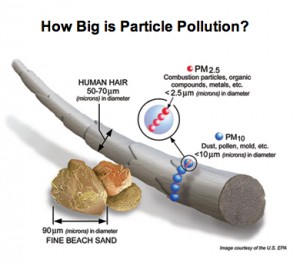
How big is PM

Recent changes in one of the U.S. Environmental Protection Agency’s National Ambient Air Quality Standards will most likely reduce the number of days that the air in Pima County is categorized as “good” on the Air Quality Index. The changes are based on EPA’s review of thousands of studies and make the air quality standard for fine particulate matter (2.5 microns or less in size) more protective of public health.

Exposure to fine particulate pollution, also known as PM2.5, can cause premature death and harmful cardiovascular effects such as heart attacks and strokes. In addition, particulate pollution causes haze and obscures mountain views. PM2.5 can be emitted directly from a variety of sources, including gasoline- and diesel-powered vehicles, smokestacks, fires, power plants, and industrial processes.

“Last year under the old standard, there were 361 days classified as ‘good’ days for PM2.5. With the new standard, some of those good air days will become ‘moderate,’ said Beth Gorman, Pima County Department of Environmental Quality’s (PDEQ) Clean Air Program Manager. “It is not that there is more pollution in our air now; rather it is that the new, stricter standards will provide a warning at the lower, more protective level where air pollution amounts could be harmful to our health,” Gorman continued. PDEQ estimates that there may be about a nine percent decrease in the number of “good” air quality days with the new standard. (See graphs in slideshow above.)

The Air Quality Index (AQI) converts air pollution concentrations to a number on a scale from 0 to 500, where “Good” is 0-50, “Moderate” is 51-100, and “Unhealthy for Sensitive Groups” is 101-150. “Even with this change to make the standard more stringent, the majority of our days will still be classified as ‘good’ for all the air pollutants we monitor. This is especially beneficial in a community such as ours where there are many people at risk when air pollution levels are elevated,” Gorman said.

PDEQ monitors fine particulate matter at six different monitoring locations throughout eastern Pima County. Up-to-the-hour air quality information can be obtained at http://www.AirInfoNow.org. Additional information regarding the EPA’s decision to revise the Air Quality Standard for PM2.5 and the recently issued formula forthe Air Quality Index can be found at http://www.epa.gov/pm/actions.html#dec12

via Changes in EPA Air Quality Standard will reduce “good” air days – Pima County News.

Posted in Air Quality, USA & Canada | Tagged , , , , , , | Leave a comment

Children falling victims to air pollution in City, says study

The rising pollution in the City has led to drastic increase in asthma among children during summer, according to a study conducted by Centre for Infrastructure, Sustainable Transportation and Urban Planning (CiSTUP) of Indian Institute of Science (IISc).

According to the study report, the incidence of asthma has gone up by 10 times in the last 16 years – from 2.8 per cent in 1994 to 28.8 per cent in 2010. Construction works, road widening, tree felling and increasing vehicular population have contributed in making Bangalore the asthma capital, said Mahesh Kashyap, a research fellow with CiSTUP. He was delivering a lecture at a workshop on fuel efficiency on Tuesday.

Underscoring the gravity of the situation in view of the unprecedented rise in respiratory ailments, Kashyap said 10 per cent of the City’s population – which is about nine lakh – suffer from health problems caused by air pollution.

The report points out that traffic police, who spend most part of the day at traffic

junctions are more susceptible to respiratory problems. At least 26 per cent of the traffic cops have asthma, 27 per cent suffer from cough and eight per cent complained of breathlessness.

There has also been a gradual increase in the average temperature of the City. The average temperature has gone up from 29.8 degree Celsius in 2008 to 30.9 degree Celsius in 2012. Kashyap said the rise in temperature will affect formation of ozone layer.

continue reading Children falling victims to air pollution in City, says study.

Posted in Air Quality, Asia, India | Tagged , , | Leave a comment

Smoking, air pollution major health threats in China

Chinese and international medical experts have warned that second-hand smoke and air pollution are among the major health threats in China.

The scientists listed unhealthy diet, uncontrolled high blood pressure,environmental tobacco smoke and outdoor and indoor air pollution as the five leading health risks facing the Chinese population, according to a statement issued at the opening ceremony of the Evidence-Based Policy Dialogue: China and the Global Burden of Diseases symposium on Monday.

Their comments were based on the new findings of a collaborative study conducted by the Chinese Center for Disease Control and Prevention China CDC, Peking Union Medical College PUMC, the Institute for Health Metrics and Evaluation IHME at the University of Washington and Australia’s Queensland University.

The study tracked disease-, disability- and demographic-related health trends in China over the two decades from 1990 and 2010.

Air pollution is dangerous, as it triggers infectious diseases, cardiovascular disorders and cancers, and the prevalence of these diseases in China is rising, the statement said.

Moreover, compared to most of the G20 countries, these threats are particularly serious in China, it said.

The experts also underlined efforts to cope with chronic diseases.

continue reading Smoking, air pollution major health threats in China — Shanghai Daily | 上海日报 — English Window to China New.

Posted in Air Quality, Asia, China | Tagged , | Leave a comment

‘Severe’ air pollution hits parts of Hong Kong

Roadside air pollution soared to dangerous levels in Hong Kong on Monday as the territory was affected by a continental air stream with high content of pollutants.

At noon, air pollution indices taken at roadside monitoring stations hit a “severe” level of 204 in Mong Kok and Central, and reached 144 in Causeway Bay.

An API reading exceeding 100 is classified as a “very high” pollution level. Health officials advise that people with heart or respiratory illnesses, the elderly and children reduce physical exertion and outdoor activities, and avoid prolonged stays in streets with heavy traffic.

The advice extends to healthy people among the general public as well when the reading hits the severe level of 200.

Monday’s poor air quality in Hong Kong was due to “a continental air stream with relatively high background air pollution” affecting the city, the Environmental Protection Department said.

And the pollutants would not be dispersed until later on Tuesday due to slow winds.

“The wind has been light over the last couple of days. The high air pollution incident is caused by the trapping of pollutants, in particular nitrogen dioxide, in the territory,” a spokesman said.

According to the Guangdong Provincial Environmental Monitoring Centre, the concentration of air pollutants significantly exceeded national quality in parts of the western Pearl River Delta estuary on Sunday.

A regional air quality index compiled by the centre showed the worst hit areas were Zhaoqing, Foshan and Jiangmen prefectures, with pollution readings hitting grades four and five, the two most severe levels on a scale of five.

The Hong Kong Observatory expected the city’s API readings to stay high on Monday and Tuesday. It said air quality was expected to improve gradually later on Tuesday when the wind was expected to pick up.

via ‘Severe’ air pollution hits parts of Hong Kong | South China Morning Post.

Posted in Air Quality, Asia, China | Tagged , , , , , , , | Leave a comment

Madrid air pollution reaches alarming levels

You don’t have to step into the street for Madrid’s roads to pose a hazard to your health: air pollution from cars in the city might just knock you over. Scientists are finding links between the gases and disease.

Pollution is not quite a top-ten killer – in Western Europe, lifestyle choices such as smoking, lack of exercise, and an unhealthy diet pose a bigger risk. Yet strikingly, the diseases linked to particulate air pollution may be the hardest to avoid if you cannot avoid the pollution itself.

In Madrid, three quarters of air pollution comes from motor vehicles. On bad days, a brown cloud sits on top of the city – prompting residents to call the smog cloud “boina” or beret because it looks like the city is wearing a cap.

More objective measures of the city’s air pollution show that it regularly exceeds European-mandated levels of gases and particles. Madrileños – or Madrid residents – walking around Atocha, one of the city’s biggest roundabouts, offer a variety of solutions for tackling the pollution problem.”We need to reduce traffic and produce cars that use other sorts of fuels,” said one woman.”Riding bicycles and using public transportation should be promoted more,” said another bystander. “I think there should be a fee, too, for cars that enter certain zones.”

continue reading Madrid air pollution reaches alarming levels | Environment | DW.DE | 12.04.2013.

Posted in Air Quality, Europe, Spain | Tagged , , , , , , , , , | Leave a comment

Recirculated air pollution descends on Derry

High levels of air pollution have been recorded in Derry.

The Department of Environment say it is currently monitoring high levels of particulate matter in the city – as well as in Belfast, Newry, Lisburn and Armagh.

“The pollution is the result of easterly airflows which are recirculation polluted air from England, Wales and Continental Europe over Northern Ireland, along with the build up of local emissions from vehicles and home heating,” a DOE spokesman said“Pollutant levels are expected to decline from tomorrow.

“During periods of High Air Pollution the symptoms of people with lung or heart disease may worsen. Healthy people are unlikely to experience any ill effects.”Hourly updates on levels of particulate matter PM10 and PM2.5, sulphur dioxide, nitrogen dioxide, ozone and carbon monoxide are available on the Department’s website: http://www.airqualityni.co.uk

via Recirculated air pollution descends on Derry – Local – Derry Journal.

Posted in Air Quality, UK | Tagged , , , , , , , , , , , , | Leave a comment

Lyndhurst air pollution breaks safety limit

IT IS an idyllic Hampshire haven spanning hundreds of square miles.

But parts of the New Forest have exceeded European limits for levels of lethal nitrogen dioxide.

The stark figures were revealed in the latest report on air pollution from New Forest District Council.

It shows kerbside analysis of nitrogen dioxide hit an annual mean concentration of 43 milligrams per cubic metre in Lyndhurst in 2011.

The annual mean objective is 40 milligrams per cubic metre.

Euro MP Keith Taylor, a member of the Green Party, paid a visit to Lyndhurst to highlight potential health problems linked to air pollution in the area.

He told the Daily Echo: “I’m here to congratulate New Forest District Council for its achievement in reducing sulphur dioxide, which is an air pollutant, but at the same time, note that on Lyndhurst High Street the levels of nitrogen dioxide are above the safety limits from the EU.

“This is the year of air, according to our European colleagues. That’s because we are increasingly aware of the health impacts of air pollution.

continue reading Lyndhurst air pollution breaks safety limit From Bournemouth Echo.

Posted in Air Quality, UK | Tagged , , , , , , | Leave a comment

When temperatures drop, pollution levels can soar

On the 5 and 6 March air pollution reached the maximum value of 10 on the UK’s air pollution index – levels where the public are advised to reduce strenuous outdoor physical activity. The easterly air flow that bought cold weather to the UK during March also brought particulate air pollution from traffic and industry across Europe which combined with local air pollution from our own cities. Yorkshire, Warrington and Birmingham were the worst areas affected on 5 March. The area with index level 10 then expanded on 6 March to include Middlesbrough, the whole of North West England and Belfast.

The situation was made worse by cold temperatures – leading to increased pollution from power generation and heating – and still nights that allowed air pollution to build up in our cites. Cold temperatures also meant that many nitrate and volatile organic carbon particles remained in the atmosphere, whereas on hot sunny days these would simply evaporate.

Particulate pollution at index level 10 is more than twice the World Health Organisation guidelines. In 1961, future West German Chancellor Willy Brandt demanded that the “sky above the Ruhr be made blue again”, making air pollution an election issue and setting in train a cleanup of one of Europe’s most polluted industrial areas.

Air pollution has changed since the sixties but with an estimated annual health cost of around £15bn in the UK, there is a big economic and public health prize from cleaning the air.

via Pollutionwatch: When temperatures drop, pollution levels can soar | Environment | The Guardian.

Posted in Air Quality, UK, World News | Tagged , , , , , , , , , | Leave a comment


