Balkan countries are source of most of SO2 emissions in Europe

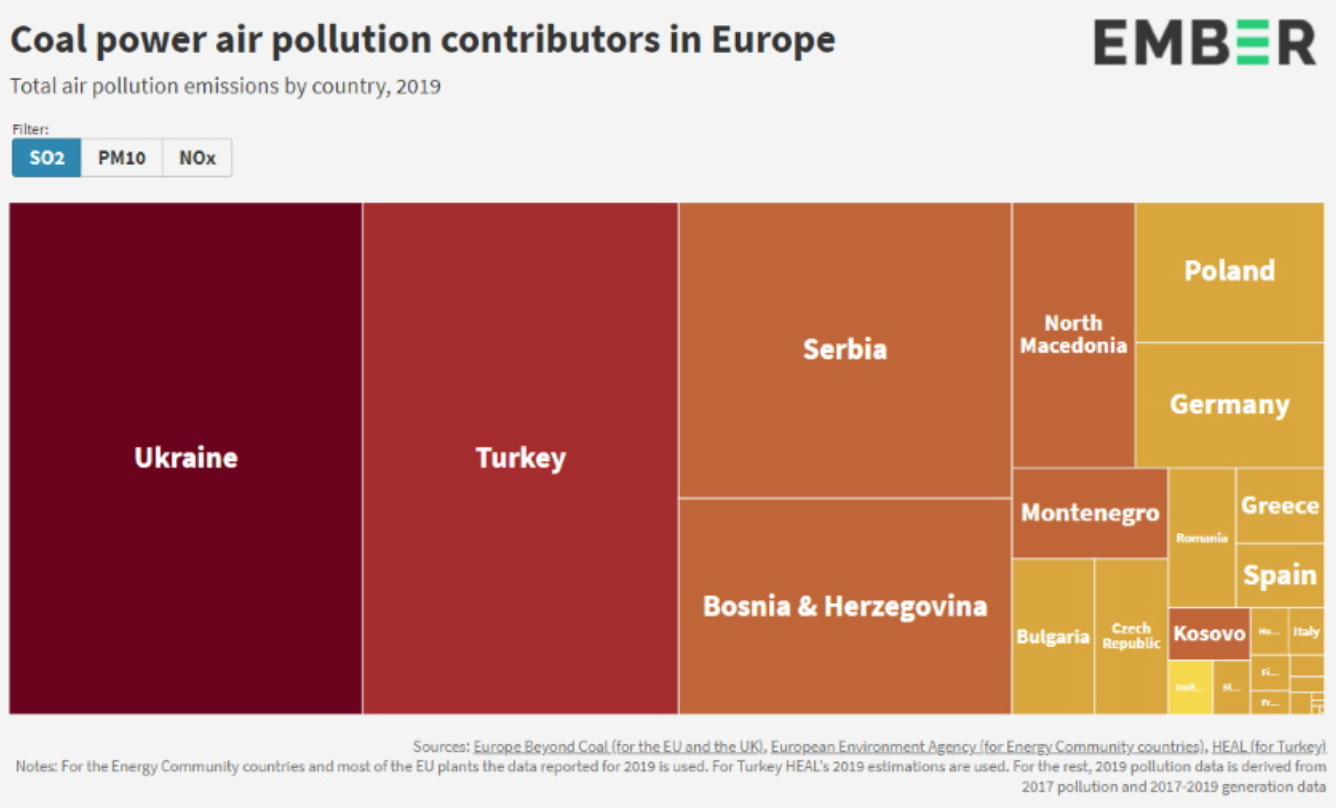
Ukraine, Turkey and the Western Balkans topped the European charts in 2019 across all types of air pollutants from coal-fired thermal power plants, Ember found. Furthermore, over half of entire SO2 emissions originated in Southeastern Europe.

Coal power air pollution statistics highlight contributions from a small number of countries in Europe, energy think tank Ember said. Turkey and Ukraine rank within the top three polluting countries and Western Balkan countries are next in the list despite their relatively small sizes. According to data for 2019 presented in the research, 61.3% of industrial sulfur dioxide (SO2) emissions came from Southeastern Europe.

When coal is burned for generating electricity, pollutants are released into the air, which poses a threat to human health. They are responsible for high numbers of premature deaths.

With pollutants sometimes traveling thousands of kilometers, air pollution from coal power affects the whole of Europe no matter the source.

Bitola thermal power plant is biggest emitter of SO2 in Balkans

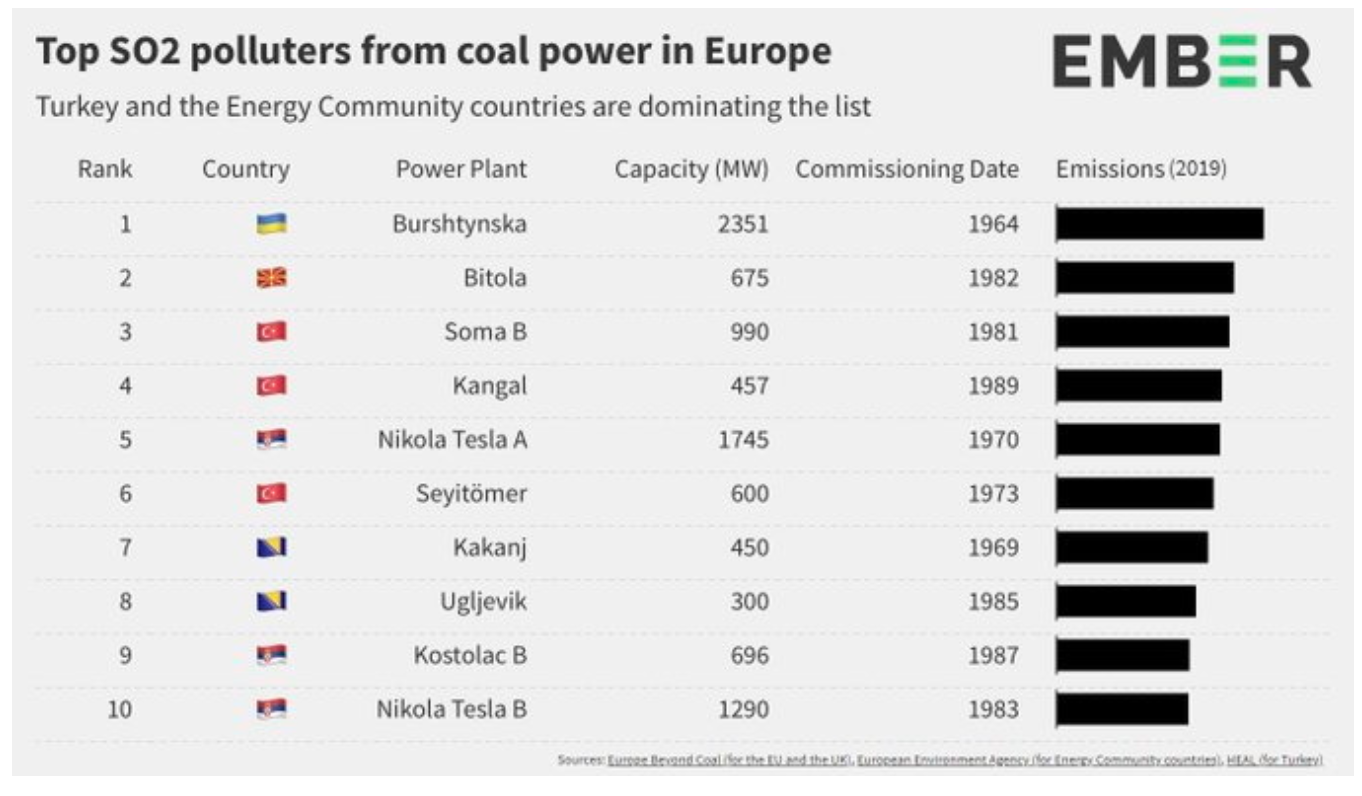
As for SO2 emissions, the top ten coal plants were responsible for 44% of the total. Burshtynska, located in Ukraine, is the biggest polluter in the category, followed by North Macedonia’s Bitola.

The remaining eight thermal power plants are all from the region tracked by Balkan Green Energy News: Soma B and Kangal (Turkey), Nikola Tesla A (Serbia), Seyitömer (Turkey), Kakanj and Ugljevik (Bosnia and Herzegovina) and Kostolac B and Nikola Tesla B (Serbia), in that order.

Ukraine’s coal plants lead in PM10 pollution

The majority of PM10 pollution from coal power generation originates from plants in Ukraine, which has eight plants in the top ten and all the top five. Turkey’s Seyitömer and Tunçbilek are also in tier one. EU countries like Germany and Poland are also among the worst for NOx pollution.

Poland’s Elektrownia Bełchatów, the largest coal-fired thermal power station in Europe, also emits most nitrogen oxides, usually marked as NOx. Next is Ukraine’s Zaporizka, which didn’t appear in the top ten in the two other categories. Yatağan, located in Turkey, is in third place.

Germany is represented with four plants. Nikola Tesla A and B are ranked sixth and ninth, respectively, and Kosovo B is tenth.

All the coal-fired thermal power plants in the three lists were commissioned more than 30 years ago.

Balkan countries are source of most of SO2 emissions in Europe

Posted in Air Quality, Europe | Tagged , , , , , , , , , , , | Leave a comment

Stronger air pollution standards in U.S. would have significant public health benefits

Reducing certain air pollutants in the U.S. by small amounts would prevent thousands of early deaths each year among elders, according to new research led by Harvard T.H. Chan School of Public Health.

The study, which focused on fine particulate matter (PM2.5), nitrogen dioxide (NO2), and ozone (O3), also found that even when levels of these pollutants met or fell below the Environmental Protection Agency’s (EPA) current National Ambient Air Quality Standards, they were still associated with significant mortality in elders. The authors said the findings raise serious concerns that the country’s current air quality standards do not sufficiently protect public health.

“Clearly the current national air pollution standards are entirely outdated and the progress in reducing air pollution is stalled,” said Joel Schwartz, professor of environmental epidemiology and senior author of the study. “The findings of this study signal a very clear message to policy makers: More rigorous PM2.5 and NO2 standards and a long-term O3 standard are absolutely necessary to protect public health, especially the health of elders.”

The study was published in Environmental Health on May 6, 2021.

To analyze the issue, the team used national Medicare data collected between 2000 and 2016 and predicted ZIP code–level estimates of ambient air pollution levels based on ground monitoring data, satellite data, meteorological conditions and several other factors. They focused specifically on establishing what is known as the “causal dose-response” relationship between the air pollutants and mortality among the Medicare population. A dose-response relationship can show how exposures to a certain amount of a substance—in this case, individual air pollutants—changes physiological function and health condition. The model created for this study also enabled the researchers to predict what would happen at the population level if exposures to these air pollutants changed.

In addition to determining that PM2.5, O3, and NO2 are all linked with significant harmful effects on human health, even at low levels, the researchers also found that substantial health gains can be achieved through small reductions in exposures. For instance, the study showed that lowering PM2.5 concentration by less than 1 microgram per cubic meter and lowering concentrations of O3 by less than 2 parts per billion and NO2 by approximately 3 parts per billion would prevent 65,935 early deaths per year among elders.

Moreover, according to Schwartz, the study highlighted the urgent need for the EPA to better regulate levels of O3, a gas that occurs naturally in the stratosphere but can also form at the ground level as a result of pollution from diesel engines and other sources undergoing chemical reactions in the presence of sunlight. At the ground level, O3 is associated with numerous health risks, especially for children, the elderly, and people who have asthma and similar conditions. There is currently no long-term exposure standard for O3, just a daily one.

“For O3, the EPA has focused on bringing down the number of peak days in the summer while producing little change in the long-term average exposure between spring and fall,” Schwartz said. “Our study shows that this is a mistake, and people are dying from it.”

Corresponding author Yaguang Wei, a doctoral candidate in the Department of Environmental Health, said that causal modeling can help provide precises predictions of how changes to air quality standards will affect public health. “We think this study can be used to help EPA, the World Health Organization, and others set their air quality standards and estimate the health benefits of specific policies, such as replacing diesel vehicles with cleaner alternatives,” Wei said.

Stronger air pollution standards in U.S. would have significant public health benefits | News | Harvard T.H. Chan School of Public Health
Posted in Air Quality, Health Effects of Air Pollution, Medical Studies, USA, USA & Canada | Tagged , , , , , , , , , | Leave a comment

Air pollution helps wildfires create their own lightning

Most people know lightning can spark wildfires. But wildfires can also spark lightning—a phenomenon that has puzzled scientists for decades. Now, researchers have revealed a key cause of this phenomenon: air pollution. Dirtier air means more lightning above wildfires—and more rain, too.

The finding “demonstrates that we should be thinking about the impact air pollution has on weather systems, including the impact on storms,” says Joel Thornton, an atmospheric scientist at the University of Washington, Seattle, who was not involved in the research.

Many factors are believed to cause lightning during a wildfire. Scientists have blamed everything from air currents to urbanization. These elements have been hard to disentangle in the air above land because the rough topography, changing land use, and varying heat create a complex set of variables that are hard to tease out.

Enter Australia’s devastating 2019–20 fire season. Known as “Black Summer,” massive blazes charred more than 186,000 square kilometers of land, and large amounts of smoke billowed southeast over the Tasman Sea. But the vast, flat, cool surface of the sea provided an opportunity to study the fires over a relatively blank canvas.

Yakun Liu, a meteorologist at the Massachusetts Institute of Technology (MIT), and his colleagues used satellite data and land-based lightning detection systems to track the movement of the aerosols—tiny airborne particles—generated by Black Summer wildfires and measure lightning activity in the region. During the fires, the air above a broad swath of the ocean became exceptionally polluted; it would probably take a volcanic eruption to do worse, Liu says.

Amid this seafaring air pollution, lightning activity increased by as much as 270% (from about 12 strokes up to 43 strokes, or lightning flash segments, per square kilometer per year) compared with the same time period the year before, the researchers report this month in Geophysical Research Letters. “That is much higher than I would have expected,” says Graciela Raga, an atmospheric scientist at the National Autonomous University of Mexico, Mexico City, who was not involved in the study.

In thunderclouds, upward-lofting ice crystals collide with descending bits of hail, and these collisions produce an electrical charge that gives rise to lightning. Liu and his colleagues detected higher concentrations of smaller ice crystals in aerosol-polluted clouds over the Tasman Sea. They believe the large influx of aerosols into the skies above the sea provided more surfaces around which cloud ice crystals could form.

The researchers also found that air pollution did more than enhance lightning; wildfire smoke more than tripled the intensity of thundershowers. Over the Tasman Sea, rainfall in lightning storms increased by 240% (from 12.2 to 41.8 millimeters per day).

There are two competing feedback loops, says Earle Williams, a meteorologist at MIT and co-author on the study. Lightning sparks fires and fires enhance lightning, he explains, whereas enhanced rainfall cleanses the atmosphere and helps fight fires.

This is a story that goes beyond wildfires, however,  Thornton says. The work is another example of how human beings—through our cities, traffic, and industrial activities—can change the weather, he says. “When you think about the size of the particles and the scale of the impacts they’re having on the nature of storms, it’s remarkable.”

Air pollution helps wildfires create their own lightning | Science | AAAS
Posted in Air Quality, World News | Tagged , , | Leave a comment

Korean Study Adds to Indications That Air Pollution is Tied to Parkinson’s

Nitrogen dioxide (NO2) is associated significantly with a higher risk for developing Parkinson’s disease, according to a recent study from Korea. The finding reinforces previous research showing a potential link between air pollution and Parkinson’s.

The results also prompted researchers to suggest that better air pollution regulations might lower incidence of the neurodegenerative disorder.

The study, “Association of NO2 and Other Air Pollution Exposures With the Risk of Parkinson Disease,” was published recently in JAMA Neurology.

Recent research has linked long-term exposure to ingested and inhaled environmental pollutants with the occurrence of neurodegenerative disorders such as Parkinson’s. How this might happen remains unclear, however.

One hypothesis states that the toxic clumps of alpha-synuclein that characterize Parkinson’s on a molecular level first form in the brain’s olfactory bulb and in the gut, before spreading throughout the nervous system. This involvement supports the environmental exposure connection by being directly linked to what we inhale and consume, respectively.

Epidemiological studies seeking to confirm the relationship between pollution and Parkinson’s have delivered inconsistent results, however. Some studies have found associations between the disorder and various airborne molecules, including ozone (O3), small particulate matter (PM2.5), and NO2.

A team of researchers from the University of Ulsan College of Medicine, in Seoul, South Korea, pointed out that most past studies have been carried out in North America and Europe, leaving little Asian data from which to draw.

To attempt to fill this gap, the group used Korea’s National Health Insurance Service (NHIS) records to look for associations between Parkinson’s occurrence and six common ambient air pollutants: PM2.5, PM10 (slightly larger small particulate matter), NO2, O3, sulfur dioxide (SO2), and carbon monoxide (CO).

NHIS records include approximately 97% of Korean residents.

The investigators compared health records to those of air pollution, which are tracked by the Seoul Research Institute of Public Health and Environment.

They identified 78,830 adults older than 40 (mean age 54.4, 52.1% female), without Parkinson’s, and who lived in Seoul from January 2002 to December 2006. They then followed this group’s records annually from January 2007 to December 2015.

A total of 338 individuals developed Parkinson’s over the study period, and from among the analyzed pollutants, only exposure to high amounts of NO2 were linked to a statistically significant increase in Parkinson’s risk.

The association between NO2 and Parkinson’s remained strong, even after adjusting for age, sex, type of insurance, and other medical conditions.

The researchers observed that NO2 exposure often is related to traffic emissions and that some studies have suggested that it exerts toxic effects on the brain. These include worsening the buildup of amyloid-beta, which can trigger the formation of alpha-synuclein clumps, causing nerve signaling difficulties and increasing markers of inflammation.

“In conclusion,” the scientists wrote, “we identified a statistically significant association between the risk of [Parkinson’s] and exposure to NO2 for the previous 5 years, especially at high exposure levels. We found no evidence for the association between the risk of PD and exposure to PM2.5, PM10, O3, SO2, or CO.”

“These findings,” they added, “suggest that regulation of air pollutants might reduce the incidence of [Parkinson’s].”

Korean Study Adds to Indications That Air Pollution is Tied to Parkinson’s
Posted in Air Quality, Asia, Health Effects of Air Pollution, Medical Studies, South Korea | Tagged , , , , , , , , , , | Leave a comment

Air at two Dhaka slums 5 times thicker than usual

Air density at two of Dhaka’s most marginalised low-income slums is four to five times higher than the permissible limit in Bangladesh for a 24-hour period.

As a result, residents suffer from air pollution-induced diseases like laryngeal problems, asthma and bronchial illnesses.

A study report published yesterday titled “Urban Localised Pollution in the Context of Climate Change” revealed this information at a virtual launching event.

According to the report, the major sources of indoor air pollution in both marginalised areas are earthen stoves for cooking and using biomass as fuel. Women are the most severely affected by air pollution, as they are exposed to smoke for long stretches of time during cooking.

The study was carried out in two large slums of Dhaka South City Corporation (DSCC) — Citypolli slum in Dholpur and Dhaka Match Colony in Shyampur. It focused on four issues — water supply, sanitation, indoor air pollution, and solid waste management.

These low-income settlements are surrounded by different air polluting industries like steel mills, plastic factory, melamine factory, brick kiln, etc.

The research was conducted between December 2020 and January 2021 under Featuring Green Earth Project, jointly implemented by Plan International Bangladesh, Bangladesh Youth Environmental Initiative (BYEI) and Population Services and Training Center (PSTC).

The project initiated the research in collaboration with the Department of Urban and Regional Planning (URP), Buet and International Centre for Climate Change and Development (ICCCAD).

Buet Professor Afsana Haque and ICCCAD Coordinator Sarder Shafiqul Alam shared the research findings in the event.

Under this research, Center for Atmospheric Pollution Studies (CAPS), Stamford University Bangladesh tested the water and air of the research areas.

The air quality report of the CAPS team reveals that Particulate Matter (PM) 2.5 and PM10 are found four to five times higher above the permissible limit under Bangladesh standards in a 24-hour period.

The water sample tested by CAPS was contaminated with foreign particles exceeding standard limits in both the study areas. They found E. Coli and ‘uncountable colonies of total coliform’ in the water. The Biological Oxygen Demand (BOD5) and chlorine concentration have been reported excessive as well.

Residents of the two slums said water is often inaccessible, scarce and polluted. Supply is often interrupted and women have to wait hours in queues to collect water.

On average, the households pay Tk 400-500 per month for water services.

Speaking as chief guest, Local Government, Rural Development & Cooperatives Minister Tazul Islam said, “Awareness is key at every stage of society. Community-led initiatives should be encouraged. Government, NGOs and the private sector must collaborate to address challenges related to waste management, water supply, water and air pollution.”

Plan International Bangladesh Director (Programme Management and Implementation) Afroz Mahal said that people migrated to Dhaka often end up in marginalised low-income areas with inadequate basic services and the problem will exacerbate due to impending climate change impacts.

Buet Vice Chancellor Professor Satya Prasad Majumder Vice, PSTC Executive Director Dr Noor Mohammad and ICCCAD Director Professor Saleemul Huq were also present at the event.

Air at two Dhaka slums 5 times thicker than usual | The Daily Star
Posted in Air Quality, Asia | Tagged , , | Leave a comment

Air pollution linked to ‘huge’ rise in child asthma GP visits

Exclusive: consultations for asthma and other respiratory infections go up with increased dirty air, finds study

A “huge” increase in the number of visits to doctors by children with asthma problems occurs after a week of raised air pollution, according to a study. The number of inhaler prescriptions also increases significantly.

Dirty air is already known to increase hospital treatment for severe asthma attacks and other respiratory problems. But the new research is the first using clinical data to show increased illness among the much bigger number of people who seek treatment from their GP.

The researchers said children were the most severely affected by the raised air pollution, but there were increases in GP consultations and inhaler prescriptions for people of all ages. Overall, they said, the study demonstrates that air pollution, particularly from diesel vehicles, affects whole communities.

The researchers called for action to cut air pollution and said pollution warnings could be used to help those at risk to prepare for episodes of increased dirty air. The research was conducted in south London over five years and analysed more than 750,000 respiratory consultations at GPs and inhaler prescriptions.

The average level of particle pollution in Lambeth during the study period was 21 micrograms per cubic metre of air (µg/m3). The researchers found that when this pollution was raised by 9 µg/m3 for a week, the number of child consultations for asthma and respiratory infections went up by 7.5%. For nitrogen dioxide pollution, the average level was 51µg/m3, and a rise of 22µg/m3 was linked with consultations rising by 6%.

“These are huge increases,” said Mark Ashworth, at King’s College London, who led the research. “We’d expected much smaller associations. This is a very large shift of the dial and has never been shown before.”

Children are already among the most frequent visitors to GPs and respiratory problems are one of the most common reasons for consultations, he said, so these percentage rises mean a large number of extra visits.

Furthermore, Ashworth said: “We think these headline figures are a substantial underestimate.” This is because the GP data was only available from Monday to Friday and during surgery hours, so consultations at weekends or in the evening were not included in the data.

“We all have in our minds the case of Ella Kissi-Debrah,” Ashworth said. “If only we’d had this evidence then.” A landmark ruling by a coroner in December found that air pollution was a cause of death of the nine-year-old girlin south London in 2013.

“We now have confirmation that diesel-related air pollution is linked strongly to respiratory illness that is bad enough to see the GP,” Ashworth said. “That’s got to be a call to reduce diesel pollution.”

Rosamund Kissi-Debrah, Ella’s mother and clean air advocate for the World Health Organization (WHO), said: “I keep on saying daily how so many are affected like Ella. Diesel must be phased out as soon as possible – the health impacts are terrible. We can’t have a generation of children on inhalers. Health professionals must continue to speak up as their voice is critical.

The coroner’s April report on the prevention of future deaths said the UK’s legal limits for particulate pollution should be halved, to be in line with WHO guidelines. He also said better warnings on air pollution levels should be provided to the public and that medical staff should be trained to give patients more information on the dangers of dirty air.

Privacy safeguards mean that large datasets of clinical data from GPs are rare but the new study, published in the journal Environmental Health, used Lambeth DataNet, which provides anonymised information on 1.2 million patients.

Data on respiratory consultations and inhaler prescriptions from 2009–2013 were compared with fine-scale air pollution data to reveal the links. The researchers took account of other factors, including the weather and levels of deprivation.

Air pollution levels have reduced since the study period, but NO2 levels remain illegally high in many urban areas and particle pollution is frequently above WHO guidelines, though there is thought to be no safe limit.

“It is not just a few severely affected people who are going to be hit by particulates and NO2,” said Ashworth. “It’s a large proportion of people who are vulnerable. Therefore, anybody taking asthma inhalers is going to have a degree of vulnerability and needs to be prepared.”

Air pollution linked to ‘huge’ rise in child asthma GP visits | Air pollution | The Guardian

Posted in Air Quality, Asthma, Health Effects of Air Pollution, Medical Studies | Tagged , , , , | Leave a comment

Air quality linked to increased risk of Alzheimer’s

Study explores how traffic-related air pollution impacts the aging brain in rodent model

Researchers at the University of California, Davis, have found a link between traffic-related air pollution and an increased risk for age-related dementia, including Alzheimer’s disease. Their study, based on rodent models, corroborates previous epidemiological evidence showing this association.

Alzheimer’s disease is the most common cause of age-related dementia and the sixth leading cause of death in the United States. More than 5 million Americans currently live with Alzheimer’s disease — a number that is expected to triple by 2050 as the population ages. Health care costs for those patients are predicted to grow from $305 billion in 2020 to $1.1 trillion by 2050.

UC Davis toxicologist Pamela Lein, senior author of the study recently published in Environmental Health Perspectives, said their findings underscore the urgent need to identify factors that contribute to the onset and progression of Alzheimer’s to develop effective preventive measures for reducing the individual and societal burden of this disease.

Lein worked with UC Davis atmospheric scientist Anthony Wexler and first author Kelley Patten, while she was a doctoral student in the UC Davis graduate group for pharmacology and toxicology, to develop a novel approach to study the impacts of traffic-related air pollution in real time. Researchers set up a rodent vivarium near a traffic tunnel in Northern California so they could mimic, as closely as possible, what humans might experience from traffic-related air pollution.

“This approach was a creative way to get at the question of what impacts air pollution has on the brain in the absence of confounding factors such as socioeconomic influences, diet, etc.,” Lein said. “It’s important to know if living close to these roadways poses a significant risk to the human brain as it ages.”

Exposure outcomes on the aging brain

The researchers exposed male and female rats for up to 14 months to filtered air or polluted air drawn from the tunnel and delivered it to animals unchanged in real time. The subjects were divided into two groups: wild type rats and those that express Alzheimer’s disease risk genes that are relevant to humans.

Testing was conducted in 3-, 6-, 10- and 15-month-old animals using hyperspectral imaging, behavioral testing and neuropathologic measures to quantify the expression of Alzheimer’s disease characteristics.

“We saw that traffic-related air pollution accelerated Alzheimer’s disease characteristics not only in the animals who express the risk gene (which we anticipated) but also in the wild type rats,” Lein said. “We didn’t anticipate that. The big, exciting discovery is that traffic-related air pollution is a risk factor for late-onset Alzheimer’s disease. This is important because this pollution is everywhere and could explain the increased number of people impacted by Alzheimer’s disease across the world.”

What remains unclear is which component of that pollution is predominately responsible for the effects on the brain. There are gases, particulate matter, road dust, tire wear, vibration and noise involved in traffic-related air pollution.

“The next set of studies is to try and tease apart specific components of traffic-related air pollution that drive these Alzheimer’s disease traits,” Lein said. “Or is it the collective mix that causes the damage?”

Fine particles (PM 2.5) in the polluted air at the study site were below federal regulatory limits, but ultrafine particles, which are not regulated, were detected in the brains of exposed animals.

“The Environmental Protection Agency only regulates down to the PM 2.5 level, but the bulk of this traffic-related air pollution is ultrafine particulate matter,” Lein said. “These studies provide incentive to re-evaluate the current regulatory standards and suggest that current ones are not protective of the aging brain.”

The study shows traffic-related air pollution can deliver a double whammy, decreasing the time of onset of Alzheimer’s disease characteristics and accelerating disease progression. While personal factors can change an individual’s risk for Alzheimer’s disease (exercise, smoking, diet), people are often poor about sticking to a plan to decrease their risk factors.

“There’s a lot of data that shows if you can regulate risk factors through policy at a population level, you have a more significant public health impact than if you try to regulate them at the individual level,” Lein said. “If we could make some progress in identifying which component in traffic-related air pollution is causing these effects, then scientists can approach legislators to develop scientifically based regulations. Even if we can delay onset of Alzheimer’s disease by five years, we could potentially save our health care system an enormous amount of money.”

This study is one of four published papers to come out of the research site to date. A prior study, published in Translational Psychiatry focused on the developing brain and found a link between traffic-related air pollution and an increased risk for changes in brain development relevant to neurodevelopmental disorders such as autism.

Air quality linked to increased risk of Alzheimer’s | EurekAlert! Science News
Posted in Air Quality, Health Effects of Air Pollution, Medical Studies | Tagged , , , , | Leave a comment

Ozone in air pollution is linked to fibroid development in Black women

Higher levels of ozone from air pollution are linked to an increased risk of developing fibroids among Black American women according to a large study published today (Friday) in Human Reproduction, one of the world’s leading reproductive medicine journals.

Fibroids are non-cancerous growths that develop in and around the womb. They are diagnosed in 25-30% of pre-menopausal women, but the true incidence is thought to be between 70-80%. Many fibroids do not cause symptoms but when they do, they are one of the main reasons women are admitted to hospital for inpatient care. Symptoms can include heavy or painful periods, stomach and back pain, constipation, frequent need to urinate, and pain or discomfort during sex. In some cases they can affect fertility and pregnancy. Women of African-Caribbean origin are diagnosed with fibroids two to three times more often than white women, and they tend to experience earlier onset of symptoms and more severe disease.

Previous research has shown that Black people are exposed to higher levels of air pollution than white people in the USA but, until now, there has been no investigation into the association between air pollution and fibroids in Black women.

The study published today investigated concentrations of three environmental pollutants in the air in 56 US metropolitan areas between 1997 and 2011: particulate matter smaller than 2.5 microns (PM2.5), nitrogen dioxide (NO2) and ozone (O3). The 21,998 premenopausal Black women who lived in these areas and were included in the research were part of the ongoing Black Women’s Health Study. They answered questionnaires every two years and were followed up until 2019.

During the 14-year follow-up period, 6238 (28.4%) of women reported having fibroids diagnosed by a doctor and confirmed by ultrasound or surgery. Average (median) concentrations of ozone were 36.9 parts per billion (ppb), with a range of 25.4 to 55 ppb.

After adjusting for factors that could affect the results, such as education, smoking, body mass index, diet and whether or not the women had been pregnant, the researchers found that the risk of self-reported fibroids increased with increasing levels of ozone in the atmosphere, but not with PM2.5 or NO2.

Ozone was linked to a 35% increased risk of fibroids among the 20% of women exposed to the highest levels of ozone (42-55 ppb) – a rate of 33.6 cases per 1000 women, compared with the 20% exposed to the lowest levels (25-33 ppb) – a rate of 31.4 cases per 1000 women. The association was stronger among women aged less than 35 years and for women who had been pregnant.

First author of the study, Dr. Amelia Wesselink, an Assistant Professor in the Department of Epidemiology at Boston University School of Public Health (Massachusetts, USA), said: “We were surprised to see an association for ozone but not for PM2.5 and NO2. The mechanisms that we think could explain the association between ozone and fibroids are also relevant for the other pollutants, so this was an unexpected finding. It may reflect that there is a mechanism unique to ozone that we are missing, but it might also mean that there is factor that we’ve not been able to measure that could affect the results. For example, we were unable to account for vitamin D exposure and vitamin D deficiency is a suspected risk factor for fibroids.”

Biological mechanisms that might be involved in the link between ozone and fibroids include an immune inflammatory response; oxidative stress (an imbalance between molecules in the body, leading to cell and DNA damage); high blood pressure that could lead to fatty deposits on artery walls; and activation of the body’s stress response.

Dr. Wesselink said that the increased risk of fibroids among Black women was not explained by known risk factors, or by socioeconomic status, or access to or quality of health care.

“We are still trying to figure out what specific exposures explain this disparity. Possible explanations that are under investigation include stress throughout life due to systematic oppression and racism; vitamin D deficiency; and environmental factors like air pollution, which we know are inequitably distributed across populations in the United States. “There have now been three studies suggesting a link between air pollution and fibroids, but ours is the first to show this in Black women. Because Black women are inequitably exposed to air pollution, these findings have important implications for racial disparity in fibroids.”

The study has some limitations. These include the way exposure to air pollution was measured; the fact that women reported doctors’ diagnoses of fibroids, which could have led to an under-estimation of the problem; and that the researchers were unable to measure factors that could affect the results, such as vitamin D exposure.

Dr. Wesselink said: “Vitamin D deficiency is a key hypothesis that is under investigation to explain the racial disparity in fibroids. It is certainly possible that our findings could be explained by vitamin D. This is something that should be considered in future work on this topic.”

She concluded: “Further research and additional funding is needed to understand the role of air pollution in fibroid development. For instance, a prospective, ultrasound-based study could identify fibroids, regardless of whether or not they are causing symptoms that lead to women seeking medical care. In addition, we need to consider the role of other features in the physical and built environment in the development of fibroids; factors such as environmental noise, access to green spaces and other neighbourhood exposures.”

Ozone in air pollution is linked to fibroid development in Black women
Posted in Air Quality | Tagged , , , , , | Leave a comment