Sandstorms turn sun blue and sky yellow in Beijing

Thick dust carrying extremely high levels of hazardous particles blows in from drought-hit Mongolia

The second sandstorm to hit China in less than a fortnight has reversed the colours of the sky, turning the sun blue and the heavens yellow.

Beijing woke on Sunday morning shrouded in thick dust carrying extremely high levels of hazardous particles.

The sandstorm was fuelled by winds from drought-hit Mongolia and north-western China.

Visibility in the city was reduced, with the tops of some skyscrapers obscured by the sandstorm. Pedestrians were forced to cover their eyes as gusts of dust swept through the streets.

The China Meteorological Administration issued a yellow alert on Friday, warning that a sandstorm was spreading from Mongolia into northern Chinese provinces including Inner Mongolia, Shanxi, Liaoning and Hebei, which surrounds Beijing.

As the sandstorm hit Beijing on Sunday morning, air pollution levels rose to a maximum level of 500, according to Beijing’s real time air quality index. Levels of the pollutant PM10, which can penetrate the lungs, passed 2,000 micrograms per cubic metre.

Levels of PM2.5, smaller particles that can penetrate the bloodstream, reached 462. The World Health Organization recommends average daily PM2.5 concentrations of just 25.

The storm caused havoc at airports in Inner Mongolia, with more than half of flights cancelled from the Baotou and Chifeng airports due to poor visibility, the South China Morning Post reported.

The China Meteorological Administration said the recent sandstorms originated from Mongolia, where relatively warmer temperatures this spring and reduced rain resulted in larger areas of bare earth.

“The dynamics for sandstorms and transmission of dust are good now,” Zhang Tao, chief forecaster for China’s Central Meteorological Observatory told state-run People’s Daily on Monday.

Zhang said north and northwestern China had less snow cover and rain this year and that temperatures since February had been higher, leading to further drying and dusty weather, kicked up by stronger than usual winds.

Average temperatures in Mongolia and northern China were about 6°C higher than normal in March, according to Zhang.

Northern China has long suffered sandstorms as deserts in the region spread further south, with deforestation intensifying the frequency during Mao Zedong’s Great Leap Forward period from 1958 to 1961.

Large-scale deforestation is also considered a factor in China’s dust storms. Beijing has planted a “great green wall” of trees to trap incoming dust, as well as trying to create air corridors that channel the wind and allow sand and other pollutants to pass through more quickly.

via Sandstorms turn sun blue and sky yellow in Beijing | Air pollution | The Guardian
Posted in Air Quality, Asia, China, Mongolia | Tagged , , , , , , , , , , | Leave a comment

Lockdown did not reduce air pollution from tyre wear in London

Less traffic meant less congestion, but the remaining vehicles went faster

I asked William Hicks how he felt when lockdown suddenly happened in the middle of his year-long air pollution investigation. “Excited,” he replied. Not the answer that I expected. “It was like moving the field laboratory to a whole new road.” Hicks, and his team from Imperial College London, were studying tiny particles from tyres, brakes and road surfaces on London’s Marylebone Road.

The inside of the field laboratory is a noisy environment full of the rattle of pumps, as an array of equipment measures the size and chemical nature of the air pollution. Hicks was measuring metal particles in the air to work out how much pollution came from each source. Barium particles are released from brake pads and zinc, used to volcanise rubber.

During my visits to the field laboratory I like to take a few minutes to climb up among the sampling equipment on the roof and watch the remarkably regular daily pattern of the traffic, but in lockdown 32% of the traffic disappeared. Less traffic meant less congestion, but the remaining traffic went faster. Brakes particles decreased with less stop-start conditions but the air pollution from tyres stayed the same. Faster traffic meant more tyre wear from each vehicle.

A 2017 study estimated that tyre wear-and-tear accounts for between 5% and 10% of microplastics entering our oceans each year. Another estimate from International Union for Conservation of Nature and Natural Resources puts this figure at about 28%. These figures make wear-and-tear from tyres at least as important as plastic bottles, bags and fibres released from clothing during washing. Heavier vehicles also produced more particle pollution than lighter ones; lorries and buses produced about four times more brake and tyre wear compared with cars and vans.

The UK and governments around the world plan to clean up exhausts and eventually to abolish combustion engines all together, but as Hicks explained, “pollution from brakes, tyres and road surfaces are here to stay”. Although electric lorries may be some time off, regenerative braking in hybrid, and electric, cars, buses and vans should decrease the toxic metal particles from brakes. This involves using the electric motor, instead of friction brakes, to slow the vehicle, recharging the battery. But controlling tyre and road wear will not be easy. The polluted roads of the future may not be the slow congested streets in city centres but the busy faster trunk roads. Less and slower traffic may be one solution, along with lighter vehicles.

Lockdown did not reduce air pollution from tyre wear in London | Pollution | The Guardian
Posted in Air Quality, Europe, London, UK | Tagged , , , , , , | Leave a comment

Health Risks Linked to Air Pollution at Levels Below WHO Targets

Hazy air days often followed by uptick in cardiovascular, respiratory deaths

A short-term rise in nitrogen dioxide air pollution could be tied to a bump in local mortality rates the next day, researchers showed in a large international study.

Across 398 cities (located mostly in the U.S., Europe, and Asia), each 10 μg/m3 increase in ground-level NO2 concentration was associated with increases in mortality the next day that persisted after adjustment for other air pollutants:

– Total mortality up 0.46%

– Cardiovascular mortality up 0.37%

– Respiratory mortality up 0.47%

Concentration-response curves, based on data from 1973 to 2018, were almost linear with no minimum threshold for harm, reported Haidong Kan, MD, PhD, of Fudan University in Shanghai, and colleagues in an epidemiological study published online in The BMJ.

“This result suggests that NO2 is associated with considerable health risks even at levels below health based standards and guidelines, including the current WHO air quality guidelines,” the group wrote.

Cities participating in the study had a median average annual nitrogen dioxide concentration of 26.9 μg/m3. The WHO sets a target of 40 μg/m3 in annual mean concentration of NO2 in air quality guidelines.

Ambient nitrogen dioxide primarily comes from vehicle and power plant emissions. The U.S. Environmental Protection Agency concluded in 2016 that there is a causal relationship between short-term exposure to NO2 and respiratory effects; evidence was deemed insufficient to blame exposure for total mortality and cardiovascular effects, however.

“Our findings from this multi-location analysis add to the supporting evidence for causal associations between short term exposure to NO2 and non-respiratory endpoints,” Kan and colleagues wrote.

“Although reduction of NO2 to zero is infeasible, our analysis provides insight into the public health benefits of substantial reductions in NO2, suggesting considerable health benefits from stricter control of NO2 emissions and tightening of the regulatory limits of NO2 in future revisions of WHO air quality guidelines,” they noted.

For their epidemiological study, the investigators drew upon the Multi-City Multi-Country Collaborative Research Network. Mortality data, obtained from local authorities within each country, captured 62.8 million total deaths from 1973 to 2018.

That most data were obtained from select developed areas precluded global generalization of the findings, Kan’s team cautioned.

Furthermore, their database was subject to potential exposure misclassification and coding errors.

via https://www.medpagetoday.com/publichealthpolicy/environmentalhealth/91793

Posted in Air Quality, Asia, Europe, Health Effects of Air Pollution, Medical Studies, USA & Canada, World News | Tagged , , , , | Leave a comment

Wildfire Smoke More Dangerous for Your Lungs Than Other Pollution

Key Takeaways

High concentrations of fine particle pollution from wildfire smoke drove an increase of up to 10% in hospital admissions for respiratory issues, a new study finds.

While other sources of pollution seem to be declining, wildfire smoke pollution is becoming more prevalent due to climate change.

Fine particles in wildfire smoke can seep into the lungs and bloodstream, causing various respiratory and cardiovascular health issues.

Last year, wildfires raged across the Western U.S., enveloping entire cities in smoke and exacerbating respiratory issues for many. As climate change drives more intense wildfire seasons, these pollutants being spewed into the air may be bringing dire health consequences.

New research finds that fine particles from wildfire smoke affect respiratory health more than those from other sources of pollution like car emissions. In a study published earlier this month in Nature Communications, researchers found that hospitalizations from wildfire smoke fine particle matter were up to 10 times greater than those from other pollution sources.

The study looks at the risk of tiny particles with diameters of up to 2.5 microns, or one-twentieth the size of a human hair. These airborne PM2.5 particles, as they’re called, are tiny enough to embed themselves deep into the lungs when people inhale them.

“PM2.5 has not really been decreasing and one of the reasons why is because wildfires are growing and becoming more frequent and intense,” lead study author Rosana Aguilera, PhD, a postdoctoral researcher at the University of California, San Diego Scripps Institution of Oceanography, tells Verywell.

What Smoke Does to Your Respiratory Tract

Studies show that PM2.5 causes inflammation in the lungs, regardless of what the particles are made of. Additionally, they are small enough to move through the respiratory tract and into the bloodstream, where they can impact vital organs.

Inflammation due to these tiny particles can cause respiratory symptoms like wheezing, shortness of breath, coughing, runny nose, and sore throat. One of the dangers of wildfire smoke, in particular, is that it can release high amounts of pollution persistently over several days, weeks, or even months.

“The repeated inhalation of these particles over a prolonged period of weeks to months leads to an inflammation that is not able to cure itself or resolve itself, and subsequently leads to severe enough symptoms to the point that one may need hospitalization,” Reza Ronaghi, MD, an interventional pulmonologist at the University of California, Los Angeles Medical Center who is not affiliated with the study, tells Verywell.

Ronaghi says that during the wildfire season, the most vulnerable people are those who already have lung disease. The inflammation caused by inhaling smoke particles can exacerbate symptoms, possibly leading to hospitalizations.

In the study, researchers did not break down the data by people’s medical conditions or specific reasons for hospitalization.

There may be other factors that affect the toxicity of wildfire smoke. For instance, the kind of tree that burns and the temperature at which it burns may influence the composition of particles that are released into the air.

“Wildfire is mainly biomass burning,” Aguilera says. “But it may also go through some infrastructure and housing and that might release additional chemicals through smoke that we inhale.”

To piece apart exactly which particles found in wildfire smoke are most toxic will require more research.

Increased Hospitalizations

Aguilera and her team studied 14 years of hospital admissions data, from 1999 to 2012. To single out PM2.5 from wildfires compared with other sources of pollution, the team estimated wildfire smoke exposure in Southern California, where the Santa Ana winds stoked fires and drove smoke toward heavily populated areas.

When there was a 10 microgram-per-cubic meter increase in PM2.5 from wildfire smoke, hospital admissions increased between 1.3 to 10%. Comparatively, the same increase in PM2.5 from other sources of pollution drove up hospital admissions rates by 1%.

Aguilera says this data adds to our growing understanding of the dangers of inhaling wildfire smoke. Previous research indicated that wildfire smoke can be highly toxic and harmful to lung health, but the large-scale public health effects had not been adequately studied.

“In light of what we have seen in terms of toxicological studies and other research, perhaps it’s not surprising that wildfire smoke may be more harmful, but it was still important to confirm this at the population level,” Aguilera says.

How to Protect Yourself From Wildfire Smoke

Experts say that with rising temperatures, wildfire seasons are likely to grow longer and more intense. If you live in a place that commonly experiences wildfires, it may be important to tend to your lung health before wildfire season hits in the summer months. 

If You Have a History of Lung Disease

People with a history of lung disease are more vulnerable to respiratory issues from inhaling smoke, Ronaghi says. Inhaling high doses of PM2.5 can exacerbate symptoms, possibly leading to hospitalization. He recommends tending to your pulmonary health before wildfire season starts.

“The most important thing that you could do beforehand is staying up to date with your respiratory medications and your respiratory health,” Ronaghi says. “That means you’re taking all your inhalers, getting your yearly flu vaccine, getting your pneumonia shot, and practicing your regular pulmonary health before the season.”

Protecting Your Overall Lung Health

People whose lungs are generally considered healthy should maintain healthy living practices, like exercising regularly and getting the annual flu shot to ensure a strong immune system.

If wildfire smoke does begin to affect the air where you live, consider checking the air quality often. On days of poor air quality, limit your time outside as much as possible and use air filtration systems to purify the air inside.

When going outside you should protect your lungs by using a face mask with N95 quality or better—Ronaghi says most surgical and cloth masks will not keep out the harmful PM2.5 particles. If you begin to experience respiratory difficulties, he says to seek medical attention sooner rather than later, as inhaling smoke will likely only progress your symptoms.

“It is very important to get this info out to the public so they can understand where the public health officials come from when we say, ‘stay indoors,’” Ronaghi says. “This can truly have long-lasting effects and can increase hospitalizations.”

Wildfire Smoke More Dangerous for Your Lungs Than Other Pollution
Posted in Air Quality | Leave a comment

Exposure to pollution has long-term effect on multiple generations

When severe forest fires last year blanketed Oregon and California with a thick layer of smoke, the high concentrations of fine particulate matter spewed into the air created one of the worst air pollution events in recent history.

A large body of research has documented that breathing in these fine particulates has severe negative health impacts, leading to cardiovascular disease and respiratory illness, and, in some cases, death.

Exposure to fine particulates has also been linked to lower educational attainment and reduced earnings.

Now new research by the U.S. Census Bureau suggests that exposure to fine particulates not only harms those directly exposed but may also indirectly impact the economic health of their children and grandchildren.

In a recent U.S. Census Bureau working paper co-authored with Jonathan Colmer, an assistant professor at the University of Virginia, we explore the long-term and even the multigenerational effects of pollution.

Our findings: Pollution affects not only individuals exposed directly and those exposed while in the womb (“first generation”) but also the “second generation” or children of those directly exposed.

In other words, if a woman is exposed to pollution while pregnant, it may affect both the child she’s carrying and her grandchildren.

For example, according to the findings, children whose parents were exposed to less air pollution were more likely to attend college as adults and, consequently, have higher expected earnings.

To examine this, we first identified hundreds of millions of links between parents and children in the 2000 and 2010 decennial censuses. We then used the American Community Survey to measure whether the children later attended college and administrative records to identify where the parents were born.

By combining these stats with measures of outdoor air quality from the Environmental Protection Agency, we were able to measure exposure to particulate matter when parents (the first generation) were in the womb.

Effect of pollution

To examine what drives the effects of pollution exposure across generations, we first compared adopted second-generation individuals to biological children in the second generation.

We found no substantial differences, suggesting that the intergenerational effects of pollution exposure do not work through a biological channel.

But we did find that how much parents earn and invest in their children has an impact. When the first generation was exposed to less pollution, they tended to have higher earnings and spend more time on child-enrichment activities, suggesting that the effect on the next generation is driven by these parental investments.

Pollution and demographics

This research is especially important in light of several other recent papers that have shown there are substantial disparities in pollution exposure across different demographic groups.

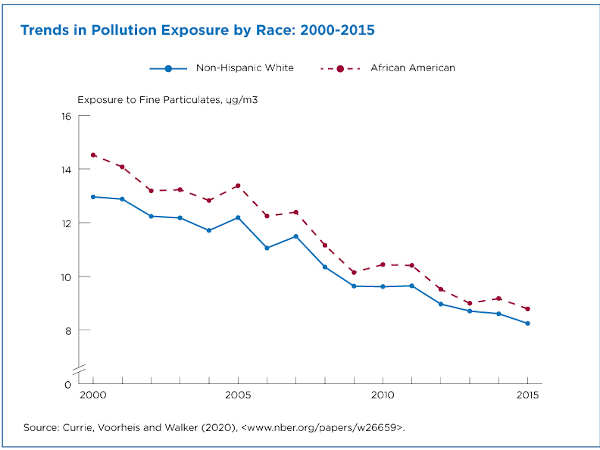
A Census working paper from 2020 shows that African Americans were exposed to higher levels of particulate matter than Whites, although this gap has narrowed in the last two decades.

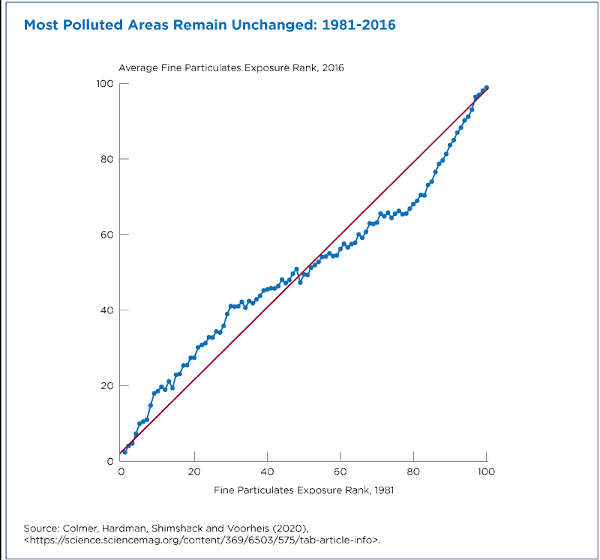
Another paper, recently published in Science, shows that while air quality has improved dramatically since the 1980s, the most polluted neighborhoods in 1981 were still the most polluted 30-40 years later.

Together, these results suggest that disparities in exposure to environmental hazards may be an important driver of differences in economic opportunity. Poor people are exposed to more pollution but pollution also harms the economic well-being of poor people and their children.

Connecting the dots with Census data

Census Bureau data is invaluable in the study of the connections between the environment, population and the economy.

To facilitate the use of this data, researchers in the Center for Economic Studies formed the Environment, Natural disasters and Energy Research Group, or ENERG. The group works to foster new innovative research and disseminate environmental insights produced from Census data with a goal of developing new public-use data products.

The research and statistics show how the environment — air and water pollution, a changing climate, and increasingly damaging natural disasters — affects America’s people and businesses.

An important part of this research is to understand how these effects interact with issues of environmental justice and the disproportionate environmental burden on disadvantaged communities. Answering these questions offers an exciting new opportunity for the Census Bureau.

via Lake County News,California – Exposure to pollution has long-term effect on multiple generations

Posted in Air Quality, Health Effects of Air Pollution, USA, USA & Canada | Tagged , , , , , | Leave a comment

Recent Australian wildfires led to record atmospheric pollution

The 2019–20 wildfires in Australia injected huge amounts of smoke into the stratosphere, which has led to record aerosol levels over the southern hemisphere.

Ilan Koren at the Weizmann Institute of Science in Israel and Eitan Hirsch at the Israel Institute for Biological Research analysed satellite data collected between 1981 and 2020 to look at what effect the devastating bushfire season in Australia had on aerosol concentrations in the stratosphere.

While aerosols in the lower atmosphere have a lifetime measured in minutes to weeks, those that reach the stratosphere can persist there for months or years.

The researchers looked at aerosol optical depth, which measures how much aerosols contribute to the amount of reflected light picked up by satellites.

The aerosol optical depth levels over the southern hemisphere in the early months of 2020 were at record levels: more than three standard deviations higher than the monthly averages prior to the wildfires, and comparable to those caused by a moderately large volcanic eruption.

Although all fires were extinguished by early May, the researchers noted that stratospheric smoke persisted across the southern hemisphere until at least July 2020, after which time it became more difficult to separate the smoke signal from other sources.

The overall effect of aerosols in the stratosphere is one of the largest uncertainties in climate science, says Koren.

In the case of the Australian wildfires, the smoke cooled Earth by blocking some solar radiation, leading to marked cooling over cloud-free ocean areas.

“But [aerosols] can also warm the stratosphere by absorbing part of the radiation [from the sun] and therefore affect processes there,” says Koren.

The intensity and location of the Australian fires were particularly suitable for injecting smoke into the stratosphere. For instance, the fires were far enough south to be located at a relatively high latitude, where the border between the lower atmosphere and the stratosphere is thinner – around 9 kilometres, compared with 18 kilometres over the tropics. “When it is shallow, the deeper clouds can penetrate it more easily and inject smoke to the stratosphere,” says Koren.

If climate change results in more fires at high latitudes in future, such as in southern Australia or the northern part of North America, we can expect these phenomena to become more common, says Koren.

Journal reference: ScienceDOI: 10.1126/science.abe1415

Recent Australian wildfires led to record atmospheric pollution | New Scientist

Posted in Air Quality, Australia & Oceania | Tagged , , , , | Leave a comment

Air pollution breaking WHO limits surrounds 25% of UK homes, study finds

Nearly 8m addresses affected by high levels of toxic particulates and nitrogen dioxide

One in four UK homes are surrounded by air pollution exceeding safety limits set by the World Health Organization, a study has shown following research revealing that road pollution affects virtually every part of Britain.

Nearly 8m UK addresses are affected by high levels of particulate matter or nitrogen dioxide, the study commissioned by campaigning group the Central Office of Public Interest (Copi) showed.

Researchers at Imperial College London used computer models to produce estimated concentrations of the levels of three toxic pollutants – PM (particulate matter) 2.5, PM10 and NO2 – at each address, accurate to 20 sq metres (24 sq yards).

The results have been compiled into a searchable national database, where people can input an address to receive a rating of low, medium, significant, high or very high, with anything above “medium” meaning the address exceeds the limit for a pollutant.

The study follows research revealing that 94% of land in Great Britain has some pollution above background levels, despite roads occupying less than 1% of the country. The University of Exeter study found that the most widespread pollutants are tiny particles, mostly from fossil fuel burning, nitrogen dioxide from diesel vehicles, and noise and light.

More than 70% of the country is affected by all of these, with the only land to escape road pollution being almost entirely at high altitudes, affecting wildlife as well as seriously harming human health. Research indicates that air pollution at up to 500 metres (547 yards) from roads damages human health.

Copi is pushing for legislation to compel estate owners and other property managers to list air pollution levels when advertising properties, having obtained a legal opinion from a QC stating that there is a “strong argument” that estate agents would be in breach of the Consumer Protection from Unfair Trading Regulations 2008 if they failed to inform customers about potential health risks.

The Copi founder, Humphrey Milles, called for transparency around the risks of air pollution: “Air pollution affects everyone. It is a dangerous, invisible killer. With this national rollout, it would be shameful for the property industry to not start acting in an honest, transparent way. Lives depend on it. Everyone has a right to know what they’re breathing.”

Jemima Hartshorn, the founder of the campaign group Mums for Lungs, described the statistics as “shocking”, but said the group was pleased the data was now publicly available.

“We hope it will really help to raise awareness of the high levels of air pollution that are making so many of us sick. We really need to see urgent action on this and foremost we continue to call on the government to commit to reaching WHO levels, at the very latest by 2030 for all major pollutants across the UK,” Hartshorn said.

“We also need to see the government committing real funds to addressing this issue, and providing many more cities with progressive clean air zones. We need to finally address the issue of wood burning that has become the major contributor to particulate matter across the country.”

The UK government is planning a £27bn expansion of England’s road network, but the Guardian reported in February that the transport secretary, Grant Shapps, had overridden official advice from civil servants to review the policy on environmental grounds. It has been a legal requirement to take into account the environmental impact of such projects since 2014.

Dirty air is estimated to cause 40,000 early deaths a year in the UK.

Air pollution breaking WHO limits surrounds 25% of UK homes, study finds | Air pollution | The Guardian

Posted in Air Quality, Europe, Health Effects of Air Pollution, UK | Tagged , , , , , , | Leave a comment

Air pollution: The silent killer called PM2.5

Over half the world’s population lives without the protection of proper air quality standards

Millions of people die prematurely every year from diseases and cancer caused by air pollution. The first line of defence against this carnage is ambient air quality standards. Yet, according to researchers from McGill University, over half of the world’s population lives without the protection of adequate air quality standards.

Air pollution varies greatly in different parts of the world. But what about the primary weapons against it? To find answers, researchers from McGill University set out to investigate global air quality standards in a study published in the Bulletin of the World Health Organization.

The researchers focused on air pollution called PM2.5 – responsible for an estimated 4.2 million premature deaths every year globally. This includes over a million deaths in China, over half a million in India, almost 200,000 in Europe, and over 50,000 in the United States.

“In Canada, about 5,900 people die every year from air pollution, according to estimates from Health Canada. Air pollution kills almost as many Canadians every three years as COVID-19 killed to date,” says co-author Parisa Ariya, a Professor in the Department of Chemistry at McGill University.

Small but deadly

Among the different types of air pollution, PM2.5 kills the most people worldwide. It consists of particles smaller than approximately 2.5 microns – so small that billions of them can fit inside a red blood cell.

“We adopted unprecedented measures to protect people from COVID-19, yet we don’t do enough to avoid the millions of preventable deaths caused by air pollution every year,” says Yevgen Nazarenko, a Research Associate at McGill University who conducted the study with Devendra Pal under the supervision of Professor Ariya.

The researchers found that where there is protection, standards are often much worse than what the World Health Organization considers safe. Many regions with the most air pollution don’t even measure PM2.5 air pollution, like the Middle East. They also found that the weakest air quality standards are often violated, particularly in countries like China and India. In contrast, the strictest standards are often met, in places like Canada and Australia.

Surprisingly, the researchers discovered that high population density is not necessarily a barrier to fighting air pollution successfully. Several jurisdictions with densely populated areas were successful in setting and enforcing strict standards. These included Japan, Taiwan, Singapore, El Salvador, Trinidad and Tobago, and the Dominican Republic.

“Our findings show that more than half of the world urgently needs protection in the form of adequate PM2.5 ambient air quality standards. Putting these standards in place everywhere will save countless lives. And where standards are already in place, they should be harmonized globally,” says Nazarenko.

“Even in developed countries, we must work harder to clean up our air to save hundreds of thousands of lives every year,” he says.

About this study

“Air quality standards for the concentration of particulate matter 2.5, global descriptive analysis” by Yevgen Nazarenko, Devendra Pal, and Parisa Ariya was published in the Bulletin of the World Health Organization.

DOI: http://dx.doi.org/10.2471/BLT.19.245704

Air pollution: The silent killer called PM2.5 | EurekAlert! Science News
Posted in Africa, Air Quality, Asia, Australia & Oceania, Canada, China, Europe, Health Effects of Air Pollution, India, Latin America, Middle East, USA, USA & Canada, World News | Tagged , , , , , , | Leave a comment