Air pollution as severe in villages as in urban India, reveals study

The new study, part-funded by NASA, combined satellite data with modelling to estimate levels of small particulate matter that damage health and lead to early death

Outdoor pollution is not primarily an urban problem and ambient air is as toxic in rural parts of India as in the urban regions, found a new study part-funded by NASA that combined satellite data with modelling to estimate levels of small particulate matter (PM2.5 > 2.5 μm) that damage health and lead to early death.

In the rest of India, the average PM2.5 levels are similar in rural and urban areas, found the study by researchers from the Colorado State University and Indian Institute of Technology Bombay. It found that most people in India (84% of the population) are exposed to pollution well above the limit of India’s standard (40 μg/m3 ), and almost the entire country is exposed to levels higher than the WHO standard (10 μg/m3 ), with “a long tail of very high concentrations (>160 μg/m3 ) in the urban regions in the Indo-Gangetic plains and parts of non-urban areas in eastern and western India”.

Around 16% of India’s population is not affected by this pollution (below 40 μg/m3 ), and that is mostly confined to the very north-western parts of India, the Western Ghats, and a few regions within India. The fraction that is below the WHO standards is very small (<0.001%), said the study, which has implications for air quality monitoring, regulations, public health, and policy. It was published in the journal, Proceedings of the National Academy of Sciences (PNAS) on Tuesday.

“I was a little surprised (with the results), though our previous work was indicating this. We calculated these using satellite data, so no, there are no significant gaps,” said lead author R. Ravishankara, University Distinguished Professor, Departments of Chemistry and Atmospheric Science at Colorado State University, US, in an email.

“Only the very north western part of India appears to be below the threshold for PM2.5. We have used premature mortality as the metric to measure the health impact. In addition to premature mortality, there are other negative impacts such as asthma, hospital visits, medical costs, etc,” said Ravishankaran.

The findings are in line with the State of Global Air 2020 report released in October, which said that India had recorded the highest annual average PM2.5 concentration exposure in the world in 2019, followed by Nepal, Niger, Qatar and Nigeria.

For the PNAS study, researchers calculated the annually averaged aerosol optical depth (AOD) from three satellite instruments (Methods) that were converted to surface PM2.5 abundances using PM2.5:AOD ratios from the GEOSChem chemical transport model. They then compared the satellite-derived daily and annual PM2.5 with the surface PM2.5 measured by India’s Central Pollution Control Board at 20 monitoring sites, most of which were in urban areas.

The annual premature deaths attributable to PM2.5 alone for urban and rural India is 1.05 million, found the study, which factored in six causes of death: ischemic heart disease, stroke, lower respiratory infections, chronic obstructive pulmonary disease, lung cancer, and type-2 diabetes.

Long-term exposure to outdoor and household air pollution contributed to over 1.67 million annual premature deaths from stroke, heart attack, diabetes, lung cancer, chronic lung diseases, and neonatal diseases, in India in 2019 according to State of Global Air Report 2020.

The analysis revealed that the risk of premature deaths attributable to PM2.5 is similar in rural and urban regions, but there were more deaths in rural areas as it is home to 69% of the country’s population.

“We have used premature mortality as the metric to measure the health impact. These are quantified in the paper. In addition to premature mortality, there are other negative impacts such as asthma, hospital visits, medical costs, etc,” said Ravisankaran.

The findings suggest that efforts to monitor and curtail air pollution should not be limited to India’s urban areas. Enhancing monitoring and regulation in rural areas, which are virtually non-existent, could help better assess the risks and inform policy for pan-India reduction of PM2.5 levels keeping in mind the rural populations lower ability to reduce risks because of economic reasons.

“The Global Burden of Disease 2019 shows us that possibly 100% of India is exposed to air that is not meeting the WHO guidelines, and anywhere between 69% to 85% of the population is exposed to air that doesn’t meet the national standard. Now there is a mix of satellite, chemical transport and ground monitor data to prove this. There are studies now showing that 30% to 50% of outdoor air pollution is contributed by household sources of emissions. The health impacts on both rural and urban populations could range from cardio-respiratory, cardiovascular conditions, diabetes, low birthweight, preterm birth and neonatal mortality,” said Kalpana Balakrishnan, the director of the Indian Council of Medical Research Centre for Advanced Research on Air Quality, Climate and Health, Chennai.

“My key message is: Please don’t forget non-urban India when dealing with air pollution. The second key message is: Science, measurements, and analyses can help overcome this problem with good information to the policymakers,” said Ravisankaran.
via https://www.hindustantimes.com/india-news/air-pollution-as-severe-in-villages-as-in-urban-india-reveals-study/story-OvuzR1U64HEE2hsW8sANNM.html

Posted in Air Quality | Tagged , , , | Leave a comment

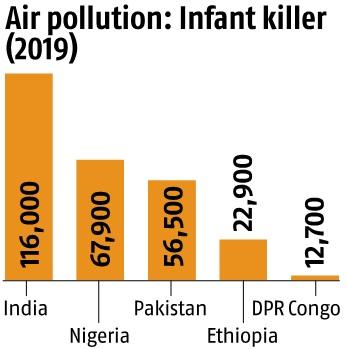
116,000 infants killed within months due to air pollution in India: Study

Particulate matter 30 times finer than human hair that enters the bloodstream and causes severe health risks

Air pollution killed around 116,000 infants in India within the first month of being born, found a new global study on air pollution’s burden on health worldwide.

More than half the infant deaths were due to PM 2.5 (particulate matter 30 times finer than human hair that enters the bloodstream and causes severe health risks) in outdoor air and the rest were linked to household air pollution due to use of solid fuels, such as charcoal, wood, and animal dung for cooking, found the State of Global Air 2020 report (SoGA 2020) released on October 21. The report published by the US-based think-tank, Health Effects Institute, claims to be the first-ever comprehensive analysis of air pollution’s global impact on newborns.

Among the youngest infants, most deaths were related to complications from low birth weight and premature birth — direct outcomes of mothers’ exposure to air pollution during pregnancy, found the study. Babies born with a low birth weight are more susceptible to childhood infections and pneumonia. The lungs of pre-term babies can also not be fully developed.

“By limiting the growth and development of babies and children, air pollution lowers their lifelong health and productivity,” said Dean Spears, founding executive director, Research Institute for Compassionate Economics (r.i.c.e.). “Yet, the consequences of air pollution for children do not get the attention that they deserve.” Spears has spent years studying the impact of air pollution on children in India.

Children’s early-life health directly impacts their adult economic productivity and the harm done to children makes air pollution such an economic cost that addressing the problem could be an economic policy that pays for itself, said Spears. His research found children born in places and times when the air pollution was especially bad grew up to be not as tall as children born in less-polluted times in the same locality.

“This newest evidence suggests an especially high risk for infants born in South Asia and sub-Saharan Africa,” said Dan Greenbaum, president, Health Effects Institute, on October 21.

116,000 infants killed within months due to air pollution in India: Study | Business Standard News

Posted in Air Quality, Asia, India | Tagged , , , | Leave a comment

Bucharest, Sofia, Zagreb among 24 cities with EU’s highest air pollution costs

Bucharest, Sofia, and Zagreb are on the list of the 24 cities with the highest total damage from air pollution, according to a study conducted by SE Delft on health-related social costs in 432 cities in the European Union, United Kingdom, Norway and Switzerland.

In total, over 130 million people live in the places covered in the 30 countries, with an average of 301,754 inhabitants per city. In 2018, total social costs for all 432 cities surpassed EUR 166 billion. The average cost per city is over EUR 385 million, the study finds.

Social costs are costs affecting welfare and comprise both direct health care expenditures and indirect health impacts

Social costs affect welfare and they comprise both direct health care expenditures (e.g. for hospital admissions) and indirect health impacts (e.g. diseases such as chronic obstructive pulmonary disease, or reduced life expectancy due to air pollution). They affect welfare because people have a clear preference for healthy life years in a good and clean environment.

Air pollution in cities stems from transport activities, household heating and a range of other activities including agriculture and industry. The study focused on the role of transport in explaining the social costs.

A 1% increase in the average journey time to work increases the social costs of PM10 emissions by 0.29% and those of NO2 emissions by 0.54%. A 1% increase in the number of cars in a city increases overall social costs by almost 0.5%, the Health costs of air pollution in European cities and the linkage with transport study reads.

Every inhabitant of a European city suffered a welfare loss of over EUR 1,250 a year on average

In 2018, every inhabitant of a European city suffered an average welfare loss of over EUR 1,250 a year owing to direct and indirect health losses associated with poor air quality. It is equivalent to 3.9% of income earned in cities.

There is a substantial spread between the figures among cities. In the Romanian capital Bucharest, total welfare loss amounts to over EUR 3,000 per capita/year, while in Santa Cruz de Tenerife in Spain it is under EUR 400.

In Bulgaria, Romania and Poland, health-related social costs are between 8% and 10% of income earned

In many cities in Bulgaria, Romania and Poland, health-related social costs are 8% to 10% of income earned. Most relate to premature mortality: for the 432 cities investigated, the average contribution of mortality to total social costs is 76.1%.

Bucharest, Sofia, Zagreb among 24 cities with EU’s highest air pollution costs
Posted in Air Quality, Europe | Tagged , , , , , , , , | Leave a comment

New study links air pollution to 15 percent of COVID-19 deaths

Researchers say deaths linked to COVID-19 and air pollution represents ‘potentially avoidable, excess mortality’.

Long-term exposure to air pollution may be linked to 15 percent of COVID-19 deaths globally, according to a new study.

Published in the journal Cardiovascular Research on Tuesday, the research from German and Cypriot experts analysed health and disease data from the United States and China relating to air pollution, COVID-19 and SARS – a respiratory illness similar to the new coronavirus disease.

The authors combined this with satellite data of global exposure to particulate matter – microscopic particles – as well as ground-based pollution monitoring networks, to calculate the extent to which air pollution could be blamed for COVID-19 deaths.

In East Asia, which has some of the highest levels of harmful pollution on the planet, the authors found that 27 percent of COVID-19 deaths could be attributed to the health effects of poor air quality.

The proportion was 19 percent in Europe, and 17 percent in North America.

The authors said the deaths linked to COVID-19 and air pollution represented a “potentially avoidable, excess mortality” and that exposure to particulate matter in air likely aggravated “co-morbidities that lead to fatal outcomes” of infection by SARS-CoV-2, the virus that causes COVID-19.

“If both long-term exposure to air pollution and infection with the COVID-19 virus come together then we have an adverse effect on health, particularly with respect to the heart and blood vessels,” said the paper’s co-author Thomas Munzel.

He said that air pollution made known COVID-19 risk factors such as lung and heart problems more likely. Specifically, the team noted that particulate matter appeared to increase the activity of a receptor on lung cell surfaces, ACE-2, which is known to be involved in the way COVID-19 infects patients.

“So, we have a double hit: air pollution damages the lungs and increases the activity of ACE-2, which in turn leads to enhanced uptake of the virus,” said Munzel, a professor at the University Medical Center of the Johannes Gutenberg University, Mainz.

‘Reduce emissions’

The authors stressed that attributing COVID-19 deaths to air pollution did not mean that pollution itself was killing people with the disease, although they did not rule out such a cause-effect linkage.

Jos Lelieveld, of the Max Planck Institute for Chemistry, told the AFP news agency that the research suggested “the pollution particles are a co-factor in aggravating the disease”.

He said their estimates suggested that more than 6,100 coronavirus deaths in the United Kingdom could be attributed to air pollution. In the US that figure is approximately 40,000.

More than 1.1 million people worldwide have died from COVID-19 since the start of the pandemic, according to data from the Johns Hopkins University.

The authors said that without a fundamental change in how cities power themselves, including a transition to clean and renewable energy sources, air pollution would continue to kill huge numbers of people even after the pandemic recedes.

“The pandemic ends with the vaccination of the population or with herd immunity through extensive infection of the population,” they wrote.

“However, there are no vaccines against poor air quality and climate change. The remedy is to mitigate emissions.”

New study links air pollution to 15 percent of COVID-19 deaths | China | Al Jazeera
Posted in Air Quality, Health Effects of Air Pollution, Medical Studies | Tagged , , , | Leave a comment

Small increases in air pollution linked to rise in depression, finds study

Exclusive: Cutting pollution levels may help to reduce rates of mental health problems, say scientists

Small increases in people’s exposure to air pollution are linked to significant rises in depression and anxiety, according to the first such study of UK adults.

The researchers found that an incremental increase in nitrogen dioxide, largely produced by diesel vehicles, heightened the risk of common mental disorders by 39%. For tiny particle pollution, which comes from burning fuels, and brake and tyre dust, the risk rose by 18%.

The scientists also found that people living in places with higher levels of particle pollution were twice as likely to experience mental health problems as those in the least polluted areas. The researchers acknowledged that other factors were important for mental health, such as genetics and childhood experiences, but added that, unlike these, air pollution could be prevented.

The study followed more than 1,000 adults in south-east London over five years, but the results are relevant for cities and towns across the world. In the UK, almost every urban area has particle pollution levels above the World Health Organization guidelines, and around the globe 90% of people breathe dirty air.

“Air pollution is not the only factor that may have an impact on the presence of mental disorders, but it is a preventable one,” said Dr Ioannis Bakolis, a lecturer at King’s College London who led the research. “Introducing measures to reduce air pollution may represent a rare and potentially impactful primary health measure for the prevention of psychiatric disorders.”

Dr Ian Mudway, a lecturer at Imperial College London and part of the research team, said rates of mental health disorders were known to be higher in urban areas, with suggested causes including deprivation and lack of green space. “But the amazing thing with this study is that when you control for all of those other features of the urban environment and socioeconomic factors, the air pollution signal remains. It’s a very robust finding,” he added.

The World Bank has estimated that air pollution costs the global economy $5tn (£3.8tn) a year but this includes only the well-known damages caused to heart and lungs by dirty air.

“There is now an increasing body of evidence suggesting air pollution isn’t great for the brain either,” Mudway said. “We may actually have been underplaying the adverse effects of air pollution on our health from cradle to grave.”

Recent research has linked dirty air to increased suicides and indicated that growing up in polluted places increases the risk of mental disorders. Other research found that air pollution causes a “huge” reduction in intelligence and is linked to dementia. A global review in 2019 concluded that air pollution may be damaging every organ in the human body.

The Bakolis-led research is published in the journal Social Psychiatry and Psychiatric Epidemiology, and used standard questionnaires to assess the mental health of people in the London boroughs of Southwark and Lambeth over five years. It used data on individuals to take into account factors including age, socioeconomic status, neighbourhood deprivation, and frequency of drinking, smoking and exercise.

The research improved on previous work by estimating air pollution levels every 20 metres across the area, meaning homes on busy roads could be distinguished from those on back streets. The study also took account of noise levels, which can be hard to separate from air pollution because traffic influences both.

The average NO2 levels in the boroughs varied from 24 to 83 micrograms per cubic metre (µg/m³), but the study found a rise in exposure of just 3 units increased the risk of common mental disorders by 39%. Small particle pollution ranged from 9 to 23 µg/m³ and a 5-unit increase led to the risk of mental health problems rising by 18%.

Epidemiological studies cannot prove a causal link between air pollution and mental health problems and scientists cannot experiment on people. But a broad range of psychiatric conditions have been linked to inflammation in the body , including the brain, and recent work has shown tiny air pollution particles lodged in the brain are associated with molecular damage.

The latest study is important, and accounted for a long list of other factors that may affect mental health, said Prof Antonio Gasparini, at the London School of Hygiene and Tropical Medicine. But he said the broad definition of mental health used mad it difficult to assess potential causal links. “More studies are needed before offering [health] recommendations,” he added.

Prof Anna Hansell, at the University of Leicester, said the research was interesting and carefully conducted. She also said more studies using different statistical techniques were needed to confirm the findings.

“However, there are already urgent grounds to reduce air pollution due to its association with chronic disease and premature deaths,” Hansell said. She added that regular exercise, even in polluted places, benefits mental and physical health.

“People should act, not only worry,” said Bakolis. The evidence of air pollution’s harm was now strong enough that people should ask their elected representatives for more action, he added.

Mudway, who is raising a young family in central London, said he walked as much as possible and chooses less polluted routes.

Small increases in air pollution linked to rise in depression, finds study | Environment | The Guardian
Posted in Air Quality, Health Effects of Air Pollution, Medical Studies | Tagged , , , , | Leave a comment

Straw burning worsens Hanoi air pollution

Hanoi farmers burning straw in suburban areas after harvesting has continued worsening the air pollution in the capital.

The roads in My Dinh urban area and Thang Long Avenue or Tran Duy Hung and Pham Hung streets are often covered in smoke and the smell of burning straw. The farmers in Quoc Oai and Thach That districts also burn straw en mass to prepare for new crops.

Since the smoke covers Thang Long Avenue, it also threatens the traffic safety. Moreover, inhaling too much carbon monoxide from straw burning can cause adverse reactions such as breathing difficulties and coughing. It can also lead to many lung illnesses, including lung infections.

“The straw is burnt before the tractors are used. We often burn fresh straw to prepare the land for new crops and the fresher the straw is the more smoke there will be,” said farmer Nguyen Van Ly in Quoc Oai District.

Many farmers believe that the burnt straw will bring much nutrition to the fields. They often burn straw in the early morning.

Straw burning worsens Hanoi air pollution
Posted in Air Quality, Asia, Vietnam, World News | Tagged , , | Leave a comment

Significant link found between air pollution and neurological disorders

Air pollution was significantly associated with an increased risk of hospital admissions for several neurological disorders, including Parkinson’s disease, Alzheimer’s disease, and other dementias, in a long-term study of more than 63 million older U.S. adults, led by researchers at Harvard T.H. Chan School of Public Health.

The study, conducted with colleagues at Emory University’s Rollins School of Public Health and Columbia University’s Mailman School of Public Health, is the first nationwide analysis of the link between fine particulate (PM2.5) pollution and neurodegenerative diseases in the U.S. The researchers leveraged an unparalleled amount of data compared to any previous study of air pollution and neurological disorders.

The study was published online October 19, 2020 in The Lancet Planetary Health.

“The 2020 report of the Lancet Commission on dementia prevention, intervention, and care has added air pollution as one of the modifiable risk factors for these outcomes,” said Xiao Wu, doctoral student in biostatistics at Harvard Chan School and co-lead author of the study. “Our study builds on the small but emerging evidence base indicating that long-term PM2.5 exposures are linked to an increased risk of neurological health deterioration, even at PM2.5 concentrations well below the current national standards.”

Researchers looked at 17 years’ worth (2000–2016) of hospital admissions data from 63,038,019 Medicare recipients in the U.S. and linked these with estimated PM2.5 concentrations by zip code. Taking into account potential confounding factors like socioeconomic status, they found that, for each 5 microgram per cubic meter of air (μg/m3) increase in annual PM2.5 concentrations, there was a 13% increased risk for first-time hospital admissions both for Parkinson’s disease and for Alzheimer’s disease and related dementias. This risk remained elevated even below supposedly safe levels of PM2.5 exposure, which, according to current U.S. Environmental Protection Agency standards, is an annual average of 12 μg/m3 or less.

Women, white people, and urban populations were particularly susceptible, the study found. The highest risk for first-time Parkinson’s disease hospital admissions was among older adults in the northeastern U.S. For first-time Alzheimer’s disease and related dementias hospital admissions, older adults in the Midwest faced the highest risk.

“Our U.S.-wide study shows that the current standards are not protecting the aging American population enough, highlighting the need for stricter standards and policies that help further reduce PM2.5 concentrations and improve air quality overall,” said Antonella Zanobetti, principal research scientist in Harvard Chan School’s Department of Environmental Health and co-senior author of the study.

Liuhua Shi, research assistant professor at Emory’s Rollins School of Public Health, was a co-lead author and Marianthi-Anna Kioumourtzoglou, assistant professor in environmental health sciences at Columbia’s Mailman School of Public Health, was a co-senior author.

Other Harvard Chan School authors included Mahdieh Danesh Yazdi, Danielle Braun, Yaguang Wei, Yun Wang, Joel Schwartz, and Francesca Dominici.

This study was supported by the Health Effects Institute (4953-RFA14-3/16-4), the National Institute of Environmental Health Sciences (NIEHS R01 ES024332, R01 ES028805, R21 ES028472, P30 ES009089, P30 ES000002), the National Institute on Aging (NIA/NIH R01 AG066793-01, P50 AG025688), and the HERCULES Center (P30ES019776). Research described in this article was done under contract to the Health Effects Institute, an organization jointly funded by the U.S. Environmental Protection Agency (assistance award number R-83467701) and some motor vehicle and engine manufacturers.

“Long-term effects of PM2.5 on neurological disorders in the American Medicare population: a longitudinal cohort study,” Liuhua Shi, Xiao Wu, Mahdieh Danesh Yazdi, Danielle Braun, Yara Abu Awad, Yaguang Wei, Pengfei Liu, Qian Di, Yun Wang, Joel Schwartz, Francesca Dominici, Marianthi-Anna Kioumourtzoglou, Antonella Zanobetti, The Lancet Planetary Health, online October 19, 2020, doi: https://doi.org/10.1016/S2542-5196(20)30227-8

Significant link found between air pollution and neurological disorders | News | Harvard T.H. Chan School of Public Health
Posted in Air Quality, Health Effects of Air Pollution, Medical Studies | Tagged , , , , , , | Leave a comment

Delhi air pollution: Health experts witness 15 percent rise in Asthma cases as air quality degrades

Health experts have been witnessing an almost 15 per cent rise in the number of Chronic Obstructive Pulmonary Disease (COPD) or Asthma patients for the past 10 days as air quality started aggravating from moderate to poor to very poor in the national capital and nearby regions.

“We are seeing a rise in COPD / Asthma patients to the tune of 15 per cent over the last 10 days. The rise of the PM 2.5 level is clearly linked to increased problems with lung health. We have also seen a new diagnosis of Asthma and other pollution-related lung diseases being on the rise,” said Dr Arunesh Kumar, Head, Respiratory Medicine (Pulmonology) at Paras Hospital.

With the winter approaching fast and estimations of the SARS-COV2 transmitting capacity getting increased in the cold weather, health experts have urged people to take extra precaution as respiratory diseases tend to worsen with a dip in temperature and rise in pollution level.

“Most of the chronic respiratory diseases like Asthma, COPD tend to get worse with lower temperature and rise in pollution. Patients see their symptoms like cough and breathlessness worsening with the start of winter. Key to this is the compliance of treatment and avoiding pollutants,” the doctor added.

Following the ongoing COVID-19 condition, experts are also trying every medium to make people aware of the necessity to mandatorily wear masks and stick to coronavirus appropriate behaviour. Also, several measures have been adopted by government and pollution watchdogs such as banning the use of diesel generators, restricting industrial and local pollutants, deploying 50 teams for strict vigilance, among others in an effort to curtail the deterioration in air pollution index.

Dr Swapneil Parikh, an internist and clinical researcher said, “Patients with Asthma and COPD do experience exacerbations in winter. Changes in temperature and humidity contribute to seasonal infections. Further, air pollution is also a major threat.” “During winters, the air temperature decreases causing a phenomenon called winter inversion where a dense layer of air traps pollutants lower in the atmosphere. This increases respiratory exposure to particulates and can worsen respiratory ailments,” Parikh added.

Terming air pollution a major threat for respiratory illness, the doctor also said that “increase in the number of vehicles and other sources of emissions also contribute to it.” According to the India Meteorological Department (IMD), if the impact of large scale parameter is to be considered there are weak La Nina conditions this year, however, the department has not issued any official forecast on winter as of yet.

During La Nina years usually, the temperature in the northern parts of the country can dip further south, leading to relatively colder winters.

Delhi air pollution: Health experts witness 15 percent rise in Asthma cases as air quality degrades
Posted in Air Quality, Asia, India | Tagged , , , , | Leave a comment