Tens of thousands of deaths linked to weak US air pollution rules – study

Researchers linked nine causes of death with a certain type pollution when reviewing medical records of deceased veterans

US air pollution rules could be hugely insufficient in preventing deaths, experts are concluding from a new study of the likely causes of death of 4.5 million veterans.

Published in the peer-reviewed journal Jama, the research finds that 99% of deaths from illnesses linked to a certain type of air pollution occur in people who are exposed to lower levels than the Environmental Protection Agency (EPA) currently deems acceptable.

But Donald Trump’s EPA could be set to maintain the current standard – thus leading to continued air pollution-associated deaths. The agency is also reconsidering the established science linking particle pollution from fossil fuels and other sources with a host of illnesses.

About 200,000 Americans are thought to die from air pollution each year, but scientists previously couldn’t pinpoint the specific causes of death for almost half of those people.

The new research reviewed the medical records of veterans who died and compared them with the air pollution levels in their zip codes. They focused on PM 2.5, or inhalable particulate matter pollution that is 2.5 micrometers or smaller – a fraction of the width of a human hair.

They linked nine causes of death with the pollution: cardiovascular disease, cerebrovascular disease, chronic kidney disease, chronic obstructive pulmonary disease, dementia, type 2 diabetes, hypertension, lung cancer and pneumonia.

Three of those conditions were newly identified associations: chronic kidney disease, hypertension and dementia.

Miles Keogh, the executive director of a group that represents state and local air regulators, said: “We know people are harmed from exposure levels lower than the [current standards].

“The question is whether the trade-offs for society are worth it. If only a few people are harmed, maybe society accepts the risk,” Keogh said. “But when a study shows 99% of death occurring at exposure levels below that threshold, that should make us look much harder at whether the threshold protects people effectively enough.”

Because scientists cannot ethically expose subjects to air pollution and test the results, they must rely on existing epidemiological data. Veterans offered a massive source of detailed records held by the federal government.

“The skeptics will always tell you this is correlation and correlation is not causation, but in environmental epidemiology, that’s really the best you could do,” said co-author Dr Ziyad Al-Aly, who directs the clinical epidemiology center at Washington University in St Louis and is chief of research at Veterans Affairs St Louis Health Care System.

Al-Aly explained that researchers examining only death records could only see “the tip of the iceberg”. His team reviewed the illnesses people struggled with before death to get a clearer picture of their overall health.

The research also confirmed striking inequities in how air pollution hurts black Americans more than white Americans. Black Americans were more likely to be exposed to higher levels of PM 2.5. But they also got sicker than white people even when they were breathing the same air. That could be because of socio-economic factors, such as poverty and access to healthcare.

“I went into it thinking pollution is color blind … it turns out to be it’s not true,” Al-Aly said. “Actually, pollution itself does discriminate. For the same level of pollution, black people tend to be affected more. And on top of that, black people get exposed to more pollution than white people.

“It’s kind of like a double-whammy,” he said. “It’s really unfair.”

New research is consistently revealing broad health threats from air pollution. Another study published on Wednesday in Brain further confirmed the links between air pollution and cognitive problems. Women in their 70s and 80s who were exposed to higher levels of air pollution experienced greater declines in memory and more Alzheimer’s-like brain atrophy, according to researchers at the University of South Carolina.

“This is the first study to really show, in a statistical model, that air pollution was associated with changes in people’s brains and that those changes were then connected with declines in memory performance,” said Andrew Petkus, an assistant professor of clinical neurology.

via Tens of thousands of deaths linked to weak US air pollution rules – study | Environment | The Guardian

Posted in Air Quality, Health Effects of Air Pollution, USA, USA & Canada | Tagged , , , , , | Leave a comment

Australia fires: Sydney blanketed by smoke from NSW bushfires

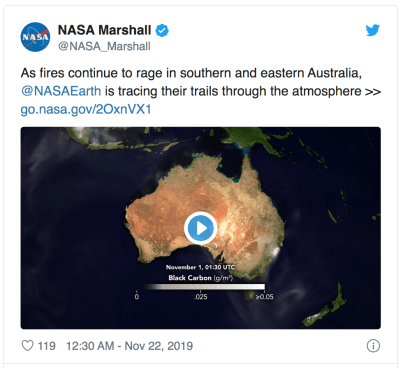
People in Sydney woke up to a city shrouded in smoke on Tuesday, as scores of bushfires rage across the region.

Strong winds overnight brought smoke from fires inland, pushing the air quality in Australia’s largest city to beyond “hazardous” levels at times.

On social media, locals have described hazy skies and the stench of smoke in their homes.

About five million people live in the state capital of New South Wales, which has been affected for weeks by fires.

Six people have died in bushfires in the state’s north since October.

Sydney residents were warned about severe fire danger on Tuesday, as temperatures soared to 37C (98.6F) in the city’s west.

Parts of the city recorded air pollution levels at eight times higher than the national benchmark.

Health officials advised people to stay indoors and avoid physical activity. They also shared first aid guides on how to help asthma sufferers and others with respiratory problems.

“The smoke is likely to hang around for the next few days,” warned the New South Wales Rural Fire Service.

Screen Shot 2019-11-20 at 08.36.24.png

Last week, Sydney faced unprecedented bushfire danger when blazes hit its suburbs and parts of its outskirts.

Authorities said the source of the smoke on Tuesday came from a blaze in Wollemi National Park, 150km (93 miles) north-west of the city, which had grown to 150,000 hectares in size.

What’s happening with the fires now?

Close to 50 bushfires continue to burn in populated coastal and inland regions to the city’s north. Authorities say 468 homes have been destroyed since blazes flared up on 8 November.

Four people were confirmed to have died in the fires since then: Vivian Chaplain, 69, Julie Fletcher, 63, Barry Parsons, 58, and George Nole, whose age is unknown. They were found in separate locations in rural NSW.

A couple, Bob Lindsey, 77, and Gwen Hyde, 68, were killed in a bushfire in the same regions in October.

Many of the affected areas have experienced thick smoke and extremely poor air quality for weeks.

Officials have warned that blazes could escalate later this week when heatwave conditions reach New South Wales and neighbouring Queensland, where scores of fires are burning.

Meanwhile, a “catastrophic” fire danger warning has been issued for parts of South Australia. The state capital, Adelaide, is forecast to reach 42C on Wednesday.

via Australia fires: Sydney blanketed by smoke from NSW bushfires – BBC News

Posted in Air Quality, Australia & Oceania | Tagged , , , , , | Leave a comment

Air pollution kills five people in Bristol each week, study shows

Toxic air contributes to health conditions such as asthma, cancer and stroke, say experts

Five people die each week in Bristol as a result of high levels of air pollution, a study has revealed.

Researchers at King’s College London examined the combined impact of PM2.5, which is mainly from domestic wood and coal burning and industrial combustion and nitrogen dioxide, which mainly comes from older polluting vehicles.

The fine particulates and nitrogen dioxide that pollute Bristol’s air cause about 260 people to die each year, the scientists calculated. These pollutants could cause up to 36,000 deaths across the UK each year, and also contribute to several health conditions including asthma, lung cancer, heart disease, stroke and diabetes.

This is the first time that new government guidance on “mortality burdens” of air pollution developed by a government advisory committee have been applied to the largest city in the south-west.

Bristol had higher levels of PM2.5 pollution than Liverpool and Greater Manchester, the study found, but a lower death rate – partly because it is less densely populated.

The research revealed that a child born in 2011 could die up to six months early if exposed over their lifetime to air pollution in the city.

The study was published as the Bristol mayor hosts an air pollution summit on Monday.

This month the city announced radical plans to address air pollution, including a proposal to ban diesel cars from central areas between 7am and 3pm from 2021. The plans are subject to government approval and consultation with residents and businesses.

The study found the annual cost of the health impact of air pollution in Bristol was up to £170m a year.

Public Health England assessed in a 2018 report that the total national cost to the NHS and social care budgets of air pollution could be up to £5.56bn for PM2.5 and NO2 combined.

Marvin Rees, the Bristol mayor, said: “We have a moral, ecological and legal duty to clean up the air we breathe. This research emphasises how vital it is that we act quickly to improve health and save lives in Bristol.”

David Dajnak, the principal air-quality scientist in the environmental research group at King’s College London, said: “This report shows that more needs to be done to address the level of threat air pollution poses to health in Bristol.

“It highlights that the highest level of air pollution in Bristol coincides with zones of exceptional population growth and areas having the highest black and minority ethnic population.”

Bristol is one of several areas in the UK with illegal levels of air pollution. The most recent government data submitted to the EU revealed that 83% of reporting zones in the UK had illegal levels.

via Air pollution kills five people in Bristol each week, study shows | Environment | The Guardian

Posted in Air Quality, Europe, UK | Tagged , , , , , , | Leave a comment

New Delhi schools closed as air pollution worsens

The air quality in New Delhi was rated as “severe” for the third day in a row. A thick gray haze covers the city, making travel and outdoor activities both dangerous and difficult.

Schools in New Delhi shut on Thursday after the air quality was rated as “severe” for the third consecutive day.

“Keeping in mind the hazardous exposure to children … all schools must remain shut for the next two days,” Bhure Lal, the chairman of the Environmental Pollution Prevention and Control Agency, said in a letter to the city government of Delhi and to its neighboring states.

The Central Pollution Control Board said that the air quality index was 472, nine times the level recommended by the World Health Organization. The maximum possible rating is 500.

Running through the smog

Air pollution in northern India peaks in the winter due to smoke from agricultural fires. The smoke from fields mixes with vehicle emissions and construction dust, making it the world’s most polluted capital.

The smog was not enough to put off the more than 1,000 children participating in a race on Thursday morning. The annual “Run for Children” event is organized by a not for profit group called Prayas. Asian news network ANI reported on the run.

“The children did not run a long distance. It was a short run,” said Prayas’ general secretary, Amod K. Kanth.

Kanth has received criticism for allowing the run to go ahead in such conditions.

via New Delhi schools closed as air pollution worsens | News | DW | 14.11.2019

Posted in Air Quality, Asia, India | Tagged , , | Leave a comment

Air pollution from traffic linked to brain cancer for first time

We bike down the West Side Highway, run along Fifth Avenue and do yoga on rooftops, all to improve our well-being — but what if we’re doing so at the expense of our long-term health?

A new study from researchers at McGill University in Canada has linked airborne nanoparticles produced by motor traffic to brain cancer for the first time ever. Published in the journal Epidemiology, the findings show that a one-year increase in pollution exposure raised the risk of brain cancer by more than 10 percent.

Scott Weichenthal, the researcher at McGill who led the study, tells the Guardian that he avoids “heavily polluted streets” when exercising outdoors.

“At an individual level, it is always a good idea to reduce your exposure to pollutants,” he says. “But the more important actions are at a regulatory level, where you can take action that reduces everyone’s exposure — that is where the real benefits come in.”

The researchers looked at the pollution-exposure levels and the medical records of 1.9 million Canadian adults from 1991 to 2016 and found a “consistent” link between brain cancer and the pollution nanoparticles emitted by combustion cars. Researchers took into account other cancer-causing factors such as obesity levels and whether or not people were smokers. However, despite the alarming and consistent data, because it is the first study of its kind, Weichenthal said more studies are needed to replicate the findings.

A global review of air pollution’s effects on the human body, published in February in the journal Chest, found that air pollution can negatively affect virtually “every organ in the body.”

But don’t worry: We don’t need to bring mini air purifiers with us everywhere just yet.

Researchers at Columbia University found that in New York, an estimated 5,660 lives were saved by lower air-pollution levels in 2012 compared to 2002 levels, according to a study published in August in Environmental Research Letters.

Best bet? Move your run into a big park — like Central or Prospect — before the snow starts to fall.

via Air pollution from traffic linked to brain cancer for first time

Posted in Air Quality, Canada, Health Effects of Air Pollution, Medical Studies, USA & Canada, World News | Tagged , , , , | Leave a comment

Tehran Schools Close Over Choking Smog

Air Quality Index in Tehran on Tuesday hovered around 130, above the threshold of “unhealthy for sensitive groups”, which has pushed authorities to take a further drastic measure to curb the smog.

Based on a number of polluting factors, the index categorizes conditions into good (0-50), moderate (51-100), unhealthy for sensitive groups (101-150), unhealthy (151-200), very unhealthy (201-300) and hazardous (301-500).

The index has breached the 100 threshold and in many areas in Tehran, toxic pollutants topped 150.

Tehran Governor General Anoushirvan Mohseni Bandpay told ISNA on Tuesday that primary schools and kindergartens are to close on Wednesday in Tehran, Shahr-e-Rey, Pakdasht, Pishva, Varamin and Qarchak.

The density of toxic pollutants has been steadily increasing since the beginning of the current Iranian month (Oct. 23), reaching levels considered dangerous for vulnerable citizens, including children, the elderly, pregnant women and those with respiratory and cardiovascular problems, who are categorized in the group of sensitive people.

To encourage private vehicle users to switch to public transport, Mohammad Taqizadeh, the head of Air Pollution Emergency Committee, said bus and subway fares in the metropolis has been slashed by half until further notice.

When air pollution hits an emergency level, representatives from Tehran City Council, Traffic Police, Tehran Municipality, Tehran Governorate and Department of Environment, along with those of interior and health ministries, convene the committee to tackle the phenomenon.

He also announced that to reduce traffic in the central parts of the capital, charges paid by cars entering the zone demarcated by the Air Pollution Control scheme have been increased by 50%.

As per the scheme, each vehicle can enter a “restricted zone” in central Tehran for free for a maximum of 20 days each season, or 80 days a year. If motorists wish to enter the zone more than the number of times allowed in the plan, they need to pay a traffic toll fee.

Spread over 88.5 square kilometers in central Tehran, the zone is bounded by Imam Ali Expressway in the east, Navvab Expressway and Chamran Highway to the west, Besat Expressway in the south and Hemmat Expressway in the north.

Vehicles are barred from entering the area between 6:30 a.m. and 7 p.m. on all days, except Fridays and national holidays. On Thursdays, the time limit is between 6:30 a.m. and 1 p.m.

Authorities have encouraged Tehran residents to avoid outdoor physical exercises, as the sprawling city experienced its eighth consecutive day of dangerously high air pollution levels.

via Tehran Schools Close Over Choking Smog | Financial Tribune

Posted in Air Quality, Iran, Middle East | Tagged , , | Leave a comment

Hazardous air quality warning as smoke from bushfires spreads across NSW and Queensland

Hazardous air quality warning as smoke from bushfires spreads across NSW and Queensland

Residents in Sydney and other parts of the east coast advised to stay indoors where possible to avoid air pollution

Much of Sydney and the Hunter regions of New South Wales have been advised to “stay inside as much as possible” on Tuesday, as winds pushing smoke from the devastating mid-north coast bushfires down the state’s east coast lead to “hazardous” air quality conditions.

Air quality in south-east Queensland has also plunged this week, with people urged to limit their time outdoors.

With NSW in the grip of a “catastrophic” fire danger warning, much of Sydney and the Hunter woke to hazardous air quality conditions on Tuesday, while in Brisbane a thick cloud of smoke also enveloped the city.

Data published by the NSW environment department showed the Illawarra region south of Sydney, also subject to the catastrophic fire warning, was also experiencing “poor” air quality.

The environment department warned people to stay inside as much as possible and avoid outdoor exertion.

“Everyone, especially people with heart or lung disease, should avoid outdoor exertion and stay inside as much as possible,” the department advised.

“Everyone should reduce prolonged or heavy exertion.”

The Bureau of Meteorology warned that hot, dry and gusty winds would generate “very dangerous fire conditions across large parts” of NSW on Tuesday.

Gabrielle Woodhouse, a forecaster with the bureau, said the “huge amount of ongoing fire” in the state’s north was pushing smoke down the coast.

She said that with the wind expected to pick up later in the afternoon, air quality was expected to worsen.

“With the wind picking up and the hot and dry conditions, those fires will likely take off again this afternoon so there could be a lot more smoke,” she said.

The weather bureau is forecasting a powerful southerly change to hit Sydney at about 7pm. While it will bring relief through cooler temperatures, it also poses a risk because fires burning near the coast would change direction.

“We’ve issued a severe weather warning for damaging winds around the Snowy Mountains and southern tablelands, that wind has just turned the corner around Eden [in the state’s south] and will move quite quickly along the coast this evening,” Woodhouse said.

“We could have gale-force winds with gusts above 90km per hour.”

On Tuesday the Rural Fire Service commissioner, Shane Fitzsimmons, said winds would begin strengthening from mid-morning.

“Now is the time to exercise those decisions to leave, leave early and go to safer locations, safer towns or safer places in your community such as shopping centres,” he said.

While there were no new fires of concern in the catastrophic fire danger areas, he said the fires burning in the northern parts of the state were increasing in activity.

“And we’re getting reports of some fire spread particularly in the fires further up in the northern areas of NSW,” he said. “There’s been a number of tactical backburning operations.”

The Queensland premier, Annastacia Palaszczuk, said employers must consider the health of outdoor workers, with smoke from the fires reducing air quality to “very poor” in major centres, including Brisbane and on the Gold Coast.

Across NSW more than 575 schools were closed on Tuesday after the state premier, Gladys Berejiklian, declared a week-long state of emergency in the wake of devastating fires on the NSW mid-north coast in which three people died and at least 150 homes were destroyed.

via Hazardous air quality warning as smoke from bushfires spreads across NSW and Queensland | Australia news | The Guardian

Posted in Air Quality, Australia & Oceania | Tagged , , , , , , , | Leave a comment

Aviation emissions’ impacts on air quality larger than on climate, study finds

New research from the Massachusetts Institute of Technology (MIT) has quantified the climate and air quality impacts of aviation, broken down by emission type, altitude and location.

The MIT team found that growth in aviation causes twice as much damage to air quality as to the climate.

Writing today in IOP Publishing’s Environmental Research Letters, they examine how this damage can be mitigated, and provide consistent comparative assessments of aviation emissions trade-offs, considering both climate and air quality impacts.

The lead researcher on the study, Dr Sebastian Eastham, from the Laboratory for Aviation and the Environment in MIT’s Department of Aeronautics and Astronautics, said: “Aviation emissions are an increasingly significant contributor to anthropogenic climate change. They cause five per cent of global climate forcing.

“When you consider the full flight, which includes emissions from takeoff, cruise and landing, aircraft emissions are also responsible for around 16,000 premature deaths a year from impaired air quality. This is small compared to other sectors, being only around 0.4% of the total deaths attributed annually to global air quality degradation, but is often overlooked in policy analysis.”

“The challenges for aviation sector decision makers wanting to reduce these impacts are the trade-offs between different emission types, and their impacts in different locations.”

Historically, attempts to address the climate and air quality impacts from aviation have been through changes in policy, technology, and/or operations – improvements to fuel efficiency; more stringent emissions standards; market-based measures to reduce CO2 emissions; or the introduction of sustainable aviation fuels.

But the study notes reducing one type of emission can come at the cost of increasing another, either in absolute terms or by limiting potential reductions offered by new technology.

Dr Eastham explained: “We could decrease NOx emissions by designing engines with lower combustor temperatures. However, the resulting loss in thermodynamic efficiency would mean we need to burn more fuel, meaning more CO2. These are the types of trade-offs that need to be quantified, and our study offers a fast way for decision makers to do this.

“We developed a set of metrics for comparing the climate and air quality impacts of aviation emissions at all flights stages, by estimating the social costs per unit of emitted pollutant. The cost metrics are broken down by flight phase – cruise, landing and take-off – and by the geographical region of emission, both per kg of emission and per kg of fuel burn.”

The research team applied the metrics to evaluate the effects of a global expansion in aviation, consistent in magnitude with its current annual growth. They then used this as a benchmark for three scenarios.

First, they considered a growth scenario with fuel efficiency increases and reductions in NOx emissions factors consistent with 10-year goals. Second, they evaluated the trade-offs between the climate and air quality impacts of engine-based NOx emissions reductions. Finally, they re-assessed the climate and air quality trade-offs of jet fuel desulphurisation.

Dr Eastham said: “Our results show three components are responsible for 97 per cent of climate and air quality damages per unit aviation fuel burn: air quality impacts of NOx at 58 per cent; climate impacts of CO2 at 25 per cent; and climate impacts of contrails at 14 per cent. It is important to note that the vast majority, around 86 per cent in fact, of the NOx impacts on air quality are due to the emissions from cruise as opposed to the landing and takeoff cycle. These components – cruise NOx emissions, CO2 emissions, and contrails – are therefore primary targets for future strategies to reduce the atmospheric impacts of aviation emissions.

“To reduce the climate impacts of aviation, measures aimed at reducing CO2 emissions and contrails are likely to have the greatest net climate benefit. In contrast, we found that 94 per cent of air quality impacts are driven by NOx. This suggests that measures aimed at reducing NOx emissions during cruise could lead to the greatest net benefits, even if they cause a small but uncertain climate NOx disbenefit and a small decrease in fuel efficiency.

“Finally, we found the air quality impacts of aviation emissions significantly exceed the climate impacts, with air quality impacts being 1.7 to 4.4 times higher than the climate impact per unit of fuel burn. This must be contrasted to ground-based industries, where post-combustion emissions control and access to cleaner fuels is widespread. For example, the climate impacts of the US power sector are of similar magnitude as the air quality impacts following significant declines in co-pollutant emissions over the past 15 years. This points towards potential political and technological opportunities for reducing the atmospheric impacts of the aviation sector.”


via Aviation emissions’ impacts on air quality larger than on climate, study finds | EurekAlert! Science News

Posted in Air Quality, World News | Tagged , , , , , , | Leave a comment