Mexico’s wildfires make Mexico City air pollution more hazardous

Screen-Shot-2019-05-15-at-3.40.42-PM

WORLD RESOURCES INSTITUTE

Dozens of wildfires have broken out in Mexico over the past week, sending plumes of smoke drifting far beyond the burn sites to blanket population centers, including Mexico City, home to 21 million people.

Officials in Mexico City have declared a state of emergency and are urging people to stay indoors, as pollution levels soar far above what’s considered healthy for human exposure. Concentrations of PM2.5—tiny particulate matter produced during any combustion, like burning trees and plants during fires—reached 158 micrograms per cubic meter yesterday.

PM2.5 concentrations can be translated to cigarette equivalencies. According to analysis co-authored by Richard Muller, a physics professor at the University of California, Berkeley, if you were, on average, exposed to 22 micrograms per cubic meter of PM2.5, it’d be the equivalent to smoking one cigarette a day. So if you divide the concentration of PM2.5 by 22, you get the rough cigarette equivalence of simply breathing your region’s air.

That means breathing the air on May 14 in Mexico City was the equivalent to smoking about seven cigarettes that day. Today, the city’s PM2.5 level sank slightly, to 143 micrograms per cubic meter, or about six and a half cigarettes.

For comparison, following last year’s wildfires in California, breathing in parts of the state was like smoking 13 cigarettes per day. In November 2017, during a particularly bad air pollution day in Delhi, breathing there was the equivalent of smoking 45 cigarettes in a day.

PM2.5 is small enough to slip deep into lungs, aggravating asthma and contributing to a range of health problems.

The pollution emergency in Mexico City comes as Mexico as a whole faces a very extreme fire year; 4,425 fires have been recorded so far this year, according to the Associated Press, and firefighters are battling an average of about 100 fires per day throughout the country.

The World Resources Institute, a nonprofit research group, is tracking the fires as they arise. Its maps are dotted with dozens of blazes and smoke plumes across Mexico this week.

Mexico is currently at the tail end of its dry season, which gives way to a season of rain in summer.

via Mexico’s wildfires make Mexico City air pollution more hazardous — Quartz

Posted in Air Quality, Latin America, Mexico | Tagged , , , , | Leave a comment

Mexico City pollution: Residents urged to stay indoors

Officials in Mexico City have declared an environmental emergency after air pollution in the Mexican capital reached levels potentially dangerous to human health.

They urged those at particular risk to stay indoors and restricted the number of cars which can be driven in the city on Wednesday.

Smoke from nearby forest fires has contributed to the spike in pollution.

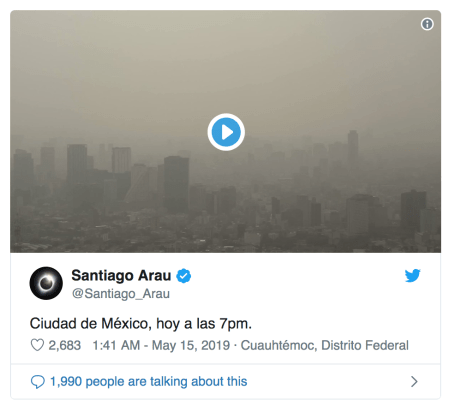
The city has been wrapped in a smoky haze for days.

Mexican photographer Santiago Arau tweeted video taken from a drone showing the extent of the pollution.

Screen Shot 2019-05-15 at 13.50.51.png

Particulate matter measuring 2.5 micrometres or less, known as PM2.5, reached 158 micrograms per cubic metre of air at one measuring station on Tuesday morning, more than six times the World Health Organisation daily mean recommended limit.

PM2.5 particles are thought to be particularly damaging because they are so small, they can penetrate the deepest parts of the lungs.

More than 21 million people live in Mexico City’s metropolitan area and it was once infamous for its poor air quality. Air pollution levels dropped in the late 1990s but have again been on the rise in recent years.

The city lies in a valley and when there is little wind, the air can quickly become stagnant.

Mexico City’s environmental commission advised residents to avoid outdoor activities and Mexico’s first division football league postponed a match between León and Club América, which was due to be played in the capital on Wednesday.

Mayor Claudia Sheinbaum said she would consider cancelling school classes if the pollution got any worse. She said schools were already keeping their pupils indoors at break time.

Screen Shot 2019-05-15 at 13.53.00.png

via Mexico City pollution: Residents urged to stay indoors – BBC News

Posted in Air Quality, Latin America, Mexico | Tagged , , , , | Leave a comment

Dust storm increases air pollution level in city, experts blame low-velocity winds

The early morning voters encountered a partially cloudy sky with dust storm blowing during the mid-morning hours.

On Sunday, the pollution levels in the city deteriorated with the AQI (air quality index) recorded at 376 (very poor), according to the air quality monitor at Vikas Sadan near Mini Secretariat.

The early morning voters encountered a partially cloudy sky with dust storm blowing during the mid-morning hours.

While the early and mid-morning hours in the city were relatively cooler, temperatures stayed around 38 degrees Celsius. The mercury rose during the day with the maximum temperature touching 40 degrees Celsius. According to the Indian Meteorological Department(IMD), the weather is all set to improve during the coming week, with temperatures hovering around 38 degrees Celsius with the possibility of rains and thunderstorms.

The Central Pollution Control Board(CPCB) had predicted that there would be a thunderstorm in the city on Sunday that would improve the AQI to moderate (190). As per the CPCB’s AQI bulletin, the AQI stood at 232 on Saturday. However, the pollution levels in the city witnessed a reversal.

Guneet Singh, an air quality expert, attributed the rise in AQI to the low-velocity winds accompanying the dust storm that prevented the pollutant PM2.5 from escaping from the atmosphere. “Showers and thunderstorms would have definitely lowered the AQI readings. The dust and particulate matter in the air get pushed down by water droplets. However, that has not happened. Also, the winds in the dust storm have been of lower velocity. Higher velocity winds often clean up the air especially PM 2.5, which is the primary local pollutant,” he said.

Higher concentrations of PM 2.5 coupled with other pollutants, such as NO2, SO2 and PM 10 deposited in the air by the low-velocity winds in the city added to the pollution levels and imparted a brownish-blue colour to the sky. Residents of the city, who braved the weather to step out for polling, were seen posting updates about the dust storm and the erratic weather.

Namita Gupta, the founder of an air quality monitoring application, said, “The frequency of summer dust storms has increased in the city in the last few years. Coupled with crop-burning activities, these dust storms always lead to an increase in the pollution levels.”

via Dust storm increases air pollution level in city, experts blame low-velocity winds | india news | Hindustan Times

Posted in Air Quality, Asia, India | Tagged , , | Leave a comment

Signficant Air Pollution Plagues Almost All U.S. National Parks

Ozone and other pollutants are obscuring views, hurting plants and causing health concerns for visitors at 96 percent of parks

National parks are places people often go to get away from the problems of urban life. But a new report from the National Parks Conservation Association (NPCA) reveals that a trip to the Rocky Mountains or Yosemite won’t help you escape one major problem of the city: air pollution. According to the report, 96 percent of the United States’ 416 national parks have significant air quality issues.

Researchers found that at times, 85 percent of parks have air that is unhealthy to breathe, reports Earther’s Yessenia Fuentes. About 89 percent of parks also suffer from haze, which reduces iconic views. At 88 percent of the parks, the problem is bad enough to affect sensitive plants and animals. For example, the study points out that at high altitudes, nitrogen from air pollution deposited by rain is causing Rocky Mountain National Park to lose its flowering plants, which are being replaced by grasses.

The most impacted spots are some of the most popular. California’s parks in particular suffer from poor air quality, according to the study. Sequoia, Kings Canyon and Joshua Tree national parks and Mojave National Preserve have dangerous levels of air pollution for more than two months per year, mostly in the summer season when they see the most visitors.

The culprit is primarily ozone, a pollutant that can trigger asthma attacks, irritate the throat and lungs and cause breathing problems in both the elderly and children. Gabrielle Canon at The Guardian reports that a study released last year in the journal Science Advances found that the average ozone concentration in 33 of the most-visited national parks was the same as those found in the 20 largest urban areas in the U.S. Currently, 330 million people visit U.S. national parks each year, meaning millions of susceptible people are being exposed to unhealthy conditions.

“The poor air quality in our national parks is both disturbing and unacceptable,” Theresa Pierno, President and CEO of the NPCA says in a press release. “Nearly every single one of our more than 400 national parks is plagued by air pollution. If we don’t take immediate action to combat this, the results will be devastating and irreversible.”

Taking action means addressing the primary cause of the bad air, most of which does not originate in the parks themselves. The biggest sources of pollution come from coal-fired power plants, transportation, and oil and gas development. Transitioning to cleaner energy and transportation are the primary ways to reduce air pollution levels.

While there are some signs that coal-powered plants are losing steam, emissions actually rose 1.8 percent in 2018 after steady declines during the previous decade. And there are concerns that air pollution will get worse if the U.S. continues its current policies. U.S. Environmental Protection Agency enforcement action against polluters has dropped by 85 percent in the last few years. Without action on these larger issues, the outlook for the parks remains hazy.

Canon reports that a 1999 policy, the Regional Haze Rule requires states to come up with plans for addressing pollution in the parks by 2021 and implement the strategies by 2028. The ultimate goal is to return parks to pre-pollution levels by 2064. But so far little progress has been made, and some parks won’t reach those levels for hundreds of years at the current pace of cleanup.

But national parks are beloved by people across the ideological spectrum, and Stephanie Kodish, clean air program director for the NPCA, tells Canon she thinks pointing out the impact on the nation’s crown jewels might spur everyone to action. “I hope that people think about our national parks as bipartisan unifiers,” she says. “That the connection to our national parks is one that can help preserve our future, our history, our culture. For the American people, they should serve as a reminder – and a warning cry.”

via Signficant Air Pollution Plagues Almost All U.S. National Parks | Smart News | Smithsonian

Posted in Air Quality, USA, USA & Canada | Tagged , , | Leave a comment

Dust, high temperatures bring Delhi’s air quality down to ‘poor’

The Aravalli range plays a critical role in checking sand migration from the Thar Desert to Delhi-NCR; but they now stand degraded

Since the evening of May 6, the particulate matter 10 (PM10) concentration in Delhi has plunged to the ‘very poor’ category taking the overall air quality down to poor. This is primarily due to the dust coming in from the dry west Rajasthan, accelerated by high temperatures and high surface winds.

Dust particles from Rajasthan are drifting towards the National Capital Region (NCR), causing a dip in the air quality in Delhi. The average concentration of coarser particles like PM10 in Delhi is more than three times the standard.

The urban heat island effect has led to the formation of a low pressure over Delhi, which is causing the movement of the wind towards the capital. The direction of the wind currently is west-south-west bringing in dust from Rajasthan.

During summers, the mixing height is usually high, allowing the dispersion of pollutants and less accumulation near the ground surface. Further, the current wind speed in Delhi is very high — close to 10-15 kilometre per hour — which is simultaneously cleaning the air.

According to the Indian Institute of Tropical Meteorology (IITM), air quality will remain in the ‘very poor’ category until May 8, following which it will improve due to expected western disturbance and thunderstorm. However, it has also forecasted an occasional episode of sudden peak in dust at isolated places within Delhi.

For more than 3 billion years, the Aravallis have stood strong against the advance of the Thar Desert towards the fertile soils of eastern Rajasthan and the Indo-Gangetic plains — preventing dust from entering Delhi.

However, now, the oldest mountain chain stands degraded — the range has shrunk by 40 per cent over the last four decades. The Aravalli range plays a critical role in checking the wind velocity and evaporation to prevent sand migration from the Thar Desert to Delhi-NCR.

via Dust, high temperatures bring Delhi’s air quality down to ‘poor’

Posted in Air Quality, Asia, India | Tagged , , , | Leave a comment

City of Amsterdam to ban polluting cars from 2030

Gasoline and diesel fueled cars and motorcycles will be banned from Amsterdam from 2030 in an effort to clean up the city’s air, the Dutch capital’s council said on Thursday.

“Pollution often is a silent killer and is one of the greatest health hazards in Amsterdam,” said the city’s traffic councillor, Sharon Dijksma.

Despite the widespread use of bicycles by many Dutch, air pollution in the Netherlands is worse than European rules permit, mainly due to heavy traffic in the cities of Amsterdam and Rotterdam.

The health ministry has warned that current levels of nitrogen dioxide and particle matter emissions can lead to respiratory illnesses, with chronic exposure shortening life expectancy by more than a year.

Amsterdam said it aims to replace all gasoline and diesel engines by emission-free alternatives, such as electric and hydrogen cars, by the end of the next decade.

It will start next year by banning diesel cars built before 2005 from the city, and will gradually expand the range of vehicles that are barred.

The city said it will use subsidies and parking permits to stimulate people to switch to cleaner cars.

via City of Amsterdam to ban polluting cars from 2030 – Reuters

Posted in Air Quality, Europe | Tagged , , , | Leave a comment

Diagnosing urban air pollution exposure with new precision

A new review of studies on levels of urban exposure to airborne pollutants and their effects on human health suggests that advanced instrumentation and information technology will soon allow researchers and policymakers to gauge the health risks of air pollution on an individual level.

In New York City alone, the economic impact of premature death from causes related to air pollution, including asthma and other respiratory conditions and cardiovascular complications, exceeds $30.7 billion a year. Globally, 4.2 million deaths per year are attributable to airborne pollution, making it the fifth-ranking mortality risk factor according to a 2015 study published in the Lancet.

An interdisciplinary research team from New York University, led by Masoud Ghandehari, an associate professor in NYU Tandon’s Department of Civil and Urban Engineering and the Center for Urban Science and Progress (CUSP), published a comprehensive review of recent efforts to assess the impact of air pollution exposure in cities.

Ghandehari’s co-authors are Andrew Caplin, Silver Professor in the NYU Department of Economics; Paul Glimcher, Silver Professor and professor of neural science and psychology; George Thurston, NYU School of Medicine professor in the Departments of Environmental Medicine and Population Health; and Chris Lim, a recent Ph.D. graduate of the School of Medicine.

Their paper, published in Nature Communications, explains how data gleaned from environmental sensors mounted on buildings and lamp poles, as well as mobile and wearable sensors, were combined with information on socioeconomic status, commuting patterns, and lifestyle habits such as outdoor exercise to develop models of pollution exposures at the neighborhood level. Such studies were conducted in major urban centers, including New York City, Hong Kong, and San Francisco, and informed public policy on air pollution limits and climate action strategies.

Yet the authors argue that advanced sensing and information technologies can be used to even greater advantage, offering the potential for far more granular assessments—at the level of the individual. “One of the questions we want to answer is how different people experience pollution, and why?” Ghandehari said.

He explained that population-level assessments overlook factors such as personal mobility—including commuting by car, bus, bicycle, or on foot, and often do not consider indoor climate control conditions or life stage. For example, students and working adults are more mobile than older people and are therefore more exposed, while children experience lifelong adversities.

Socioeconomic status is also a known factor for increased exposure to airborne pollutants as well as increased risk of asthma and cardiovascular disease. “People from all points on the economic spectrum live in polluted areas, yet they often have different health outcomes,” Ghandehari said. “Using technology to study individual associations between air pollution and health outcomes—rather than group associations—will yield evidence-based arguments for change that would particularly impact individuals at higher risk of negative health impacts.”

via Diagnosing urban air pollution exposure with new precision

Posted in World News | Tagged , , | Leave a comment

‘Dangerously high’ levels of air pollution found in Northern Ireland

Poisonous air across Northern Ireland is contributing to illness and early death for many people, it has been claimed.

The stark warning comes as an investigation into air quality in Belfast revealed “dangerously high” levels of pollutants.

Levels of nitrogen dioxide (NO2) were so high in some areas that it breached legal limits at 30 sites across the city.

An environmental group monitored levels of NO2 for several weeks, providing a snapshot of NO2 pollution.

NO2 is a toxic gas which inflames the lining of the lungs.

The results found levels of NO2 pollution breaching legal limits at 30 sites across Belfast and North Down.

The group claimed that particularly high readings were recorded outside the Royal Victoria Hospital and at the Belfast Metropolitan College Millfield Campus.

The legal annual limit for NO2 is 40 micrograms per cubic metre, however, there are no safe levels of exposure to air pollution.

The air quality samples were collected using diffusion tubes situated at over 100 sites then processed and analysed by a laboratory.

The Department of Agriculture, Environment and Rural Affairs (Daera) test air quality at 18 sites across Northern Ireland with nine in the greater Belfast area.

Green Party leader Clare Bailey warned that polluted, poisonous air across towns and cities in Northern Ireland is contributing to illness and early death for many people.

“This is an important study alerting us to an air pollution emergency across Belfast and beyond,” she said.

“Clean air is a human right, but many of us are breathing in heavily polluted and poisonous air each and every day.

“Air pollution is often invisible, with residents in heavily polluted areas not realising the extent of the problem and the resulting health impacts.

“Some of the most concerning levels of NO2 were recorded across inner city working class communities, with heavy traffic prevalent.

“The scientific evidence on the effects of air pollution is well documented and mounting.”

Respiratory symptoms, asthma prevalence and certain types of cancer can all be attributed to air pollution.

New studies have linked the problem with dementia and complications during pregnancy.

“Urgent action is required to address this public health emergency,” Ms Bailey added.

“NO2 pollution is closely linked with vehicle emissions, particularly diesel engines. A green transport strategy aimed at reducing the number of vehicles on our roads and increasing access to public transport is long overdue.

“The Department must also commit to increased air quality monitoring. Eighteen testing sites across Northern Ireland is inadequate.

“Communities are suffering from the poisonous effects of air pollution often without realising the harmful effects of the air they are breathing.

“I also want to see the introduction of a Clean Air Act which enshrines clean air as a human right and updates the legislation for modern fuels and technologies to reduce harmful air emissions and protect human health and the environment.”

via ‘Dangerously high’ levels of air pollution found in Northern Ireland – The Irish News

Posted in Air Quality, Europe, UK | Tagged , , , , | Leave a comment