Portuguese among most vulnerable from pollution and extreme temperatures

Targeted action is needed to better protect the poor, the elderly and children from environmental hazards like air and noise pollution and extreme temperatures, especially in Europe’s eastern and southern regions, the European Environment Agency (EEA) said in a report published this week.

Page10_EEA_2

In the report, he EEA warns that the health of Europe’s most vulnerable citizens remains disproportionately affected by these hazards, despite overall improvements in Europe’s environmental quality.

According the report, poorer regions (when compared with northern European nations) including Portugal, are where potential problems are the worst.

The EEA report ‘Unequal exposure and unequal impacts: social vulnerability to air pollution, noise and extreme temperatures in Europe’ draws attention to the close links between social and environmental problems across Europe.

The distribution of these environmental threats and the impact they have on human health closely mirror differences in income, unemployment and education levels across Europe.

“The European Environment Agency is to be commended for this report that examines how the poor, the old and the very young are those most at risk from poor air quality, excessive noise and extremes of temperatures. It informs our efforts to make sure that we are a Europe that protects all”, said Karmenu Vella, EU Commissioner for Environment, Maritime Affairs and Fisheries.

Eastern European regions and regions in southern Europe (including Portugal), where incomes and education are lower and unemployment rates higher than European averages, were more exposed to air pollutants including particulate matter (PM) and ground level ozone (O3), researchers found.

Wealthier regions, including large cities, tend to have on average higher levels of nitrogen dioxide (NO2), mostly because of the high concentration of road traffic and economic activities. However, within these regions themselves, it is still the poorer communities that tend to be exposed to higher local levels of NO2.

Exposure to noise is much more localised than exposure to air pollution and ambient levels vary considerably across short distances.

The analysis did find a tentative link between noise levels in cities and lower household incomes, suggesting that cities with poorer populations have higher noise levels.

Southern and south-eastern European regions are more affected by higher temperatures, the EEA said.

Many regions in Bulgaria, Croatia, Greece, Italy, Portugal and Spain are also characterised by lower incomes and education, higher levels of unemployment and larger elderly populations.

via Portuguese among most vulnerable from pollution and extreme temperatures – The Portugal News

Posted in Air Quality, Europe | Tagged , , , | Leave a comment

Mongolians send children into countryside to escape choking winter smog

Mongolia has extended school winter holidays in the world’s coldest capital and many families have sent children to live with relatives in the vast, windswept grasslands to escape choking smog and respiratory diseases such as pneumonia.

The temperature is expected to drop to minus 32 degrees Celsius (minus 26F) in Ulaanbaatar on Monday night, as residents burn coal and trash to try to keep warm and concentrations of smog particles known as PM2.5 routinely exceed 500 mg per cubic metre, 50 times the level considered safe by the WHO.

Mongolia, a former Soviet satellite landlocked between Russia and China, has invested public money and foreign aid to tackle pollution, but improvement has been slow, with residents saying inaction has been compounded by a corruption scandal that has paralysed parliament.

In a crowded township more than 40 miles from Ulaanbaatar, Jantsandulam Bold’s five grandchildren are breathing more easily after fleeing the capital.

“Fresh air and sun are most important for kids to grow healthy and robust,” says Jantsandulam, 57, making milk tea for her grandchildren in her home, a thickly padded felt hut known as a “ger”, or in Russian, a “yurt”.

“This little one had flu when he came here but the fresh air has treated him well,” she said, pointing at her five-year-old grandson.

The children are nearing the end of a two-month break, with schools due to reopen next Monday.

About 60 percent of Mongolia is covered by grassland, where the mining of copper, gold, coal and other minerals provides employment, while the Gobi desert envelops the South. But almost half the population live in Ulaanbataar.

Reuters calculations based on U.S. Embassy data show annual average PM2.5 concentrations hit 100 micrograms in Ulaanbaatar in 2018. They soared to 270 in December. PM2.5 in China’s most polluted city of Shijiazhuang stood at an average 70 micrograms last year, down 15.7 percent from 2017. The World Health Organisation recommends a concentration of no more than 10 micrograms.

The WHO said 80 percent of Ulaanbaatar’s smog was caused by coal burning in “ger” districts, where thousands of rural migrants, used to a nomadic lifestyle, have pitched huts. It estimates air pollution causes more than 4,000 premature deaths a year.

A joint study by the U.N. International Children’s Emergency Fund (UNICEF) and Mongolia’s National Centre for Public Health said children living in one smog-prone district of Ulaanbaatar had 40 percent less lung function than those living in the countryside.

“Air pollution aggravates respiratory diseases and children under five are most vulnerable as their organs are still not mature,” said Bolormaa Bumbaa, a doctor at Bayangol District’s Children’s hospital in Ulaanbaatar.

via Mongolians send children into countryside to escape choking winter smog | World Economic Forum

Posted in Air Quality, Asia, Mongolia | Tagged , , , , | Leave a comment

‘It is so scary’: how the UK’s filthy air is sending children to A&E

Young patients with respiratory problems are a regular sight for doctors due to air pollution crisis

Parents ‘worryingly unaware’ of damage from air pollution

Sixteen-month-old Madalena grins and throws her flashing ball across the consulting room, oblivious to the conversation going on around her.

Her mother, Patricia Correia, is explaining to the doctor that the family is thinking of returning to Portugal after a series of “wheezing episodes” that have forced the toddler to be rushed to A&E five times in the past six months. Once she was so ill, she was kept in for four days.

“It is very, very frightening because you can see her struggling, starting to breathe really fast,” Correia tells the consultant. “And I know her oxygen saturation level is dropping because I am a nurse. It is so scary.”

Correia fears her daughter is at the sharp end of the UK’s air pollution crisis, which contributes to about 40,000 deaths a year and has profound long-term health implications for millions more.

The family, who arrived in the UK in 2016, is considering a return to Correia’s native Portugal where the air will be cleaner and Madalena may recover. “We came here because in Portugal there are not many jobs for nurses and we thought it would be a good life, but now? It is not easy because I will have to quit nursing but her life … her life is precious.”

The consultation at the Royal London hospital is being carried out by Prof Jonathan Grigg, one of the UK’s leading specialists in respiratory illnesses in children.

In the two hours the Guardian sits in on the session, there is a regular flow of parents and children into his room.

The stories follow a pattern: babies and toddlers with severe wheezing episodes, older children with sometimes crippling asthma. Anxious parents are offered information and reassurance, a range of medicines are talked through and future appointments booked.

One nine-year-old boy has had such a severe episode it triggered a heart attack and he must now use a wheelchair. A 20-month-old has been in and out of A&E in the past few months and his father wants to know if he is in danger.

Last year, figures from the Office for National Statistics revealed a record number of people were dying of asthma, with experts warning that air pollution and a lack of basic care could be to blame.

As the consultations come to an end, Grigg, who set up the Doctors Against Diesel campaign and is a leading member of Royal College of Paediatrics and Child Health, said the patients’ stories were all too familiar.

And although, he said, it was impossible to ascribe air pollution as the sole cause in any individual case, the UK’s filthy air “is very severe and is a major driver of adverse respiratory effects”.

“The WHO said recently that air pollution is the new tobacco and I think, in terms of its impact on health, that is how we should think of it.”

Grigg says awareness of air pollution has grown significantly in recent years, with patients often ahead of the medical profession in terms of understanding. A growing number of people were asking him whether they should try to move house or school – or, as with Correia, move country – to avoid the impact of the UK’s air pollution.

“I am wary of advising people because, hand on heart, I can’t say their child will get better if they move and often people do not have that option. Rather, I advise them to come together with other parents and ask the school or the council what can be done, why there are so many cars on the roads outside their schools or homes … collective action seems better than trying to deal with this as individuals.”

The scale of the crisis has become more evident over recent months – especially its impact on children. Reports have emphasised the links between illegally poisonous air and heart diseasedementia, reduced cognitive ability and asthma deaths.

Schools are becoming increasingly vocal, demanding that parents and children walk rather than use cars to get to and from school. Others are installing air purifiers in the classroom after growing concern around levels of indoor air pollution.

Some regional politicians – Sadiq Khan in London and Andy Burnham in Manchester – are beginning to take action, although campaigners say the plans do not go far enough, fast enough, and many medics and environmentalists are increasingly exasperated with the government, which has lost three court cases over its perceived lack of action on air pollution.

It is a sentiment shared by Grigg who says it is “crazy” that ministers have still not taken decisive action to get the most polluting diesel vehicles off the road – even though they know the damage the vehicles are doing to the nation’s health.

But promises of action in the future may already be too late to persuade Correia – and thousands like her – to stay.

“We did not think about pollution before we became parents,” she says as she straps Madalena into a sling. “But now we are and we know about this, what else can we do?”

via ‘It is so scary’: how the UK’s filthy air is sending children to A&E | Environment | The Guardian

Posted in Air Quality, Europe, London, UK | Tagged , , | Leave a comment

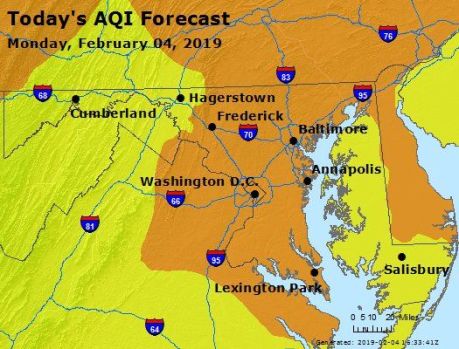
There’s an air quality alert in Washington, the sky is hazy and it’s February. What’s going on?

Ordinarily when air quality alerts are in effect, the air is muggy and oppressive, as if you could cut it with a knife. The overwhelming majority of these alerts happen between June and August.

But Feb. 4, the air was thick with haze, and a Code Orange alert was in effect for the Washington-Baltimore region. This means the air was expected to be unhealthy for sensitive groups such as young children, older adults and those with respiratory conditions.

CD2

The Maryland Department of Environment predicted elevated levels of fine-particle pollution, with the worst conditions in urban areas.

If you looked up at the sky Monday, an unseasonably mild day in Washington, the haze was unmistakable.

“As beautiful as the weather is in DC today, it’s weirdly hazy. Can someone explain this to me?” tweeted Laur_Katz.

In its air quality discussion, the Maryland Department of Environment attributed this winter pollution episode to a “stout capping inversion” which trapped a cocktail of air pollutants from wood burning and vehicle emissions near the ground.

Inversions occur when the air temperature warms as it rises. (Normally, the air cools with altitude.) When warmer air sits above a layer of colder air near the ground — which is heavier — pollutants get stuck.

“Any local pollutants emitted were staying nearby and very close to the surface,” said Dan L. Goldberg, an atmospheric scientist specializing in air quality at Argonne National Laboratory, in email.

44ST5KOO4NAKTG24TJDTGZETEI

Such a capping inversion is strongest during the morning. Into the afternoon, Goldberg explained, the pollutants are able to disperse more as the sun heats up the ground and the inversion erodes.

The conditions that allowed this inversion to develop began with Friday’s snowfall.

“The fresh snow traps cold air near the surface very well,” Joel Dreessen, a meteorologist with Maryland’s Department of Environment, said in an email. “Particles jumped dramatically Saturday (in comparison to Friday) due to the inversion which set up. This very stout near-surface inversion was/is in place through Monday due to ongoing high pressure in the region.”

A Code Orange alert was first issued for the Baltimore region Sunday before it was expanded to the Washington region for Monday. On Sunday, Goldberg and Dreessen said, the observed particle pollution stayed just below Code Orange level in the Baltimore region but exceeded this level in south-central Pennsylvania.

Screen Shot 2019-02-05 at 10.05.25

Dreessen said that ode Orange conditions in winter are “fairly rare” and that the last instance occurred Dec. 4, 2017. In all, there have been three instances of these particle pollution episodes during the winter months since 2014, he said.

These winter particle pollution cases — tied to inversions — are different from typical summer pollution, which is mostly the result of ground-level ozone spurred by hot weather and stagnant air.

The air quality is expected to improve through midweek, as the inversion is expected to weaken by Tuesday morning and then dissipate altogether after a cold front passes.

via There’s an air quality alert in Washington, the sky is hazy and it’s February. What’s going on? – The Washington Post

Posted in Air Quality, USA, USA & Canada | Tagged , , , , , , | 1 Comment

Men who live on a main road are more likely to struggle to get an erection

Men who live on main roads are more likely to have difficulty getting an erection due to exposure to pollution, a study suggests.

Toxic fumes reduced blood flow to the genitals, tests on rats showed, putting them at risk of developing erectile dysfunction.

Men may also find they get tired quicker during sex, as the fumes can reduce lung capacity, researchers claim.

The study comes amid an array of evidence showing a growing association between polluted air and diseases, as well as fertility.

Men who live on main roads are more likely to have difficulty getting an erection due to exposure to pollution, a Chinese study on rats suggested

The study, at Guangzhou University in China, compared the sexual performance of rats in four different groups, The Sun reports.

The first group inhaled pollutants for two hours of the day for three months, the second for four hours, and the third for six hours.

A ‘significant reduction’ in erectile function was seen in the groups of rats that had inhaled polluted air for four and six hours.

WHAT IS IMPOTENCE?
Erectile dysfunction, also known as impotence, is when a man is unable to get or maintain an erection.

It is more common in the over-40s but affects men of all ages.

Failure to stay erect is usually due to tiredness, stress, anxiety or alcohol, and is not a cause for concern.

However, it can be a sign of an underlying medical condition such as high blood pressure or cholesterol, side effects of medication, or hormonal issues.

Lifestyle factors than can affect the condition include obesity, smoking, cycling too much, drinking too much, and stress.

Source: NHS Choices

Dr Shankun Zhao, who was involved in the study, said: ‘For the first time our study revealed the effect of vehicle exhaust on penile erection.

‘Our results raise concerns about the potential role played by long-term exposure to gasoline vehicle exhaust in the development of erectile dysfunction.’

Previous studies have linked pollution to an increased risk of breast cancer, mouth cancer, autism in children and heart disease.

Scientists at The Chinese University, Hong Kong found men living in areas with high levels of air pollution were found to have distorted sperm.

Experts analysed exposure to sooty particles which are particularly linked to emissions of old diesel cars.

These particles – called PM2.5 – are so fine that they are breathed into the lungs and enter the blood stream.

via Men who live on a main road are more likely to struggle to get an erection

Posted in Air Quality, Health Effects of Air Pollution, Medical Studies | Tagged , , | Leave a comment

Bangkok chokes as pollution busting efforts falter

The small park in Bangkok’s Rama III district is mostly popular with runners circling its neatly trimmed garden track to the sound of birdsong.

But on Thursday, they were joined by a convoy of fire trucks and half a dozen military drones, drawing dozens of curious onlookers.

After an hour setting up, the drones and water cannon were pumping thick plumes of water into the empty sky above. Speakers blared warnings about the operation and instructed runners to keep their distance.

The odd display was the Thai government’s latest attempt at curbing the alarmingly high levels of pollution that have been plaguing the capital for weeks. The drones, geared with water tanks and fire-fighting sprinklers, were supposed to break up the smog that has been smothering the city of around 10 million people for at least a month.

Initially, Thailand’s authorities said the worsening pollution was being blown over from China, predicting that it would be gone within a week or so. Then, as the smog persisted, they tried cloud seeding. Now, drones and water cannon are their latest salvo.

“Do they actually think this is going to help?” asked Gong, a 50-year-old man who comes to the park often to use its free-weight gym.

“The only thing happening today is that runners are getting wet and they have to watch out for these drones,” he said, drawing laughter from weightlifters nearby.

Toxic air

As amusing as they might have found the scene, Bangkok residents are welcoming any attempts to combat the toxic smog that has forced authorities to close more than 400 schools, advise people to wear a mask when they’re not indoors and limit the time they spend outside.

New research from Thailand’s National Institute of Development Administration (NIDA) suggests Bangkok’s air has reached particularly concerning levels of toxicity, with the lingering smog being full of dangerous heavy metals and various carcinogenic compounds.

Professor Siwatt Pongpiachan, director of NIDA and a global leading expert on urban pollution, told Al Jazeera he was concerned to find that Bangkok’s air contained dangerous levels of cadmium, tungsten, arsenic and polycyclic aromatic hydrocarbons (PAHs) inside the fine dust air, known as PM 2.5.

Siwatt explained that their levels are particularly dangerous, based on the World Health Organization’s (WHO) standards for measuring safe air, adding that Bangkok’s pollution was largely coming from within the city itself.

PAHs are toxic carcinogenic compounds that can be sourced to forest fires, car exhausts, cigarette smoke and insecticides, among others.

The Thai capital, meanwhile, has some 10 million registered vehicles, pollutant-pumping factories and numerous daily cremations.

Siwatt said the widespread burning of sugarcane fields in northern provinces is also contributing to the crisis, which makes tackling the problem extremely difficult.

The WHO has been campaigning to decrease toxic pollution around the globe for years,educating the public on the dangers to health and urging governments to prioritise clean air as megacities such as New Delhi and Beijing struggle with debilitating levels of pollution. Its guideline for PM2.5 is for an annual average of no more than 10 micrograms/cubic metre.

‘Sense of urgency’

Bangkok has never seen pollution on this scale, and many residents were shocked at the smog lurking above. On social media, where Thais often go to express their outrage, memes comparing the city to post-apocalyptic backdrops in films such as Bladerunner 2049 and Mad Max have been widely shared.

Many are concerned the government is focusing on the symptoms rather than the cause of the problem.

“I think we need to push the government with a sense of urgency if we want to see positive results,” said Sirima Panyametheekul, an academic in the Department of Environmental Engineering at Thailand’s Chulalongkorn University. “We need urgent measures to be implemented, like reducing the density of traffic and cleaning the streets.”

Thailand also needs to adopt more stringent measures for PM2.5, she added.

The density of the microscopic particles can reach 50 micrograms for each cubic metre volume before the government has to act, according to Sirima, who recommends that level be halved.

Currently, air quality is sitting around 61 to 93 micrograms/cubic metre depending on the location.

“I know that’s challenging,” she said. “But it’s important. If not 25, we can at least start at 35 or 30.”

Need for legislation

The government, which dropped a plan to use sugar water that was supposed to “capture” the toxins, stands by its approach to the current air crisis.

“It’s going to work,” said Somjiak Nonthagaew, the director of Bangkok’s Fire and Rescue Department, on deploying drones and fire-fighting equipment to combat the smog.

“It should definitely help, but of course not 100 percent. We would have liked to do more, but we have limited options and resources. But we sprayed at six locations today, and we think it was a success,” added Nonthagaew, between shouting loud updates into his phone as the mist began to descend over the park.

But Siwatt is not convinced.

He says Thailand needs to develop policies that would reduce the toxic compounds in the air, citing neighbouring countries such as Singapore and the Philippines. He’s also urging authorities to introduce a Clean Air Act, like the one the British government rolled out after the deadly 1952 London Smog, which blanketed the UK capital for several days.

Thai authorities say that the current smog should lift in a few days as a result of their tackling operations. According to Somjiak, they plan to deploy water cannons and drones until the air quality improves.

But without major changes, the smog is bound to return.

“It’s going to take a few years before we see any Clean Air Act laws,” Siwatt said. “And before thinking about the timeframe, we need to convince the government and all the future political parties to agree that Thailand really needs clean air.”

via Bangkok chokes as pollution busting efforts falter | News | Al Jazeera

Posted in Air Quality, Asia, Thailand | Tagged , , | Leave a comment

Children exposed to air pollution at school may be at greater risk of overweight and obesity

Exposure to air pollution, particularly at school, could be associated with a higher risk of overweight and obesity during childhood. This is the conclusion of a study by the Barcelona Institute for Global Health (ISGlobal), an institution supported by “la Caixa,” performed with 2,660 children between 7 and 10 years of age from 39 schools in Barcelona.

A few studies have associated exposure to air pollution with a higher risk of child obesity and overweight. However, these studies focused mainly on exposure at home, without considering the school environment.

The study, published in Environment International and performed under the BREATHE project, assessed for the first time the relation between obesity and overweight risk and air pollution levels at school and home, the two microenvironments where schoolchildren spend most of their time.

On one hand, the research team collected data on the children’s weight and height and calculated their body mass index and obesity and overweight status. On the other hand, they used sensors in the schoolyard to measure the levels of outdoor pollution — nitrogen dioxide (NO2), elemental carbon (EC), particle matter (PM2.5) and ultrafine particles -during one week in summer and another week in winter. They also estimated exposure levels to NO2, NOx, PM2.5, PM10 and PMcoarse at the home address.

“We observed that children exposed to medium or high levels of air pollution at school -ultrafine particles, NO2, PM2.5 and EC- had a higher risk of obesity and overweight as compared to those exposed to lower levels,” concludes first author Jeroen de Bont, researcher at ISGlobal and IDIAP Jordi Gol. Exposure to high levels of PM10 at home was also associated with higher risk of obesity or overweight during childhood, although in this case the analysis was done with estimates of exposure levels.

“The study has however some limitations, which means that the results are to be cautiously interpreted,” says Martine Vrijheid, ISGlobal researcher and study coordinator. “Being a cross-sectional study, we only have data at one time-point, and we do not have enough data to establish the nature of the association. To draw more solid conclusions, we need new longitudinal studies that follow the study participants over time,” she adds.

Regarding the mechanisms linking air pollution and overweight, some animal studies suggest that pollution can induce oxidative stress, insulin resistance and systemic inflammation, factors that are known to contribute to obesity,” explains de Bont.

Most children were exposed to air pollution levels above those recommended by the World Health Organisation (WHO), both at school and home. Specifically, over 75% were exposed to PM2.5 levels above those recommended (10?g/m3) and more than 50% breathed NO2 levels above those considered as safe (40?g/m3).

via Children exposed to air pollution at school may be at greater risk of overweight and obesity — ScienceDaily

Posted in Air Quality, Health Effects of Air Pollution, Medical Studies | Tagged , , , , , , , , | Leave a comment

Bangkok schools closed over air pollution concerns

More than 400 schools in Thailand’s capital, Bangkok, were shut for the rest of the week Wednesday due to increasing concern over dangerously unhealthy air pollution.

Faced with public discontent as well as a possible health crisis, Police Gen. Asawin Kwanmuang, the city’s governor, also declared the city a “pollution control zone,” allowing authorities to take legal measures to combat the threat, including road closings and diversions. Violators of orders to curb pollution, which could include limits on diesel exhaust, outdoor burning and construction activities, could face up to three months in prison.

Prime Minister Prayuth Chan-ocha directed Asawin to order the closure of 437 schools after officials said the pollution would continue until next Monday. They said still air and heavy traffic are causing a buildup of particles in the air.

The Pollution Control Department said the amount of especially dangerous tiny “PM 2.5” particles has risen in all areas in and around Bangkok since Monday.

“We decided to eliminate the problem by closing down the schools,” Asawin said. “We’re afraid that it can be dangerous for the children.” Technical colleges are included among the closed institutions but universities are still considering what to do.

Mongkolsak Lajina, the father of a 5-year-old student, suggested that closing schools was a token gesture.

“I don’t think it will help much. It helps that students do not have to commute to schools,” he said. “But we need better measures to effectively deal with this problem.”

The Public Health Ministry said people should refrain from outdoor activities and exercise, and look instead for indoor venues. Many commuters and pedestrians have begun wearing face masks.

“These measures will help only temporarily,” said Aek Pongpairoj, a doctor living in Bangkok. “If we want a long-lasting solution, all sectors must be involved, not just government agencies; for example, the private sector involving construction. There are so many construction sites and I can see that preventive measures aren’t enough.”

Pollution levels also rose elsewhere in Thailand, bringing a heavy haze to Chiang Mai and other northern areas well ahead of the annual “smoky season” that normally begins in late February, when farmers burn agricultural waste and dry weather allows airborne particles to accumulate.

Efforts to reduce the pollution level in Bangkok by hosing down roads and spraying water in the air have been criticized as ineffective. People were asked to limit open-air burning of materials, and have even been advised to use shorter incense sticks in upcoming Lunar New Year celebrations.

via Bangkok schools closed over air pollution concerns – Pattaya Mail

Posted in Air Quality, Asia, Thailand | Tagged , , , | Leave a comment