Air pollution affects happiness not just health, scientists find 

Air pollution is not just bad for health also makes people unhappy, a new study has shown.

Researchers at MIT and the University of Beijing discovered a direct link between the amount of particulates in the air and happiness.

Research has previously shown that air pollution is damaging to health, cognitive performance, labor productivity, and educational outcomes.

But air pollution also has a broader impact on people’s social lives and behavior, according Siqi Zheng, the Samuel Tak Lee Associate Professor in MIT’s Department of Urban Studies

“Pollution also has an emotional cost,” said Dr Zheng. “People are unhappy, and that means they may make irrational decisions.”

Researchers used pollution data from 144 Chinese cities and monitored general happiness of urban dwellers by looking at the mood using 210 million messages from China’s largest microblogging platform, Sina Weibo.

They found a significantly negative correlation between pollution and happiness levels, with every increase in pollution above a healthy level bringing happiness down by 0.04 points out of 100.

On Monday some parts of London recorded Air Quality Index (AQI) levels of 151, more than 100 points above healthy limits.

It suggests that people were four points unhappier than they would have been without polluted levels. For China, pollution can rise into the 700s, which could be having a major impact on happiness.

Women were also found to me more sensitive to higher pollution levels than men, as were those on higher incomes.

The research was published in the journal Nature Human Behaviour.

via Air pollution affects happiness not just health, scientists find 

Posted in Air Quality, Health Effects of Air Pollution, Medical Studies | Tagged , , , , , | Leave a comment

Air Pollution Forces School Closures Across Macedonia

Macedonia’s government has ordered the winter break for students to be extended to January 23 because of extremely high levels of air pollution in many cities across the country.

The government said in a statement on January 20 that the measure is to “shorten the time of exposure of students to air pollution and to protect their health.”

City officials in Skopje also have introduced free public transport and have doubled the prices for parking in order encourage people not to use private cars in the capital.

Authorities blame extremely high levels of air pollution across Macedonia on people using old vehicles for transportation and wood-burning stoves for heat.

Two cities in Macedonia – the western city of Tetovo and the capital, Skopje — were named by the European Air Quality Index in December 2018 as the most polluted cities in Europe.

Public health institutions have issued warnings and have attributed the deaths of some 1,500 people a year to air pollution in the Balkan country since 2015.

Toxic PM10 and PM2.5 air particles in Skopje in recent days were more than 10 times over the allowed limits.

PM2.5 particles cause hazy air and contribute to respiratory illnesses, heart disease, stroke, and cancer.

via Air Pollution Forces School Closures Across Macedonia

Posted in Air Quality, Europe | Tagged , , | Leave a comment

Air pollution alert for Friday

Air pollution is expected to get worse in Bangkok on Friday following a slight improvement in weather conditions on Thursday.

Fewer locations reported fine particle dust higher than safe levels on Thursday, while the Thai Meteorological Department issued a warning about a high pressure area hovering over Laos and Thai Northeast that will cause a temperature drop by 1-3 degrees Celsius in Greater Bangkok on Friday.The Pollution Control Department (PCD), meanwhile, reported that 16 roadside areas and nine general areas (away from main roads) of Greater Bangkok had unsafe levels of particulates smaller than 2.5 microns (PM2.5) in the air. The safe limit is 50 micrograms of PM2.5 per cubic metre of air. In Bangkok, a roadside area on Paholyothin Road in Chatuchak district, another spot in front of Kasetsart University in Bang Khen district, and another area near the Thanon Tok Intersection in Bang Kho Laem district each reported an unsafe level of 62 micrograms.
The PCD also reported that the air quality on Friday would be “moderate” and cited the weather bureau as saying there would be no rain in the capital city and five surrounding provinces.In the wake of air pollution, various agencies have this week implemented dust-reducing measures such as the suspension of construction work January 16-22 for the Mass Rapid Transit Authority of Thailand’s Orange, Yellow and Pink electric rail lines. Bangkok Mass Transit Authority checked vehicles and weeded out exhaust-spewing buses from roads, while traffic police nearly doubled checkpoints from the previous 12 to be 20 to seize exhaust-spewing vehicles. The Bangkok Metropolitan Administration sent workers to clean and spray water at risky spots daily.

via Air pollution alert for Friday

Posted in Air Quality, Asia | Tagged , , | Leave a comment

Air pollution becomes Afghanistan’s silent killer

From a distance, giant khaki blankets appear to smother Kabul’s spectacular mountainside.

Visitors may even be enthralled by the phenomenon. Only when near the suburbs, however, do they realize the enveloping layer is thick smog of dirt and fumes.

A report released in the US last month listed Kabul as among the top 10 most polluted cities in the world. For many Afghans, it is a potent silent killer.

The Afghan government, riven by internal strife and locked in conflict with the Taliban, lacks the technology to monitor pollution levels in a city of nearly 6 million people.

It also either keeps no official statistics on how many die annually as a result of air pollution, or does not acknowledge them. Its resources are scant, and measures to curb pollution exist only on paper.

Estimates by independent researchers about the number of deaths, though, are shocking. A former Afghan public health worker, based in the UK, told the BBC that 30,000 people died due to conditions linked to air pollution last year alone. Others say it is even higher.

“The latest report from the Health Effects Institute’s State of Global Air project estimates that air pollution was attributable for 51,600 deaths in Afghanistan in 2016,” noted the Conflict and Environment Observatory in June 2018.

“With an annual rate of 406 deaths per 100,000, its air pollution is among the worst in the world. The report combines data on PM2.5, ozone and indoor air pollution associated with the combustion of solid fuels.”

Common causes of pollution include low-quality fuel, inefficient vehicles, and the burning of tires, rubber, plastic and coal.

Harsh droughts have contributed to the decrease in air quality, and at night, when temperatures drop below freezing, Kabul’s residents often have no choice but to use these dirty fuel sources to keep warm.

With power shortages exacerbating high electricity and gas prices, households are also burning around 2,200 kg of wood annually. That can cause serious respiratory issues, and has been linked to cancer.

“Your heart and lungs cannot distinguish the poison caused by these particles, and we all breathe them in every day,” Dr. Rabbani Nazbar said.

Environmental expert Mohammad Kazim Humayoun, meanwhile, told Arab News that people in Kabul should consider wearing facemasks and washing their hands regularly to lessen the effects of pollution.

Last month, the Afghan Parliament summoned officials to explain what was being done to reduce air pollution. “How can we justify this ongoing situation to the people?” Speaker Abdul Rauf Ibrahimi asked.

Waheed Mayar, a spokesman for the Ministry for Public Health, admitted that air pollution in Kabul was rising, but did not comment on the number of deaths it may have caused.

He said the Afghan government planned to acquire better pollution-testing facilities, and to take less efficient vehicles off the roads, but could not give a time frame for when either might happen. It also held an initiative last year, giving government employees an extra day off work to cut traffic pollution — it is unclear what effect this may have had.

via Air pollution becomes Afghanistan’s silent killer

Posted in Air Quality, Asia | Tagged , , | Leave a comment

Smog blankets Bangkok as experts warn of serious threat to public health

Bangkok has been engulfed by smog for the past few days as experts warn of the threat to public health if the unhealthy air quality levels persist.

The authorities must take the air pollution problem in the Thai capital seriously and strictly enforce mitigation measures to protect people’s health, academics said, while warning of serious financial costs to match.

They pointed out that the country would face billions of baht in additional health costs unless the severe air pollution blanketing the capital was promptly curbed.

The pollution continued to remain at harmful levels for the third straight day on Sunday (Jan 13) and the situation was likely to remain critical for at least another month due to weather patterns, said Dr Witsanu Attavanich, associate professor of economics at Kasetsart University.

He feared both state agencies and the public were largely underestimating the dangers of air pollution and proper prevention and mitigation measures were still inadequate.

Bangkokians awoke on Sunday morning to find their city once again smothered by thick smog that reduced visibility to just one kilometre in some areas. It was not regular winter fog, but a deadly cloud of fine dust particles and other air pollutants, according to China-based air-pollution monitoring website http://aqicn.org. The site reported that the PM2.5 air-quality index (AQI) in Bangkok on Sunday reached a peak of 195, an unhealthy level, while some areas such as Bang Khen district were at hazardous levels, with PM2.5 AQI at 394 on Sunday morning. The site forecast that Bangkok would face harmful levels every morning for the rest of the week because there was little wind.

Nevertheless, people wearing face masks remained a rare sight around the capital. Many children and seniors could be seen going about their outdoor activities as usual.

“Air pollution is really a silent killer and many Thais underestimate the danger to their health, so not many people protect themselves by wearing a face mask or installing air purifiers at home,” Dr Witsanu said.

The official air pollution warning system is also too weak and does not reflect the true severity of the situation,” he said. “Thais don’t have lungs of steel, so we need to consider the environment and people’s health before we pursue economic growth.”

According to his research on pollution-related health costs in 2017, every microgram of PM10 beyond the safe limit cost the people of Bangkok up to 18.42 billion baht (S$780 million) in medical expenses.

While his research did not examine the financial impact that PM2.5 pollution triggered, Dr Witsanu said medical costs are definitely much higher because PM2.5 has a greater impact on health. The current pollution in the capital will cause immeasurable additional health expenditure, he warned.

“We all know that air pollution is not a new problem in Bangkok and agencies such as the Bangkok Metropolitan Administration (BMA) and Pollution Control Department (PCD) already have mitigation measures to tackle the problem. But our question is whether these measures are being strictly implemented and whether they can truly mitigate the problem,” he said.

He emphasised the importance of the authorities taking air pollution seriously and immediately tackling the problem at its root. He called for monitoring construction sites and limiting cars on the streets, rather than simply telling people to wear face masks. He urged everyone to spread the word about air pollution.

Environmental-health expert Sonthi Kotchawat cautioned that PM2.5 was so harmful because it consists of very fine dust particles small enough to pass through the lungs and enter the bloodstream. Long exposure can cause respiratory diseases, including lung cancer, heart disease and stroke, he said. He added that it was important to mitigate air pollution at its roots by controlling outdoor burning, implementing pollution controls in the transportation sector and curbing the use of fossil fuels.

He urged the PCD to not merely issue warnings, saying its officials are obligated by law to mitigate the pollution at its source and protect the environment and public health.

BMA Environment Department director Chatree Wattanakhajorn said his agency has issued a ban on outdoor burning, was monitoring pollution-control measures at all construction sites and was constantly cleaning the roads.

via Smog blankets Bangkok as experts warn of serious threat to public health, SE Asia News & Top Stories – The Straits Times

Posted in Air Quality, Asia, Thailand | Tagged , , | 1 Comment

Air pollution ‘as bad as smoking in increasing risk of miscarriage’

Scientists called study’s findings upsetting and said toxic air must be cut

Air pollution is as bad for pregnant women as smoking in raising the risk of miscarriage, according to a scientific study. They said the finding was upsetting and that toxic air must be cut to protect the health of the next generation.

Air pollution is already known to harm foetuses by increasing the risk of premature birth and low birth weight. Recent research has also found pollution particles in placentas.

The effect of long-term exposure to dirty air on the risk of miscarriage has been analysed previously. Studies from Brazil to Italy to Mongolia found a link, but others failed to do so.

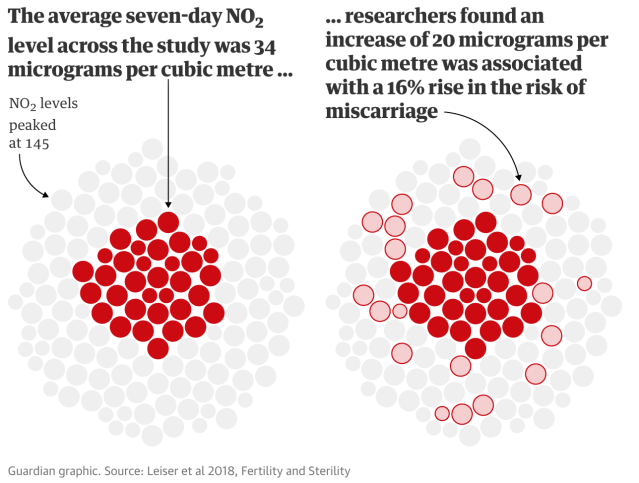
However, the latest study is the first to assess the impact of short-term exposure to air pollution. It found that raised levels of nitrogen dioxide (NO2) pollution that are commonplace around the world increased the risk of losing a pregnancy by 16%.

screen shot 2019-01-14 at 20.36.19

“It’s pretty profound,” said Dr Matthew Fuller, at the University of Utah’s department of emergency medicine and one of the research team. “If you compare that increase in risk to other studies on environmental effects on the foetus, it’s akin to tobacco smoke in first trimester pregnancy loss.” NO2is produced by fuel burning, particularly in diesel vehicles.

The research, published in the journal Fertility and Sterility, was conducted in Salt Lake City in the US, and surrounding urban areas. But Fuller said the results were applicable elsewhere: “There are many places in the world that suffer from pollution that is far greater, so this is not a problem unique to Utah. This is a problem we are all facing.” NO2 levels in Salt Lake City are similar to those in cities such as London and Paris.

Fuller was initially alerted to the issue when a family member lost a miscarried during a particularly poor period of air quality in 2016. He said: “That triggered the question in my mind and then I started noticing anecdotally that I was seeing spikes in miscarriage numbers in the emergency department during and after [pollution spikes].”

Fuller teamed up with the population health scientist Claire Leiser and others to see if the effect was real. They analysed the records of more than 1,300 women who attended the emergency department after miscarriages from 2007 and 2015.

A woman’s exposure to air pollution at the time of the miscarriage was compared with similar times when she did not miscarry, meaning that age, weight, income and other personal factors were accounted for. The strongest link with a lost pregnancy was the level of NO2 in the seven days before the miscarriage.

The average seven-day NO2 level across the whole period was 34 micrograms per cubic metre (μg/m3), but peaked at 145μg/m3. The researchers found an increase in NO2 pollution of 20μg/m3 was associated with a 16% rise in the risk of miscarriage. “Many of us think there is an effect [of air pollution] on our health, but to find out there are actual effects on unborn children is very upsetting,” said Fuller.

Higher levels of particle pollution were also linked to a greater risk of miscarriage, as found in a previous study, but the association in the new work was not statistically significant. However, other recent studies on long-term exposure to particle pollution in IranItalyMongolia and the US found significant links. Other air pollutants, including ozone and sulphur dioxide have also been implicated in these analyses.

The mechanism by which air pollution could harm a foetus has not yet been established but a likely hypothesis is that the pollutants cause oxidative stress and inflammation.

Dr Sarah Stock, at the University of Edinburgh and not part of the research team, said: “Air pollution is clearly detrimental to the health of millions of mothers, babies and children worldwide. Measures to reduce the impact of air pollution are crucial to ensure the health of future generations.”

But she noted that the risk of miscarriage varied substantially with the number of weeks of pregnancy and that the study had not been able to record this information, potentially introducing a bias into the result.

Leiser said: “If we were able to get the gestation stage that would be a real benefit, to get a sense of when the woman is most at risk. There really needs to be more studies done on this specific issue. But we know enough about air pollution and birth outcomes to say, if you are pregnant, talk to your doctor.”

The best action is to cut overall levels of pollution in urban areas, said Fuller. However he said women could choose to time their pregnancies to avoid the most polluted times of year. This is winter in Utah and many other places, but will vary depending on local conditions.

Fuller also said pregnant women could avoid exertion on polluted days and consider buying indoor air filters. “But in the developing world these are luxuries many people can’t afford,” he said.

via Air pollution ‘as bad as smoking in increasing risk of miscarriage’ | Environment | The Guardian

Posted in Air Quality, Health Effects of Air Pollution, Medical Studies | Tagged , , , | Leave a comment

Haze returns to city as long holiday ends

Air pollution caused by dust is set to worsen again in the capital, the Pollution Control Department (PCD) has warned.

The ultrafine dust returned to Bangkok on Sunday, with 21 areas reporting air pollution exceeding the “safety limits”, according to the PCD’s official release.

After clear blue skies during the New Year holiday period, the capital’s skyline was once again shrouded in smog Sunday morning.

An influx of vehicles driven by those returning from out of town coupled with dry weather and poor air circulation were blamed.

The PCD’s air monitoring station found 21 roads where levels of airborne particulate matter of up to 2.5 micrometres in diameter (PM 2.5) exceeded the acceptable Thai standard of 50 microgrammes per cubic metre (µg/m³).

Exposure to PM 2.5 has been found to cause short-term adverse health effects such as eye, nose, throat and chest irritation, as well as being linked to long-term health conditions such as asthma and cardiovascular disease.

Normal face masks do not work effectively as PM 2.5 particles are smaller than the width of a single human hair.

The PCD warned that air pollution levels Monday will range between moderate and harmful in the city, and people should monitor relevant information from authorities but not panic.

The last haze prompted City Hall to spray water to clean roads as well as implement various other measures, including a ban on parking cars on main roads and impounding vehicles with exhaust fumes that exceed emissions guidelines.

via Haze returns to city as long holiday ends | Bangkok Post: learning

Posted in Air Quality, Asia | Tagged , , , | Leave a comment

Study finds that severe air pollution affects the productivity of workers

Economists from the National University of Singapore (NUS) have completed an extensive study revealing that exposure to air pollution over several weeks is not just unhealthy, it can also reduce employee productivity.

Associate Professor Alberto Salvo from the Department of Economics at the NUS Faculty of Arts and Social Sciences and an author of the study, explained, “Most of us are familiar with the negative impact air  can have on health, but as economists, we wanted to look for other socioeconomic outcomes. Our aim with this research was to broaden the understanding of air pollution in ways that have not been explored. We typically think that firms benefit from lax pollution regulations, by saving on emission control equipment and the like; here we document an adverse effect on the productivity of their work force.”

The results of this study were published in the American Economic Journal: Applied Economics on 3 January 2019.

The link between air pollution and productivity

The NUS team, including Associate Professor Haoming Liu and Dr. Jiaxiu He, spent over a year gathering information from factories in China. This involved interviewing managers at one dozen firms in four separate provinces, before obtaining access to data for two factories, one in Henan and the other in Jiangsu.

The factories were textile mills, and workers were paid according to each piece of fabric they made. This meant that daily records of productivity for specific workers on particular shifts could be examined. Hence, the researchers compared how many pieces each  produced each day to measures of the concentration of particulate matter that the worker was exposed to over time.

A standard way of determining the severity of pollution is to measure how many  less than 2.5 micrometres in diameter (PM2.5) are in the air. The majority of people living in developing countries are exposed to particle concentrations that health authorities deem harmful. At the two factory locations, pollution levels varied significantly from day to day, and overall they were consistently high. At one location, PM2.5 levels averaged about seven times the safe limit set by the US Environmental Protection Agency, at 85 micrograms per cubic metre.

Interestingly, unlike previous literature, the team found that daily fluctuations in pollution did not immediately affect the productivity of workers. However, when they measured for more prolonged exposures of up to 30 days, a definite drop in output can be seen. The study was careful to control for confounding factors such as regional economic activity.

“We found that an increase in PM2.5, by 10 micrograms per cubic metre sustained over 25 days, reduces daily output by 1 per cent, harming firms and workers,” says Associate Professor Liu. “The effects are subtle but highly significant.”

The researchers remain agnostic about the reasons that explain why productivity goes down when pollution goes up. “High levels of particles are visible and might affect an individual’s well-being in a multitude of ways,” explained Associate Professor Liu. “Besides entering via the lungs and into the bloodstream, there could also be a psychological element. Working in a highly polluted setting for long periods of time could affect your mood or disposition to work.”

First-of-its-kind study examining prolonged exposure to air pollution

Research on how living and working in such a polluted atmosphere affects productivity is very limited, partly due to worker output being difficult to quantify. One previous study that focused on workers packing fruit in California found a large and immediate effect from exposure to ambient PM2.5, namely that when levels rise by 10 micrograms per cubic metre, workers become 6 per cent less productive on the same day.

That study’s estimate appears large for a developing country. “Labourers in China can be working under far worse daily conditions while maintaining levels of productivity that look comparable to clean air days. If the effect were this pronounced and this immediate, we think that factory and office managers would take more notice of pollution than transpired in our field interviews. Therefore, our finding that pollution has a subtle influence on  seems realistic,” Associate Professor Liu added.

All the data collected in the NUS study are being made open access to serve as a resource for other researchers to accelerate progress in this topic. “This was a key criterion for inclusion in our study,” Associate Professor Salvo added. “We wanted to share all the information we gathered so that other researchers may use it as well, hopefully adding to this literature’s long-run credibility. We saw no reason why data on anonymous workers at a fragmented industry could not be shared.”

via Study finds that severe air pollution affects the productivity of workers

Posted in Air Quality, Asia, China | Tagged , , , , , | Leave a comment