Poor air quality recorded in most of western Taiwan

The air quality in most parts of western Taiwan on Wednesday was generally rated “unhealthy,” prompting state-owned Taiwan Power Co. (Taipower) to reduce the output of two coal-fired power plants to cut air pollution emissions.

As of noon, the Environmental Protection Administration (EPA)’s Air Quality Index (AQI) flashed an orange warning, indicating unhealthy air for sensitive groups, at 31 monitoring stations in parts of western Taiwan.

The orange warnings were concentrated in central and southern Taiwan, but three also appeared in the north — in Banqiao in New Taipei, Guanyin in Taoyuan and Hukou in Hsinchu — according to the EPA’s Taiwan Air Quality Monitoring Network.

The air quality was rated as either good or fair in eastern Taiwan and mostly fair in the greater Taipei area, the monitoring data showed.

With the high number of monitoring stations flashing orange alerts in the central and southern parts of the country, Taipower reduced power generation at the coal-fired Taichung Power Plant and Hsinta Power Plant to cut air pollution emissions, according to the EPA.

The EPA’s AQI takes into account ozone, PM2.5 and PM10 particulates, carbon monoxide, sulfur dioxide and nitric oxide concentrations in the air.

via Poor air quality recorded in most of western Taiwan | Society | FOCUS TAIWAN – CNA ENGLISH NEWS

Posted in Asia, Taiwan | Tagged , , , , | Leave a comment

Agricultural fires can double Delhi pollution during peak burning season: Pollution may reach levels up to 20 times higher than safe limits

Pollution may reach levels up to 20 times higher than safe limits

It’s become a deadly autumn tradition in northern India: after the rains of the late summer monsoon subside, farmers set fires to their fields to clear stubble after the harvest and send choking smoke rolling across the countryside. New Delhi, already thick with pollution, can grind to a halt for days. Last year, the chief minister of the Delhi state likened the city to “a gas chamber.”

While crop burning has been illegal for years, there hasn’t been a large enough deterrent to effectively crack down on the practice, in part because it’s been difficult to measure exactly how much smoke from the fires is making it downwind to the city.

Now, researchers from the Harvard John A. Paulson School of Engineering and Applied Sciences (SEAS) have demonstrated that in October and November, a peak burning season in nearby Punjab, about half of all pollution in Delhi can be attributed to agricultural fires on some days.

The research is published in Environmental Research Letters.

“On certain days during peak fire season, air pollution in Delhi is about 20 times higher than the threshold for safe air as defined by the World Health Organization,” said Daniel H. Cusworth, a graduate student at SEAS and first author of the paper.

To model how much of that pollution is coming from the fires, the researchers used satellite data from NASA to identify hotspots corresponding to active fires. The team gathered available data for October and November, 2012 to 2016 and plugged it into a particle dispersion model — an algorithm that accounts for geography, wind patterns, and physics to predict how far and in what direction smoke particles travel.

During the post-monsoon season, the air in northern India is particularly stagnant, meaning smoke particles don’t vent into the atmosphere as they would during other times of the year. Instead, the black carbon and organic particulate matter slowly permeates throughout the entire region, which is home to 46 million people. In urban areas, that smoke mixes with existing pollution from cars and factories creating a thick, deadly haze.

On average, without fires, urban Delhi experiences about 150 micrograms per cubic meter of fine particulate air pollution.

To put that into perspective, the World Health Organization (WHO) puts the threshold for safe air at 25 micrograms per cubic meter, and India’s Central Pollution Control Board limits exposure to 60 micrograms per cubic meter, said Cusworth, a member of the Atmospheric Chemistry Modeling Group led by Daniel J. Jacob, the Vasco McCoy Family Professor of Atmospheric Chemistry and Environmental Engineering, and Loretta J. Mickley, Senior Research Fellow at SEAS.

Extreme fires during the post-monsoon season can pump on average about 150 micrograms per cubic meter of fine particulate matter into the city, doubling the amount of pollution and increasing total levels 12 times higher than WHO recommendations, and even 20 times higher on some days.

“A relationship between pollution and mortality is well known,” said Mickley, who co-authored of the paper. “We hope this research can help provide policymakers with a quantitative sense of the consequences of agricultural burning in order to inform decision-making.”

The paper was co-authored by Melissa P. Sulprizio, Tianjia Liu, Miriam E. Marlier, Ruth S. DeFries, and Sarath K. Guttikunda, and Pawan Gupta.

via Agricultural fires can double Delhi pollution during peak burning season: Pollution may reach levels up to 20 times higher than safe limits — ScienceDaily

Posted in Air Quality, Asia, India | Tagged , , , , , | Leave a comment

China renews blue alert for sandstorms

The national weather observatory continued its blue alert for sandstorms on Wednesday, forecasting wind and dust for north China.

From Wednesday evening to Thursday, parts of Inner Mongolia, Ningxia, Gansu, Shaanxi and Xinjiang will be affected by the dust, said the National Meteorological Center.

Parts of Inner Mongolia, Ningxia and Gansu will be swept by sandstorms.

Since Monday, the country’s northern areas have witnessed their fourth wave of dusty weather this year, affecting more than 9 provincial-level regions and covering an area of 1.5 million square kilometers, NMC data showed.

The sandstorms led to serious air pollution Wednesday. Monitoring stations in Beijing showed PM10 and PM2.5 readings jumped to nearly 2,000 micrograms per cubic meter and over 300 micrograms per cubic meter, respectively.

The center suggested people in the affected regions close their doors and windows at home and wear masks outdoors

China has a four-tier color-coded system for severe weather, with red being the most serious, followed by orange, yellow and blue.

via China renews blue alert for sandstorms – SHINE

Posted in Asia, China, Mongolia | Tagged , , , , , , , | Leave a comment

Beijing Experiences First Big Sandstorm of 2018; High Pollution Levels Leave Beijingers Dismayed

Beijingers woke up to extremely thick haze and PM10 levels of over 2,000 this morning (Mar 28) as a sandstorm settled over the capital. Though pollution levels have crept back gradually since Spring Festival, following one of the best winters Beijing has seen in five years, the off-the-scale measurements this morning have reignited widespread high-strung rhetoric about the city’s air quality.

Many of the panicked Beijingers posting photos of the soupy horizon and writing frantic messages in WeChat groups about local air quality were somewhat relieved to hear that the wildly high amounts of PM10 (bigger particulate matter than the more commonly reported on PM2.5 levels) could be attributed to the sandstorm.

Yann Boquillod, creator of the AirVisual air quality monitor, reassured fellow members of a pollution-centric WeChat group who were lobbing questions and concerns his way, writing: “The winds are supposed to blow the pollution [away], instead it brought sand. Wait for a few hours, it will be gone. Sandstorms don’t last very long, usually.”

PM10 is considered less unhealthy that its smaller PM2.5 counterpart given that though they can enter the lungs as you breathe, their larger size means that they do not pass into our bloodstream. Nevertheless, state media reports that PM2.5 levels reached 255 this morning, putting it into “very unhealthy” territory (according to the official Beijing Real-time Air Quality Index) but not wholly dissimilar to what we’ve experienced over the past few days.

For some context, Beijing has certainly seen worse, say during the stretch of red alert level smog in late 2016 and late 2015, or the “airpocalypse” of 2013.

Such ongoing concerns are compounded for parents like Sugandha Joshi, who hails from India and arrived in Beijing last year with her family. “Pollution was our biggest concern when we decided to move into Beijing, but we were so glad to find that throughout the winter the air was clean,” she says. However, now she is left to wonder “why the pollution is increasing with the arrival of spring? As a mother of a three-year-old who goes to a kindergarten, naturally, I am concerned.”

Geiger

Geiger with his daughter. He tells the Beijinger that “My toddler has grown up thinking the sky is normally white.” – Photo: Kyle Mullin, courtesy of Kevin Geiger

Another expat parent named Kevin Geiger, who has lived in Beijing since 2008, concurs, saying he is deeply worried about how the capital’s air quality is affecting his three-year-old daughter and his newborn. “My toddler has grown up thinking the sky is normally white,” he says. However, the recent resurgence in smog hasn’t prompted him to flee the capital just yet. “Simply pulling up and out is not so simple. Our lives and our children’s lives are here,” he says.

Those of us who, like Geiger, have decided to remain in Beijing despite its notorious haze can be heartened by one point raised by an air quality expert, who spoke to the Beijinger on the condition of anonymity. He said: “We estimate that we had 50 percent fewer emissions over this winter compared to last.” He went on to attribute that to actual progress, rather than flukes like better weather, saying: “The [recent] good weather was not the reason for low pollution because the weather was nearly the same as previous years.” Based on that, the prospects for Beijing’s air quality are still boding well overall, meaning the grim appearance of today’s skyline or the uptick of smog in recent weeks shouldn’t leave us to despair just yet.

Remember, if you’re concerned about high pollution levels, avoid exercising outside, stay in a low-polluted environment (via an air filter etc.), and wear a mask that works if you do need to venture outside. For articles on these and more, read our full air pollution coverage here.

via Beijing Experiences First Big Sandstorm of 2018; High Pollution Levels Leave Beijingers Dismayed | the Beijinger

Posted in Air Quality, Asia, China | Tagged , , , , | Leave a comment

As fires spread in North, pollution levels spiral

Public cautioned to respect burning ban 

Air pollution in northern Lampang and Phayao provinces escalated to hazardous levels yesterday as fires spread in the region.

The PM10 level stood at between 81 and 104 microgrammes per cubic metre, up from Sunday’s readings, according to information provided by the Pollution Control Department’s (PCD) measuring stations in Lampang’s Muang and Mae Mo districts.

Though the levels were still under the safe limit of 120 ug/m³, officials said they were treating the situation seriously as dust levels continue to rise.

Forest fires are a major cause of fine dust, or particulate matter known as PM10. These particles are less than 10 microns in diameter — or about 1/7th as thick as a human hair. PM10 can trigger asthma attacks, cause or aggravate bronchitis and other lung diseases, and reduce the body’s ability to fight infections, according to information from the PCD.

Hazy conditions in the North have been blamed on fires tied to agricultural burning practices and the extreme dryness seen from February to April, when rainfall is less common.

The situation in Lampang deteriorated Monday as brush fires in Chae Som forest reserve kept expanding, Ronnarong Koetnuan, head of the reserve’s fire-forest prevention unit, told media outlets.

So far, 59 rai have been ravaged, including forest areas inside the Doi Phra Bat wildlife sanctuary and Mae Suk-Mae Soi forest reserve in Muang Pan district. Mr Ronnarong pointed an accusing finger at…

via As fires spread in North, pollution levels spiral | Bangkok Post: news

Posted in Air Quality, Asia | Tagged , , , , , , | Leave a comment

Major link between air pollution and childhood asthma in Bradford, study finds

The study adds to ‘overwhelming evidence’ that air pollution is harming children, it is claimed.

Air pollution may be responsible for nearly 40% of childhood asthma cases in a northern city that was at the centre of the Industrial Revolution, a study has found.

The new research puts Bradford on the map – but not in a good way.

International scientists used computer simulations to assess the impact of exposure to irritant gases called nitrogen oxides in the West Yorkshire city.

f73d0482-f588-4315-9a27-7bc6c37ddc32-1366x456

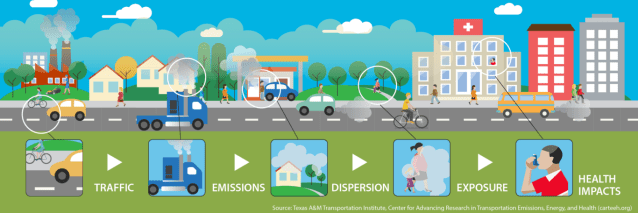
Graphic charting the impact of air pollution. (Center for Advancing Research in Transportation Emissions, Energy, and Health http://www.carteeh.org/PA)

They found that up to 38% of all annual cases of childhood asthma in Bradford may be attributable to air pollution.

Pollution from road vehicles alone was linked to 24% of cases.

Dr Haneen Khreis, who led the research while working at the University of Leeds’ Institute for Transport Studies, said: “Overall rates of childhood asthma cases in Bradford are higher than the national average as were emergency hospital admissions for asthmatic children under 16 years of age.

“Traffic-related air pollution is a real concern to the community.

“Our team’s previous research has shown that children exposed to high levels of traffic-related air pollution have a higher risk of developing asthma.

“Quantifying the number of childhood asthma cases that are directly attributable to traffic-related air pollution has not been done in the past and as we show now, a significant portion of cases is largely preventable.”

The computer models in the study allowed the team to chart how much air pollution was present in the city and how much of it could be traced to road traffic.

The findings, reported in the journal Environment International, shed light on the reasons why rates of childhood asthma have soared in the UK since the 1950s.

Britain has one of the highest rates of childhood asthma in the world, with an estimated one in 11 children suffering from the lung condition.

Asthma facts

  • Asthma affects one in 11 individuals and one in five households in the UK, a total of 5.4 million people.
  • Every 10 seconds someone in the UK has a potentially life-threatening asthma attack.
  • A total of 1.1 million children in the UK – one in 11 – suffer from asthma.
  • On average, three people in the UK die every day from asthma.
  • In 2016, a total of 1,410 people were killed by the condition.
  • The NHS spends around £1 billion a year treating and caring for people with asthma.

Asthma UK

Around 5.4 million people in the UK are living with asthma, including 1.1 million children, according to the charity Asthma UK.

In 2016, a total of 1,410 people in Britain died from asthma.

Overall, asthma rates in the UK are thought to have plateaued since the 1990s.

Professor John Wright, director of the Bradford Institute for Health Research, said: “This important study adds to the overwhelming evidence that air pollution is harming our children.

“The good news is that we can all save lives by driving less and using cleaner fuels.”

Bradford was at the heart of the Industrial Revolution, which saw the city become a textile boom town in the 19th century, largely thanks to easy access to coal for fuel.

Major sources of air pollution in the Bradford area include traffic, industry, domestic and commercial heating, and to a lesser extent diesel trains and aircraft, said the researchers.

Simon Bowens, from the environmental group Friends Of The Earth, said: “Bradford’s rates of childhood asthma are a chilling reminder that air pollution is a public health crisis, and it is our children that are bearing the brunt of it. Swift action is needed to clean up Bradford’s air, with the wellbeing of residents depending on it.”

via Major link between air pollution and childhood asthma in Bradford, study finds | BT

Posted in Air Quality, Asthma, Europe, Health Effects of Air Pollution, UK | Tagged , , , , | Leave a comment

Sweden gives green light for cities to ban old diesel cars

Sweden’s towns will soon be allowed to ban old diesel engines from their town centres in an effort to improve the environment and combat air pollution, the government announced on Friday.
Sweden’s centre-left Social Democrat-Green coalition government did not impose such rules itself, but left the decision up to local authorities.

From the start of year 2020, cities and municipalities will be allowed to create environmental zones regulating the cars in the zones. Diesel cars meeting the emission standards of Euro 5 and Euro 6 will be permitted in the zones, but from July 1st 2022 only Euro 6 diesel cars will be allowed.

Cars running on petrol will be allowed in the zones if they meet the Euro 5 emission standards.

The EU’s emission standards Euro 5 and Euro 6 came into force on September 1st 2009 and September 1st 2014, respectively. The new rules therefore affect cars older than that.

In Sweden around 1.3 diesel cars would be affected by the new rules, reports the TT newswire. In Stockholm alone around 50,000 car owners would be squeezed out, according to official estimates.

Councils will also be allowed to create a separate category of even more tightly regulated zones allowing access only to electric cars, fuel cell vehicles and cars running on Euro 6 natural gas.

However, the decision for imposing the environmental zones is left up to local authorities. The ruling parties in Malmö are against it; in Gothenburg even parties on the same side are split.

“Our air is so clean we don’t think we need it,” said Malmö councillor Andreas Schönström.

In Stockholm, opinion on whether to go ahead with environmental zones as early as 2022 is divided, and even then is likely it would only affect certain streets, not the entire city centre.

In any case, Sweden is not the only country to propose such rules amid a raging debate about diesel engines. In Germany, a top court ruled last month that cities can impose diesel driving bans.

via Sweden gives green light for cities to ban old diesel cars – The Local

Posted in Air Quality, Europe | Tagged , , , , , | Leave a comment

Respro® Experience: Running in Cold Temperatures

SAND ULTRALIGHT TRICK

Yesterday I went running with my Respro® Ultralight™ mask. I had heard that runners and cyclists use the mask to warm up their lungs while training in cold temperatures so I thought I’d try it for myself. It was snowing slightly at minus 1 degree with a wind chill factor that made it feel even colder and the path along the river where I run is exposed to the elements.

I started my jog with my mask on and had no problem keeping to my normal jogging
pace. At first it felt a bit odd to have my mouth and nose covered but as it wasn’t impeding my breathing I continued. My face also felt warmer in the biting wind. After 1.5 km my lungs felt warm so I decided to take the mask off to see if there was any noticeable difference. Initially, I had a burst of energy feeling freer but that soon changed as my lungs started to feel tighter very quickly in the cold air. I ran for 1km and my pace slowed down to under my usual steady jog pace 5:30Min/km. The air temperature seemed to be making it harder for my lungs to stay open and I was having to work harder to keep up my pace. For my last 1km I stopped briefly and put the mask back on and my pace started to improve. I settled back into a steady jog no problem at all.

I repeated this the next day. It was another cold day and the results were the pretty much the same, usual steady pace with mask on, slower pace with mask off.

What surprised me was how my initial thoughts of the mask being restrictive changed to seeing the mask as being beneficial and enabling, which made it easier to wear it the second time round; in fact I wanted to wear it!

Whilst I mostly run in an environment which is not heavily polluted, I will definitely wear my mask while running in cold temperatures regardless of air quality. I could feel the benefit and my performance was not impacted in anyway.

Note: mask in picture: I ‘pimped’ my Sand coloured Respro® Ultralight™ mask with multi-coloured cotton thread easy to do back-stitch.

Pearl, UK

Posted in Air Quality | Leave a comment