Low-Emission Zone now operational in downtown Haifa; Israel’s first; initially targeting heavy diesels

Israel’s Ministry of Environmental Protection (MoEP) and Haifa Municipality have begun operating a low-emission zone (LEZ). As of 2 February 2018, polluting heavy diesel vehicles were no longer allowed in downtown Haifa. These buses and trucks must install a particulate filter in order to enter the restricted area. The creation of a low-emission zone (LEZ) is part of a larger plan to reduce air pollution from transportation in Haifa.

The LEZ plan is divided into two parts: The first stage, which began 2 February, includes only diesel vehicles weighing more than 3.5 tons. About 22,000 owners of polluting diesel vehicles have received letters that explained the restriction and gave them the option of installing a particulate filter in their heavy vehicles at a subsidized price. In addition, there was extensive publicity about the LEZ and road signs have been put up throughout Haifa.

During this the first stage, the Haifa municipality will issue warnings to owners of polluting vehicles that enter the restricted areas, explaining that if they do not install a particulate filter in their vehicle, they will be fined if they enter the LEZ. Enforcement during this stage will be carried out by city inspectors and the Israel Police. Then cameras will be installed at entrances to the city and enforcement will be carried out automatically.

In the second stage, to begin in early 2019, all diesel fuel vehicles (including vans and commercial vehicles under 3.5 tons, but excluding private cars) that do not meet Euro 4 standards for air pollution will be restricted from the LEZ. These vehicles will only be allowed to enter the LEZ if a particulate filter that reduces air pollution is installed in them.

Haifa is the first [city we are taking on] in the revolution that we’re leading in Israel to reduce vehicular air pollution. Some 1,100 people die every year as a result from air pollution from transportation, and a low-emission zone has proven to be one of the most efficient tools in the significant reduction of vehicular air pollution in large cities. We hope that Haifa is only the beginning of a change. In the near future, this model will expand into the Krayot and Jerusalem, and I call upon other mayors to take part in this struggle, which is important to our health and our children’s health. We will no longer be indifferent to vehicular air pollution.

—Environmental Protection Minister Zeev Elkin
The LEZ plan is a significant component of a range of additional actions promoted by the municipality and the government to reduce air pollution in Haifa Bay and Israel. Among the actions taken by the national government are subsidies for hybrid taxis; incentives to purchase electric buses; and support for electric car-sharing programs.

The Haifa Bay industrial zone is one of the most sensitive areas in Israel in terms of air pollution due to its large concentration of industrial facilities, port, petrochemical complex, physical proximity to concentrations of population, and topographical and climatic factors that affect the dispersion of pollutants.

Screen Shot 2018-02-15 at 09.26.55

NOx emissions from the transportation sector in Haifa have remained fairly stable, while those from the power-generation sector and industry have dropped. Source: MOEP.

In 2008, a task force was created to create and implement a Haifa Bay Action Plan to reduce these emissions. The plan focused on NMVOCs and on about 15 facilities and installations with high pollution potential.

In September 2015, the Israeli government approved an updated, ILS 330-million (US$93-milion) Action Plan to Reduce Air Pollution and Environmental Risks in Haifa Bay. The new Haifa LEZ is a result of this updated plan.

via Low-Emission Zone now operational in downtown Haifa; Israel’s first; initially targeting heavy diesels – Green Car Congress

Posted in Air Quality, Middle East | Tagged , , , | Leave a comment

Iran: Air Pollution In Southwestern City 60 Times Higher Than Safe Levels

Heavy air pollution caused by haze and dust particles in Iran’s southwestern city of Ahvaz, Khuzestan Province, has surged to 60 times above safe levels, crossing the “hazardous” level, in which the entire population is likely to experience adverse health effects.

According to the latest data released by the Environmental Protection Organization of the province, the air quality index in Ahvaz on Tuesday showed 9,000 micrograms per cubic meter, indicating that the dust pollution is 60 times higher than the permitted level.

The air pollution in Mahshahr, Khuzestan, has also reached 2,101 micrograms per cubic meter, according to the data.

Last month, Leader of the Islamic Revolution Ayatollah Seyed Ali Khamenei authorized the Iranian administration to withdraw a sum of $150 million from the National Development Fund for projects to tackle the heavy dust pollution in the country.

The order came as President Hassan Rouhani on January 22 ordered Agriculture Minister Mahmoud Hojjati and Head of Iran’s Environmental Protection Organization (IEPO) Isa Kalantari to pay a visit to the southwestern parts of the country to address the heavy dust pollution in the areas.

Kindergartens, schools and some organizations in many cities in Khuzestan have been closed down in recent weeks because of the heavy dust pollution.

via Iran: Air Pollution In Southwestern City 60 Times Higher Than Safe Levels – Eurasia Review

Posted in Air Quality, Iran, Middle East | Tagged , , | Leave a comment

Nine states censured by EU over illegally high air pollution levels

400,000 Europeans die prematurely every year from air pollution.

The Czech Republic is one of nine EU states summoned to Brussels recently to explain what they’re doing about illegally high pollution levels.

Officials from the nine, including Germany, Spain, France, Italy, Hungary, Romania, Slovakia and the UK,  were censured at an air quality ministerial summit on 30 January.

They were warned that if they don’t lower their levels they’ll be referred to the European Court of Justice – and cases against Bulgaria and Poland have already commenced.

EU air quality limits are currently breached in 130 cities in 23 EU countries and every year, more than 400,000 Europeans die prematurely from air pollution.

via Nine states censured by EU over illegally high air pollution levels | Euronews

Posted in Air Quality, Europe, France, Germany, Italy, Spain, UK | Tagged , , , , , , , , , , , | Leave a comment

Rainmakers consider seeding Bangkok sky as PM2.5 returns to ‘safe’ level

The Royal Rainmaking and Agricultural Aviation Department is preparing to seed clouds above Bangkok in an attempt to ease the capital’s smog problems.

Haze has spread over the capital over the past few days, causing a health hazard for vulnerable people, and leading Agriculture and Cooperatives minister Grisada Boonrach to order that rainmaking operations be carried out.

Two of the department’s aircraft took off yesterday in response to the order to survey the city’s conditions and plan rainmaking.

Rainmaking operations have previously helped fight the haze crisis in the North.

The Pollution Control Department announced at 3pm yesterday that the amount of PM2.5 particulate matter in Bangkok had returned to safe limits.

PM2.5 refers to particulate matter below 2.5 micrometres in diameter.

“The amount ranged between 38 and 49 micrograms per cubic metre of air,” the department said.

According to the department, PM2.5 poses a health threat when it reaches above 50 micrograms per cubic metre of air, while the World Health Organisation puts the limit at 25 micrograms.

Environmental group Greenpeace Thailand has lately reported that authorities must take into account PM2.5 levels when assessing air quality.

In the past, the Pollution Control Department usually used PM10 as their main indicator and excluded the PM2.5 measurements.

via Rainmakers consider seeding Bangkok sky as PM2.5 returns to ‘safe’ level

Posted in Air Quality, Asia, Thailand | Tagged , , , | Leave a comment

Thick haze layer envelopes city

Mumbai: air quality remained ‘poor’ for yet another day with thick layer of haze over the city. The overall Air Quality Index (AQI) level of Mumbai was recorded at 263 on Thursday, according to the System of Air Quality and Weather Forecasting And Research (SAFAR). While the PM2.5 levels across the city have been recorded at being more than 300 at places, the Nitrogen Oxides (NO2) levels also soared up to 180 at various areas on Thursday against the standard limit of 100. Experts stated that prolonged increase of NO2 levels could cause respiratory problems for sensitive people.

NO2 gases are usually produced by the combustion of fuels in air at high temperatures, such as in car engines. These gases contribute to the formation of smog and acid rain. Among the four cities that SAFAR monitors, including Delhi and Ahmedabad that recorded ‘very poor’ and ‘poor’ AQI levels respectively, NO2 levels were seen highest in Mumbai.

“While the PM2.5 is the major pollutant in Mumbai, the NO2 levels had also increased in the city. The decline in the city’s air quality could be attributed to both pollution levels and weather condition,” said Gufran Beig, Project Director, SAFAR. The Asian Age had reported that the withdrawal of the western disturbances and increase in moisture levels have led to suspension of pollutants in the air.

Areas like Borivali, Bhandup, BKC, Mazag-aon and Navi Mumbai recorded ‘very poor’ AQI with PM2.5 levels highest in Mazagaon at 338. NO2 levels in Bhandup and BKC were recorded at 180 while Navi Mumbai recorded 117. All of these readings fall under ‘moderate’ levels. “When the NO2 levels are this high, it shows that the city needs to curb its vehicular and industrial pollution. The weather conditions are showing what is there in the air. The city needs to come up with a holistic transport system and reduce the number of private vehicles,” said Sunil Dahiya, senior campaigner, Greenpeace.

via Thick haze layer envelopes city

Posted in Air Quality, Asia, India | Tagged , , | Leave a comment

Polluted air may pollute our morality

Exposure to air pollution, even imagining exposure to air pollution, may lead to unethical behavior, according to findings published in Psychological Science, a journal of the Association for Psychological Science. A combination of archival and experimental studies indicates that exposure to air pollution, either physically or mentally, is linked with unethical behavior such as crime and cheating. The experimental findings suggest that this association may be due, at least in part, to increased anxiety.

“This research reveals that air pollution may have potential ethical costs that go beyond its well-known toll on health and the environment,” says behavioral scientist Jackson G. Lu of Columbia Business School, the first author of the research. “This is important because air pollution is a serious global issue that affects billions of people—even in the United States, about 142 million people still reside in counties with dangerously polluted air.”

Previous studies have indicated that exposure to air pollution elevates individuals’ feelings of anxiety. Anxiety is known to correlate with a range of unethical behaviors. Lu and colleagues hypothesized that pollution may ultimately increase criminal activity and unethical behavior by increasing anxiety.

In one study, the researchers examined air pollution and crime data for 9,360 US cities collected over a 9-year period. The air pollution data, maintained by the Environmental Protection Agency, included information about six major pollutants, including particulate matter, carbon monoxide, nitrogen dioxide, and sulfur dioxide. The crime data, maintained by the US Federal Bureau of Investigation, included information about offenses in seven major categories, including murder, aggravated assault, and robbery.

The researchers found that cities with higher levels of air pollution also tended to have higher levels of crime. This association held even after the researchers accounted for other potential factors, including total population, number of law enforcement employees, median age, gender distribution, race distribution, poverty rate, unemployment rate, unobserved heterogeneity among cities (e.g., city area, legal system), and unobserved time-varying effects (e.g., macroeconomic conditions).

To establish a direct, causal link between the experience of air pollution and unethical behavior, the researchers also conducted a series of experiments. Because they could not randomly assign participants to physically experience different levels of air pollution, the researchers manipulated whether participants imagined experiencing air pollution.

In one experiment, 256 participants saw a photo featuring either a polluted scene or a clean scene. They imagined living in that location and reflected on how they would feel as they walked around and breathed the air.

On a supposedly unrelated task, they saw a set of cue words (e.g., sore, shoulder, sweat) and had to identify another word that was linked with each of the cue words (e.g., cold); each correct answer earned them $0.50. Due to a supposed computer glitch, the correct answer popped up if the participants hovered their mouse over the answer box, which the researchers asked them not to do. Unbeknownst to the participants, the researchers recorded how many times the participants peeked at the answer.

The results showed that participants who thought about living in a polluted area cheated more often than did those who thought about living in a clean area.

In two additional experiments, participants saw photos of either polluted or clean scenes taken in the exact same locations in Beijing, and they wrote about what it would be like to live there. Independent coders rated the essays according to how much anxiety the participants expressed.

In one of the experiments conducted with university students in the US, the researchers measured how often participants cheated in reporting the outcome of a die roll; in the other experiment with adults in India, they measured participants’ willingness to use unethical negotiation strategies.

Again, participants who wrote about living in a polluted location engaged in more unethical behavior than did those who wrote about living in a clean location; they also expressed more anxiety in their writing. As the researchers hypothesized, anxiety level mediated the link between imagining exposure to air pollution and unethical behavior.

Together, the archival and experimental findings suggest that exposure to air pollution, whether physical or mental, is linked with transgressive behavior through increased levels of anxiety.

Lu and colleagues note that there may be other mechanisms besides anxiety that link air pollution and unethical behavior. They also acknowledge that imagining experiencing air pollution is not equivalent to experiencing actual air pollution. They highlight these limitations as avenues for further research.

Ultimately, the research reveals another pathway through which a person’s surroundings can affect his or her behavior:

“Our findings suggest that air pollution not only corrupts people’s health, but also can contaminate their morality,” Lu concludes.

via Polluted air may pollute our morality

Posted in Air Quality, Health Effects of Air Pollution, Medical Studies | Tagged , , , | Leave a comment

Bangkok’s air pollution level remains high

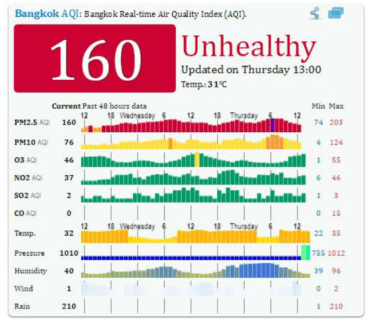
The Pollution Control Department warned on Thursday that unhealthy levels of particulate matter would continue to make life uncomfortable in Bangkok for a few more days, blaming it on weather conditions.

The department reported the noon levels of particulate matter 2.5 microns or less in diameter (PM2.5) ranged between 72 and 95 microgrammes per cubic metre of air. This was up from 69-94mcg on Thursday morning. The safe level is no more than 50mcg.

The department said fine-particle pollution was rising throughout the capital.

Director-general Sunee Piyapanpong said the cold weather caused particulate matter to accumulate in the air and, based on weather forecasts, Bangkok’s air was likely to remain highly unhealthy for a few more days.

She advised people with health problems, especially respiratory issues, to avoid areas of traffic congestion but she did not warn against outdoor activities at this time.

The city’s air has been polluted since late last month. Officials blamed it on still air, which was normal during the seasonal transition from winter to summer and does not ventilate the capital.

Screen Shot 2018-02-08 at 09.03.00

via Bangkok’s air pollution level remains high | Bangkok Post: news

Posted in Air Quality, Asia, Thailand | Tagged , , | Leave a comment

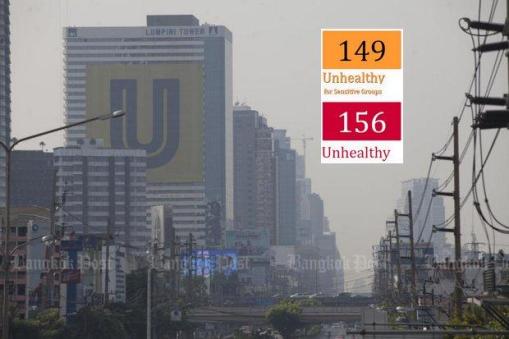
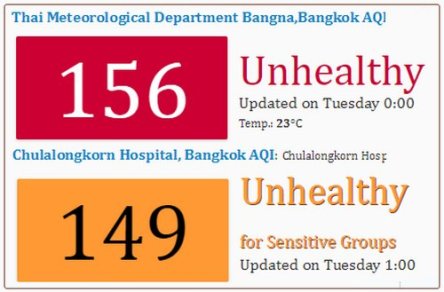
Bangkok chokes again on hazardous haze

c1_1407994_180206043733_620x413

Haze in Bangkok containing dust particles reached 82 microgrammes per cubic metre Monday, exceeding safe limits, according to the Pollution Control Department.

The department on Monday reported four locations in the city affected by airborne particulates that exceeded the safe limit of of 50 μg/m3.

Levels of dust were measured at 82 μg/m3 along Intharaphithak Road, 68 μg/m3 in Wang Thonglang district and 63 μg/m3 along Rama IV and Lat Phrao Roads.

The airborne particulates tended to increase as a result of gusty winds and temperatures dropping to 19C-20C, the department said. Patients suffering from respiratory and cardiovascular diseases were advised to wear masks if they head outdoors.

2641550

Also Monday, the Public Health Ministry intensified preventive measures against annual haze across the upper North to reduce health risks caused by air pollution.

Health Department director-general Wachira Pengchan said the measures would be implemented in eight northern provinces.

They are Chiang Mai, Chiang Rai, Mae Hong Son, Lampang, as well as Lamphun, Phayao, Prae, and Nan.

Local public health agencies were told to work closely with the public in the provinces which tend to face air pollution caused by slash-and-burn activities by farmers from January to April every year.

People’s health can be badly affected by harmful haze, Mr Wachira said.

He was speaking at a meeting discussing public health policy against haze in Phayao on Monday.

The meeting was also attended by over 100 officials attached to local public health agencies from the eight provinces.

Health risk assessments must be conducted to provide proper healthcare and preventive measures, he said. Public awareness about haze must be also improved, he added.

Kraisook Phetcharaburanin, a doctor at the Phayao Provincial Public Health Office, said the eight provinces have suffered from haze related air pollution since 2002.

According to the Chiang Mai-based Office of Disease Prevention and Control 1, the upper North saw the highest number of cardiovascular diseases and respiratory illness cases caused by dust particles.

via Bangkok chokes again on hazardous haze | Bangkok Post: news

Posted in Air Quality, Asia, Thailand | Tagged , , , , | Leave a comment