Delhi Air Pollution: ‘Dust’ Screen Hiding Bigger Killers

Dust may be the most visible marker of Delhi’s air pollution, but its sheer abundance may actually be masking the bigger killers- emissions from vehicles, thermal power plants and industries.

Studies and research reports have underlined that it’s the chemical composition of ultrafine particulates PM2.5 or PM10, and not their volume, which is more crucial in determining the toxicity of air.

The Environment Pollution (Prevention and Control) Authority (EPCA), a Supreme Court-appointed pollution watchdog, made a similar point in a report to the top court, that particles from coal and diesel are more harmful than wind-blown dust, as they can lead to an increase in heart disease-related deaths.

“Similarly, particles from diesel combustion are very toxic and have been classified by the World Health Organisation as a class I carcinogen for strong links with lung cancer, putting them in the same bracket as tobacco smoking and asbestos.

“This suggests that we must prioritise the more harmful particulates for action. Combustion sources- vehicles, power plants and industry- need more stringent and priority action,” the report says.

The EPCA mentioned it separately under a section addressing number versus toxicity.

An Indian Institute of Technology-Kanpur report, which assessed the chemical composition of pollution from various sources in the city, also concluded that combustion- vehicular and industrial alike- was responsible for the formation of PM2.5 in greater quantity.

Among PM2.5 and PM10, the most dominant pollutants in Delhi’s air, PM2.5 is deadlier owing to its tinier size, up to 30 times smaller than the width of a human hair, aiding it in lodging deep in the lungs and subsequently entering the bloodstream.

The IIT report found that PM2.5 Nitrate particles formed from nitrogen oxides and sulphate particles formed from sulphur dioxides can be 25 per cent of the total PM2.5 load in the city.

Both nitrates and sulphates are classified as ‘secondary particles’, which are formed due to the reaction of gases such as sulphur dioxide (SO2) and oxides of nitrogen (NOx) emitted from vehicles, thermal power plants and industries.

“In a broad sense, fractions of secondary particles of both PM 10 and PM2.5 in two seasons were consistent and need to be controlled for better air quality in Delhi and the National Capital Region,” the report pointed out.

It estimates that of around 312 tons of NOx produced per day in the city, nearly 52 per cent come from industrial point sources such as power plants and 36 per cent from vehicular emissions, “probably making it the most important emission”.

via Delhi Air Pollution: ‘Dust’ Screen Hiding Bigger Killers
Posted in Air Quality, Asia, India | Tagged , , , , , , , | Leave a comment

European Air Quality Index: current air quality information at your finger tips

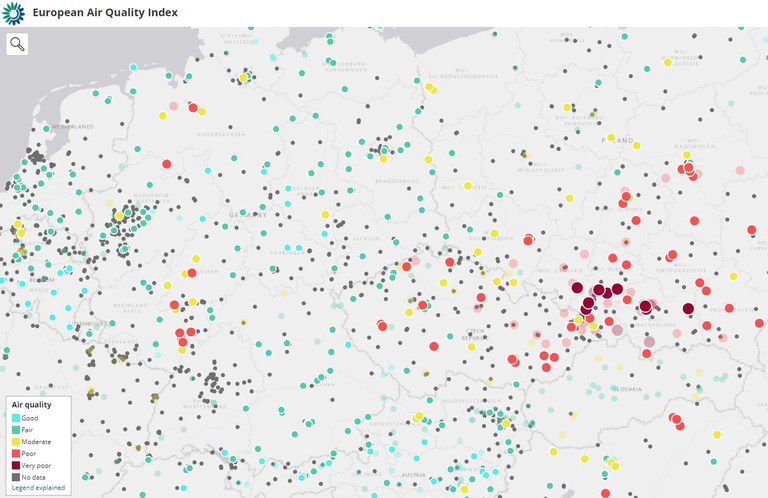
A new European Air Quality Index, launched today by the European Environment Agency (EEA) and the European Commission, allows users to check the current air quality across Europe’s cities and regions. The Index is accompanied by new country fact sheets that provide updated air quality information for EEA member countries.


The EEA and the European Commission’s new online service, the European Air Quality Index, provides information on the current air quality situation based on measurements from more than 2 000 air quality monitoring stations across Europe.

The Index consists of an interactive map that shows the local air quality situation at station level, based on five key pollutants that harm people’s health and the environment: particulate matter (PM2.5 and PM10), ground-level ozone (O3), nitrogen dioxide (NO2) and sulphur dioxide (SO2).

Users can zoom in or search for any town or region in Europe to check the overall air quality and measurements per key pollutant. The Index shows an overall rating for each monitoring station, marked by a coloured dot on the map, corresponding to the worst rating for any of the five pollutants.

“The new European Air Quality Index gives citizens an easy way to access information on their local air quality, which can have a direct impact on their health. This information, accessible to everyone, is an important basis for a dialogue and decisions that are needed to safeguard people’s health, especially in cities,” said Hans Bruyninckx, EEA Executive Director, presenting the Index today at the Clean Air Forum, organised by the European Commission, in Paris.

Karmenu Vella, EU Commissioner for the Environment, Maritime Affairs and Fisheries, also welcomed the Index, saying: “Air pollution is an invisible killer, so the Air Quality Index is needed to inform European citizens on the state of the air they breathe in their own neighbourhood. We are working with cities, regions, countries and industry to tackle the sources of that pollution, which is a cocktail coming from factories, homes and fields, not only from transport. We must all work together to improve air quality.”

The EEA has also published updated country fact sheets that provide an annual summary of air pollution and its impacts in EEA member countries. Providing more detailed, country-level information on both air pollutant emissions and air quality, the fact sheets complement the EEA’s annual Air Quality in Europe – 2017 report, published in October.

The EEA’s latest annual air quality report shows that most people living in Europe’s cities are still exposed to levels of air pollution deemed harmful by the World Health Organization. The most harmful pollutant, fine particulate matter (PM2.5), caused the premature death of an estimated 400 000 Europeans in 2014. According to the report, air pollution has also significant economic impacts, increasing medical costs, reducing employees’ productivity, and damaging soil, crops, forests, lakes and rivers. Road transport, agriculture, power plants, industry and households are the biggest emitters of air pollutants in Europe.


via European Air Quality Index: current air quality information at your finger tips — European Environment Agency

Posted in Air Quality, Europe | Tagged , , , , , , | Leave a comment

Air pollution linked to osteoporosis-related bone fractures

Exposure to air pollution increases the risk of bone loss and fractures.

Beyond the risks of cardiovascular disease, respiratory disease and even cancer, living in a highly polluted zone for a significant time could increase the risk of osteoporosis-related bone fracture, especially in older people.

This is according to two new American studies published in the journal The Lancet Planetary Health.

Exposure to high levels of fine particulate matter (PM2.5) in the atmosphere could accelerate bone density loss and increase the risk of fracture, say researchers at Columbia University’s Mailman School of Public Health, New York.

Like the toxic substances in cigarette smoke, air pollution could cause inflammation and oxidative stress, leading to bone loss.

The researchers came to this conclusion by means of two parallel studies. In the first, they studied hospital admissions between 2003 and 2010 for osteoporosis-related fractures in patients over 65 years old. The results indicated that even small increases in fine particle concentrations could lead to an increase in bone fractures in older adults.

In the second study, the scientists followed 692 men from low-income backgrounds in the region of Boston over the same period. Participants’ average age was 47. They found that adults living in areas with high levels of fine particles and black carbon, a pollutant from automotive emissions, had lower levels of parathyroid hormone, a key calcium and bone-related hormone.

The researchers also found that participants in the study had greater decreases in bone density than men exposed to lower levels of these pollutants.

In April, the same team of experts published research reporting that B vitamins (50 milligrams of B6, 2.5 milligrams of B9, 1 milligram of B12) could diminish the toxic effects of air pollution on the immune and cardiovascular systems. However, scientists are currently unsure whether the benefits of B vitamins extend to bone loss.

The researchers report that there are an estimated two million osteoporosis-related bone fractures in the United States each year.

The researchers conclude that, like smoking and lack of physical exercise, air pollution is a risk factor for bone fractures.

via Air pollution linked to osteoporosis-related bone fractures | The Citizen

Posted in Air Quality, Health Effects of Air Pollution, Medical Studies | Tagged , , | Leave a comment

People with certain blood types appear to be more at risk from air pollution

The kind of blood you have could increase or decrease your risk of having a heart attack in response to high levels of air pollution, new research suggests.

A variant ABO gene – which can only be found in A, B, and AB blood types – has been linked with elevated risk of heart attack during periods of significant air pollution, whereas people with blood type O show lower risk.

“We wondered, if someone has a specific variation in this ABO gene, are they more or less likely to experience a heart attack in times of higher pollution?” says clinical epidemiologist Benjamin Horne from the Intermountain Medical Center Heart Institute in Salt Lake City, Utah.

Horne’s team analysed data from Intermountain Healthcare patients seen between 1993 and 2007, and identified a subset of patients that experienced an acute coronary syndrome (ACS) event corresponding with short-term exposure to high PM2.5 levels – a measure of concentration of fine, inhalable particles with a diameter of 2.5 micrometres and smaller.

When they cross-matched the data, they found that carriers of an ABO variant called rs687289 A allele had a marginally higher risk of heart trouble during high PM2.5 concentrations.

“The primary mutation we studied differentiates between O blood types and non-O, which includes positive and negative A, B, and AB blood types,” says Horne.

“The one that’s been found in genetic studies to be lower risk is O. The other three were higher risk.”

That said, everybody’s level of risk appears to rise when PM2.5 concentration rises above the threshold of 25 micrograms of fine particles per cubic metre of air – it’s just that the risk goes up more for people with non-O blood types.

“Two years ago we published findings that showed once you go above that, each additional 10 micrograms of pollution per cubic metre of air provided substantially higher risks,” says Horne.

“At levels higher than 25 micrograms per cubic metre of pollution, the increase in risk is linear, while below that level there’s little if any difference in risk.”

For each 10 additional micrograms of PM2.5 particles per cubic metre, risk for people with non-O blood types goes up by 25 percent, whereas for people with O blood it only goes up by 10 percent.

It’s not the only time recently that blood types have been linked with these kind of cardiac problems.

A study presented in April analysed more than 1.3 million people and also found that people with non-O blood types stood a higher risk of cardiovascular events including heart attacks and stroke, although it did not establish what causal mechanisms were behind the pattern.

In reference to the latest research, the team says the new findings aren’t anything to panic over, but are worth being aware of.

“In the information we provide to our patients about pollution, we try to stress that they can do something about it to reduce their risks,” Horne says.

“Stay indoors out of pollution. Exercise indoors. And make sure they’re compliant with taking their heart medication to reduce their risk.”

The findings were presented this week at the American Heart Association’s Scientific Sessions 2017 conference in Anaheim, California.

via People with certain blood types appear to be more at risk from air pollution – ScienceAlert

Posted in Air Quality, Health Effects of Air Pollution, Medical Studies | Tagged , , , | Leave a comment

Air pollution may increase osteoporosis-related bone fracture risk

Adults, particularly those with a low income and aged at least 65 years, have an increased risk for bone fracture and osteoporosis-related loss of bone mineral density with long-term exposure to air pollution, according to findings published in The Lancet Planetary Health.

“Decades of careful research has documented the health risks of air pollution, from cardiovascular and respiratory disease, to cancer and impaired cognition, and now osteoporosis,” Andrea Baccarelli, MD, PhD, chair and Leon Hess professor of environmental health sciences at the Mailman School of Public Health, Columbia University, said in a press release. “Among the many benefits of clean air, our research suggests, are improved bone health and a way to prevent bone fractures.”

Baccarelli and colleagues conducted two independent studies to determine the relationship between ambient concentrations of particulate matter and bone health.

In the first study, researchers evaluated data from 9.2 million Medicare enrollees aged at least 65 years from the Northeast/mid-Atlantic U.S. between 2003 and 2010 to determine the association of long-term concentrations of particulate matter less than 2.5 µm (PM2.5) and osteoporosis-related fracture hospital admissions.
Rates of bone fracture admissions were higher in communities with higher annual PM2.5 concentrations compared with lower concentrations, after controlling for covariates. The rate for hospital admission for bone fracture was 4.1% higher with each 1 interquartile range (IQR) increase in PM2.5 (RR = 1.041; 95% CI, 1.03-1.051).

In the second study, researchers evaluated data from the Boston Area Community Health/Bone Study (BACH/Bone Study) on 692 men (mean age, 46.7 years) with low-income to determine the association between long-term black carbon and PM2.5 concentrations with serum calcium homeostasis biomarkers and annualized BMD over 8 years.

Concentrations of parathyroid hormone were lower in participants living in locations with higher compared with lower concentrations of black carbon. Further, serum parathyroid concentrations were negatively associated with PM2.5 exposure.

BMD measures at baseline were not associated with PM2.5 or black carbon concentrations in participants’ residential areas. However, during the 8-year follow-up, participants living in areas with higher concentrations of ambient particles had higher loss of BMD at multiple anatomical sites. Femoral neck BMD decreased by 0.08% per year and ultradistal radius decreased by 0.06% per year with each 1 IQR increase in 1-year black carbon concentration at baseline.

“Our findings support an association between long-term exposure to particulate air pollution and reduced bone health, particularly among low-income older individuals,” the researchers wrote. “Improvements in particulate air pollution concentrations could contribute to substantial better bone health, prevent bone fractures, and reduce the health costs associated with fractures, particularly in elderly and low-income populations.”

In an accompanying editorial, Tuan V. Nguyen, PhD, principal research fellow and head of the genetics and epidemiology of osteoporosis lab, osteoporosis and bone biology division at Garvan Institute of Medical Research, St. Vincent’s Clinical School, University of New South Wales in Australia, wrote that, “Osteoporosis and its consequence of fragility fracture represent one of the most important public health problems worldwide because fracture is associated with increased mortality.

“It is now clear that genetic factors account for a modest proportion of fracture cases and bone density variance, suggesting that an environmental profile in the form of the exposure is likely the main driver of the disease,” he wrote. “Conceptually, an individual’s risk of fracture is grounded by the individual’s genome and modified by the individual’s exposome. The delineation of the interaction between genome and exposome has the potential to transform our thinking about the etiology of osteoporosis.” – by Amber Cox

via Air pollution may increase osteoporosis-related bone fracture risk

Posted in Air Quality, Health Effects of Air Pollution, Medical Studies | Tagged , , | Leave a comment

Delhi Smog: Gurugram Schools to Remain Closed Till November 11

In view of the unbearable air pollution, all government and private schools in Gurugram will remain closed on November 10 and 11, news agency ANI reported on Thursday.

The Gurugram district administration undertook a slew of measures after high levels of PM 2.5 were found
Besides closing down schools, all brick kilns, hot mix plants and stone crushers have also been shut down till further orders.
Delhi’s Deputy Chief Minister Manish Sisodia had also directed all schools to remain closed till Sunday.
Earlier in  the day, the Gurugram district administration undertook a slew of measures  after high levels of PM 2.5 were found. Besides closing down schools, all brick kilns, hot mix plants and stone crushers have also been shut down till further orders.
Apart from it, the police have been directed to take swift action against visibly polluting vehicles along with strict enforcement of PUC (pollution under control) norms.
Earlier on Wednesday, Delhi’s Deputy Chief Minister Manish Sisodia had also directed all schools of national capital to remain closed till Sunday.
“Can’t compromise with the health of children. All schools including private and government will remain closed till Sunday for all the classes,” Sisodia had said in a series of tweets.
“The air pollution has become unbearable affecting all. It has engulfed the city. The reasons for this may be varied from stubble burning in Haryana and Punjab to vehicular/ construction pollution but the fact remains that it is affecting the health of Delhi’s citizens,” an official order from Sisodia’s office had said yesterday.

via Delhi Smog: Gurugram Schools to Remain Closed Till November 11 – India.com

Posted in Air Quality, Asia, India | Tagged , , , | Leave a comment

DELHI AIR POLLUTION IS AT AN ALARMING LEVEL

On Tuesday the Minister of State in the Ministry of Environment, Forest and Climate Change, Mahesh Sharma, expressed concern over the alarming levels of pollution in the national capital region and said the government was taking preventive measures to tackle it.

Sharma told, “It is a matter of concern as the pollution is at an alarming level in Delhi. The Government is concerned about it and is monitoring it continuously. Preventive measures are being taken. This is because of the change in weather from four directions yesterday.”

He further said the government had advised water sprinkling particularly at construction sites.

Meanwhile, Deputy Chief Minister of Delhi Manish Sisodia called upon the Centre for its intervention to tackle the pollution menace.

“Chief Minister Arvind Kejriwal had written letters to the Central Government in August seeking its intervention. He wrote that this problem would again prevail in November. But the Centre didn’t respond. We are requesting the Central Government to take some action. The reason for smog is the burning of stubble in Haryana and Punjab. Until the Central Government does not make policies together with Delhi, nothing will happen in Haryana and Punjab,” he told the media.

Delhi Chief Minister Arvind Kejriwal, describing the city as a “gas chamber”, attributed the pollution to crop burning in adjoining states.

“Delhi has become a gas chamber. Every year this happens during this part of year. We have to find a soln to crop burning in adjoining states,” Kejriwal tweeted today.

The national capital on Tuesday woke up to ‘severe’ air quality due to a thick blanket of smog.

The rapid fall in air quality and visibility began last evening as moisture combined with pollutants shrouded the city in a thick cover of haze.

The Central Pollution Control Board (CPCB) by 10 a.m. recorded ‘severe’ air quality, meaning the intensity of pollution was extreme.

A ‘severe’ Air Quality Index comes with the warning that air affects healthy people and seriously impacts those with existing respiratory or cardiovascular diseases.

weatherchart1new

via Delhi air pollution is at an alarming level – Eastern Eye

Posted in Air Quality, Asia, India | Tagged , , | Leave a comment

Higher air pollution in Chinese cities tied to higher mortality rate

New research presented today at APHA’s 2017 Annual Meeting and Expo examined the burden of air pollution and its association with mortality in Chinese cities. The study by researchers at Drexel University Dornsife School of Public Health showed a significant correlation between higher air quality index concentrations and higher mortality rates. The study is the first to provide strong evidence of the burden of air pollution in major Chinese cities, as well as the impacts of air quality and climate change on urban population mortality.

Study authors examined daily air quality data from more than 100 cities in China between 2012 and 2015 and compared the data with mortality numbers available from the Chinese Center for Disease Control and Prevention. Air quality was measured with the air quality index, a pollution yardstick that includes ground-level ozone, particle pollution, carbon monoxide, sulfur dioxide and nitrogen dioxide. A higher air quality index value indicates a greater amount of pollution.

When researchers compared higher air quality index valued cities with mortality rates, they found that the two measures were significantly correlated. They also confirmed that cities with lower air quality index values had lower mortality rates. This correlation remained significant after researchers adjusted for covariates. Significantly, more than 5 percent of the variation in all-cause mortality could be explained by the difference in air quality index across China.

“Our research shows that air pollution is not just significantly linked to health problems like cardiovascular disease, diabetes and asthma, but also to a significantly higher rate of death,” said Longjian Liu, MD, PhD, MSc, who presented the study and serves as a visiting associate professor at Harvard University T.H. Chan School of Public Health and associate professor at Drexel University Dornsife School of Public Health. “People living in cities across the globe need to know how air pollution can harm them long term. They are the ones who will pay the price of poor air quality if action isn’t taken to clean up their air.”

The study observed that the monthly average air quality index of cities differed significantly by temperature, with the highest air quality index values occurring in winter and the lowest in summer. The study also showed significant geographic clustering of cities by air quality index, with the highest values in northern cities and the lowest in southeast China.

Researchers also found that heat index, precipitation and sunshine hours were negatively associated with air quality index.

via Higher air pollution in Chinese cities tied to higher mortality rate — ScienceDaily

Posted in Air Quality, Asia, China | Tagged , , | Leave a comment


