Korea has worst air of advanced economies, report shows

Korea has the worst air quality of any advanced country, with its fine dust level soaring over the past 17 years, according to an Organization for Economic Cooperation and Development (OECD) report released Sunday.

The report shows Korea had the worst level 12 times over the period with a fine dust level of 32 micrograms per cubic meter in 2015, compared with a 13.7 micrograms average for the OECD countries.

The fine dust exposure level refers to ultrafine particles or particle matter in one cubic meter of air.

Poland was second worst, with 23.4 micrometers, which is 8.6 micrometers lower than Korea.

At the other end of the scale, Iceland and Norway recorded 2.9 and 4.4 micrometers respectively as clean countries, the report said. The countries recorded low level of ultrafine particles, reflecting a significantly high level of reliance on renewable energy.

Iceland is 88.5 percent reliant on renewable energy and Norway is 44.6 percent. Korea figure is just 1.5 percent.

President Moon Jae-in pledged in August to expand the development and use of clean energy technologies, replacing aging coal and nuclear power plants by 2030.

The ministry will no longer give licenses to build or operate coal plants.

Source: Korea has worst air of advanced economies, report shows

Posted in Air Quality, Asia, South Korea | Tagged , | Leave a comment

5,000 deaths annually from dieselgate in Europe 

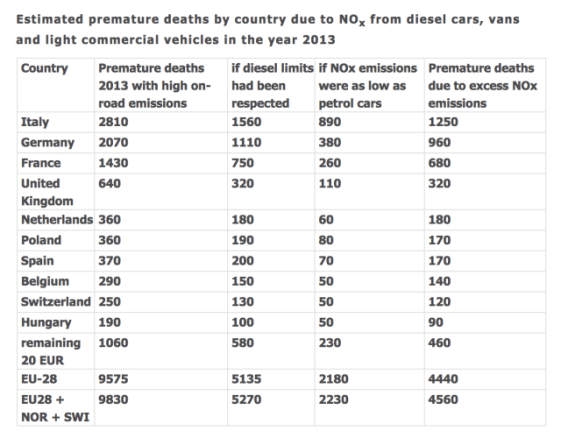
Excess emissions from diesel cars cause about 5,000 premature deaths annually across Europe, a new study shows.

Since the late 1990s the share of diesel cars in the EU has risen to around 50% in the fleet, with important variations between countries. There are now more than 100 million diesel cars running in Europe, twice as many as in the rest of the world together. Their NOx emissions are however 4 to 7 times higher on the road than in official certification tests. Modern engine controls have been optimized by manufacturers for the specific laboratory testing but underperform in real-driving. In this new study, researchers at IIASA and the Norwegian Meteorological Institute have calculated the premature deaths from these excess NOx emissions for the population in all European countries.

Health effect estimates           
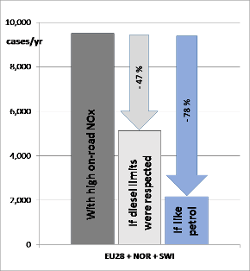
About 425,000 premature deaths annually are associated with the current levels of air pollution in EU28, Norway and Switzerland. More than 90% of these premature deaths are caused by respiratory and cardiovascular diseases related to exposure to fine particulate matter. NOx is a key precursor to this fine particulate matter. This new study estimates that roughly 10,000 premature deaths annually can be attributed to NOx emissions from diesel cars, vans and light commercial vehicles. About half–around 5,000 premature deaths annually–are due to NOx emissions being much higher than limit values in real-world driving. Petrol cars have much lower emissions.

“If diesel car emissions were as low as petrol car emissions, three quarters or about 7,500 premature deaths could have been avoided” says IIASA researcher Jens Borken-Kleefeld.

The countries with the highest number of premature deaths attributable to fine particles from diesel cars, vans and light commercial vehicles are Italy, Germany and France. That is because of both their large populations and a high share of diesel cars. However, the risk per capita is almost twice as high in Italy as in France.

Number of premature deaths due to excess NOx emissions from diesel cars, vans and light commercial vehicles in Europe (left column). Almost 50% could be have been avoided if diesel emission limits had been respected on the road (center column). Almost 80% could have been avoided had diesel cars emitted no more NOx than petrol cars (right column).

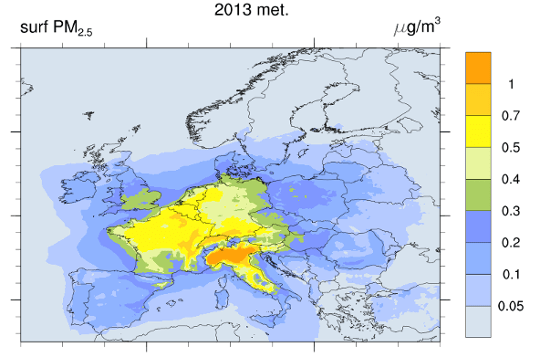
“This reflects the very adverse pollution situation, particularly in highly populated Northern Italy”, says research leader Jan Eiof Jonson from the Norwegian Meteorological Institute. The lowest risks are in Norway, Finland and Cyprus where risks are at least fourteen times lower than the EU28+ average.

The researchers note that is not the very first calculation of health impacts for Europe. Notably the Nature paper came up with about 7,000 premature deaths due to excess NOx from LDDV. Their results were discussed and reported widely, but there was less focus on results in Europe, which are presented in detail in the new study. 

The study was conducted by the Norwegian Meteorological Institute in cooperation with the International Institute for Applied Systems Analysis (IIASA) in Austria, and the Dept. Space, Earth & Environment at Chalmers University of Technology in Sweden. In this study the Norwegian Meteorological Institute has calculated the pollutant concentrations and depositions based on NOx emissions from LDDVs from different countries and model years provided by IIASA. IIASA has also made the health effect calculations.

This map shows the concentration of fine particulate matter due to excess NOx emissions from diesel cars, vans and light commercial vehicles across Europe. Blue colours indicate low concentrations, orange and red indicates high extra pollution. Unit: microgram PM2.5 per cubic metre, annual average 2013. © Jonson et al 2017

Source: 5,000 deaths annually from dieselgate in Europe – 2017 – IIASA

Posted in Air Quality, Europe, France, Germany, Health Effects of Air Pollution, Italy, Medical Studies | Tagged , , , , , , , | Leave a comment

North China moves to fight winter air pollution 

Beijing, Tianjin and Hebei have rolled out measures to fight air pollution as the most heavily polluted season, winter, is coming.

The port city of Tianjin will restrict production in heavily polluting industries, including steel, casting, construction materials and coking, according to a local government action plan to curb air pollution during the four-month central heating season that usually starts on November 15.

Steel output will be slashed by half, it said.

Data showed that pollutants from the burning of coal increase by 30 percent during winter, said Yang Yong, an official with Tianjin Environmental Protection Bureau.

Without output limits, one of the most effective ways to reducing pollution, the amount of pollutants would exceed the environmental capacity, said Yang.

Most of the industries affected are suffering from overcapacity and the limits would not lead to a marked shortage of supply, he said.

Hebei, home to several of cities in China’s top 10 most polluted, has issued similar measures for heavily polluting industries.

The province is also ordering its rural regions near Beijing to use electricity and natural gas to replace burning coal, a major cause of smog in winter.

In Beijing, developers will even be banned from land auctions if three or more of their projects are found to be failing to control dust.

The Beijing-Tianjin-Hebei region sits at the heart of the North China Plain where air pollution, particularly winter smog, often occurs as a result of the high concentration of industrial and vehicle emissions, limited air circulation and the burning of coal.

Local governments are taking harsher measures to fight air pollution with more residents increasingly worried about the health impacts, particularly of PM2.5, airborne particles smaller than 2.5 microns in diameter.

China has set a target to reduce the level of PM 2.5 pollution by at least 15 percent in the cities around the Beijing-Tianjin-Hebei region between October 2017 and March 2018.

Source: North China moves to fight winter air pollution – Xinhua | English.news.cn

Posted in Air Quality, Asia, China | Tagged , , , , | Leave a comment

Dodgy diesel emissions kill 5000 a year in Europe

The test-dodging tricks of some diesel car manufacturers result in extra pollution that is responsible for around 5000 premature deaths a year, according to a new study.

About 5000 people across Europe die prematurely every year because of discrepancies between certification tests and real-world driving conditions for diesel vehicles.

That’s the disturbing conclusion arising from a study by scientists from the Norwegian Meteorological Institute (NMI), Austria’s International Institute for Applied Systems Analysis, and Chalmers University of Technology in Sweden.

The finding is the latest to emerge from separate research teams that have all established that diesel vehicle emissions standards are engineered to meet exacting laboratory test standards rather than authentic driving conditions.

As a result, diesel engine contributions to air pollution are much higher – in some cases, the latest study finds, up to seven times higher – than their official certification states.

And this discrepancy, the scientists report, costs thousands of lives each year.

The research, led by the NMI’s Jan Eiof Jonson, found that air pollution in Europe accounts for 425,000 premature deaths every year. Most of these deaths are through respiratory and cardiovascular failure caused by exposure to fine particulate matter – of which various nitrogen oxides (known collectively as NOx) are a key precursor and the principle pollutant emitted by diesel engines.

Nitrogen oxides from diesel engines are responsible for 10,000 premature deaths every year – but Jonson and colleagues found that roughly half of these were caused by the discrepancy between claimed and actual emissions.

Vehicles in this category are emitting way above the maximum legal limits, but are permitted to do so because their certified emission levels fall beneath the threshold in highly artificial test conditions.

Although over-emitters are being driven across Europe, the particulate matter density differs from region to region. The study found it was at its worst in Germany and Italy.

“This reflects the very adverse pollution situation, particularly in highly populated northern Italy,” says Jonson.

Diesel-powered vehicles are increasingly popular, but especially so in the EU, which is now home to more than 100 million of them – twice as many as the rest of the rest of the world put together.

Ironically, the petrol-driven vehicles they are replacing are, in the matter of NOx emissions at least, much less toxic.

“If diesel car emissions were as low as petrol car emissions, three quarters, or about 7,500, premature deaths could have been avoided,” says co-author Jens Borken-Kleefeld.

The study, published in the journal Environmental Research Letters, adds detail to findings from previous research into NOx emissions and diesel vehicles.

Notably, in the journal Nature in 2016, a team led by Susan Anenberg of Environmental Health Analytics in Washington DC, US, found that one-third of heavy diesel vehicles and half of light ones in 11 markets across the globe exceeded emissions certification limits.

The geographic markets covered by Anenberg’s team accounted for about 80% of annual sales of new diesel vehicles.

The scientists calculated that if lab-test emissions limits were effectively enforced in the real world then diesel-related NOx emissions could be nearly eliminated.

If this was done, they calculated, approximately 174,000 premature deaths could be avoided in the year 2040.

Source: Dodgy diesel emissions kill 5000 a year in Europe | Cosmos

Posted in Air Quality, Europe, Germany, Italy | Tagged , , , , , , | Leave a comment

Air pollution in Barcelona rises by 48% on public transport strike days, study reveals

Air quality in the Spanish city of Barcelona deteriorates by as much as 48% during public transport strikes, researchers have found. The study found that alterations in public transport could trigger a rise in the number of private vehicle trips, which in turn increases air pollution levels.

The study was undertaken by Barcelona Institute for Global Health (ISGlobal), working. with the Institute of Environmental Assessment and Water Research (IDAEA-CSIC). They studied changes in air pollution concentrations during strikes affecting public transport in the city of Barcelona. The researchers say their findings clearly indicate the important role-played by public transport services in curbing urban air pollution in the city.

Their study was published in the journal Science of the Total Environment.

The researchers measured daily levels of various pollutants – including nitrogen monoxide (NO), nitrogen dioxide (NO2), particulate matter (PM10, PM2.5 and PM1),black carbon (BC) and carbon monoxide (CO) – on the 208 days between 2005 and 2016 where public transport stoppages were caused by strikes on the city’s underground, rail and bus system.

On days when the public transport system in Barcelona was affected by strike action, the researchers found a mean daily and citywide rise in air pollution levels ranging from 4% in the case of NO2, and to 8% in the case of NO compared to days when the system was running normally.

Stoppages affecting the underground metro system had the greatest influence on air quality. The researchers suggest this is probably because the metro is the most used mode of public transport in the city. On days when the metro service was interrupted, increases in mean daily levels ranged from 8% for (PM 10) to 48% for nitrogen monoxide.

Xavier Basagaña, ISGlobal researcher and co-author of the study, said: “These findings highlight the essential role played by public transport in curbing high levels of urban air pollution. Almost half of all inter-urban trips to and from Barcelona are still made in a private vehicle, so there is an ample margin for increasing public transport use and improving air quality.”

Xavier Querol, a researcher at IDAEA-CSIC and co-author of the study, said: “The increases were detected above all in pollutants emitted mainly by cars (black carbon, nitrogen monoxide, carbon monoxide) and less in those produced by other sources as well as road traffic.”

According to data published by Barcelona’s city council, some 73% of daily trips in the city are internal. Of these, more than half are made on foot or by bicycle, with 29% on public transport and 14% in private vehicles. Of the other 27%, which are trips made to and from other towns, 3% are made on foot or by bicycle, 50% on public transport and 47% in a private vehicle.

Source: Air pollution in Barcelona rises by 48% on public transport

Posted in Air Quality, Europe, Spain | Tagged , , , , | Leave a comment

People of color exposed to more pollution from cars, trucks, power plants over 10 years

A new nationwide study finds that the U.S. made little progress from 2000 to 2010 in reducing relative disparities between people of color and whites in exposure to harmful air pollution emitted by cars, trucks and other combustion sources.

The groundbreaking study led by University of Washington researchers estimated exposure to outdoor concentrations of a transportation-related pollutant — nitrogen dioxide (NO2) — in both 2000 and 2010, based on neighborhoods where people live. It found disparities in NO2 exposure were larger by race and ethnicity than by income, age or education, and that those inequities persisted across the decade.

While absolute differences in exposure to the air pollutant dropped noticeably during that time period for all populations, the relative difference — or the gap between pollution levels to which white people and people of color were exposed — narrowed only a little.

The study will be published Sept. 14 Environmental Health Perspectives. The researchers developed a first-of-its-kind model that combines satellite and regulatory measurements with land use data to predict pollution at a neighborhood level throughout the United States.

The positive news is that across the U.S., average exposure to NO2 for all races and income levels dropped from 2000 to 2010. Measured in parts per billion (ppb), estimated average annual NO2 exposure decreased from 17.6 to 10.7 ppb for nonwhite populations, and from 12.6 to 7.8 ppb for white populations.

Yet people of color were consistently exposed to more air pollution than their white non-Hispanic counterparts during the decade. Considering relative differences, nonwhites experienced 40 percent higher exposures than whites in 2000; in 2010, that gap shrunk only slightly, to 37 percent. Furthermore, in 2000, concentrations of NO2 in neighborhoods with the highest proportion of nonwhite residents were 2.5 times higher than in neighborhoods with the lowest proportion of nonwhite residents. In 2010, that value increased slightly, to 2.7 times higher.

The study concludes that if people of color had breathed the lower NO2 levels experienced by whites in 2010, it would have prevented an estimated 5,000 premature deaths from heart disease among the nonwhite group.

“The finding that shocks us is that when it comes to how much NO2 a person breathes, it’s still race that matters,” said senior author Julian Marshall, UW professor of civil and environmental engineering.

“At any income level — low to medium to high — there’s a persistent gap by race, which is completely indefensible. It says a lot about how segregated neighborhoods still are and how things are segregated,” Marshall said.

NO2 comes from sources such as vehicle exhaust, power plants and off-road equipment and is one of six important “criteria air pollutants” monitored by the Environmental Protection Agency. It has been linked to asthma symptoms, increased susceptibility to respiratory problems and heart disease.

The research team, which began their work at the University of Minnesota, previously analyzed NO2 concentrations for the year 2006 by race, income and other demographic factors identified in the U.S. Census. The team’s air pollution model, which combines existing EPA air quality monitoring and satellite data with detailed land use information, allows them to accurately predict pollution concentrations across the country at the U.S. Census block level — information previously unavailable at that scale.

In this first longitudinal study of its kind, researchers wanted to examine how much progress was made in addressing inequities in NO2 exposure over a decade. They compared environmental injustice metrics in 2000 and 2010 on a national basis and by region, state, county and urban areas.

On the whole, researchers said, policies to reduce NO2 air pollution are working. But the finding that exposure differences are larger by race and ethnicity than by income, age or education was equally true in 2010 as in 2000.

“Everyone benefited from clean air regulations and less pollution; that’s the good news,” said lead author and UW civil and environmental engineering doctoral student Lara Clark. “But the fact that there is a pervasive gap in exposure to NO2 by race — and that the relative gap was more or less preserved over a decade — is the bad news.”

The UW study did not explore the underlying reasons for that gap, but its findings are consistent with previous research. Both racial minorities and low-income households are disproportionately likely to live near a major road where transportation-related pollution is typically highest. U.S. cities, in general, also tend to be more segregated by race and ethnicity than by income.

The UW team did conclude that the narrowing of the racial gap in NO2 exposures was driven more by improving air quality than by demographic changes over the 10-year period.

“That suggests that air pollution is coming down faster than cities are becoming less segregated,” Marshall said.

Next steps for the research team include looking at how changes in demographics, industry and urban form at the city level affect NO2 exposure, and developing similar models for other EPA criteria air pollutants.

Source: People of color exposed to more pollution from cars, trucks, power plants over 10 years | EurekAlert! Science News

Posted in Air Quality, Health Effects of Air Pollution, USA & Canada | Tagged , , , , | Leave a comment

Air quality study to be run at east London’s ‘most-polluted’ schools 

Tests will be carried out at 50 primary schools in London’s “worst-polluted” areas as part of a new plan to protect children from toxic air.

The £250,000 scheme, paid for by the Mayor of London’s Air Quality Fund, will test air quality in a bid to prevent pupils being exposed to pollution at school.

Sybourn Primary School in Walthamstow and Oakdale Junior School in South Woodford are among the schools where where air quality will be measured.

Engineering consultant WSP, which has been commissioned to carry out the study, will also be tasked with examining ways to improve air quality in areas around schools.

Mayor of London, Sadiq Khan, said: “It is shameful that children across London are breathing in toxic air simply by going to and from school and I am determined to do everything in my power to safeguard their health.

“These air quality audits are a big step towards helping some of the most polluted schools in London identify effective solutions to protect pupils from toxic fumes but, of course, this is only part of the solution.

“We are making great strides in London but I can’t do this alone. The government must match my ambition in tackling the biggest public health emergency of a generation.”

The study is due to be completed by the end of the year and a final report is scheduled for publication March 2018.

Recommendations in the report could include measures such as moving school entrances away from busy roads and the introduction of “no engine idling” schemes.

The move to test air quality at Sybourne Primary School was praised by Jennette Arnold, London Assembly Member for Hackney, Islington and Waltham Forest.

She said: “There is a lot of evidence showing that air quality can have a long-term detrimental impact on the health of our children.

“It’s great to see that the Mayor is taking genuine steps to tackle the impact of toxic air on children in Waltham Forest, and I hope this audit is just the start.”

Source: Air quality study to be run at east London’s ‘most-polluted’ schools

Posted in Air Quality, Europe, London, UK | Tagged , , , , | Leave a comment

REVIEW: Temples of the Holy City of Varanasi! Shiva & Kali worship, Buddha sermon at Sarnath, Respro® Ultralight™ mask review. 

Namaste from the holy city of Varanasi!

India is large and diverse, with terrain ranging from snowy mountains to southern backwaters. Yukiro and I only got to see a fraction of it on our trip through Rajasthan and the Golden Triangle.

However, we absolutely had to make a detour to Varanasi, also known as Kashi or Benares — the famous spiritual destination on the River Ganges.

India was stress-free for us, since we were travelling with Janu Private Tours, one of the most trusted tour companiesJanu and his team can arrange customized itineraries for any part of the country, tailored to your specific interests. They connected us with their outstanding partner, Experience Varanasi Tours, for this portion of our journey.

Even for experienced travellers like ourselves, Varanasi is an intense destination. Picture tuk-tuks weaving through bumpy roads with horns blaring, inches from the beggars and holy cows in the streets. There’s dirt, noise, difficult sights — and it’s incredible, what a city of adventure! 

I was “all in” and wanted to experience the more challenging aspects of India. However, I was concerned I’d feel nauseous from the various smells and pollutants: dung, rotting fruits, garbage, fumes from the traffic…

Anyone who travels with me knows I’m very sensitive to smoke, pollen and other air debris. I didn’t want to wind up ill and unable to see the colorful city life (such as random monkeys!).

For example, I was keen to see the cremation pyres on the banks of the Ganga (which I’ll show you in the next post). However, the image shows how thick the smoke can be.

To make sure we were prepared for anything, Yukiro and I got original Respro® masks! Made in the United Kingdom, these masks are equipped with professional-grade technology to filter out pollution. (Plus, they have a cyber-Goth-Industrial look!)

Respro® offers many types of pollution masks, geared to specific needs such as allergies, urban cycling, industrial filtration. Their FAQ section has info on the differences and how to choose the right size (you can also email them, as their customer service is terrific).

The team suggested The Ultralight™ Mask for our India travels. This mask is made from lightweight, air-permeable mesh material and has two POWA™ elite exhalation valves: ideal for facial ventilation in hot, humid climates.

Plus, the design is fashion-fab: Mad Max meets The Walking Dead apocalyptic chic! It’s an essential item for desert festivals such as Burning Man and Wasteland Weekend, for both the look and the functionality.

The Respro® mask attaches in the back with Velcro, and has a changeable Hepa-Type™ PM2.5 filter (the white portion inside). These Cinqro™ Urban filters have activated charcoal cloth plus a particle filter layer to protect you from exhaust pollution.

Here’s a close-up of The Ultralight™ Mask. The black shell, made of of breathable 4-way stretch fabric, is easy to wash. It has a malleable nylon nose clip for a secure fit around the bridge.

But what if the mask doesn’t match your outfit of the day? Respro® has dozens of skins in various colors and patterns, letting you refresh your look!

I always change around my hair color and clothes, and this Petal Mixed Neoprene outer-shell was a perfect match.

Cube Pattern 1 was a stylish choice for this green monster. It’s easy to switch over the skins over the filter and valve.

I’m very glad I got a Respro® mask for my travels. If you’re in a high-particulate area, run or cycle in urban areas, or have medical condition such as asthma or allergies… these pro masks are a lifesaver. (And the ninja warrior style is A+!)

Source: Temples of the Holy City of Varanasi! Shiva & Kali worship, Buddha sermon at Sarnath, Respro® Ultralight mask review. | La Carmina Blog – Alternative Fashion, Travel, Subcultures

Posted in Air Quality, Respro® Mask Reviews, Respro® Products | Tagged , , | Leave a comment