Nepal’s Kathmandu ranks 5th in Pollution Index 2017

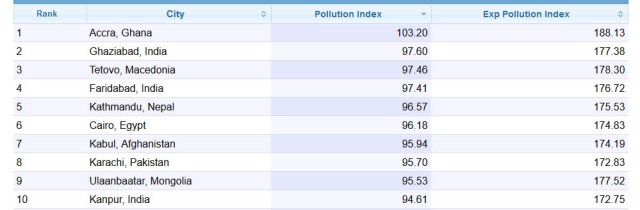
Nepal’s capital city Kathmandu has ranked 5th in Pollution Index 2017 mid-year as published by the Numbeo.com recently.

African country Ghana’s capital city Accra tops the list as New Zeanland’s capital city Wellington ranks as the least polluted cities among 269 cities around the globe.

Kathmandu slumps two spots down to 5th with 96.57 pollution index.

Numbeo said it included relevant data from World Health Organisation and other institutions for the ranking.

The cities were listed on the basis of air pollution and then the water pollution/accessibility followed by other pollution types.

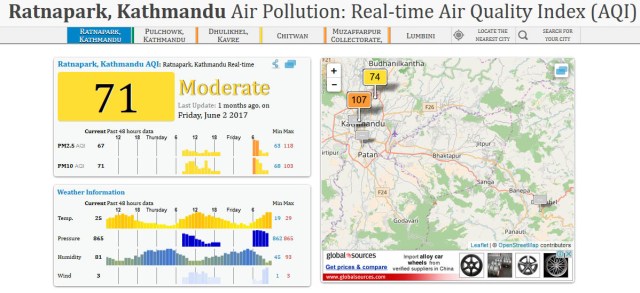
According to the Department of Environment of Nepal, the particulate matter (PM 2.5) of Ratnapark is 107 µg/m³ marking Kathmandu as one of the unhealthy cities to live in.

PM 2.5 indicates the matter present in the air that are 2.5 microns or below. These particles include dust, coal, particles exited from power plants and home heating, car exhaust and pollen plants among others.

Kathmandu’s downfall was heralded due to the snail paced road expansion projects in the Kathmandu Valley and delay in the underground installation of Melamchi Drinking Water pipes in the city.

The government’s failure to replace the old and outdated vehicles plying on the roads of the city have also added air pollution in Kathmandu.

The renewed hopes of making Kathmandu a better place to live after the local level elections was confined to the public stunt of mayor and deputy mayor brooming the streets in Kathmandu.

The KMC needs to do more and come up with more strategies, including installation of dustbins around the city to collect disposable and non disposable products to preserve, clean and safeguard the air quality of the Kathmandu.

KMC also needs to strictly implement the government’s decision of keeping a plastic dustbins inside the vehicle to restrict the passengers from throwing garbage out of the vehicle onto the streets.

Locals and pedestrians have been hit hard along roads in Kathmandu Valley due to dust in dry season and muddy waterlogged road during monsoon.

It has been learned that there is surge in the number of respiratory related diseases in the valley due to air pollution.

Kathmandu denizens and visitors need to do their part to improve the air quality of the Kathmandu.

Source: Nepal’s Kathmandu ranks 5th in Pollution Index 2017

Posted in Air Quality, Asia | Tagged , , | Leave a comment

Metro traffic becoming health hazard 

Traffic congestion in Metro Manila is now a critical health issue for Filipinos, an environmental group said in a statement on Wednesday.

This was revealed by a study conducted by Kaibigan ng Kaunlaran at Kalikasan (KKK), a non-government organization that advances sustainable development by providing science-based research to policy makers.

“Not only is this costing the country and Filipinos billions in potential income every day, traffic congestion in Metro Manila is also contributing largely to respiratory and cardiovascular diseases,” the study stated.

“Inhalation and ingestion of pollutants from mobile sources can cause diseases such as asthma, chronic obstructive pulmonary disease, heart disease and stroke,” it added.

The project “Modeling Particulate Matter Dispersion in Metro Manila” used an internationally recognized mathematical technique to predict the pathways of pollution from various sources.

The study revealed that 76% of air pollutants came from vehicle emissions; 20% from burning refuse, street-side cooking, and construction work; while only 4% is attributed to “industrial” sources.

According to the World Health Organization (WHO), around three million deaths per year are linked to outdoor pollution, with majority occurring in Southeast Asia and the Western Pacific.

Locally, the Department of Health (DOH) has noted that the leading causes of death include cardiovascular and respiratory diseases, among them, lung cancer exacerbated, if not directly caused, by air pollution.

The study covered 16 cities and one municipality.

It was conducted over a period of two years and completed recently with support from nonprofit group Clean Air Asia, Scientific Research Institute Manila Observatory and independent professionals.

The study, however, noted that not all of Metro Manila experiences dirty air the same way due to variability of factors including air quality monitoring data, topography, actual traffic count, type of vehicles and fuels, and meteorology, among others.

KKK called on the government to lead a transition from cars to mass transit to lessen air pollution.

“A highly functional mass transport system, combined with land use and population management, would greatly support a drive for cleaner air in Metro Manila,” the group said.

Source: Metro traffic becoming health hazard | Cebu Daily News

Posted in Air Quality, Asia | Tagged , , | Leave a comment

Hanoi to ban motorbikes by 2030 to curb pollution, traffic 

Officials in Vietnam’s traffic-choked capital Hanoi vowed on Tuesday to banish motorbikes by 2030 to ease environment and congestion woes, a decision that swiftly divided a city where two-wheelers are the main means of transportation.

Hanoi is famed for legions of motorbikes — sometimes stacked with entire families or overloaded with deliveries — that clog roads in a fast-growing city with limited public transportation. There are five million motorbikes among a population of about seven million, compared to half a million cars on the road.

In a country where the average annual wage is still around $2,200, the affordability of motorbikes makes them ubiquitous. Yet critics have blamed the emissions-heavy motorbikes for Hanoi’s deteriorating air quality and worsening traffic congestion. The decision to ban motorbikes by 2030 was approved by 95 out of 96 city councillors at a meeting on Tuesday.

Officials said the number of vehicles was growing at an “alarming” rate, according to a report on the city government’s website. “Traffic jams and air pollution will become serious in the future if no immediate management measures are in place,” the report said. The ban will be implemented in metropolitan districts and public transport options would be increased to wean people off their scooters, the report added.

The number of registered motorbikes in Vietnam is among the highest in Southeast Asia, and officials in Hanoi have long-mulled banning the bikes in an effort to modernise the city along the lines of Seoul or Tokyo. Some welcomed the move, saying the ban is crucial to cleaning up Hanoi’s air, which is notoriously smoggy in the winter months.

“Too many private cars, too many motorbikes… the quality of air is really bad and the decision made today will improve that,” economist and transport expert Luong Hoai Nam told AFP. The city clocked 282 days of “excessive” levels of PM2.5 — fine particulate matter harmful to human health — last year, according to non-governmental group GreenID, citing World Health Organisation guidelines.

The Hanoi government is rolling out an air monitoring system in an effort to make Hanoi “green and clean and civilised so that people living and working here have a high quality of life”, Nguyen Trong Dong, the head of the city’s environment department told AFP last month.

On social media, some people decried the motorbike ban announcement — questioning whether the government will really offer viable public transport alternatives as promised. “This idea is totally insane,” said office worker Hoang Thuy Duong, who rides a motorbike to work daily. “Motorbikes are the best means of transportation in Hanoi. I doubt authorities can replace them with public vehicles,” she told AFP.

Hanoi does not have a metro system, only public buses which account for 12 percent of travel demand in the city. Officials said Tuesday they plan to boost that share to around 50 percent by 2030. Construction of a sky train in the city has been repeatedly delayed but is slated to open next year. Some said limiting individual vehicle use is not effective without efficient public transport in place. “When you just employ banning as one measure they never succeed,” said Jung Eun Oh, senior transport specialist at the World Bank in Vietnam.

Source: Hanoi to ban motorbikes by 2030 to curb pollution, traffic – GG2

Posted in Air Quality, Asia, Vietnam | Tagged , , , | Leave a comment

Ahmedabad becomes first city to install air monitoring and warning system

Gujarat installs an air monitoring and warning system to make the people aware of the growing problem of air pollution and fight against it.

 Air pollution has been a major threat all over the world and India shelters four out of the ten most polluted cities in the world. According to World Health Organisation (WHO), air pollution is measured by the amount of particulate matter under 2.5 micrograms found in every cubic meter of air. As per the data provided by the WHO, 7 million premature deaths occur every year due to air pollution and 3 million deaths due to outdoor air quality.

India and China are the two major countries to record the maximum number of deaths due to air pollution.

After the success of the plant set up in Ahmedabad to to fight against the extreme heat in the city, it launches another project and the first of its kind to depict the air pollution and make people aware of it. An air monitoring and warning system is installed in the city. The Air Information and Response (AIR) was launched in May, this systems records the air quality measures daily pollution levels in eight locations. The people are warned about the polltion through five color-coded alerts of the levels, and their related effects, displayed on huge LED screens set up across the city. It also warns the people when the pollution is likely to reach the level of ‘very poor’ or ‘severe’.

Chirag Shah, a deputy health officer at the Ahmedabad Municipal Corporation said that air pollution is major risk for the human kind and it can be controlled only if proper data is collected. He also added that just by collecting the data does not solve the problem, investment needs to be done and measures needs to be taken to curb the problem.

Dileep Mavalankar, head of the Indian Institute of Public Health also seconded the opinion of Chirag shah. He was also a part of the AIR plan as well as the Heat Action Plan.

The main cause for the air pollution according to BJP party President Amit Shah, is diesel-fueled vehicles, construction, cooking fires and the burning of trash. He said that few activites could be stopped in order to control the growing danger with increase in air pollution.

Air pollution can cause lung cancer, strokes and heart disease over the long term and sometimes even be the reason for a sudden heart attack.

Source: Ahmedabad becomes first city to install air monitoring and warning system – The Indian Wire

Posted in Air Quality, Asia, India | Tagged , , , , | Leave a comment

Air pollution issues go back to court

Air pollution is forcing the UK government back to court for the seventh time.

The environmental legal group ClientEarth says minsters failed to conduct their recent public consultation on clean air properly.

It also says the government’s pollution plans for Scotland, Wales and Northern Ireland are far too vague.

A government spokesman said ministers were committed to improving air quality.

ClientEarth’s case centres on the disparity between the consultation document the government produced for the public, and a related technical document from government experts.

The technical document makes it clear that the best way of combating pollution is for councils to set up clean air zones and then to charge vehicles for entering them.

But the consultation document – produced around election time following a court ruling – said councils should try all other measures before imposing charging zones.

Critics said the consultation had been rendered toothless by ministers’ wish to avoid political controversy.

ClientEarth says the difference between the two documents could open the government to judicial review from members of the public or councils who feel they were not properly consulted.

Its spokesman Tim Reid told BBC News: “The government needs to consult on this issue – it’s just not behaving properly. We are dismayed to be taking them back to court again.”

The group thinks that even a brief consultation of one or two weeks on charging zones would insulate ministers from further legal challenge as they prepare their air pollution strategy by the 31 July deadline imposed by a previous court ruling.

The other issue before the courts is the relationship between the UK and the nations.

Air pollution is a devolved issue, but ClientEarth argues that the UK government must take overall responsibility for EU laws. It says the pollution strategy for Wales, Scotland and Northern Ireland is “plans about plans”.

A government spokesman said: “We have jointly consulted with the devolved authorities on proposals to further improve the nations’ air quality and will publish a final air quality plan by 31 July.

“The draft plan sets out steps the UK, Scottish government, and Welsh governments and the Department of Agriculture, Environment and Rural Affairs in Northern Ireland propose to take to improve air quality in our towns and cities.”

Source: Air pollution issues go back to court – BBC News

Posted in Air Quality, Europe, UK | Tagged , , , , | Leave a comment

How air pollution is linked to type 2 diabetes 

An interdisciplinary team of scientists from the University of Leicester and other institutions has played a pivotal role in research investigating a possible link between air pollution and the rise in type 2 diabetes.

New research, published in the journal Environment International, examined data from 10,443 participants from diabetes screening studies in Leicestershire, UK.

The exposure to air pollution, the number of cases of type 2 diabetes and the impact of demographic and lifestyle factors were all considered.

The authors concluded that demographic factors largely explained the association between air pollution and type 2 diabetes.

The research team, supported by the NIHR, is composed of University of Leicester experts from a wide variety of fields, including Earth Observation Science, the University’s Diabetes Research Centre and the Department of Health Sciences and builds upon world-leading research in these areas.

Dr Gary O’Donovan, who led the research and is formerly of the University of Leicester and now at Loughborough University, said: “High air pollution and low physical activity are two of the leading causes of disease and premature death in middle and high-income countries.

“Like most cities in the UK, Leicester has only a handful of air quality monitors. The UN has estimated that two thirds of world’s population will be living in cities by 2050 and our cities must become better, healthier places in which to live.

“Cities like Copenhagen in Denmark and Medellín in Colombia are doing a much better job of measuring air pollution and facilitating active transport than most cities in the UK.”

Exposure to traffic related air pollutants is known to cause insulin resistance, a hallmark of the disease, and observational evidence has been applied to better understand a potential link.

Professor Roland Leigh, Technical Director of EarthSense and Director of Enterprise at the University of Leicester’s Institute for Space and Earth Observation, and co-author of the study, said: “We know that air pollution is the world’s largest environmental health risk affecting 92% of the population and associated with more than three million deaths per year, and evidence suggested it may contribute to the rise in type 2 diabetes.

“While original results suggested association between air pollution and associated particulates and type 2 diabetes, when the effects of lifestyle and demographic factors were considered, and given the limited size of the sample, evidence for direct association with air pollution was inconclusive.

“We will, however, continue to apply cutting-edge air quality research to unpick potentially connected long-term exposure factors,” continued Professor Leigh. “As innovators in air quality monitoring, the University of Leicester and EarthSense has a fundamental contribution to make in the understanding of the complex issues of pollution exposure and health.”

Diabetes is one of the leading causes of death in lower middle, upper middle and high income economies. The global prevalence of diabetes has nearly doubled, from 4.7% in 1980 to 8.5% in 2014, with the majority of cases being type 2. Experimental evidence exists to suggest exposure to nitrogen dioxide and associated particulate matter is related to inflammation and insulin resistance.

The CHAMPIONS Study into the association between air pollution and type 2 diabetes was conducted by representatives from the University of Leicester Diabetes Research Centre, University of Leicester Earth Observation Science Group, University of East Anglia Norwich Medical School and University of Leicester Department of Health Sciences.

EarthSense Systems is a joint venture between aerial mapping company Bluesky and the University of Leicester.

Source: How air pollution is linked to type 2 diabetes — ScienceDaily

Posted in Air Quality, Health Effects of Air Pollution, Medical Studies | Tagged , , , | Leave a comment

Luxury cruise liners ‘have worse air pollution than Piccadilly Circus’

Some come with 10-storey slides, running tracks and private gyms while one boasts as many trees as a small city suburb. But the luxury ocean liners luring record numbers of tourists on to round-the-world cruises may not be as healthy as they seem.

Even on the open water, the air pollution on some ships is double that of central London, according to an investigation by Dispatches, the investigative series on the UK’s Channel 4.

The exhaust fumes the boats belch out at sea are not covered by regulations that limit emissions on land, and the heavy fuel oil that powers the ships’ engines is allowed to contain 3,500 times more sulphur than road fuel.

Standing on the deck, downwind of a ship’s funnel, investigators found air pollution of 84,000 ultrafine particles per cubic centimetre. This is more than double the 38,400 ultrafine particles per cubic centimetre found at Piccadilly Circus and almost 20 times as much as the 4,285 particles at Camber Sands beach on the south coast of England.

Ultrafine particles are particularly damaging to human health because they are small enough to cross the membranes in our lungs.

Matt Loxham, a respiration biologist at Southampton University, said that ultrafine particles were about a thousand times thinner than a strand of human hair. “Larger particles that we inhale usually get trapped in the airways by phlegm, or by hairs in the nostrils. But ultrafines can get right into the depths of the lung and distribute throughout the body,” he said.

“There are some areas of the ship deck that are affected by really quite high levels of particulate matter. These are levels you would expect in some of the most polluted cities in the world.”

About 1.9 million people in the UK go on a cruise each year, a 60 per cent increase since 2007. At sea, ships are free to dump raw sewage 12 miles offshore. The liners, which can carry more than 7,000 passengers and crew, are also largely unfettered when it comes to flushing out “grey water” from sinks and showers. “Although there are local regulations, there are no global regulations despite the fact the water can contain pollutants such as cooking oil, detergents, soaps and food waste,” Dispatchessaid. “Grey water is believed to have similar environmental impacts to sewage. It would be illegal to dump it in rivers on land, but not at sea.”

Dr Loxham said the air pollution could affect asthmatics and exacerbate cardiovascular symptoms for passengers with pre-existing conditions.

Daniel Rieger, of the German eco-charity Nabu, said a single cruise liner could create as much particulate matter as one million cars. “You can say that 30 cruise ships pollute as much as all the cars in the United Kingdom,” he said.

A team from Dispatches travelled on the P&O ship Oceana, which is more than 250m long, 15 storeys high and can carry more than 2,000 passengers. They used an infra-red camera to film gases that are not visible to the naked eye, and a P-Trak ultrafine particle counter to measure air pollution.

Carnival Corporation, which owns P&O, said that cruise liners made up less than 1 per cent of the world’s “50,000 commercial maritime vessels”.

“Although a tiny fraction of the global maritime industry, cruise lines are leaders in implementing alternative fuels and emission-reduction technology,” a spokesman said. “The industry has invested more than $US10 billion ($13bn) in new ships that can use alternative fuels such as liquefied natural gas.”

The company said it had spent $US400 million installing exhaust gas cleaning systems on 60 ships that could reduce particulate matter by up to 80 per cent. According to Carnival’s figures for 2015, its fleet released the equivalent of 10 million tonnes of CO2 into the atmosphere.

Source: Luxury cruise liners ‘have worse air pollution than Piccadilly Circus’

Posted in Air Quality, Europe, UK | Tagged , , , | Leave a comment

Increased Air Pollution Can Take A Decade Off Your Life

Increased air pollution can cut a human’s lifespan by between 9 and 11 years, almost a decade longer than most previous estimates had calculated at only one or two years.

On average, an increase of pollution particles by 10 micrograms per cubic metre, will kill the population 10 years earlier, according to a formula devised by Professor Mikael Skou Andersen of Aarhus University, Denmark.

In his research, Professor Andersen was attempting to find a definitive way to calculate the effects of air pollution on the economy, as he argues governments won’t act on fossil fuels until they see the monetary cost of premature deaths.

“People are willing to pay a price to reduce risks for dying prematurely, provided we have an understanding of the implications and magnitudes of such risks,” said Professor Andersen.

In order to encourage environmental action Andersen argues that researchers must find a robust way to determine this financial impact globally, as current variations in methodology leaves cost differing “wildly” between Europe and the USA.

In fact, the cost of losing someone to air pollution is three times higher in the USA, estimated to be worth $7.4 million.

However in Europe, because the methodology looks at change in life expectancy (presuming most victims are in their seventies or eighties) it only sees them lose one of two years of life with less financial consequence.

“Many European countries are unable to meet the air pollution standards they have agreed to in the European Union. We need to understand the true impact of long-term exposure to air pollution to develop better informed policies and reduce fossil fuel consumption,” he said.

So in order to work out a more accurate figure, Andersen used a life table of 100,000 people with an age distribution and determined the number of people expected to survive for their remaining lifetime in each group.

The result revealed the average age of an air pollution victim is 78.9 years and their average loss of life expectancy is between nine and eleven years.

Andersen hopes that this information will inform international institutions and policy makers that want to accurately account for deaths caused by air pollution due to fossil fuel consumption.

The World Health Organisation says that 16,355 deaths in the UK are attributable to ambient air pollution, and according to a 2015 King’s College London report, 9,500 of these are in the capital.

It should be noted that these figures are not collaborated across the board and other reports, such as one commissioned by the UK government, say that removing all anthropogenic (human-made) particulate matter air pollution (measured as PM2.5 1) could save the UK population approximately 36.5 million life years over the next 100 years.

Fintan Hurley, lead author on the study, explained the disparity: “It’s not as simple as it seems, but air pollution does kill people, and I do think it’s a fair way of summarising the mortality effect on the population.”

Source: Increased Air Pollution Can Take A Decade Off Your Life | HuffPost UK

Posted in Air Quality, Health Effects of Air Pollution | Tagged , | Leave a comment


