Air pollution more harmful to children in cars than outside, warns top scientist 

Exclusive: Walking or cycling to school is better for children’s health as cars are ‘boxes collecting toxic gases’ says David King

Children are at risk of dangerous levels of air pollution in cars because exposure to toxic air is often far higher inside than outside vehicles, a former government chief scientific adviser has warned.

Prof Sir David King, writing for the Guardian, says walking or cycling to school would be much better for children’s health. The warning comes as the UK government faces a third legal defeat for failing to tackle the country’s illegal levels of air pollution. Air pollution is known to damage children’s developing lungs but recent research also indicates it harms children’s ability to learn at school and may damage their DNA.

“Children sitting in the backseat of vehicles are likely to be exposed to dangerous levels [of air pollution],” said King. “You may be driving a cleaner vehicle but your children are sitting in a box collecting toxic gases from all the vehicles around you.”

He said new legislation to ban smoking in cars with children had gained widespread support. “So why are we still happy for our children to breathe in toxic emissions in the back of our cars?”

“The best thing for all our health is to leave our cars behind,” said King, who now advises the British Lung Foundation. “It’s been shown that the health benefits of walking and cycling far outweigh the costs of breathing in pollution. If more drivers knew the damage they could be doing to their children, I think they’d think twice about getting in the car.”

A range of experiments, some as far back as 2001, have shown that drivers inside vehicles are exposed to far higher levels of air pollution than those walking or cycling along the same urban routes.

Prof Stephen Holgate, an asthma expert at Southampton University and chair of the Royal College of Physicians working party on air pollution, said there was enough evidence to tell parents that walking and cycling exposes their children to less air pollution than driving.

“It is nine to 12 times higher inside the car than outside,” he said. “Children are in the back of the car and often the car has the fans on, just sucking the fresh exhaust coming out of the car or lorry in front of them straight into the back of the car.”

Children are more vulnerable than adults, he said, because air pollution can stunt the growing of their lungs and because it increases the risk of sensitisation which can lead to asthma and other respiratory conditions.

Holgate said walking or cycling are better when possible, to reduce pollution exposure in cars and to increase physical exercise. He said: “There are multiple benefits to be gained. But parents are confused at the moment because they think there is less pollution in cars than outside, which is not the case.”

Ben Barratt, from King’s College London, measured the exposure of people travelling by car, bus, bicycle and walking in London in 2014. “The car driver, by a very long way, was exposed to the highest level of pollution,” he said. “The fumes from the vehicles in front and behind were coming into the car and getting trapped there. It is not true that you can escape pollution by sitting inside a vehicle.”

Recent research has added to the concern about the impact of air pollution on children, beyond the direct harm to their lungs. A study in Barcelona showed that air pollution reduces the ability of children to concentrate and slows their reaction times. “This adds to the evidence that air pollution may have potential harmful effects on neurodevelopment,” the scientists wrote.

A smaller study, in California, showed higher levels of traffic-related air pollution correlated with increased DNA damage in children.” Children may be especially vulnerable to the effects of telomeric DNA damage due to their physical development as well as developing immune system,” said the scientists.

Levels of nitrogen dioxide (NO2), emitted mostly by diesel vehicles, have been above legal limits in almost 90% of urban areas in the UK since 2010. The toxic fumes are estimated to cause 23,500 early deaths a year and the problem has been called a public health emergency by a cross-party committee of MPs.

The environmental law firm ClientEarth has defeated the ministers twice in the courts over the adequacy of government air quality plans. Ministers’ latest proposals were published on 5 May but were widely condemned as inadequate, and ClientEarth is now suing the government a third time.

“Air pollution hasn’t been taken seriously,” said Holgate. “There is a very strange situation where the government has to make laws by being taken to court repeatedly. In my view it is really quite appalling that we haven’t started to deal with this properly and put children’s and adults’ health first.”

Diesel drivers have been given tax breaks by successive governments, including when King was chief scientific adviser, to buy diesel cars because they have lower carbon dioxide emissions. Stricter regulations were supposed to limit NO2 emissions from diesels but cheating and the exploitation of loopholes by car manufacturers led to vehicles that emitted far more pollution on the road than in lab tests.

The British Lung Foundation’s Breathe Easy Week takes place on 12-16 June 2017 and a National Clean Air day in the UK takes place on 15 June.
Source: Air pollution more harmful to children in cars than outside, warns top scientist | Environment | The Guardian

Posted in Air Quality, Health Effects of Air Pollution | Tagged , , , , , | Leave a comment

With particles, size really matters 

In 1996, the Scottish scientist Anthony Seaton put forward a new theory about the health problems from modern air pollution. Throughout our evolution, we have always lived with dusts, but Seaton suggested that the problems from modern air pollution were due to the sheer number of tiny pollution particles that we are now exposed to.

Since 1996, scientists have been looking for the health impacts from these tiny particles. A small number of studies, including one in London, found increased heart attacks when there were high numbers of particles in a city’s air. Major sources of exposure include traffic, airports and also fast-food restaurants.

Unlike other pollutants, such as nitrogen dioxide, we struggle to produce maps of particle numbers for a city. This makes it difficult to relate rates of deaths and heart attacks to the number of particles that we encounter as we go about our lives.

There is some good news. In 2008, the UK followed Germany and Scandinavian countries by cleaning diesel fuel. Taking out sulphur impurities reduced the number of particles next to roads by around 60%. Since then exhaust filters on diesel vehicles produced further slow improvements, but there are no plans to clean up aircraft fuel.

Source: With particles, size really matters | Environment | The Guardian

Posted in Air Quality, Health Effects of Air Pollution | Tagged , , , | Leave a comment

Air pollution causes 14,000 additional deaths a year in Korea: report

About 14,000 people are dying prematurely every year in South Korea as a result of air pollution, a medical professor said Monday, citing a report by the U.S.-based Institute for Health Metrics and Evaluation.

Cheong Hae-kwan, a professor at the Medical College of Seoul’s Sungkyunkwan University, said during a seminar that the number of premature deaths in South Korea caused by air pollution was tallied at 13,703 in 2013 in the IHME report.

The figure translates into 4.5 percent of the country’s entire deaths in the reported year or one every 20 deaths per year resulting from polluted air.

The main culprit was the emission of dangerous air particles, known as PM2.5, which was responsible for 12,037 deaths comprising 4,274 deaths from lung cancer, 1,901 ones from ischemic heart disease and 5,862 ones from cerebral stroke.

The number of people who died of chronic obstructive pulmonary disease or asthma after being exposed to ozone was estimated at 1,666 at rest.

Cheong also cited the projection of the Organization for Economic Cooperation and Development that South Korea could top the group of developed market economies with premature deaths from air pollution in the next 40 years.

The OECD projection said that in South Korea, there will be an estimated 1,109 deaths per 1 million people caused by air pollution in 2060, about three times the 359 deaths reported in 2010. South Korea’s proportion of air pollution-related economic losses in its gross domestic product was projected at 0.63 percent, higher than Japan with 0.42 percent and the United States with 0.21 percent.

Source: Air pollution causes 14,000 additional deaths a year in Korea: report

Posted in Air Quality, Asia, South Korea | Tagged , , | Leave a comment

Traffic-related air pollution linked to DNA damage in children

Children and teens exposed to high levels of traffic-related air pollution have evidence of a specific type of DNA damage called telomere shortening, reports a study in the May Journal of Occupational and Environmental Medicine.

Young people with asthma also have evidence of telomere shortening, according to the preliminary research by John R. Balmes, MD, of University of California, Berkeley, and colleagues. They write, “Our results suggest that telomere length may have potential for use as a biomarker of DNA damage due to environmental exposures and/or chronic inflammation.”

The study included 14 children and adolescents living in Fresno, Calif. — the second-most polluted city in the United States. The researchers assessed the relationship between polycyclic aromatic hydrocarbons (PAHs), a “ubiquitous” air pollutant caused by motor vehicle exhaust; and shortening of telomeres, a type of DNA damage typically associated with aging.

As the exposure to PAHs increased, telomere length decreased in linear fashion. Children and teens with asthma were exposed to higher PAH levels than those without asthma. The relationship between PAH level and telomere shortening remained significant after adjustment for asthma and other factors (age, sex, and race/ethnicity) related to telomere length.

The study adds to previous evidence that air pollution causes oxidative stress, which can damage lipids, proteins, and DNA. Research has suggested that children may have different telomere shortening regulation than adults, which might make them more vulnerable to the damaging effects of air pollution.

“Greater knowledge of the impact of air pollution at the molecular level is necessary to design effective interventions and policies,” Dr. Balmes and coauthors conclude. With further research, telomeres could provide a new biomarker to reflect the cellular-level effects of exposure to air pollution. Telomeres might also provide new insights into the understanding how pollution exposure leads to adverse health outcomes.

Source: Traffic-related air pollution linked to DNA damage in children — ScienceDaily

Posted in Air Quality, Asthma, Health Effects of Air Pollution, Medical Studies | Tagged , , , | Leave a comment

Air you breathed yesterday was more polluted than on Diwali

Wednesday was even more polluted than Diwali with the peak level of particulate matter (PM) 2.5 crossing those of the festive day last year.

According to Central PollutionControl Board (CPCB), the 24-hour concentration of PM 2.5 at 9.30 am was 698.21 — nearly 11 times higher than the national safe standard. On October 31 (just a day after Diwali), PM2.5 peak was 690.90 micrograms per cubic metre, while the highest level on Tuesday was 349.36.

The national safe standard prescribes the upper limit of concentration of PM2.5 as 60g/m3.Similarly, the air quality index (AQI), measured over a 24-hour period, was 486 on Wednesday, which is considered as ‘severe’. AQI is an indicator of air pollution from the levels of many pollutants that include PM 2.5.

As AQI increases, people are likely to experience severe health effects. And with both PM2.5 and AQI shooting up, the CPCB listed Gurgaon as the most polluted location in the country among the 38 cities and towns it surveyed for air pollution.

Delhi’s AQI, on the other hand, was ‘moderate’ at 163 on Wednesday. Even Ghaziabad and Noida also reported AQI at 197 and 163, respectively. Other cities that generally remain polluted in the country, including Lucknow, Jodhpur and Faridabad, also reported ‘moderate’ and ‘satisfactory’ levels of air pollution.

Haryana State Pollution Control Board (HSPCB) blamed the increase in construction activities, coupled with wind speed, for the rise in the concentration of PM 2.5.

 “Sudden increase in the wind speed is responsible for the dispersal of PM2.5. Increase in construction activities is also responsible to some extent. There is a need to settle dust so that wind can’t blow it, which generally raises the level of particulate matter in the lower atmosphere,” said Jai Bhagwan, regional officer, HSPCB.

Niranjan Raje, a former member of Environment Pollution (Prevention & Control) Authority, said, “There are two major causes of an increase in air pollution — dust constantly emitting out of construction sites and an increase in the use of diesel generators. Another reason is traffic congestion due to diversions for construction of underpasses on Delhi-Gurgaon expressway.”

Source: Air you breathed yesterday was more polluted than on Diwali | Gurgaon News – Times of India

Posted in Air Quality, Asia, India | Tagged , , , , , | Leave a comment

Researchers unveil new hyper-local air pollution map

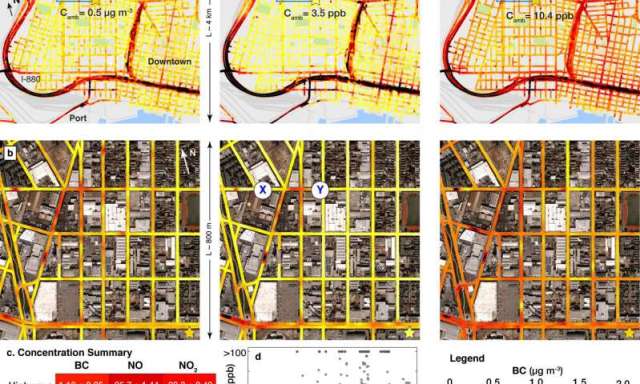
Engineering researchers at The University of Texas at Austin have developed the most detailed and extensive local map of air pollution ever produced for an urban area, using specially equipped Google Street View cars to measure air quality on a block-by-block basis. This new hyper-local mobile approach to measuring air quality, which reveals that air pollution can vary dramatically even within a single city block, could address major air quality monitoring gaps worldwide.

The research team was led by Cockrell School of Engineering assistant professor Joshua Apte in partnership with the Environmental Defense Fund (EDF), Google and Aclima, a California-based provider of environmental sensors. By integrating Aclima’s sensor system into Google Street View cars, the team mapped air pollution in 78 square miles of Oakland, California, over an entire year, collecting one of the largest data sets of air pollution ever measured of single city streets. This new technique maps urban air pollution at 100,000 times greater spatial resolution than is possible with traditional government air quality monitors. Their approach and findings were published this week in the journal Environmental Science & Technology. The study included co-authors from the University of Washington, University of British Columbia, Utrecht University, Lawrence Berkeley National Laboratory, Aclima and EDF.

The team believes that their hyper-local mobile measurement system could be implemented in many cities throughout the world, providing detailed air quality information for citizens, families, local governments and scientists. The new technique could address major air quality monitoring gaps worldwide and has the potential to transform the way air pollution is monitored in urban areas as well as shed light on the health effects on city dwellers.

Air pollution is a major global risk factor for illness and death, and the air pollution that people are breathing can be, at times, far worse than what official air quality monitors report. Most large urban areas have only one air quality monitor for every 100 to 200 square miles. In comparison, the UT Austin team’s mobile approach maps air pollution every 100 feet, or at about four to five locations along a single city block.

“Air pollution varies very finely in space, and we can’t capture that variation with other existing measurement techniques,” Apte said. “Using our approach and analysis techniques, we can now visualize air pollution with incredible detail. This kind of information could transform our understanding of the sources and impacts of air pollution.”

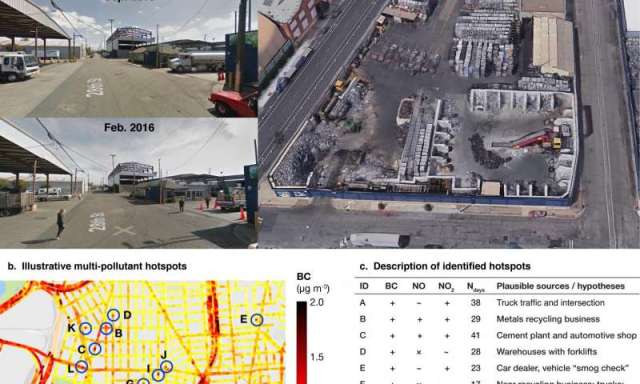
In many locations, the team’s Google cars measured air pollution levels that were several times higher than at Oakland’s official monitors. In their analysis, the researchers also identified many recurring hotspots where pollution on a single block was consistently much higher than elsewhere in a neighborhood. These pollution hotspots included the port, busy intersections, restaurants, warehouses, industrial plants and vehicle dealerships.

“What surprised us is that there are consistently locations that can be as much as six times more polluted on one end of the block than on the other,” said Kyle Messier, a UT Austin postdoctoral fellow and a co-author of the study. “Among other things, this demonstrates that people are getting disproportionate exposures of unhealthy air at some locations.”

This project is the latest phase of a partnership between EDF and Google, who have been working together since 2012 to map and measure a growing list of health and environmental risks, including hidden leaks from local natural gas systems.

“Air pollution is largely an invisible threat, one that poses especially disproportionate risks in lower-income areas like West Oakland. This new method allows us to visualize the data so communities and policymakers can identify the sources of harmful pollution and take action to improve safety and health,” said Steven Hamburg, EDF’s chief scientist.

The study’s approach was designed to be cost-effective and easily replicated. For instance, research partner Aclima designed pollution sensing systems that made it straightforward to collect high-quality air pollution data on moving vehicles day after day. Driving more than 14,000 miles, the Google cars collected 3 million measurements of nitric oxide, nitrogen dioxide and black carbon pollutants in Oakland, generating the largest urban air quality data set of its kind.

As the study’s principal investigators, UT Austin’s contributions included:

  • Designing the data collection approach and directing where the cars drove on a daily basis.
  • Developing data analysis algorithms to produce block-by-block maps of street-level air pollution from measurements made by passing Street View cars.
  • Identifying neighborhood hotspots of air pollution.
  • Determining how this approach could be efficiently scaled up to other urban areas.

In the future, Apte hopes to take this mobile air quality monitoring approach to other major cities to help formulate a hyper-local map of air pollution in the United States that could help people make more informed decisions.

“You could use this information when you’re picking a school for your kids. Is there a school with a playground that might have better air quality because your kid has asthma?” Apte said. “This hyper-local information about consistent air quality can be really useful for people, especially those who are vulnerable because of age or health condition.”

Source: Researchers unveil new hyper-local air pollution map

Posted in Air Quality | Tagged , | Leave a comment

New hyper-local air pollution map unveiled 

Engineering researchers at The University of Texas at Austin have developed the most detailed and extensive local map of air pollution ever produced for an urban area, using specially equipped Google Street View cars to measure air quality on a block-by-block basis. This new hyper-local mobile approach to measuring air quality, which reveals that air pollution can vary dramatically even within a single city block, could address major air quality monitoring gaps worldwide.

The research team was led by Cockrell School of Engineering assistant professor Joshua Apte in partnership with the Environmental Defense Fund (EDF), Google and Aclima, a California-based provider of environmental sensors. By integrating Aclima’s sensor system into Google Street View cars, the team mapped air pollution in 78 square miles of Oakland, California, over an entire year, collecting one of the largest data sets of air pollution ever measured of single city streets. This new technique maps urban air pollution at 100,000 times greater spatial resolution than is possible with traditional government air quality monitors. Their approach and findings were published this week in the journal Environmental Science & Technology. The study included co-authors from the University of Washington, University of British Columbia, Utrecht University, Lawrence Berkeley National Laboratory, Aclima and EDF.

The team believes that their hyper-local mobile measurement system could be implemented in many cities throughout the world, providing detailed air quality information for citizens, families, local governments and scientists. The new technique could address major air quality monitoring gaps worldwide and has the potential to transform the way air pollution is monitored in urban areas as well as shed light on the health effects on city dwellers.

Air pollution is a major global risk factor for illness and death, and the air pollution that people are breathing can be, at times, far worse than what official air quality monitors report. Most large urban areas have only one air quality monitor for every 100 to 200 square miles. In comparison, the UT Austin team’s mobile approach maps air pollution every 100 feet, or at about four to five locations along a single city block.

“Air pollution varies very finely in space, and we can’t capture that variation with other existing measurement techniques,” Apte said. “Using our approach and analysis techniques, we can now visualize air pollution with incredible detail. This kind of information could transform our understanding of the sources and impacts of air pollution.”

In many locations, the team’s Google cars measured air pollution levels that were several times higher than at Oakland’s official monitors. In their analysis, the researchers also identified many recurring hotspots where pollution on a single block was consistently much higher than elsewhere in a neighborhood. These pollution hotspots included the port, busy intersections, restaurants, warehouses, industrial plants and vehicle dealerships.

“What surprised us is that there are consistently locations that can be as much as six times more polluted on one end of the block than on the other,” said Kyle Messier, a UT Austin postdoctoral fellow and a co-author of the study. “Among other things, this demonstrates that people are getting disproportionate exposures of unhealthy air at some locations.”

This project is the latest phase of a partnership between EDF and Google, who have been working together since 2012 to map and measure a growing list of health and environmental risks, including hidden leaks from local natural gas systems.

“Air pollution is largely an invisible threat, one that poses especially disproportionate risks in lower-income areas like West Oakland. This new method allows us to visualize the data so communities and policymakers can identify the sources of harmful pollution and take action to improve safety and health,” said Steven Hamburg, EDF’s chief scientist.

The study’s approach was designed to be cost-effective and easily replicated. For instance, research partner Aclima designed pollution sensing systems that made it straightforward to collect high-quality air pollution data on moving vehicles day after day. Driving more than 14,000 miles, the Google cars collected 3 million measurements of nitric oxide, nitrogen dioxide and black carbon pollutants in Oakland, generating the largest urban air quality data set of its kind.

As the study’s principal investigators, UT Austin’s contributions included:

  • Designing the data collection approach and directing where the cars drove on a daily basis.
  • Developing data analysis algorithms to produce block-by-block maps of street-level air pollution from measurements made by passing Street View cars.
  • Identifying neighborhood hotspots of air pollution.
  • Determining how this approach could be efficiently scaled up to other urban areas.

In the future, Apte hopes to take this mobile air quality monitoring approach to other major cities to help formulate a hyper-local map of air pollution in the United States that could help people make more informed decisions.

“You could use this information when you’re picking a school for your kids. Is there a school with a playground that might have better air quality because your kid has asthma?” Apte said. “This hyper-local information about consistent air quality can be really useful for people, especially those who are vulnerable because of age or health condition.”

Source: New hyper-local air pollution map unveiled — ScienceDaily

Posted in Air Quality | Tagged , | Leave a comment

Marseille to cut port dues for eco-friendly ships

Marseille Fos has joined the World Ports Climate Initiative (WPCI) and is set to reduce port dues for ships performing better than required under air pollution regulations.

From July 1 this year the incentive will apply to eligible ships among the 236 container carriers and cruise vessels – a 60/40% split – that call at the port. Other sectors will be added in 2018.

The WPCI features the Environmental Ship Index (ESI), which scores atmospheric pollution on a zero to 100 scale.

Currently around 50 ports worldwide offer reduced call charges based on the ESI.

Marseille Fos reductions will apply from a score of 35 – the level attributed to ships equipped to take shoreside electrical power at berth instead of using onboard diesel generators.

The port was the first in France to announce a cold ironing facility following an agreement with Corsica and Sardinia ferry operator La Meridionale.

The company’s three ships have been equipped since January. For each vessel, CO2 and particle emissions have been cut by the equivalent of more than 3,000 vehicles per day on the 64km route from Marseille to Aix, while NOx emissions are down by the equivalent of 65,000 vehicles per day.

In a further green initiative, Marseille Fos has launched a website link to reinforce its cooperation with AirPACA, the air quality monitoring association for the Provence-Alpes-Cote d’Azur region.

Source: Marseille to cut port dues for eco-friendly ships

Posted in Air Quality, Europe, France | Tagged , , , | Leave a comment