Hot, hazy day for Hong Kong as air quality poses ‘very high’ health risk in Central, Causeway Bay and Mong Kok 

Weather to remain sunny with low visibility through the day, with one or two isolated showers in the afternoon

A blanket of heavy pollution smothered Hong Kong’s biggest business and shopping districts on Wednesday.

Citizens braving the sweltering heat also had to put up with pollution levels categorised as “very high” in Central, Causeway Bay and Mong Kok.

According to the Environmental Protection Department, as of 11am the air quality health index had reached 8 at roadside stations in the two districts, indicating a very high health risk. Roadside stations in Mong Kok and general stations in Tuen Man and Tai Po reported AQHI readings of 7, indicating a high health risk.

In Central, the level of harmful PM2.5 particulates had reached 107 micrograms per cubic metre, four times the World Health Organisation’s safety limit of 25 and well above Hong Kong’s limit of 75. In Causeway Bay, the level reached 101.

The Environmental Protection Department advises children, the elderly and those with existing heart or respiratory illnesses to reduce outdoor activities to a minimum when the health risk is very high.

“The general public are advised to reduce, or reduce to a minimum, outdoor physical exertion, and to reduce time outdoors, especially in areas with heavy traffic,” a spokesman for the department said.

According to the Hong Kong Observatory, the pollution was brought by high pressure over the western North Pacific as well as light winds locally.

“The visibility fell to about 3,000 metres over many places,” the Observatory said in its weather report.

According to the report, it will remain hot and sunny with low visibility through the day, with one or two isolated showers in the afternoon.

It will be mainly fine and hot over the next couple of days.

As of 10am, the Observatory recorded 28 degrees Celsius in Tsim Sha Tsui. Temperatures reached 30 degrees in Sha Tin, Tseung Kwan O, Tsing Yi, Tsuen Wan Shing Mun Valley, Kowloon City, Happy Valley, Wong Tai Sin, Kwun Tong and Sham Shui Po.

Source: Hot, hazy day for Hong Kong as air quality poses ‘very high’ health risk in Central, Causeway Bay and Mong Kok | South China Morning Post

Posted in Air Quality, Asia, China | Tagged , , , , | Leave a comment

Air pollution, Europe’s largest environmental health hazard

Health issues surrounding air quality were brought into the spotlight this week with World Asthma Day, which takes place every year in May.

There is no doubt that air pollution is unhealthy and that it aggravates conditions such as asthma. The seriousness of the issue is one that the European Commission has grappled with for some time.

The European Federation of Allergy and Airways Diseases Patients’ Association (EFA) report that 10 times more people are killed by air pollution than by road accidents in the European Union.

The Air Quality in Europe report, published late last year by the European Environmental Agency (EEA), found that air pollution had significantly impacted the health of Europeans, particularly in urban areas. It analysed air quality from 2000 to 2014 based on data from official monitoring stations across Europe, including more than 400 cities.

Air quality, according to the report, was slowly improving but air pollution remained the single largest environmental health hazard in Europe, resulting in a lower quality of life due to illnesses and an estimated 467,000 premature deaths per year.

The report also showed that in 2014 around 85 percent of the urban population in the EU were exposed to fine particulate matter at levels deemed harmful to health by the World Health Organization (WHO). Particulate matter can cause or aggravate cardiovascular diseases, asthma and lung cancer.

“Emission reductions have led to improvements in air quality in Europe, but not enough to avoid unacceptable damage to human health and the environment,” said EEA executive director Hans Bruyninckx on publication of the report.

The EU’s Ambient Air Quality Directive sets limit values for air pollutants, including nitrogen dioxide (NO2), an irritant gas which at high concentrations causes inflammation of the airways. Long term exposure can decrease lung function, increase the risk of respiratory conditions and increase the response to allergens.

When the limits of the directive are exceeded, member states are required to adopt and implement air quality plans to resolve the issue.

Despite this obligation, air quality has remained a problem with 23 out of 28 member states still exceeding air quality limits, which includes more than 130 cities across Europe.

Legal wrangling and penalties

In February this year, the commission had sent final warnings to Germany, France, Spain, Italy and the UK for failing to address repeated breaches of air pollution limits for NO2.

In Germany 28 air quality zones were highlighted including Berlin, Munich, Hamburg and Cologne; France (19 zones including Paris, Marseille and Lyon); the United Kingdom (16 zones, among them London, Birmingham, Leeds, and Glasgow); Italy (12 zones, including Rome, Milan and Turin) and Spain (3 zones, one being Madrid and two covering Barcelona).

It is up to the individual countries to choose the appropriate measures to address the exceeding limits, but the commission said much more effort was necessary at local, regional and national levels to meet their obligations.

If member states fail to act within two months, it may decide to take the matter to the European Court of Justice (ECJ). A legal process that could ultimately end in significant fines for the offending country.

And the commission is not fearful of taking the legal route. It has already taken legal action against member states over poor air quality, focusing initially on particulate matter for which the compliance deadline was 2005. The deadline for compliance for NO2 was 2010.

In April, Bulgaria was found guilty by the ECJ for systematic and constant exceeding of EU norms on fine particulate matter over its whole country. The ruling issued no financial penalties against the country, although it did have to pay its own costs and that of the commission.

Poland is the next to face a case on fine particulate matter in front of the ECJ.

To date legal action on NO2 involves 12 member states, with ongoing infringement cases against Austria, Belgium, the Czech Republic, Denmark, France, Germany, Hungary, Italy, Poland, Portugal, Spain and the United Kingdom.

Of the five countries issued a final warning, Italy has not responded in time, a commission source told EUobserver last week. France and the UK replied on time, but the commission was still assessing the responses. Both Spain and Germany requested an extension.

It is thought likely that further action against other member countries may follow.

With the UK set to start Brexit negotiations, the commitment to air quality could be a topic of exit discussions.

The UK government has already tried to keep its plans under wraps citing its general election rules, but it was ordered last week to publish its plans after a High Court ruling.

Despite the legal wranglings and threat of penalties, there still seems to be continuing challenges for EU states to meet their requirements under the air quality directive.

Real cost to the economy

Only last month, a political call to action was made for more effort to tackle triggers to allergies and asthma. The call to action pushed for stronger action to guarantee clean air and was made by a multi-stakeholder partnership between the European Parliament Interest Group on Allergy and Asthma, the European Academy of Allergy and Clinical Immunology and EFA.

EFA president Mikaela Odemyr said: “The rise of allergy, asthma and COPD is intimately linked to the quality of the air people breathe in.”

“We have been advocating through EFA for stronger air quality legislation at European level with some satisfactory results like stricter pollution levels by 2030 for more pollutants, but local and national authorities should prioritise air quality compliance into their policies, and to respect the levels set.”

The European Environmental Bureau (EEB) agrees that there needs to be more action against member states, saying that people in Europe were becoming more and more aware of the dangers of toxic air pollution.

EEB spokesman Anton Lazarus told EUobserver that the failure of states to meet air quality limits was “worrying”.

“European laws are designed to protect citizens from harm, and EU action against member states that fail to tackle illegal air should be welcomed and encouraged. As citizens, this is a perfect example of ‘what Europe can do for us’,” he said.

“More stringent penalties could be effective in forcing governments to act, but they shouldn’t be necessary given that reducing pollution has huge health, environmental and even economic benefits. Every person suffering from bronchitis or asthma, and unable to work as a result, is a real cost to the economy; governments need to understand this.”

This view was backed by European Public Health Alliance (EPHA), which argues that strict implementation of existing EU standards on air quality is vital for public health.

“Financial incentives are vital to ensure the proper implementation of EU law. Member states should not regard implementing policies as costs but rather as an investment,” EPHA policy coordinator Zoltan Massay-Kosubek told EUobserver.

“A healthy economy needs a healthy population – yet air pollution hampers economic productivity, and the health related economic costs are enormous – the health costs from air pollution alone is estimated [to be] €330 – €940 billion a year,” he added.

The WHO said that while its own guidelines are not legally binding, it works closely with EU countries to provide evidence for sound policy-development to improve air quality.

Air pollution is responsible for a significant burden on health, environment, national economies and wellbeing in Europe, the WHO told EUobserver.

New air quality standards

While the commission grapples with the failure of members to meet the air quality directive, EU member states, on 28 April, agreed to new air pollution standards for large combustion plants (LCP), which in large part affects the coal industry.

According to the EEB, the 280 coal-fired power plants in the EU – which produces one-quarter of all the electricity generated in the bloc – are responsible for more than 70% of the EU’s sulphur dioxide emissions and more than 40% of nitrogen oxide emissions from the industry sector.

The so called LCP BREF sets lower emissions levels of nitrogen oxides (NOx), sulfur dioxide (SO2) and particulate matter (PM) into the air, as well as, for the first time, mercury.

If strictly implemented across the EU, the resulting emissions reductions could save more than 20,000 lives each year from coal pollution alone, according to a report published last October.

The new standards will have to be complied with by 2021.

But like the air quality directive, the LCP BREF will be a test of member states and, in this case, industry’s will to clean Europe’s air.

Source: Air pollution, Europe’s largest environmental health hazard

Posted in Air Quality, Europe, Health Effects of Air Pollution | Tagged , , , , , , , , , , , , , , , , , , , , , , , , , , , , , | Leave a comment

Polluted environment linked to higher cancer rates 

Study is first to measure the effect of cumulative environmental exposures on cancer rates.

Poor quality across a wide range of physical measurements – notably air, water, built environment, population density and soil – collectively contribute to cancer incidence, new research has revealed.

An analysis published in the journal Cancer has found that in US municipalities with a range of pollution and environmental degradation issues the total number of cancer cases was significantly above the national average.

The higher numbers were recorded across all types of cancer, but especially so in breast and prostate cases.

To reach their findings, the research team led by Jyotsna Jagai of the University of Illinois mined and cross-referenced two US federal databases: the Surveillance, Epidemiology and End Results (SEER) Program State Cancer Profiles; and the Environmental Quality Index.

The quality index comprises county-level data measuring a range of environmental factors. Jagai’s team compared these results with the geographically arrayed data contained in the cancer profiles.

The team determined that the average cancer rate across all US counties was 451 cases per 100,000 people. In counties determined to have multiple environmental problems, the average was 490.

Jagai concludes that poor pollution outcomes in a number of domains exert a strong influence on disease numbers.

“Our study is the first we are aware of to address the impact of cumulative environmental exposures on cancer incidence,” she says. “This work helps support the idea that all of the exposures we experience affect our health.”

Source: Polluted environment linked to higher cancer rates | Cosmos

Posted in Air Quality, Health Effects of Air Pollution, Medical Studies | Tagged , , , , | Leave a comment

Fatal attraction: The link between pollution and heart disease

WHY air pollution causes lung disease is obvious. Why it also causes heart disease is, though, a conundrum. One suggestion is that tiny particles of soot migrate through the lungs, into the bloodstream and thence to the walls of blood vessels, where they cause damage. Until now, this has remained hypothetical. But a study published in ACS Nano, by Mark Miller of Edinburgh University, suggests not only that it is correct, but also that those particles are specifically carried to parts of blood vessels where they will do maximum damage—the arterial plaques associated with cardiovascular disease.

One reason the particle-migration hypothesis has proved hard to confirm is that it is tricky to follow soot around the body. Soot is made of carbon, and that element, when finely divided and at low concentration, is difficult to isolate in biological material. Instead, Dr Miller and his colleagues used soot-sized particles of gold for their experiments. These are easy to detect, even at low concentrations, by means such as mass spectroscopy and Raman spectroscopy. Also, gold is chemically inert and therefore unlikely to be toxic. This is important, because some of Dr Miller’s experimental animals were people.

The first group of these human guinea pigs were 14 healthy men. Each was asked to exercise for two hours while inhaling air containing particles of gold. Dr Miller and his colleagues then monitored the volunteers’ blood and urine for 24 hours, and again three months later.

As expected, none of the volunteers showed signs of gold in their blood or urine before their exposure to the particles. All but two, however, did so 24 hours later. This proved that tiny particles can indeed migrate from the lungs into the circulation. Moreover, at the three-month recheck, the concentrations of gold in their bodily fluids remained more or less unchanged. Gold, once breathed in, is retained.

This experiment did not, however, tell Dr Miller where the particles were going and how they (or, rather, their carbon equivalents) can cause heart problems. He and his colleagues suspected that the culprits were immune-system cells called macrophages. These exist to engulf foreign bodies, such as bacteria, and would thus be quite capable of swallowing small particles of carbon or gold. They are also involved in inflammatory responses, which are helpful when short-lived (such as in reaction to a wound) but threatening when chronic (as in the inflammation associated with arterial plaques). Dr Miller and his colleagues thus wondered if their particles were being carried specifically to those plaques by macrophages.

Preliminary experiments on mice genetically engineered to be prone to vascular disease suggested they were. Dr Miller made these animals breathe in gold particles twice a week for five weeks. Then, a day after the final exposure, he killed and dissected them. He found that a given mouse’s diseased arteries contained five times as much gold as its healthy ones did.

To see if something similar is true in people, the team then recruited three further volunteers. In this case, those signed up were the opposite of healthy. They were patients with plaque-clogged arteries, who were at risk of suffering a stroke. This particular trio were asked to breathe in the gold dust 24 hours before they underwent surgery intended to clear their plaques and unblock their constricted vessels. Dr Miller and his colleagues were thus able to examine the extracted plaques for the presence of gold—which they found, as by now they expected to, in abundance.

It remains to be determined whether particles of carbon behave in the same way as particles of gold. But, given carbon’s high chemical reactivity compared with gold’s, it is a fair bet that macrophages will be even more likely to notice and swallow it. So, though Dr Miller’s work does not point towards a better treatment for pollution-induced cardiovascular disease, it does add weight to the arguments of those who worry about levels of air pollution.

Source: Fatal attraction: The link between pollution and heart disease | The Economist

Posted in Air Quality, Health Effects of Air Pollution | Tagged , , , | Leave a comment

Beijing hit by new air pollution crisis as huge sandstorm blows in 

Dozens of flights are reported cancelled and residents urged to stay indoors to avoid breathing in dangerous particles

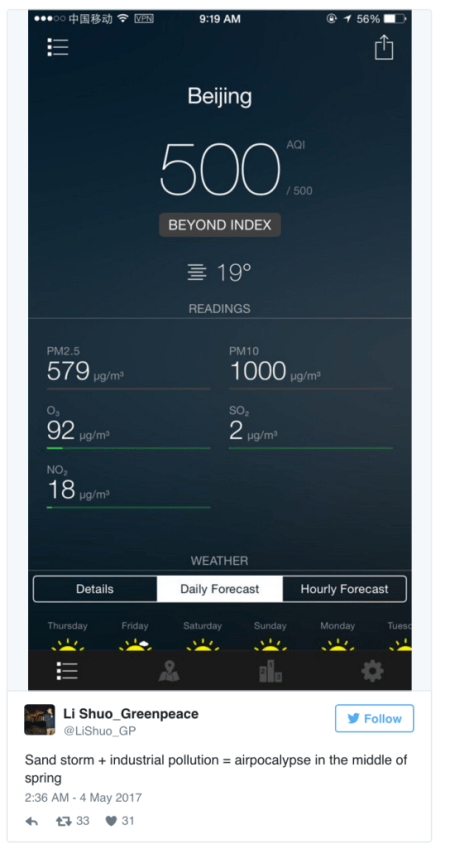
A putrid, nicotine-shaded mist loomed over Beijing on Thursday after a massive sandstorm slammed into the Chinese capital bringing the latest “airpocalypse” to this smog-choked city.

Dozens of flights were reportedly cancelled at Beijing’s airport, the world’s second busiest, and authorities urged residents to stay indoors after levels of PM10, a tiny inhalable particle linked to a variety of lung complaints, soared to above 2,000 micrograms per cubic metre.

“This is insane,” Li Shuo, Greenpeace’s Beijing-based climate campaigner, tweeted after the sandstorm swept across northern China in the early hours of Thursday.

“Sand storm + industrial pollution = airpocalypse in the middle of spring,” Li added.

China’s official news agency, Xinhua, said at least nine Chinese regions – from Xinjiang and Gansu in the west to Hebei and Heilongjiang further east – would be affected by the air pollution between Thursday and Friday. Visibility in Beijing had plummeted to about 1km in the capital and was expected to deteriorate further.

Before and after shots of Beijing published by Chinese state media captured the severity of the city’s latest air pollution crisis, which local authorities blamed largely on sand that winds had blown in from Mongolia and the Chinese province of Inner Mongolia.

The Chinese magazine Caixin warned readers that high concentrations of particulates such as PM10 and PM2.5 had been linked to lung cancer and strokes.

Li, the Greenpeace activist, said the sandstorm was reminiscent of those witnessed about two decades ago before a large-scale reforestation campaign in northern China helped reduce the number of sandstorms reaching the capital.

“We have had a lucky few years recently. Sandstorms have traditionally been a problem for Beijing and for the northern part of China around this season in March, April or May. But we have made some progress in terms of combating sandstorms over the past few years,” Li said.

“The peak point was in the late 1990s, early 2000s. Then, we could have not just one but several such episodes in the spring and they would be as severe or even worse than what we have seen today.”

Li said Beijing’s latest “airpocalypse” would make it harder for China to meet its air quality targets and should serve as an alert that progress in the fight against air pollution appeared to be losing steam.

After a period of advances, recent months had seen “quite a significant slowdown” in the rate of air quality improvement as a result of the ramping up of industrial activity around Beijing, Li claimed.

Last December tens of thousands of “smog refugees” were forced to flee China’s pollution-stricken north after a dangerous cocktail of pollutants enveloped swaths of north and central China.

Li said he hoped Beijing’s latest air pollution crisis would also remind the public that while industrial smog remained a pressing issue, desertification, which some view as one of China’s most urgent environmental challenges, was also still a problem as a result of deforestation, urbanisation and industrial development.

Source: Beijing hit by new air pollution crisis as huge sandstorm blows in | World news | The Guardian

Posted in Air Quality, Asia, China | Tagged , , , , , , | Leave a comment

Hanoi slowly choking on rising air pollution 

A new study has found that air quality in the capital can soar up to 10 times higher than World Health Organization limits.

A new study to measure the air quality in Vietnam’s major cities has found that pollution levels during the first three months of the year hit levels classified as “very harmful” more often than a year ago in Hanoi.

From January to March, ambient air pollution in the capital exceeded the World Health Organization’s standards on 78 days, the study by the Hanoi-based Green Innovation and Development Center (GreenID) at the Vietnam Union of Science and Technology Associations found.

Ambient air pollution is measured by the concentration of particulate matter 2.5 (PM2.5), a fraction of the width of a human hair which is released from vehicles, industry and natural sources like dust.

The PM2.5 concentration in Hanoi on February 15 was 234 μg/m3, the study found. The WHO limit is 25 μg/m3.

Nguy Thi Khanh, director of the center, told a conference on Wednesday that pollution had hit levels that were “very harmful to health” on multiple occasions.

The study said air quality in Ho Chi Minh City was better than in Hanoi, but the ambient air pollution also exceeded the WHO limit on 78 days.

The Real-Time Air Quality Index on aqicn.org forecasts that pollution levels in Hanoi will hit “very unhealthy” levels this Sunday and Monday, so people should stay indoors and limit outdoor activity. The index measures air pollution in 60 countries worldwide. The team is mainly based in Beijing, and uses measurements provided by the U.S. diplomatic mission in China and environmental protection agencies worldwide.

Khanh said Vietnam needs to reduce its urban pollution with strict rules to cut carbon dioxide emissions and develop clean energy.

There are more than 5 million motorbikes on Hanoi’s roads and as many as 19,000 new vehicles are registered each month. Around 140 new cars and 750 new motorbikes are also registered every day in Ho Chi Minh City, Vietnam’s most crowded city with 12 million people.

An environment ministry study between 2011 and 2015 released last September also warned that air quality has become worse in many urban areas, especially the two largest cities.

In February, a global environment study measured Vietnam’s air pollution as the second deadliest in Southeast Asia after Indonesia in terms of the raw number of premature deaths.

Deaths attributable to dangerous air particles in Vietnam jumped 60 percent from 26,300 in 1990 to 42,200 in 2015, according to the study by the Health Effects Institute, a Boston research institute focused on the health impacts of air pollution, and the Institute of Health Metrics and Evaluation in Seattle.

Ambient particulate matter ranks fifth among risk factors for total deaths around the world, after high blood pressure, smoking, diabetes and high cholesterol.

Source: Hanoi slowly choking on rising air pollution – VnExpress International

Posted in Air Quality, Asia, Vietnam | Tagged , , , , | Leave a comment

Keeping cool in the summer leads to increased air pollution 

As the weather warms, so does the use of air conditioners. But running these devices requires power plants to ratchet up electricity production, causing air polluting emissions to rise. An analysis of 27 states found that, on average, summer emissions of sulfur dioxide (SO2), nitrogen oxides (NOx) and carbon dioxide (CO2) go up by hundreds to thousands of metric tons per degree Celsius increase. The report appears in the ACS journal Environmental Science & Technology.

A large body of research has investigated the influence of weather and climate on atmospheric chemistry. But few studies have examined the specific effects of climate on electricity emissions and air quality. Although overall emissions have dropped due to pollution control devices and a drop in coal use, regional and seasonal increases in power plant pollution could affect people’s health and the environment. SO2 and NOx — both of which are regulated in the U.S. — can cause respiratory problems, particularly in children, people with asthma and the elderly. CO2 is a primary greenhouse gas targeted by power plant regulations. Tracey Holloway, David Abel and colleagues wanted to quantify the historical relationship between summertime air temperature and the power plant emissions of these three gases.

Using data collected between 2003 and 2014, the researchers crunched the numbers on electricity emissions in 27 states, mostly in the Eastern U.S. From this analysis, they observed that power plants released 3.35 percent more SO2 on average per degree Celsius increase in temperature, and NOx and CO2 rose by 3.60 percent and 3.32 percent, respectively. States with more coal power plants such as Ohio, Pennsylvania and Indiana released the most electricity-related SO2 emissions in the summer at more than 1,300 metric tons per day, per state. However, New Jersey, Connecticut and Vermont power plants released very little SO2. States like Texas with a large power demand showed high emissions of all pollutants, but smaller changes in emissions per degree Celsius. Overall, the calculations showed that hotter outdoor temperatures correlated with 140,000 metric tons more CO2 emissions. The researchers say that making buildings more energy efficient, especially on hot days, could play an important role in lowering power-plant emissions and improving air quality in the future.

Source: Keeping cool in the summer leads to increased air pollution — ScienceDaily

Posted in Air Quality, Health Effects of Air Pollution, USA & Canada | Tagged , , , , , | Leave a comment

Smog, Sandstorm Send Beijing Air Pollution Readings Soaring 

Masks were donned, and air purifiers cranked up to max, as Beijing’s chronic air pollution returned Thursday, shrouding the city’s skyline in a thick pall, and sending residents scurrying for cover as airborne particle ratings breached 20 times WHO safe levels.

Exacerbating the customary deluge of smog from factories and coal-burning power plants was a large sandstorm, a seasonal phenomenon caused by spring winds whipping up the nearby Gobi Desert and depositing its fine dust on the sprawling Chinese capital of 21 million.

As a result, levels of PM2.5 — microscopic particles that can cause breathing and circulation problems and even premature death — reached a staggering 630, while readings of the larger and similarly hazardous PM10 particles were off the scale at 1,000. (The WHO sets 24-hour mean safe levels at 25 and 50 respectively.)

Stay-at-home mom Pan Jia, 31, made her five-year-old daughter wear a face mask on the way to kindergarten this morning. “They have an air purifier and hopefully she can stay in the classroom for the whole day,” she says. “The air really is terrible.”

Children and the elderly have been told to stay indoors, and drivers instructed to take extra precautions on the road, as the government issued a “blue alert” for the sandstorm, which also affected huge swaths of the nation’s populous northeast.

To help tackle sandstorms, 32 million acres of new forest have been planted since 2008 in the northern Gobi Desert, according to the State Forestry Administration. As a result, sandstorms have become less frequent and intense. (Two storms in March 2002 deposited 56,000 tons of dust on Beijing.)

“When I was young, there were more sandstorms in Beijing, but we didn’t know the harm,” adds Pan. “After every [exercise] class outdoors I could feel the sand between my teeth.”

Social media has been abuzz with photos of off-the-scale pollution meters, sand piled on cars and face-mask selfies, taken in front of walls of smog. Companies selling air purifiers seized on the opportunity to hawk their products.

“It’s hard for Beijing to handle the air pollution,” posted one user to China’s Twitter-like microblog Weibo. “If the north wind comes, the smog is gone, but the sand storm comes. Without the north wind, the sand won’t come, but the smog is hard to clear. I wish some official could find a smart solution.”

China’s pollution contributes to 1.6 million deaths each year, according to a recent study, and has become a serious problem for the ruling Communist Party. A fund to combat smog has been boosted 250% this year to $5.8 million, according to the Ministry of Finance, the problem is worsening. Beijing’s PM2.5 readings spiked by 27% over the first quarter of 2017 compared to last year, reports the South China Morning Post.

Thursday’s smog was also likely augmented by a huge forest fire that broke out Tuesday in the Greater Hinggan Mountains in the nearby province of Inner Mongolia. More than 8,300 firefighters are working to extinguish the blaze, according to local authorities, which has engulfed at least 50 sq km of China’s largest forest. The fire originated across the border in Russia.

Source: Smog, Sandstorm Send Beijing Air Pollution Readings Soaring | Time.com

Posted in Air Quality, Asia, China | Tagged , , , | Leave a comment