Fatal attraction: The link between pollution and heart disease

WHY air pollution causes lung disease is obvious. Why it also causes heart disease is, though, a conundrum. One suggestion is that tiny particles of soot migrate through the lungs, into the bloodstream and thence to the walls of blood vessels, where they cause damage. Until now, this has remained hypothetical. But a study published in ACS Nano, by Mark Miller of Edinburgh University, suggests not only that it is correct, but also that those particles are specifically carried to parts of blood vessels where they will do maximum damage—the arterial plaques associated with cardiovascular disease.

One reason the particle-migration hypothesis has proved hard to confirm is that it is tricky to follow soot around the body. Soot is made of carbon, and that element, when finely divided and at low concentration, is difficult to isolate in biological material. Instead, Dr Miller and his colleagues used soot-sized particles of gold for their experiments. These are easy to detect, even at low concentrations, by means such as mass spectroscopy and Raman spectroscopy. Also, gold is chemically inert and therefore unlikely to be toxic. This is important, because some of Dr Miller’s experimental animals were people.

The first group of these human guinea pigs were 14 healthy men. Each was asked to exercise for two hours while inhaling air containing particles of gold. Dr Miller and his colleagues then monitored the volunteers’ blood and urine for 24 hours, and again three months later.

As expected, none of the volunteers showed signs of gold in their blood or urine before their exposure to the particles. All but two, however, did so 24 hours later. This proved that tiny particles can indeed migrate from the lungs into the circulation. Moreover, at the three-month recheck, the concentrations of gold in their bodily fluids remained more or less unchanged. Gold, once breathed in, is retained.

This experiment did not, however, tell Dr Miller where the particles were going and how they (or, rather, their carbon equivalents) can cause heart problems. He and his colleagues suspected that the culprits were immune-system cells called macrophages. These exist to engulf foreign bodies, such as bacteria, and would thus be quite capable of swallowing small particles of carbon or gold. They are also involved in inflammatory responses, which are helpful when short-lived (such as in reaction to a wound) but threatening when chronic (as in the inflammation associated with arterial plaques). Dr Miller and his colleagues thus wondered if their particles were being carried specifically to those plaques by macrophages.

Preliminary experiments on mice genetically engineered to be prone to vascular disease suggested they were. Dr Miller made these animals breathe in gold particles twice a week for five weeks. Then, a day after the final exposure, he killed and dissected them. He found that a given mouse’s diseased arteries contained five times as much gold as its healthy ones did.

To see if something similar is true in people, the team then recruited three further volunteers. In this case, those signed up were the opposite of healthy. They were patients with plaque-clogged arteries, who were at risk of suffering a stroke. This particular trio were asked to breathe in the gold dust 24 hours before they underwent surgery intended to clear their plaques and unblock their constricted vessels. Dr Miller and his colleagues were thus able to examine the extracted plaques for the presence of gold—which they found, as by now they expected to, in abundance.

It remains to be determined whether particles of carbon behave in the same way as particles of gold. But, given carbon’s high chemical reactivity compared with gold’s, it is a fair bet that macrophages will be even more likely to notice and swallow it. So, though Dr Miller’s work does not point towards a better treatment for pollution-induced cardiovascular disease, it does add weight to the arguments of those who worry about levels of air pollution.

Source: Fatal attraction: The link between pollution and heart disease | The Economist
Posted in Air Quality, Health Effects of Air Pollution | Tagged , , , | Leave a comment

Beijing hit by new air pollution crisis as huge sandstorm blows in 

Dozens of flights are reported cancelled and residents urged to stay indoors to avoid breathing in dangerous particles

A putrid, nicotine-shaded mist loomed over Beijing on Thursday after a massive sandstorm slammed into the Chinese capital bringing the latest “airpocalypse” to this smog-choked city.

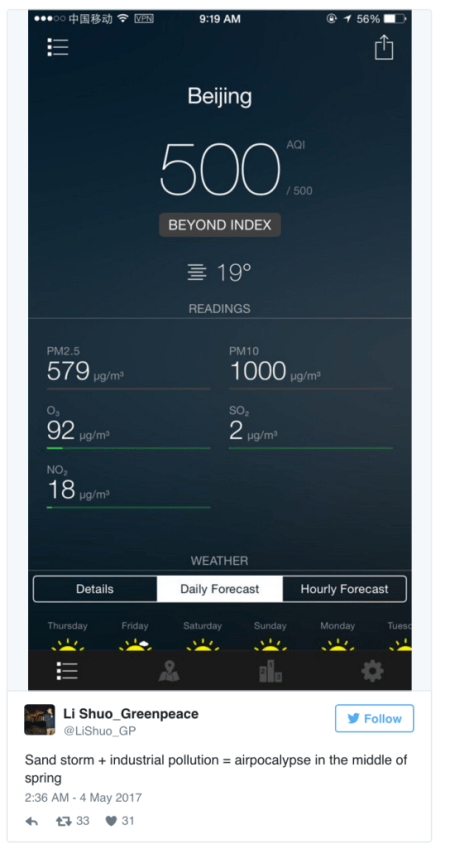
Dozens of flights were reportedly cancelled at Beijing’s airport, the world’s second busiest, and authorities urged residents to stay indoors after levels of PM10, a tiny inhalable particle linked to a variety of lung complaints, soared to above 2,000 micrograms per cubic metre.

“This is insane,” Li Shuo, Greenpeace’s Beijing-based climate campaigner, tweeted after the sandstorm swept across northern China in the early hours of Thursday.

“Sand storm + industrial pollution = airpocalypse in the middle of spring,” Li added.

China’s official news agency, Xinhua, said at least nine Chinese regions – from Xinjiang and Gansu in the west to Hebei and Heilongjiang further east – would be affected by the air pollution between Thursday and Friday. Visibility in Beijing had plummeted to about 1km in the capital and was expected to deteriorate further.

Before and after shots of Beijing published by Chinese state media captured the severity of the city’s latest air pollution crisis, which local authorities blamed largely on sand that winds had blown in from Mongolia and the Chinese province of Inner Mongolia.

The Chinese magazine Caixin warned readers that high concentrations of particulates such as PM10 and PM2.5 had been linked to lung cancer and strokes.

Li, the Greenpeace activist, said the sandstorm was reminiscent of those witnessed about two decades ago before a large-scale reforestation campaign in northern China helped reduce the number of sandstorms reaching the capital.

“We have had a lucky few years recently. Sandstorms have traditionally been a problem for Beijing and for the northern part of China around this season in March, April or May. But we have made some progress in terms of combating sandstorms over the past few years,” Li said.

“The peak point was in the late 1990s, early 2000s. Then, we could have not just one but several such episodes in the spring and they would be as severe or even worse than what we have seen today.”

Li said Beijing’s latest “airpocalypse” would make it harder for China to meet its air quality targets and should serve as an alert that progress in the fight against air pollution appeared to be losing steam.

After a period of advances, recent months had seen “quite a significant slowdown” in the rate of air quality improvement as a result of the ramping up of industrial activity around Beijing, Li claimed.

Last December tens of thousands of “smog refugees” were forced to flee China’s pollution-stricken north after a dangerous cocktail of pollutants enveloped swaths of north and central China.

Li said he hoped Beijing’s latest air pollution crisis would also remind the public that while industrial smog remained a pressing issue, desertification, which some view as one of China’s most urgent environmental challenges, was also still a problem as a result of deforestation, urbanisation and industrial development.

Source: Beijing hit by new air pollution crisis as huge sandstorm blows in | World news | The Guardian

Posted in Air Quality, Asia, China | Tagged , , , , , , | Leave a comment

Hanoi slowly choking on rising air pollution 

A new study has found that air quality in the capital can soar up to 10 times higher than World Health Organization limits.

A new study to measure the air quality in Vietnam’s major cities has found that pollution levels during the first three months of the year hit levels classified as “very harmful” more often than a year ago in Hanoi.

From January to March, ambient air pollution in the capital exceeded the World Health Organization’s standards on 78 days, the study by the Hanoi-based Green Innovation and Development Center (GreenID) at the Vietnam Union of Science and Technology Associations found.

Ambient air pollution is measured by the concentration of particulate matter 2.5 (PM2.5), a fraction of the width of a human hair which is released from vehicles, industry and natural sources like dust.

The PM2.5 concentration in Hanoi on February 15 was 234 μg/m3, the study found. The WHO limit is 25 μg/m3.

Nguy Thi Khanh, director of the center, told a conference on Wednesday that pollution had hit levels that were “very harmful to health” on multiple occasions.

The study said air quality in Ho Chi Minh City was better than in Hanoi, but the ambient air pollution also exceeded the WHO limit on 78 days.

The Real-Time Air Quality Index on aqicn.org forecasts that pollution levels in Hanoi will hit “very unhealthy” levels this Sunday and Monday, so people should stay indoors and limit outdoor activity. The index measures air pollution in 60 countries worldwide. The team is mainly based in Beijing, and uses measurements provided by the U.S. diplomatic mission in China and environmental protection agencies worldwide.

Khanh said Vietnam needs to reduce its urban pollution with strict rules to cut carbon dioxide emissions and develop clean energy.

There are more than 5 million motorbikes on Hanoi’s roads and as many as 19,000 new vehicles are registered each month. Around 140 new cars and 750 new motorbikes are also registered every day in Ho Chi Minh City, Vietnam’s most crowded city with 12 million people.

An environment ministry study between 2011 and 2015 released last September also warned that air quality has become worse in many urban areas, especially the two largest cities.

In February, a global environment study measured Vietnam’s air pollution as the second deadliest in Southeast Asia after Indonesia in terms of the raw number of premature deaths.

Deaths attributable to dangerous air particles in Vietnam jumped 60 percent from 26,300 in 1990 to 42,200 in 2015, according to the study by the Health Effects Institute, a Boston research institute focused on the health impacts of air pollution, and the Institute of Health Metrics and Evaluation in Seattle.

Ambient particulate matter ranks fifth among risk factors for total deaths around the world, after high blood pressure, smoking, diabetes and high cholesterol.

Source: Hanoi slowly choking on rising air pollution – VnExpress International

Posted in Air Quality, Asia, Vietnam | Tagged , , , , | Leave a comment

Keeping cool in the summer leads to increased air pollution 

As the weather warms, so does the use of air conditioners. But running these devices requires power plants to ratchet up electricity production, causing air polluting emissions to rise. An analysis of 27 states found that, on average, summer emissions of sulfur dioxide (SO2), nitrogen oxides (NOx) and carbon dioxide (CO2) go up by hundreds to thousands of metric tons per degree Celsius increase. The report appears in the ACS journal Environmental Science & Technology.

A large body of research has investigated the influence of weather and climate on atmospheric chemistry. But few studies have examined the specific effects of climate on electricity emissions and air quality. Although overall emissions have dropped due to pollution control devices and a drop in coal use, regional and seasonal increases in power plant pollution could affect people’s health and the environment. SO2 and NOx — both of which are regulated in the U.S. — can cause respiratory problems, particularly in children, people with asthma and the elderly. CO2 is a primary greenhouse gas targeted by power plant regulations. Tracey Holloway, David Abel and colleagues wanted to quantify the historical relationship between summertime air temperature and the power plant emissions of these three gases.

Using data collected between 2003 and 2014, the researchers crunched the numbers on electricity emissions in 27 states, mostly in the Eastern U.S. From this analysis, they observed that power plants released 3.35 percent more SO2 on average per degree Celsius increase in temperature, and NOx and CO2 rose by 3.60 percent and 3.32 percent, respectively. States with more coal power plants such as Ohio, Pennsylvania and Indiana released the most electricity-related SO2 emissions in the summer at more than 1,300 metric tons per day, per state. However, New Jersey, Connecticut and Vermont power plants released very little SO2. States like Texas with a large power demand showed high emissions of all pollutants, but smaller changes in emissions per degree Celsius. Overall, the calculations showed that hotter outdoor temperatures correlated with 140,000 metric tons more CO2 emissions. The researchers say that making buildings more energy efficient, especially on hot days, could play an important role in lowering power-plant emissions and improving air quality in the future.

Source: Keeping cool in the summer leads to increased air pollution — ScienceDaily

Posted in Air Quality, Health Effects of Air Pollution, USA & Canada | Tagged , , , , , | Leave a comment

Smog, Sandstorm Send Beijing Air Pollution Readings Soaring 

Masks were donned, and air purifiers cranked up to max, as Beijing’s chronic air pollution returned Thursday, shrouding the city’s skyline in a thick pall, and sending residents scurrying for cover as airborne particle ratings breached 20 times WHO safe levels.

Exacerbating the customary deluge of smog from factories and coal-burning power plants was a large sandstorm, a seasonal phenomenon caused by spring winds whipping up the nearby Gobi Desert and depositing its fine dust on the sprawling Chinese capital of 21 million.

As a result, levels of PM2.5 — microscopic particles that can cause breathing and circulation problems and even premature death — reached a staggering 630, while readings of the larger and similarly hazardous PM10 particles were off the scale at 1,000. (The WHO sets 24-hour mean safe levels at 25 and 50 respectively.)

Stay-at-home mom Pan Jia, 31, made her five-year-old daughter wear a face mask on the way to kindergarten this morning. “They have an air purifier and hopefully she can stay in the classroom for the whole day,” she says. “The air really is terrible.”

Children and the elderly have been told to stay indoors, and drivers instructed to take extra precautions on the road, as the government issued a “blue alert” for the sandstorm, which also affected huge swaths of the nation’s populous northeast.

To help tackle sandstorms, 32 million acres of new forest have been planted since 2008 in the northern Gobi Desert, according to the State Forestry Administration. As a result, sandstorms have become less frequent and intense. (Two storms in March 2002 deposited 56,000 tons of dust on Beijing.)

“When I was young, there were more sandstorms in Beijing, but we didn’t know the harm,” adds Pan. “After every [exercise] class outdoors I could feel the sand between my teeth.”

Social media has been abuzz with photos of off-the-scale pollution meters, sand piled on cars and face-mask selfies, taken in front of walls of smog. Companies selling air purifiers seized on the opportunity to hawk their products.

“It’s hard for Beijing to handle the air pollution,” posted one user to China’s Twitter-like microblog Weibo. “If the north wind comes, the smog is gone, but the sand storm comes. Without the north wind, the sand won’t come, but the smog is hard to clear. I wish some official could find a smart solution.”

China’s pollution contributes to 1.6 million deaths each year, according to a recent study, and has become a serious problem for the ruling Communist Party. A fund to combat smog has been boosted 250% this year to $5.8 million, according to the Ministry of Finance, the problem is worsening. Beijing’s PM2.5 readings spiked by 27% over the first quarter of 2017 compared to last year, reports the South China Morning Post.

Thursday’s smog was also likely augmented by a huge forest fire that broke out Tuesday in the Greater Hinggan Mountains in the nearby province of Inner Mongolia. More than 8,300 firefighters are working to extinguish the blaze, according to local authorities, which has engulfed at least 50 sq km of China’s largest forest. The fire originated across the border in Russia.

Source: Smog, Sandstorm Send Beijing Air Pollution Readings Soaring | Time.com

Posted in Air Quality, Asia, China | Tagged , , , | Leave a comment

UK government agrees to publish air pollution strategy in next week 

No 10 will not challenge high court judgment, which rejected ministers’ efforts to keep policy secret until after election

A draft plan to tackle air pollution will finally be published within the next week, after No 10 said it would not challenge a court ruling forcing the government to release information before the election.

Theresa May’s official spokesman said the government would not appeal against the high court judg ment, which rejected attempts by ministers to keep the policy under wraps until after the poll.

This means the government will have to publish its draft air-quality plan before 9 May , but No 10 said it wanted to wait until after the purdah period for the local elections was over on Thursday.

The strategy will set out how ministers plan to tackle the UK’s air pollution crisis, which is believed to be responsible for 40,000 premature deaths a year.

Ministers had applied to the court to keep their plans secret until after the general election, saying it was necessary to “comply with pre-election propriety rules”.

But Mr Justice Garnham said the environment secretary, Andrea Leadsom, was in breach of a court order to take action in the shortest possible time and that any further delays would constitute a further breach.

He said it was essential to publish draft plans to cut air pollution immediately to safeguard public health. The judge rejected a government application to appeal, saying ministers would have to go to the appeal court if they wanted to seek permission to challenge his ruling.

Garnham ordered ministers to publish their draft plan within two weeks – five days after local elections on 4 May – and said the government must comply with his original order and release their final policy on tackling the crisis by 31 July.

“The continued failure of the government to comply with directives and regulations constitutes a significant threat to public health,” he said.

The judge said government figures showed that nitrogen dioxide pollution – primarily from diesel traffic – was linked to the premature deaths of 23,500 people a year in the UK. “That is more than 64 deaths each day,” Garnham said.

The court decided the threat to public health constituted “exceptional circumstances”, which meant purdah guidelines in the run-up to a general election could be waived. “Immediate publication [of the policy] is essential,” he said.

It was the latest legal blow to the government after it lost a court case brought by the environmental group ClientEarth over its failure to take measures to reduce air pollution, which put it in breach of EU law and domestic regulations.

The judge said the government’s original plans were so poor as to be unlawful. They included five clean-air zones. The judge gave ministers until 4pm on 24 April to present a new draft policy to tackle air pollution from diesel traffic.

The government was then called to court by Garnham to explain why it had made a last-minute application late last Friday to delay publication of a draft policy to tackle air pollution until after the election.

James Eadie QC, representing the government, said the policy was ready to be published but it would be controversial and should therefore be withheld until after the election.

“If you publish a draft plan, it drops all the issues of controversy into the election … like dropping a controversial bomb,” he said, adding that it could risk breaching rules about civil service neutrality and lead to the policy being labelled a Tory plan.

But Garnham said in his judgment that purdah was not a principle of law and the exceptional circumstances of the threat to public health that meant its rules could be overridden.

“It does not give ministers a defence to the principles of private and public law … It is not binding on the courts. It provides no immediate right for an extension of time to comply with an order of the court. It is not a trump card,” he said.

The judge said the court had in November ordered Leadsom to publish the draft plan to tackle illegal levels of air pollution and that she had still failed to do so.

“In November 2016, I found the secretary of state was in breach of directives and regulations. The secretary of state remains in breach. She is obliged to comply as soon as possible.” Garnham added that any further delay would constitute a further breach.

Source: UK government agrees to publish air pollution strategy in next week | Environment | The Guardian

Posted in Air Quality, Europe, UK | Tagged , | Leave a comment

Stringent exhaust gas tests for cars in Europe 

As of October 2017, newly launched car models will have to pass more stringent exhaust gas tests in the EU and in Switzerland. The new test method includes measuring drives in actual traffic. Empa already tested currently available cars with the new method — with alarming results.

By now, it’s no secret: the certification requirements for cars in the EU and in Switzerland have precious little to do with the cars’ actual exhaust emissions on the roads. The “real” exhaust emissions are, therefore, determined in separate studies, including at Empa. Air pollution control experts from the Federal Office for the Environment (FOEN) draw upon this kind of data if they want to estimate road traffic emissions. On behalf of the Swiss government, Empa measures about a dozen vehicles a year, which are supplied by randomly selected individuals for a small fee. The data is fed into the European HBEFA database (Handbook Emission Factors for Road Transport) and is used, amongst other things, by international research institutes and authorities as a basis for expert reports.

High nitric oxide emissions

Last January was a prime example of what can happen during such measurements: the test candidate, a 2016 diesel Renault Mégane, already displayed high nitric oxide emissions at Empa’s test rig. This is because the Empa researchers focused on the vehicle’s actual values — as intended in the new WLTP method — and not the outdated standards of the previous approval procedure. For instance, the vehicle was measured as being almost 300 kilograms heavier than the type test regulations allow for — not out of spite, but because the car drives around the streets at this weight. Later, during the so-called RDE test (Real Driving Emissions), up to 1,300 milligrams of nitric oxides per kilometer were measured in the exhaust. In other words, this current Euro 6 vehicle emits about as much nitric oxides as a ten or 15-year-old diesel car. As of October 2017, however, new models will only be allowed to emit 170 milligrams per kilometer!

Acclaimed by motor journalists

A year earlier, the very same model had been crowned “Car of the Year” by European car journalists. How is it possible for a modern diesel vehicle to display such high emissions on the roads? One problem is the previous exhaust gas regulations, which failed to keep up with the rapid developments in powertrain systems. These regulations are fraught with unrealistic dead-weight and driving resistance requirements, and predefined, high-speed gearshift points that have nothing to do with reality. This realization is nothing new: already back in 2010, a decision was made to develop a new, more realistic exhaust gas measuring technique. But why has it taken so long? The topic is complicated and processed by an international working group, which had to make do with many, sometimes even divergent demands.

In the case of the Renault Mégane, the exhaust gas recirculation evidently turned itself off during the test drive — perhaps because the outside temperature was below the minimum temperature in the lab. Other manufacturers also switch off the exhaust gas treatment to go easy on the engine, when it is used outside the test rig — which is perfectly legal according to EU emissions regulation 715/2007/EG.

In Audis and Fiats, for instance, it is turned off after 22 minutes, as the German newspaper Handelsblatt reported (the NEDC dynamometer test lasts 20 minutes); in Mercedes cars below 10 degrees and in Opels even below 17 degrees Celsius, as Handelsblatt also stated (the NEDC dynamometer test requires temperatures above 20 degrees). Opel also switches to another cycle at an air pressure below 915 millibars, as the magazine Der Spiegel reported. The deactivation, therefore, occurs at an altitude of over 850 meters above sea level (the highest testing lab for car certifications in Europe is situated in Madrid, at an altitude of 700 meters).

In February 2017, Opel, Daimler and VW expressed their willingness to voluntarily recall around 500,000 vehicles across Europe to correct their exhaust gas treatment software, which was not illegal so far. On top of this, VW has to correct 2.4 million cars containing an illegal software.

Public research

If we also want to use exhaust gas treatment systems continuously at low temperatures and in other adverse conditions, they need to be understood in technical detail, designed correctly and operated under optimal conditions. As the current scandal reveals: there is a still a lot of catching up to do in this respect. Empa makes significant contributions in this sector with a high-temperature flow lab by studying in detail the injection behavior of AdBlue, an aqueous urea solution that is injected into the exhaust gas in new diesel vehicles. Researchers measure the spray cone right down to single droplets using laser measuring devices, study the formation and evaporation of liquid AdBlue films on the walls of the exhaust pipe, and gauge the AdBlue breakdown all the way until the formation of the reduction agent for the nitric oxides in the adjacent catalytic converter. These results are channeled back into the refinement of exhaust gas treatment systems.

During Empa’s exhaust gas tests, the experts from the Automotive Powertrain Technologies lab drive along a defined route southeastwards from Dübendorf, around Lake Greifensee, then back on the highway from Uster via Brüttiseller Kreuz (see map). During the journey, the NOx emissions are meticulously recorded by a so-called PEMS (Portable Emission-measuring System).

The Mégane is not alone

Empa has already tested three new lower mid-range diesel vehicles with the current exhaust gas standard Euro 6 using the new RDE procedure. In all of them, NOx emissions during every phase of the trip lay between 600 and 1,400 milligrams per kilometer; exhaust gas tests by other labs reveal a similar picture. In other words, the Renault Mégane is not alone. These vehicles can continue to be sold until the fall 2019; however, upcoming model series must pass the stricter WLTP and RDE tests to be approved.

Anyone who would like to drive a cleaner car than the law requires today does have an alternative, though: with NOx emissions way below 10 milligrams per kilometer, the natural / biogas vehicle that was also included in the measurements fared around 60 to 140 times better than the diesel cars.

Source: Stringent exhaust gas tests for cars in Europe — ScienceDaily

Posted in Air Quality, Europe | Tagged , , , , , , | Leave a comment

India to make every single car electric by 2030 in bid to tackle pollution that kills millions 

Every car sold in India will be powered by electricity by the year 2030, according to plans unveiled by the country’s energy minister.

The move is intended to lower the cost of importing fuel and lower costs for running vehicles.

“We are going to introduce electric vehicles in a very big way,” coal and mines minister Piyush Goyal said at the Confederation of Indian Industry Annual Session 2017 in New Delhi.

Comparing the drive to a 2015 initiative in the country to reduce energy bills by promoting LED lightbulbs, he told reporters: “We are going to make electric vehicles self-sufficient… The idea is that by 2030, not a single petrol or diesel car should be sold in the country.”

Mr Goyal said the electric car industry would need between two and three years of government assistance, but added that he expected the production of the vehicles to be “driven by demand and not subsidy” after that.

“The cost of electric vehicles will start to pay for itself for consumers,” he said according to the International Business Times. “We would love to see the electric vehicle industry run on its own,” he added.

An investigation by Greenpeace this year found that as many as 2.3 million deaths occur every year due to air pollution in the country. The report, entitled ‘Airpocalypse’, claimed air pollution had become a “public health and economic crisis” for Indians.

It said the number of deaths caused by air pollution was only “a fraction less” than the number of deaths from tobacco use, adding that 3 per cent of the country’s Gross Domestic Product (GDP) was lost to the levels of toxic smog.

“India’s pollution trends have been steadily increasing, with India overtaking China in number of deaths due to outdoor air pollution in 2015,” the report said, saying a “robust monitoring system” was urgently needed.

Delhi was India’s most polluted city, the report found, with concentrations of particulate matter 13 times the annual limit set by the World Health Organisation.

Mr Goyal said the electric car scheme would first target “larger consumer centres, where pollution is at an all-time high”, such as Delhi.

Source: India to make every single car electric by 2030 in bid to tackle pollution that kills millions | The Independent

Posted in Air Quality, Asia, India | Tagged , , , | 1 Comment