Cities need to ‘green up’ to reduce impact of air pollution: The harmful impact of urban air pollution could be combated by strategically placing low hedges along roads in a built-up environment of cities instead of taller trees, a new study has found 

The harmful impact of urban air pollution could be combated by strategically placing low hedges along roads in a built-up environment of cities instead of taller trees, a new study has found.

The study, just published in the journal Atmospheric Environment, points out that low hedges reduce the impact of pollution from vehicles in cityscapes where there are large buildings close to roads, far more effectively than taller trees. In some environments, trees actually make the pollution more concentrated depending on prevailing wind conditions and built-up configurations.

The study is a collaborative effort by partners from the UK, Europe and USA, led by the University of Surrey’s Professor Prashant Kumar, under the umbrella of H2020 funded project, iSCAPE: Improving Smart Control of Air Pollution in Europe.

Higher trees only have more of an impact in reducing air pollution in areas which are more open and are less densely populated by taller buildings.

Urban air quality continues to be a primary health concern as most of the world’s population currently lives in urban areas (54% in 2014), and percentage is projected to rise to 66% by 2050; this is coupled with the fact that one of the main global sources of air pollution in cities is traffic emissions.

Professor Prashant Kumar, who is Chair in Air Quality & Health at the University of Surrey, said future urban planning need to consider designing and implementing more “green infrastructure,” such as trees or hedges in the built environment to create a more healthy urban lifestyle.

Green infrastructure in cities is an urban planning solution for improving air quality as well as enhancing the sustainability of cities for growing urban populations. These green solutions include street trees, vegetation barriers (including hedges), green (or living) walls, and green roofs. They act as porous bodies which influence local dispersion of pollution and aid the deposition and removal of airborne pollutants, making the air cleaner.

Professor Kumar said: “We all know air pollution is a major factor of everyday urban life. This comprehensive review highlights that trees and hedges, as well as other green infrastructure, must be used strategically to help create healthier, less polluted cities that are also more pleasant for everyone to live and work in.

“Our other research study into London’s air quality, published this week in Atmospheric Environment, investigated the underlining factors responsible for the air pollution exposure in urban environments. The other aspects, such as time of day and wind speed, emerged as important predictors of air pollution exposure for the above-ground modes (car, bus, walk) compared with openable/non-openable windows for the underground trains.

“Our earlier study showed the weathering impact of air pollution on the building materials such as limestone, sandstone and carbon steel, used in many heritage buildings and built infrastructure. This is why we need to protect buildings as well as humans in cities in future urban planning, so the strategic placing of hedges, trees and other green infrastructure can have a direct benefit as an air pollution control measure in cities.”

The study also highlighted that green infrastructure has both positive and negative impacts on air quality at street levels, depending on the urban location it is in as well as its vegetation characteristics.

In a “street canyon” environment, where buildings like skyscrapers are close together on either side of the street, high-level green infrastructure (such as trees) generally have a negative impact on air quality. Instead, low-level hedges reduce air pollution exposure in such places. In a similar way, green walls and roofs act as a sink to effectively reduce pollution.

In open road conditions, thick, dense and tall vegetation barriers restrict the freshly emitted vehicle emissions from reaching roadsides in high concentrations where people walk, cycle or live nearby.

Apart from air pollution reduction, other benefits of urban green infrastructure include urban heat island mitigation, the potential reduction in energy consumption, better stormwater management, and climate change mitigation.

Professor Kumar added: “Under the framework of the iSCAPE project, we are currently performing targeted field investigations to quantify the effects of different types of green barriers along the busy open-road sides. This will help to develop evidence-based guidelines to support future urban planning and the public to make informed choices to “green up” their surrounding environments.”


Source: Cities need to ‘green up’ to reduce impact of air pollution: The harmful impact of urban air pollution could be combated by strategically placing low hedges along roads in a built-up environment of cities instead of taller trees, a new study has found — ScienceDaily

Posted in Air Quality, Health Effects of Air Pollution | Tagged , , | Leave a comment

Diesel cars pump out 50 per cent more toxic emissions than they should, major report finds

Diesel cars are pumping out 50 per cent more toxic emissions than they should be if all were complying with pollution laws, researchers have found.

In Europe the failure to meet emissions standards could be leading to the deaths of 11,500 people every year, the new report by the University of York and the International Council on Clean Transportation .

Between 2008 and 2015 Volkswagen rigged diesel cars so they could pass stringent environmental tests while emitting dangerous levels of pollution. But until now it was unclear if other car companies had fitted similar ‘defeat devices.’

The new research concluded that diesels are emitting far more nitrogen oxides than they should for reasons which could range from ‘engine calibration to equipment failure, inadequate maintenance, tampering by vehicle owners, the deliberate use of defeat devices, or simply deficient certification test procedures.’

Professor Roy Harrison FRS, Professor of Environmental Health, University of Birmingham, said: “This is a rigorous study which highlights the serious consequences which have resulted directly from the irresponsible actions of the motor manufacturers in producing vehicles which meet regulatory requirements under test conditions, but emit far higher pollutant levels during on-road use.

“The study may well underestimate the full consequences for public health as it quantifies only the effects of particulate matter and ozone formed in the atmosphere as a result of excess nitrogen oxides emissions, but not the direct effects of the oxides of nitrogen themselves.”

Nitrogen oxide is a key contributor to outdoor air pollution.  Long-term exposure to these pollutants is linked to a range of adverse health outcomes, including disability and reduced life expectancy due to stroke, heart disease, chronic obstructive pulmonary disease, and lung cancer.

 The government is currently planning an incentive scheme to allow diesel owners to scrap their cars for cash, if they are older models and registered at an address where air pollution is already at dangerous levels. The High Court recently ruled that the Department for the Environment must produce a plan to tackle air pollution in British cities which regularly breach safe air levels.

For the new diesel report, researchers analysed data from 30 studies of vehicle emissions under real-world driving conditions around the world.

They found that vehicles emitted 13.2 million tons of nitrogen oxide under real-world driving conditions, which is 4.6 million tons more than the 8.6 million tons expected under official laboratory tests.

Josh Miller, researcher at the International Council on Clean Transportation (ICCT), said: “For light-duty vehicles, such as passenger cars, trucks, and vans, the European Union produced nearly 70 per cent of the excess diesel nitrogen oxide emissions.”

At a global level, the study estimates that the impact of all real-world diesel nitrogen oxide emissions will grow to 183,600 early deaths in 2040, unless something is done to reduce it.

The research was published in the journal Nature.

Source: Diesel cars pump out 50 per cent more toxic emissions than they should, major report finds

Posted in Air Quality | Tagged , , , | Leave a comment

Lack of dust makes China’s air pollution much worse 

Airborne dust is normally seen as an environmental problem, but the lack of it is making air pollution over China considerably worse.

A new study suggests less dust means more solar radiation hits the land surface, which reduces wind speed.

That lack of wind in turn leads to an accumulation of air pollution over heavily populated parts of China.

The researchers found that reduced dust levels cause a 13% increase in human-made pollution in the region.

Sands from the Gobi

Hundreds of millions of people across China continue to be impacted by air pollution from factories and coal-fired power plants.

Studies suggest that the dirty air contributes to 1.6 million deaths a year, about 17% of all mortalities.

But this new research says that the human-induced pollution is being made worse or better by naturally occurring dust that blows in from the Gobi desert.

Using models to simulate 150 years of wind and dust patterns in the region, the researchers found that the dust deflects significant amounts of sunlight.

Without it, more heat from the Sun hits the land. Differences in the temperatures between land and sea cause the winds to blow. Without the dust, the land warms up more and that changes the temperature differential with the sea leading to weaker breezes – and more air pollution.

“There are two dust sources. One is the Gobi and the other is the highlands of north-west China, but we found the Gobi had much more influence,” said lead author Yang Yang, from the Pacific Northwest National Laboratory in Washington State, US.

“Less dust in the atmosphere causes more solar radiation to reach the surface. It weakens the temperature difference between the land and the sea and impacts the circulation of the winds and causes a stagnation over eastern China and that causes an accumulation of air pollution.”

Small change, big impact

The decreases in dust emissions are considerable, varying by almost a third. The impact on winds speeds are quite small by comparison, a reduction of barely more than one-tenth of one mile per hour.

However, when this takes place on a large scale over a wide region, the small change in speed means a 13% increase in the amount of air pollution over eastern China during the winter.

Another study has recently shown a link between declining Arctic sea ice and a major air pollution event in China in 2013.

The authors of the new study believe that both theories could be true.

“Our study has the same mechanism: the weakening of winds causes more pollution, and what is behind this needs to be studied,” said Yang Yang.

“We have two views on this kind of weakening of wind. They found the sea ice, we found the dust-wind interaction can also lead to weakening of the wind. I think both of them are important.”

The researchers believe that the study may inform broader questions about how natural and human-created aerosols interact.

Many parts of the world, in addition to China, are now suffering from increased levels of air pollution and understanding how dust, winds and emissions work together may help limit some of the worst impacts of dirty air.

One of the key lessons from this study is that the absence of dusty conditions could mean the air you are breathing is worse for you, not better.

“You’re damned if you do, damned if you don’t,” said Prof Lynn Russell from the Scripps Institution of Oceanography in California.

“Dust emissions can impair visibility, but they are not so harmful in terms of air quality,” she told BBC News.

“If it’s not a dusty year, you may be happy and spending more time outdoors because you don’t have this dust in the way, but you are actually going out to spend more time in more toxic air.”

The study has been published in the journal Nature Communications.

Source: Lack of dust makes China’s air pollution much worse – BBC News

Posted in Air Quality, Asia, China | Tagged , | Leave a comment

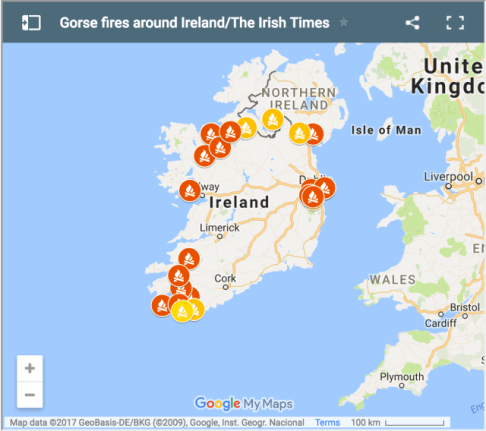
Gorse fires: Residents in affected areas told to stay indoors

Cloosh Valley blaze led to Galway city having air pollution similar to that in Beijing

People living in areas affected by recent gorse fires have been advised to avoid spending prolonged periods of time outdoors.

The HSE offered the advice in a public health statement, after more than 100 gorse fires were detected across the State in recent weeks.

Minister for Agriculture Michael Creed also said on Thursday that people were illegally burning foliage at the moment and this was leading to out-of-control fires.

Landowners and the public were warned this week it is illegal to burn any vegetation growing on land during certain periods.

Anybody found burning vegetation between March 1st and August 31st is liable for prosecution by gardaí.

In its statement, the HSE said people, particularly those in the west of Ireland, should “avoid spending long amounts of time outdoors in areas affected by any smoke or ash.

“Smoke levels will change depending on wind conditions, so please use personal judgment.”

The seriousness of the fires has been attributed to a prolonged dry spell since the beginning of April, with average rainfall at 25 per cent of normal levels for this time of year.

Cloosh Valley in Co Galway has been among the worst affected areas, with one academic saying the smoke pollution arising from the valley’s fires had led to air pollution in Galway city comparable to that in Beijing.

Dr Liz Coleman, of the NUI Galway Centre for Climate and Air Pollution Studies, said the city had experienced smoke pollution for two hours on Tuesday, but it dispersed “quite quickly” afterwards.

She told RTÉ that the event was recorded on a monitoring network.

The network’s data, which is webcast live every five minutes, shows smoke pollution reaching at least 20 times the normal background level on Tuesday evening.

High-pollution events can have significant health impacts on sections of the population, including the elderly, immunosuppressed and those with chronic conditions such as asthma, Dr Coleman said.

“All you can do is stay indoors, close the windows and wait for it to pass,” she said.

Dr Coleman said the World Health Organisation had determined that 25 microgrammes of particles per metre cubed is the safest level of air quality. On Tuesday evening in Galway, the reading was 150.

‘Under control’

Meanwhile, Coillte said the fire at Cloosh Valley had been suppressed after fire-fighting on Wednesday.

Vast areas of forest and bog land in the valley have been devastated by the blaze.

Coillte said its staff and Army personnel will remain on site on Thursday to monitor hot spots, “as there is still some risk that fires could reignite”.

“With stable weather conditions and the forecast of rain on Saturday evening, it is hoped that there will be no further resurgence of the fire,” it said.

“A civil helicopter will also remain on standby today should it be needed.”

Donegal Fire Service said it had responded to 51 wild fires over the last five days, but there were currently none burning in the county.

“It is the view of the Donegal Fire Service that the vast majority of these fires are started with some form of human intervention, either accidentally or deliberately, and we would call on all members of the public to be aware of the dangers and consequences of deliberate fire-setting,” said a spokeswoman.

She said some fires “can . . . be started unintentionally by thoughtless and careless behaviour”.

Mr Creed told RTÉ’s Morning Ireland that under the current controlled burning regulations a farmer has to alert the authorities of any planned fires, so they would then be on hand to ensure the blaze did not spread.

He said gorse fires were not without consequences – financially and environmentally – and people should be extremely careful.

Source: Gorse fires: Residents in affected areas told to stay indoors

Posted in Air Quality, Europe | Tagged , , | Leave a comment

Women at greater heart disease risk from air pollution, study says 

Doctors have warned dieters for decades to watch what they eat to stall the development of heart trouble, but a new study suggests air pollution may also contribute to heart disease.

A release from the American Heart Association said the results from the study show that car exhaust can hamper the body’s production of high-density lipoprotein (HDL).

According to the Mayo Clinic’s website, HDL cholesterol is thought to filter more dangerous forms of cholesterol from the bloodstream.

The Multi-Ethnic Study of Atherosclerosis, funded by the National Heart, Lung and Blood Institute, the Environmental Protection Agency and others, focused on measuring HDL levels after exposure to air pollution.

During the yearlong investigation, the black carbon commonly found in highway-generated air pollution led to lower HDL readings in both men and women, but with greater impact found in women.

The study’s primary author, Griffith Bell of Seattle’s University of Washington School of Public Health, said lower HDL levels can predispose people to developing heart disease later in life.

“Our study helps strengthen the biological plausibility of the link between traffic-related air pollution and cardiovascular disease,” Bell said in the release. “We’re slowly beginning to understand some of the biology of how that link works.”

Bell cautioned that further study is necessary to firmly establish the link between airborne pollution and cholesterol because this study examined data at a single point in time.

Source: Women at greater heart disease risk from air pollution, study says | Patient Daily

Posted in Air Quality, Health Effects of Air Pollution, Medical Studies | Tagged , , , | Leave a comment

Hot, hazy day for Hong Kong as air quality poses ‘very high’ health risk in Central, Causeway Bay and Mong Kok 

Weather to remain sunny with low visibility through the day, with one or two isolated showers in the afternoon

A blanket of heavy pollution smothered Hong Kong’s biggest business and shopping districts on Wednesday.

Citizens braving the sweltering heat also had to put up with pollution levels categorised as “very high” in Central, Causeway Bay and Mong Kok.

According to the Environmental Protection Department, as of 11am the air quality health index had reached 8 at roadside stations in the two districts, indicating a very high health risk. Roadside stations in Mong Kok and general stations in Tuen Man and Tai Po reported AQHI readings of 7, indicating a high health risk.

In Central, the level of harmful PM2.5 particulates had reached 107 micrograms per cubic metre, four times the World Health Organisation’s safety limit of 25 and well above Hong Kong’s limit of 75. In Causeway Bay, the level reached 101.

The Environmental Protection Department advises children, the elderly and those with existing heart or respiratory illnesses to reduce outdoor activities to a minimum when the health risk is very high.

“The general public are advised to reduce, or reduce to a minimum, outdoor physical exertion, and to reduce time outdoors, especially in areas with heavy traffic,” a spokesman for the department said.

According to the Hong Kong Observatory, the pollution was brought by high pressure over the western North Pacific as well as light winds locally.

“The visibility fell to about 3,000 metres over many places,” the Observatory said in its weather report.

According to the report, it will remain hot and sunny with low visibility through the day, with one or two isolated showers in the afternoon.

It will be mainly fine and hot over the next couple of days.

As of 10am, the Observatory recorded 28 degrees Celsius in Tsim Sha Tsui. Temperatures reached 30 degrees in Sha Tin, Tseung Kwan O, Tsing Yi, Tsuen Wan Shing Mun Valley, Kowloon City, Happy Valley, Wong Tai Sin, Kwun Tong and Sham Shui Po.

Source: Hot, hazy day for Hong Kong as air quality poses ‘very high’ health risk in Central, Causeway Bay and Mong Kok | South China Morning Post

Posted in Air Quality, Asia, China | Tagged , , , , | Leave a comment

Air pollution, Europe’s largest environmental health hazard

Health issues surrounding air quality were brought into the spotlight this week with World Asthma Day, which takes place every year in May.

There is no doubt that air pollution is unhealthy and that it aggravates conditions such as asthma. The seriousness of the issue is one that the European Commission has grappled with for some time.

The European Federation of Allergy and Airways Diseases Patients’ Association (EFA) report that 10 times more people are killed by air pollution than by road accidents in the European Union.

The Air Quality in Europe report, published late last year by the European Environmental Agency (EEA), found that air pollution had significantly impacted the health of Europeans, particularly in urban areas. It analysed air quality from 2000 to 2014 based on data from official monitoring stations across Europe, including more than 400 cities.

Air quality, according to the report, was slowly improving but air pollution remained the single largest environmental health hazard in Europe, resulting in a lower quality of life due to illnesses and an estimated 467,000 premature deaths per year.

The report also showed that in 2014 around 85 percent of the urban population in the EU were exposed to fine particulate matter at levels deemed harmful to health by the World Health Organization (WHO). Particulate matter can cause or aggravate cardiovascular diseases, asthma and lung cancer.

“Emission reductions have led to improvements in air quality in Europe, but not enough to avoid unacceptable damage to human health and the environment,” said EEA executive director Hans Bruyninckx on publication of the report.

The EU’s Ambient Air Quality Directive sets limit values for air pollutants, including nitrogen dioxide (NO2), an irritant gas which at high concentrations causes inflammation of the airways. Long term exposure can decrease lung function, increase the risk of respiratory conditions and increase the response to allergens.

When the limits of the directive are exceeded, member states are required to adopt and implement air quality plans to resolve the issue.

Despite this obligation, air quality has remained a problem with 23 out of 28 member states still exceeding air quality limits, which includes more than 130 cities across Europe.

Legal wrangling and penalties

In February this year, the commission had sent final warnings to Germany, France, Spain, Italy and the UK for failing to address repeated breaches of air pollution limits for NO2.

In Germany 28 air quality zones were highlighted including Berlin, Munich, Hamburg and Cologne; France (19 zones including Paris, Marseille and Lyon); the United Kingdom (16 zones, among them London, Birmingham, Leeds, and Glasgow); Italy (12 zones, including Rome, Milan and Turin) and Spain (3 zones, one being Madrid and two covering Barcelona).

It is up to the individual countries to choose the appropriate measures to address the exceeding limits, but the commission said much more effort was necessary at local, regional and national levels to meet their obligations.

If member states fail to act within two months, it may decide to take the matter to the European Court of Justice (ECJ). A legal process that could ultimately end in significant fines for the offending country.

And the commission is not fearful of taking the legal route. It has already taken legal action against member states over poor air quality, focusing initially on particulate matter for which the compliance deadline was 2005. The deadline for compliance for NO2 was 2010.

In April, Bulgaria was found guilty by the ECJ for systematic and constant exceeding of EU norms on fine particulate matter over its whole country. The ruling issued no financial penalties against the country, although it did have to pay its own costs and that of the commission.

Poland is the next to face a case on fine particulate matter in front of the ECJ.

To date legal action on NO2 involves 12 member states, with ongoing infringement cases against Austria, Belgium, the Czech Republic, Denmark, France, Germany, Hungary, Italy, Poland, Portugal, Spain and the United Kingdom.

Of the five countries issued a final warning, Italy has not responded in time, a commission source told EUobserver last week. France and the UK replied on time, but the commission was still assessing the responses. Both Spain and Germany requested an extension.

It is thought likely that further action against other member countries may follow.

With the UK set to start Brexit negotiations, the commitment to air quality could be a topic of exit discussions.

The UK government has already tried to keep its plans under wraps citing its general election rules, but it was ordered last week to publish its plans after a High Court ruling.

Despite the legal wranglings and threat of penalties, there still seems to be continuing challenges for EU states to meet their requirements under the air quality directive.

Real cost to the economy

Only last month, a political call to action was made for more effort to tackle triggers to allergies and asthma. The call to action pushed for stronger action to guarantee clean air and was made by a multi-stakeholder partnership between the European Parliament Interest Group on Allergy and Asthma, the European Academy of Allergy and Clinical Immunology and EFA.

EFA president Mikaela Odemyr said: “The rise of allergy, asthma and COPD is intimately linked to the quality of the air people breathe in.”

“We have been advocating through EFA for stronger air quality legislation at European level with some satisfactory results like stricter pollution levels by 2030 for more pollutants, but local and national authorities should prioritise air quality compliance into their policies, and to respect the levels set.”

The European Environmental Bureau (EEB) agrees that there needs to be more action against member states, saying that people in Europe were becoming more and more aware of the dangers of toxic air pollution.

EEB spokesman Anton Lazarus told EUobserver that the failure of states to meet air quality limits was “worrying”.

“European laws are designed to protect citizens from harm, and EU action against member states that fail to tackle illegal air should be welcomed and encouraged. As citizens, this is a perfect example of ‘what Europe can do for us’,” he said.

“More stringent penalties could be effective in forcing governments to act, but they shouldn’t be necessary given that reducing pollution has huge health, environmental and even economic benefits. Every person suffering from bronchitis or asthma, and unable to work as a result, is a real cost to the economy; governments need to understand this.”

This view was backed by European Public Health Alliance (EPHA), which argues that strict implementation of existing EU standards on air quality is vital for public health.

“Financial incentives are vital to ensure the proper implementation of EU law. Member states should not regard implementing policies as costs but rather as an investment,” EPHA policy coordinator Zoltan Massay-Kosubek told EUobserver.

“A healthy economy needs a healthy population – yet air pollution hampers economic productivity, and the health related economic costs are enormous – the health costs from air pollution alone is estimated [to be] €330 – €940 billion a year,” he added.

The WHO said that while its own guidelines are not legally binding, it works closely with EU countries to provide evidence for sound policy-development to improve air quality.

Air pollution is responsible for a significant burden on health, environment, national economies and wellbeing in Europe, the WHO told EUobserver.

New air quality standards

While the commission grapples with the failure of members to meet the air quality directive, EU member states, on 28 April, agreed to new air pollution standards for large combustion plants (LCP), which in large part affects the coal industry.

According to the EEB, the 280 coal-fired power plants in the EU – which produces one-quarter of all the electricity generated in the bloc – are responsible for more than 70% of the EU’s sulphur dioxide emissions and more than 40% of nitrogen oxide emissions from the industry sector.

The so called LCP BREF sets lower emissions levels of nitrogen oxides (NOx), sulfur dioxide (SO2) and particulate matter (PM) into the air, as well as, for the first time, mercury.

If strictly implemented across the EU, the resulting emissions reductions could save more than 20,000 lives each year from coal pollution alone, according to a report published last October.

The new standards will have to be complied with by 2021.

But like the air quality directive, the LCP BREF will be a test of member states and, in this case, industry’s will to clean Europe’s air.

Source: Air pollution, Europe’s largest environmental health hazard

Posted in Air Quality, Europe, Health Effects of Air Pollution | Tagged , , , , , , , , , , , , , , , , , , , , , , , , , , , , , | Leave a comment

Polluted environment linked to higher cancer rates 

Study is first to measure the effect of cumulative environmental exposures on cancer rates.

Poor quality across a wide range of physical measurements – notably air, water, built environment, population density and soil – collectively contribute to cancer incidence, new research has revealed.

An analysis published in the journal Cancer has found that in US municipalities with a range of pollution and environmental degradation issues the total number of cancer cases was significantly above the national average.

The higher numbers were recorded across all types of cancer, but especially so in breast and prostate cases.

To reach their findings, the research team led by Jyotsna Jagai of the University of Illinois mined and cross-referenced two US federal databases: the Surveillance, Epidemiology and End Results (SEER) Program State Cancer Profiles; and the Environmental Quality Index.

The quality index comprises county-level data measuring a range of environmental factors. Jagai’s team compared these results with the geographically arrayed data contained in the cancer profiles.

The team determined that the average cancer rate across all US counties was 451 cases per 100,000 people. In counties determined to have multiple environmental problems, the average was 490.

Jagai concludes that poor pollution outcomes in a number of domains exert a strong influence on disease numbers.

“Our study is the first we are aware of to address the impact of cumulative environmental exposures on cancer incidence,” she says. “This work helps support the idea that all of the exposures we experience affect our health.”

Source: Polluted environment linked to higher cancer rates | Cosmos

Posted in Air Quality, Health Effects of Air Pollution, Medical Studies | Tagged , , , , | Leave a comment