Indonesia burning: forest fires predicted to be worst on record 

There are widespread forest fires in Indonesia almost every year during the dry season, but this year’s are proving particularly devastating, destroying vast tracts of jungle and blanketing neighbouring countries in toxic smog

How serious are this year’s fires?

Nasa satellites have detected more than 117,000 forest fires in Indonesia this year, according to the global fire emissions database. Most are believed to have been started deliberately to clear land for farming. They have been raging for several months and have destroyed tens of thousands of hectares of forest.

Screen Shot 2015-11-01 at 14.58.28

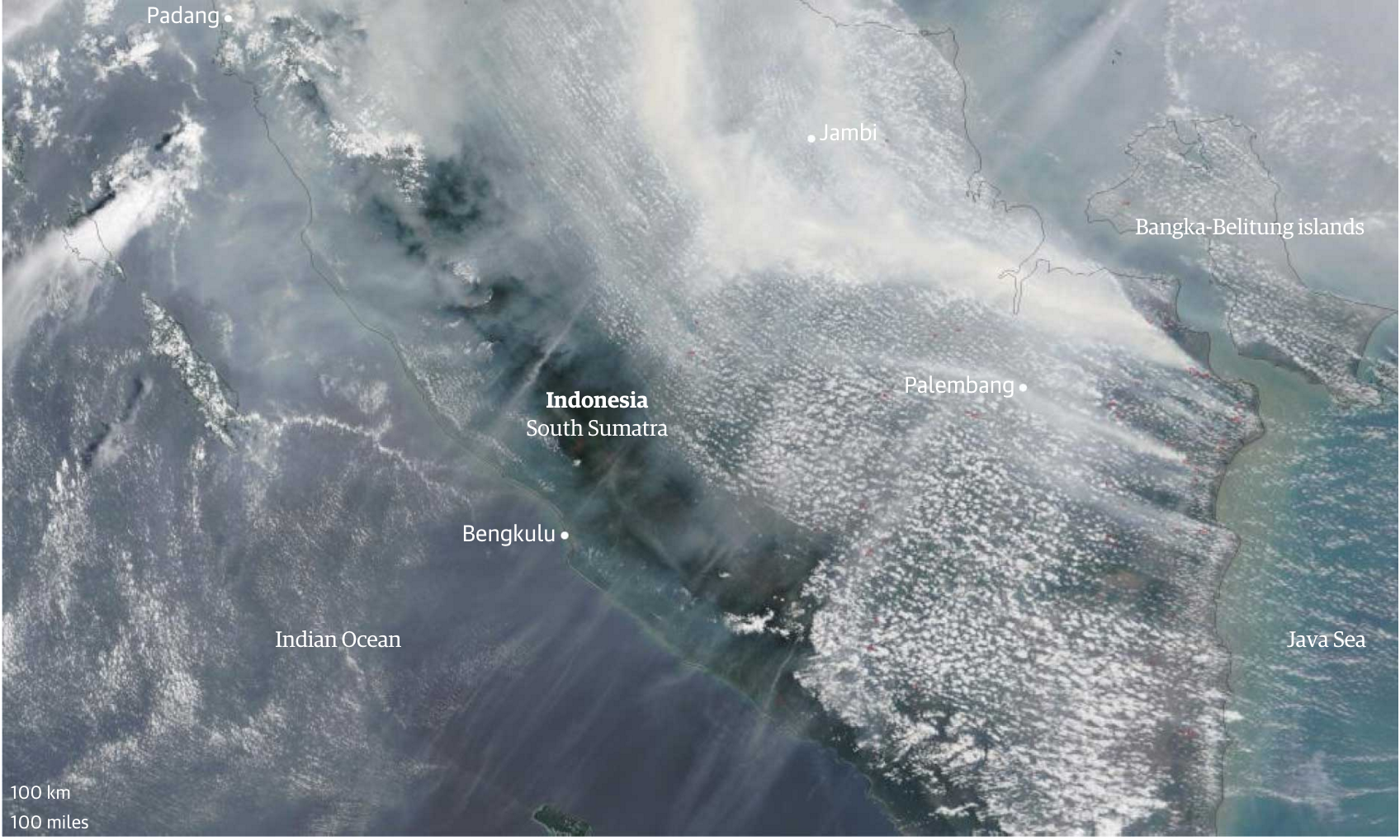
Worst-affected areas – Southern Sumatra

Most of the fires are on the islands of Sumatra and the Indondesian part of Borneo, known locally as Kalimantan. Smoke, smog and haze have also affected neighbouring countries including Malaysia, Singapore, Thailand and the Philippines, grounding flights and forcing schools to close. Visibility has been reduced in some areas to less than 50 metres (160 feet).

Screen Shot 2015-11-01 at 14.58.46

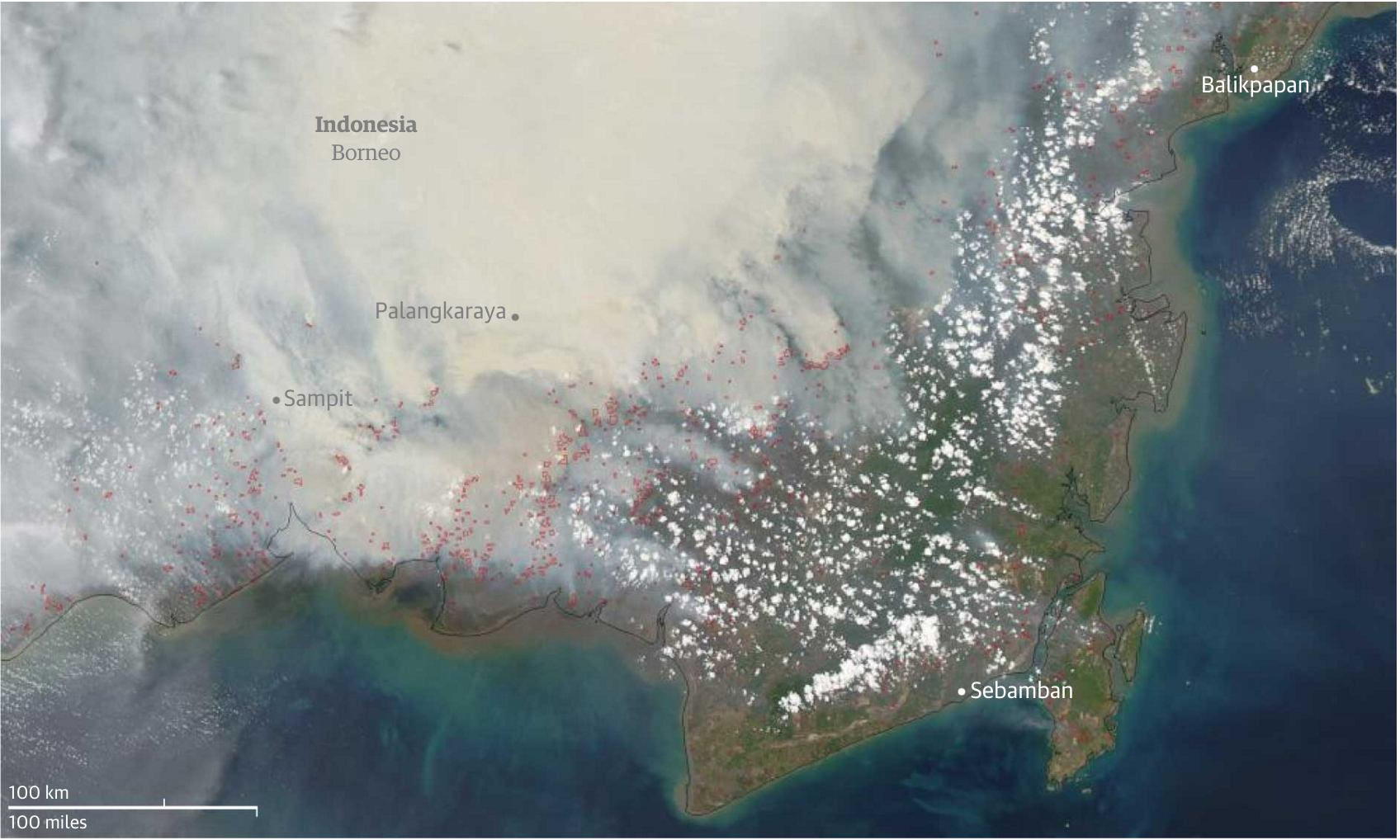
Worst-affected areas – Palangkaraya, Borneo

The smog and haze have been particularly bad in Borneo, measuring 1,986 on the pollution index compiled by Indonesia’s meteorology agency. Values over 350 are considered hazardous. Conservationists also say the fires threaten nearly a third of the world’s orangutan population.

Screen Shot 2015-11-01 at 14.59.53

Burgeoning carbon emissions

Peat fires, like those currently raging in Indonesia, produce large quantities of carbon emissions, emitting up to 10 times more methane than fires on other land. The 1997 Indonesian fires are estimated to have produced between 13 and 40% of the world’s annual carbon emissions, and Nasa has said this year’s could be more serious if they are not brought under control soon. The agency estimates that as of 21 September, they had produced about 600m tonnes of CO2, and predicts that by the time they are doused they will have produced more CO2 emissions than Germany does in a year.

Source: Indonesia burning: forest fires predicted to be worst on record | World news | The Guardian

Posted in Air Quality, Asia | Tagged , , , , , , , , , , , | Leave a comment

New study uncovers the underlying causes of Delhi’s air pollution problems

A new study “Air Pollution Challenges for developing megacities like Delhi” published today in Atmospheric Environment has described how Delhi suffers a toxic blend of geography, growth, poor energy sources and unfavourable weather that perpetuates and propagates its dangerously high levels of air pollution.

A team of researchers led by the University of Surrey assessed how Delhi’s landscape, weather, energy consumption culture, and growing urban population combines to elevate concentrations of air pollutants, including ultrafine particles, the most harmful to human health.

“Air pollution has been placed in the top ten health risks faced by human beings globally. Delhi has the dubious accolade of being regularly cited as the most polluted city in the world, with air pollution causing thousands of excess deaths in a year in this growing megacity, explained Dr Prashant Kumar of the University of Surrey.

” Whilst it might be easy to blame this on increased use of vehicles, industrial production or a growing population, the truth is that Delhi is a toxic pollutant punchbowl with myriad ingredients, all which need addressing in the round.”

Delhi is one of the largest population centres in the world. Classed as the world’s fifth ‘megacity’, it has a population of 25.8 million, which continues to grow. With this growth, our research predicted that the number of road vehicles will increase from 4.7 million in 2010 to nearly 26 million by 2030. Total energy consumption in Delhi has risen 57% from 2001 to 2011.

As a landlocked megacity Delhi has limited avenues for flushing polluted air out of the city. Coastal megacities such as Mumbai have at least a chance to ‘replace’ polluted air with relatively unpolluted sea breezes, whereas Delhi’s surrounding regions are sometimes even more polluted than the city. For example, most of the brick kilns used for making bricks are not located in the city, but in predominantly upwind surrounding industrial areas.

These outside pollutants can be attributed to use of low-quality fuels such as raw wood, agricultural and plastic waste in industrial settings, cow dung for cooking stoves and widespread use of diesel generators due to unreliable infrastructure. These sources release fine particle pollutants, the most dangerous to human health.

In Delhi fine particle pollution rates are ten times higher than that of Chennai, which has ten times more cars but is coastally located, without the surrounding industrial areas.

Coupled with Delhi’s densely packed architecture, and varying building heights the ‘breathability’ of the city is inhibited by its weather conditions. The city’s decreasing temperature (attributed to the effects of pollution) draws outside polluted air into the city centre, whilst windy, dusty conditions during summer exacerbate this problem.

“The picture of Delhi’s pollution problem is complicated and is aggravated by some factors that are out of human control,” continued Dr Kumar. “However, in this growing city it is important that the population is protected in whatever ways they can be from health-endangering pollutants. Simple remedies such as ‘greening’ unpaved roadside areas through a natural or artificial grass canopy could possibly help in limiting coarse dust particles during dry and windy seasons. Natural measures, such as the development of wetlands and trees are also effective.”

“There is also a cultural context here. Even the best science and technology will not succeed in reducing emissions and improving air quality if it is not considered in a broader framework of economic development of the country, rising awareness of public health risks and a change in attitudes and regulation towards poor quality fuels. It is a complicated, pick-and-mix of problems that will prove difficult to combat without innovative, encompassing and quick action.”

Source: New study uncovers the underlying causes of Delhi’s air pollution problems

Posted in Air Quality, Asia, India | Tagged , , , | Leave a comment

Haze Due to Air Pollution Reducing Surface Solar Radiation in China

Haze due to weak winds and air pollution is reducing surface solar radiation in China, which has major consequences for the climate, the environment and the economy. These are the findings of a research report now being published in Scientific Reports. An international team of researchers including those from the University of Gothenburg is behind the study.

In the world as a whole, surface solar radiation has increased since 1990, although in China, it has decreased.

Slowing winds increase air pollution

In the study, long-term historical meteorological data were combined with relatively short measurements of air pollution particles in China in an innovative way to clarify interactions among the solar radiation, surface wind and air pollution.

The studies have found that lower solar surface radiation in China is due to a combination of higher air pollution in the area and lower surface winds in China. As in other areas in the northern hemisphere, the surface wind in China has been weakened in recent decades. When the wind slows down, the concentration of small particles of air pollution (aerosols) increase, which help increase haze and leads to solar dimming in the area.

“Mapping the link between solar surface radiation and air pollution is significant since the relationship is heavily masked by clouds which play a major role in affecting solar surface radiation,” says Deliang Chen, Professor of Physical Meteorology at the Department of Earth Sciences, University of Gothenburg and co-author of the research article.

More solar dimming with slowing winds

The research reveals that the solar dimming due to air pollution increased significantly during the day in polluted areas in China, when wind speed was lower than 3.5 metres per second.

The study also shows that 20 per cent of the reduced surface solar radiation in China is due to the concentration of small particles of air pollution (aerosols), which is in turn strengthened by 20 per cent by low wind speed.

The effect of solar dimming is a lower influx of sunlight that affects photosynthesis, among other things, and has profound consequences for the climate, the environment and the economy.

“It was a successful cooperation between colleagues from the US, China and Sweden. I am happy that we succeeded in providing a quantitative estimate of the effect of air pollutant on surface solar radiation in interaction with wind,” says Changgui Lin, the leading author of the article and researcher at the Department of Earth Sciences, University of Gothenburg.

Source: http://www.gu.se/

Source: Haze Due to Air Pollution Reducing Surface Solar Radiation in China

Posted in Air Quality, Asia, China | Tagged , , , | Leave a comment

VW emissions cheat estimated to cause 59 premature US deaths 

Recall of affected cars by the end of 2016 would avoid more than 130 further early deaths, research shows

Nearly 60 people will die prematurely from the excess air pollution caused by Volkswagen cheating emissions tests in the US, according to a new study.

The first peer-reviewed estimate of the public health impacts of VW’s rigging of tests for 482,000 diesel cars in the US found that if the company recalls all the affected cars by the end of 2016, more than 130 further early deaths could be avoided.

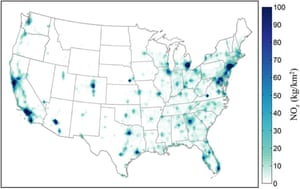
The study, published in the journal Environmental Research Letters on Thursday, concluded that most of the 59 premature deaths were caused by particulate pollution (87%) with the rest caused by ozone exposure (13%). Most of the deaths were estimated to have occurred on the east and west coasts of the US.

The number of deaths was reached by looking at the amount of extra pollution emitted between 2008 and 2015 by the VW cars fitted with the defeat devices.

Particulate and ozone air pollution in the US was estimated by the Environmental Protection Agency to cause around 164,300 premature deaths in 2010. Diesels still make up a relatively small share of the US car fleet.

As well as the early deaths, the researchers estimated that the extra pollution from VW’s cars caused around 31 cases of chronic bronchitis, 34 hospital admissions for respiratory and cardiac issues, and 120,000 days when people had to restrict their physical activity as a result. The economic cost of the health impacts was put at $910m.

Air quality expert Dr Gary Fuller, of King’s College London, said the research was a good assessment of the health impacts but it should not be assumed that the numbers could be extrapolated for other parts of the world, such as the UK.

“The very small number of diesels in the US, and the density of European cities means people are much more exposed to traffic emissions [in Europe] than in the US,” he said. He added that the study may have underestimated the total number of premature deaths because it did not consider the direct impact of the toxic gas nitrogen dioxide.

Daniel Kammen, the journal’s editor-in-chief and professor of energy at the University of California at Berkeley, who did not work on the study, said it was a “rigorous evaluation” of “potentially exceeding serious” impacts.

The study assumed the cars travelled 40.5bn km between 2008 and 2015, resulting in excess NOx emissions of 36.7m kg because of the cheating of emissions tests.

VW has admitted that around 11m cars have been affected by the rigging worldwide, with 1.2m in the UK. It emerged early this week that the UK government has only one £100,000 machine able to test real-world emissions.

Dr Penny Woods, chief executive of the British Lung Foundation, said: “The VW emissions scandal is only the tip of the iceberg. Many cars that genuinely meet emissions standards in the lab actually produce much higher levels of emissions when used in the real world. It is clear, therefore, that we need a commitment to routine, independent real-world testing on all cars.”

On Wednesday, carmakers in Europe won a one-year delay to such real-world tests, despite the VW revelations.

Source: VW emissions cheat estimated to cause 59 premature US deaths | Environment | The Guardian

Posted in Air Quality, USA & Canada | Tagged , , , , , | Leave a comment

Improvements in Glasgow air pollution levels

Glasgow is revoking a city-wide air quality management plan after a major improvement in pollution levels.

The city council declared the whole of Glasgow an air quality management area in 2012 after targets were exceeded.

The authority said tests had shown 95% of areas were now meeting air quality targets but some still faced challenges posed by traffic emissions.

The improvement is being attributed to more low-emission buses, a cycle-hire scheme and a city car club.

‘Good progress’

Councillor Alistair Watson, the council’s executive member for sustainability and transport, said: “While we have made very good progress, we recognise that there is more to be done.

“We will continue to work together with our partners to reduce air pollution levels and improve the health of our citizens.”

Councillor Watson said there had been a number of initiatives over the last three years to improve air quality in the city.

These included a bus quality partnership with now sees only lower emission vehicles on particular public transport routes; the introduction of a car club, and schemes to encourage more sustainable transport such as the city’s first all-electric bus service and the cycle hire scheme.

Source: Improvements in Glasgow air pollution levels – BBC News

Posted in Air Quality, Europe, UK | Tagged , , , | Leave a comment

European politicians back new law to reduce air pollution

The European Parliament on Wednesday backed a new draft law to cut toxins in the air and halve the number of premature deaths caused by pollution.

Environment campaigners, however, said the plans are too conservative and the proposed limits for emissions are above safe levels agreed by the World Health Organization.

Implementation is also expected to be a challenge as many of the 28 member states are already in breach of weaker existing EU air pollution law, while the Volkswagen scandal has drawn public attention to emissions of nitrogen oxides (NOx) that far exceed official levels.

The new law, which still needs endorsement by member states, sets national limits on major pollutants, including dust and NOx until 2030.

After opposition from the farming lobby, the plenary session of the European Parliament in Strasbourg voted to include ammonia and methane but exclude enteric methane emitted by ruminant animals.

European Commission data shows more than 400,000 premature deaths a year in the European Union are linked to air pollution, which causes respiratory disease and some forms of cancer. The number should halve if the draft law takes effect, the Commission says.

EU Environment Commissioner Karmenu Vella welcomed the vote as “a positive step towards an agreement on new ambitious yet realistic EU rules”.

Environment campaigners, however, said the members of the European Parliament had missed the opportunity to save more lives and reduce costs to society.

“With the Volkswagen scandal fresh in their minds, MEPs had a major opportunity to right a wrong and take action to clean up Europe’s air,” said Louise Duprez, senior policy officer for air pollution at the European Environmental Bureau.

Source: European politicians back new law to reduce air pollution | Reuters

Posted in Air Quality, Europe | Tagged , , , | Leave a comment

UK, Germany and France lobbying for weakened cap on toxic car pollution 

MEPs outraged as biggest three European countries push for watered down nitrogen oxide targets ahead of crucial EU vote

Europe’s biggest countries are lobbying for a proposed EU cap on nitrogen oxide (NOx) pollution from cars to be weakened in a vote on Wednesday, despite the VW diesel emissions scandal and revelations that 90% of cars do not currently meet pollution standards when on the road.

The UK has called for NOx emissions at twice the current legal maximum to be allowed until 2019, and for loopholes after that to permit emissions 40% above the European commission’s proposal of 80mg/km, the Guardian understands.

The British request was made in a paper submitted ahead of Wednesday’s decisive vote by a Brussels committee of national representatives.

Germany and France are pushing for similar targets, while other EU states support a drive by car manufacturers to delay implementation of the new rules for a year. Spain has held out for a start date three years later than that.

The Green MEP Bas Eickhout described the lobbying as “cynical and incomprehensible”. He said: “This is an outrage. We strongly urge the commission and EU governments to approve a test cycle that is based on real driving emissions, with no exemptions. The alternative would be a failure for Europe’s citizens.”

Earlier today, MEPs sitting in Strasbourg voted against any exemptions to the EU’s proposed NOx mandate, although their resolution is not binding.

The environmental thinktank Transport & Environment (T&E) said that the lobbying by big EU countries risked a permanent overshoot of the strict standard, due to come into force in 2017.

“Europe can’t afford to lose any more time,” said Greg Archer, of T&E. “We need to show determination, and stick to the rules agreed long ago.”

Some 23,500 people in Britain die prematurely from NOx emissions every year. The UK government is clear that the greatest contributor to illegal levels of NOx is the failure of vehicles to comply with regulations outside the testing lab.

The European commission proposal for the vote, seen by the Guardian, would allow emissions to be 60% over the current limit from 2017 when comes into force, and then falling to 20% after 2019. This would create a NOx cap of 95mg/km.

Diplomats say that the outcome of the vote, which will be decided by a qualified majority of national representatives on the technical committee for motor vehicles, is too close to call.

“Everything is possible,” one told the Guardian. “There could be some change to the commission proposal to try to find a qualified majority. It is still open.”

Car makers such as Fiat, Volvo and Seat argue that without leeway in the NOx targets, their revenues will be hit by having to pull existing vehicles from the market early. They also want to be given leeway after 2019 to reflect uncertainties in test measurements.

However, MEPs rejected their position today, passing a resolution by 493 votes to 145 calling for auto-manufacturers to be given no flexibility at all in meeting the 80mg/km NOx limit. The MEPs also appealed for emissions tests to be widened to include pollutants such as particulate matter and sulphur dioxide. An inquiry should be set up into the role played by national authorities in the VW scandal, they said.

Similar sentiments were expressed by some European countries at a meeting of environment ministers in Luxembourg yesterday.

“The car industry has a huge credibility problem which also affects our health and environment and the EU reputation,” said Carole Dieschbourg, Luxembourg’s environmental minister. “We need the new tests and better governance very soon.”

Source: UK, Germany and France lobbying for weakened cap on toxic car pollution | Environment | The Guardian

Posted in Air Quality, Europe, France, Germany, UK | Tagged , , , , , , , , | Leave a comment

Indonesia considers national emergency over forest fires

Indonesia is considering declaring a national emergency over fires that have been smouldering across the archipelago for weeks, sending haze drifting across much of Southeast Asia, the vice president said on Tuesday.

Indonesia is considering declaring a national emergency over fires that have been smouldering across the archipelago for weeks, sending haze drifting across much of Southeast Asia, the vice president said on Tuesday.

The government would intensify efforts to contain the fires that have caused pollution levels across the region to spike to unhealthy levels, and forced school closures and flight cancellations, Vice President Jusuf Kalla said.

“The problem is too big,” Kalla said in an interview at his office in Jakarta.

“We are now considering to,” he said, referring to a declaration of an emergency, adding that thousands of troops would be deployed to help combat the fires.

President Joko Widodo is expected to make a decision on the emergency after returning from the United States, Kalla said.

Kalla’s comments come just a day after Widodo announced he would cut short his first official trip to the United States to fly directly to the haze-affected areas.”He will be more focussed on domestic problems,” Kalla said of the president’s decision to cancel his visit to Silicon Valley, where he was expected to discuss investment deals with Apple and Google executives.

The fires, often deliberately set by plantation companies and smallholders, have been burning for weeks in the forests and carbon-rich peat lands of Sumatra and Kalimantan islands.

Recently, they have spread to places like Papua as the El Nino weather phenomenon exacerbates the dry season and hampers firefighting efforts.

An aide to the vice president, Wijayanto Samirin, said elevating the crisis to national emergency status would allow the government to speed up procurement processes for much-needed foreign firefighting equipment.

But he added there were concerns that businesses could use the government action to declare force majeure on deals in sectors ranging from palm oil to banking.

Kalla said about 40 million Indonesians in five provinces had been affected by the haze. The national disaster agency said late on Monday that haze was starting to spread south towards Java island, where over half the country’s population lives.

Indonesia has also deployed warships to evacuate infants and other vulnerable residents of haze-hit areas, a minister said last week.

The evacuations will be a last resort, said coordinating security minister Luhut Pandjaitan, if authorities are unable to provide care for those suffering from respiratory diseases.

The last time the country declared a national emergency was when the Indian Ocean tsunami killed more than 100,000 people in 2004.

Source: Indonesia considers national emergency over forest fires: VP – Channel NewsAsia

Posted in Air Quality, Asia | Tagged , , , , , | Leave a comment