Saharan dust storm rolls into southern Spain turning sky bright ORANGE

A Saharan dust storm rolled into southern Spain on Monday afternoon (March 14) turning the normally blue skies a bright hue of orange. Footage captured in the province of Almeria in Andalucia showed the town of San Jose bathed in the strange light. Fearing respiratory issues and eye irritation, most people stayed indoors waiting for the skies to clear. “Never seen anything like it,” said the filmer. “It looks unreal but this was filmed on a Panasonic GH-5 using the ‘Natural’ colour profile,” he added.

Saharan dust storm rolls into southern Spain turning sky bright ORANGE
Posted in Air Quality, Europe, Spain | Tagged , , | Leave a comment

No Breathing Easy for City Dwellers: Nitrogen Dioxide

NASA-funded scientists have, for the first time, connected health outcomes in cities around the world to satellite and ground-based data on air pollution. The researchers concluded that despite improvements in some parts of the world and for certain pollutants, air quality continues to be an important contributor to disease. Mitigating pollution is crucial to public health, especially for children, who can be particularly susceptible to respiratory diseases such as asthma.

“Nearly everyone in any city around the world is exposed to air that has harmful levels of air pollution in it,” said lead author Susan C. Anenberg, an associate professor of global health at George Washington University and a member of NASA’s Health and Air Quality Applied Sciences team.

Globally, air pollution is the fourth leading risk factor for death. Some pollutants are concentrated around urban areas, where about half the world’s population lives. In highly developed countries, closer to 80 percent of the population lives in urban areas. “We know that air pollution and population are both co-located in urban areas,” Anenberg said, “but we’ve never before had estimates of the burden of disease from air pollution in cities around the world.”

The studies by Anenberg and colleagues focused on nitrogen dioxide (NO2) and fine particulate matter (PM2.5). Nitrogen dioxide—which is largely produced by emissions from cars, trucks, and buses—is associated with the incidence of pediatric asthma. It is also a precursor to ozone and PM2.5—the leading cause of death related to air pollution.

In the studies, the teams combined two decades of satellite observations made across 13,000 urban areas worldwide with health data from the Global Burden of Disease study, a comprehensive study on health, risk factors, disease, and death in 204 countries around the world. “This is the first time that we have concentrations for all urban areas around the world,” Anenberg said. “And not just what concentrations of pollutants people are exposed to, but what this means for their health.”

The map above shows the change in annual average nitrogen dioxide concentrations between 2000 and 2019. The map is based on data from a land use regression model, combined with data from the Ozone Monitoring Instrument on Aura. The team used these datasets to expand several years of ground-based monitoring data up to a global scale at high resolution.

The researchers then paired the NO2 concentrations with population data and asthma rates from the Global Burden of Disease study. This allowed them to estimate the incidence of pediatric asthma attributable to nitrogen dioxide between 2000 and 2019. They estimated that 1.85 million new asthma cases globally in 2019 were attributable to nitrogen dioxide. Two-thirds of these new cases occurred in urban areas.

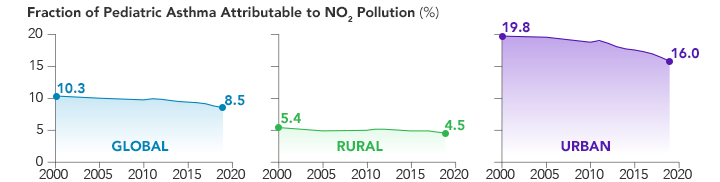
The chart above shows the fraction of all asthma cases globally, as well as in rural and urban areas, that were attributable to nitrogen dioxide pollution. The urban rate declined (from 19.8 percent to 16.0 percent) but the total number of cases in urban areas stayed about the same, with 1.22 million cases in 2000 and 1.24 million cases in 2019.“

The percentage of asthma cases attributable to nitrogen dioxide went down, and that is good news,” Anenberg said, “but it was balanced out by growth in population. That was why we had about the same number in 2000 versus 2019.”

Urban asthma cases attributable to nitrogen dioxide increased in south Asia, sub-Saharan and north Africa, and the Middle East. Many other areas of the world—both high-income and low-income economies—saw declines in NO2 and asthma rates.

However, despite some declines in nitrogen dioxide concentrations in some regions, it is “not enough to ensure that children are breathing clean air,” Anenberg added. “About three-quarters of cities globally have nitrogen dioxide concentrations that exceed the current World Health Organization guidelines.”

NASA Earth Observatory images by Joshua Stevens, using data courtesy of Anenberg, S. C., et al. (2022). Story by Sara E. Pratt.

No Breathing Easy for City Dwellers: Nitrogen Dioxide

Posted in Air Quality, Health Effects of Air Pollution | Tagged , , , , , , , | Leave a comment

Living in more polluted areas increases risk for poor mental wellbeing

People in the UK who live in more polluted areas, such as near busy roads, are at a higher risk of poor mental wellbeing, new research led by the University of St Andrews has found.

The study examined four types of air pollutants—nitrogen dioxide, sulfur dioxide and two types of particulate matter, those with diameters of less than 10 and 2.5µm (micrometers)—and linked these to individual-level health data.

It found a connection between air pollution and people reporting low mental wellbeing affects such as feeling unhappy, being under stress and not being able to concentrate.

It also found a potential link between increasing concentration of sulfur dioxide and particulate matter and elevated scores of poor mental wellbeing for people from a Pakistani/Bangladeshi origin in comparison with British-White people, and for non-UK born individuals in comparison with those born in the UK.

Nitrogen dioxide is mainly produced from traffic exhaust around busy roads, while sulfur dioxide is mainly an industrial type of pollutant. Nitrogen dioxide and sulfur dioxide are gaseous types of pollutants. Particulate matter is related to both traffic exhaust and industrial processes and it is made up of microscopic solid or liquid matter suspended in the atmosphere.

Mary Abed Al Ahad, of the School of Geography and Sustainable Development at St Andrews, says that “the main conclusion from the study was that living in a polluted area appears to be linked to suffering from mental wellbeing issues.”

“Our results cross disciplines to provide environmental health researchers and policymakers with the needed evidence towards reducing air pollution emissions to improve the individual’s mental wellbeing and health.”

“However, further research will be needed to examine the link between pollution and wellbeing more closely.”

The study used data from the Understanding Society: The UK household Longitudinal Study which measured wellbeing using the General Health Questionnaire (GHQ12) scale, a widely used scale in population health research to capture non-psychotic psychiatric illness.

The GHQ12 scale is composed of 12 questions about an individual’s experience of 12 symptoms related to mental wellbeing in the few weeks preceding the data collection date.

The 12 questions are on subjects including: ability to concentrate; losing much sleep; feeling you are playing a useful part; capability of taking decisions; being under stress; inability to overcome difficulties; enjoying normal activities; being able to face up to problems; feeling unhappy and depressed; losing confidence; thinking of self as worthless; and feeling reasonably happy.

Individuals are then asked to rate the questions and a general mental wellbeing score is formulated.

The paper is published in PLOS ONE and is available online.

Living in more polluted areas increases risk for poor mental wellbeing
Posted in Air Quality, Health Effects of Air Pollution, Medical Studies, UK | Tagged , , , , | Leave a comment

Mother’s exposure to air pollution associated with low-birth-weight babies

Since babies with low birth weight often have poor health outcomes, there is considerable interest in identifying the factors that affect birth weight. Air pollution has been identified as one possible factor, however several studies have produced conflicting results and there is scarce data from the Middle East region. A recent study, initiated by Professor Hagai Levine of the Hebrew University (HU)-Hadassah Braun School of Public Health, showed unequivocally that air pollution is associated with low-birth-weight babies. Using personal, anonymized data and detailed high-resolution pollutant data enabled the Hebrew U. team to produce more accurate statistical analyses. Indeed, Levine maintains, “it is now clear that governments need to set up the infrastructure to integrate environmental and health data at the personal level.”

This study, led by Wiessam Abu Ahmad, a doctoral student of Levine and Prof. Ronit Nirel at HU’s Department of Statistics and Data Science, looked at the link between an air pollutant known as PM2.5 and the birth weight of 380,000 singleton babies born to mothers all over in Israel during the years 2004–2015. Their findings were published this week in the journal Environmental Research.

Israel, a country with the highest fertility rate among OECD countries and high levels of the air pollutant PM2.5, made it an ideal location to look for an association between low birth weight and poor air quality. Abu Ahmad explained that as the model included siblings, it enabled the estimation of the variance in low birth weight to be accounted for by variances between different mothers, leading to more accurate estimates. The data used by the research team included: personal anonymized data on the mothers, including the area where they lived and the weight of their babies at birth (provided by Maccabi Health Services); and daily air pollutant concentration over each square kilometer of Israel, derived from satellite data (provided by Ben Gurion University).

The study clearly showed the association between the level of the air pollutant PM2.5 and low birth weight. It also revealed that mothers who were underweight and those of lower socioeconomic status were more vulnerable to exposure to air pollution. Further, the study found that the association with air pollution was stronger among female babies and first births—a fact that is thought to be due to a biological mechanism that has yet to be identified.

The association of air pollutants with low birth weight raises the question of whether the Israeli government should take the impact on the developing baby into account and increase its efforts to reduce pollution. That said, much of the pollution in Israel is carried in by the wind from other countries.

The findings are, however, an important contribution in identifying a contributory cause to low birth weight. Most importantly, this study breaks new ground in establishing the value of collecting personal detail relating to individuals rather than taking averages over aggregated data.

Mother’s exposure to air pollution associated with low-birth-weight babies
Posted in Air Quality, Health Effects of Air Pollution, Medical Studies, Middle East | Tagged , , , , | Leave a comment

A NEW GENERATION OF RESPRO® MASKS

Respro® have developed a range of CE certified masks based on our popular existing sports masks.

It provides you with the assurance that our masks as a whole (not just the filter), are fully tested and comply with European requirements for the use of respiratory masks in the Health and Safety at Work market.

All of our CE masks are certified FFP-1R and come fitted with a long lasting CE 250 Hepa-Type™ filter for sub-micron particulate filtration and an adjustable head strap to ensure that the mask maintains its seal even in the most active sports.

All of our non CE masks are manufactured to a similar technical specification and we can assure you that the build quality remains the same. If you are looking to upgrade your current mask to a CE specification mask then all you need is the following parts:

1. CE 250 Hepa-Type™ filter

2. Respro® Mask Strap MK2

Posted in Respro® Masks, Respro® Products | Tagged , , , | Leave a comment

Half of US adults were exposed to harmful lead levels as kids, study finds

Researcher calls findings ‘infuriating’ as team finds significant impact on cognitive development

Over 170 million Americans who were adults in 2015 were exposed to harmful levels of lead as children, a new study estimates.

Researchers used blood-lead level, census and leaded gasoline consumption data to examine how widespread early childhood lead exposure was in the country between 1940 and 2015.

In a paper published in the Proceedings of the National Academy of Sciences on Monday, they estimated that half the US adult population in 2015 had been exposed to lead levels surpassing five micrograms per deciliter – the Centers for Disease Control and Prevention threshold for harmful lead exposure at the time.

The scientists from Florida State University and Duke University also found that 90% of children born in the US between 1950 and 1981 had blood-lead levels higher than the CDC threshold. And the researchers found significant impact on cognitive development: on average, early childhood exposure to lead resulted in a 2.6-point drop in IQ.

The researchers only examined lead exposure caused by leaded gasoline, the dominant form of exposure from the 1940s to the late 1980s, according to data from the US Geological Survey. Leaded gasoline for on-road vehicles was phased out starting in the 1970s, then finally banned in 1996. The study’s top author, Michael McFarland, an associate professor of sociology at Florida State University, said the findings were “infuriating” because it was long known that lead exposure was harmful, based on anecdotal evidence of its impacts throughout history.

Though the US has implemented tougher regulations to protect Americans from lead poisoning in recent decades, the public health impacts of exposure could last for several decades, experts told the Associated Press.

“Childhood lead exposure is not just here and now. It’s going to impact your lifelong health,” said Abheet Solomon, a senior program manager at the United Nations children’s fund.

Early childhood lead exposure is known to have many impacts on cognitive development. It also increases risk for developing hypertension and heart disease, experts said.

“I think the connection to IQ is larger than we thought, and it’s startlingly large,” said Ted Schwaba, a researcher at University of Texas at Austin who studies personality psychology and was not part of the new study.

Schwaba said the study’s use of an average to represent the cognitive impacts of lead exposure could result in an overestimation of impacts on some people and underestimation in others.

Previous research on the relationship between lead exposure and IQ found a similar impact, though over a shorter study period.

Bruce Lanphear, a health sciences professor at Simon Fraser University in Vancouver who has researched lead exposure and IQ, said his 2005 study found the initial exposure to lead was the most harmful when it came to loss of cognitive ability as measured by IQ.

“The more tragic part is that we keep making the same … mistakes again,” Lanphear said. “First it was lead, then it was air pollution … Now it’s PFAS chemicals and phthalates [chemicals used to make plastics more durable].

And it keeps going on and on.“And we can’t stop long enough to ask ourselves: should we be regulating chemicals differently?” he said.

Half of US adults were exposed to harmful lead levels as kids, study finds | US news | The Guardian
Posted in Air Quality, Health Effects of Air Pollution, Medical Studies, USA, USA & Canada, World News | Tagged , , , , , , | Leave a comment

Bangkok air good but PM2.5 levels unhealthy in 12 upper Thailand provinces

Twelve provinces in the North, Northeast and Central were found to have particles less than 2.5 microns in diameter (PM2.5) in the air at levels higher than the safety standard, the Centre for Air Pollution Mitigation (CAPM) reported.

The CAPM reported at 7am that Chiang Rai, Mae Hong Son, Nan, Lamphun, Lampang, Phrae, Saraburi, Bueng Kan, Nong Khai, Nakhon Phanom, Kalasin and Ubon Ratchathani provinces were found to have PM2.5 inhalable particles higher than the safety standard of 50 micrograms per cubic metre of air.

The centre reported that the air quality in Bangkok during the past 24 hours was good with the PM2.5 measured at 15 to 34mcg per cubic metre.

The CAPM added that the air quality in the southern and eastern regions are also good with the PM2.5 being measured at 11-19mcg per cubic metre and 14-30mcg per cubic metre respectively.

At noon, the Air4Thai.com reported that the highest level of PM2.5 was measured at Tambon Meechai in Nong Khai province’s Muang district, at 93mg per cubic metre.

Forest and post-harvest plantation burnings in the northern and northeastern provinces are blamed for higher levels of PM2.5 levels there.

Bangkok air good but PM2.5 levels unhealthy in 12 upper Thailand provinces
Posted in Air Quality | Leave a comment

Air pollution in London contributes to over 1,700 hospital admissions for asthma

London’s poor air quality led to over 1,700 hospital admissions for asthma and serious lung conditions between 2017-2019, according to new analysis.

The report from Imperial College London’s Environmental Research Group modelled the impact of air pollution in London on asthma admissions, comparing levels of pollution from 2019 to 2016. The report was commissioned by the Greater London Authority via Imperial Projects.

The report estimates that between 2017-2019 air pollution in London contributed to around:

700 asthma admissions in children

200 asthma admission in adults

900 asthma/Chronic obstructive pulmonary disease (COPD) admissions in the elderly

These estimates are obtained by combining the pollution concentrations in London with information from previous studies on the percentage change in asthma admissions on days with different air pollution concentrations.

Improving air quality

The report does find that as a result of air quality improvements in London the number of air pollution attributable asthma admissions in London has reduced.

The improvement in air pollution levels reduced the number of hospital admissions for asthma and serious lung conditions by 30 per cent – from 2,450 (2014 – 2016) to 1,700 (2017 – 2019).

The largest percentage improvement was among children under the age of 14 – between 2014 and 2016, around?1,000 of those admitted to hospital with airway diseases were children under 14 with asthma. Between 2016 and 2019, these air pollution attributable admissions were reduced to 700, a 30 per cent reduction.

Dr Heather Walton, Senior Author of the report, said: “Air pollution continues to contribute to many hospital admissions for asthma and COPD in London but it is good to see that these hospital admissions have decreased from 2016 to 2019 as a result of air pollution reductions in London. More policies to reduce air pollution in London should reduce these numbers further and reduce other health impacts of air pollution as well.”

The full report is available at: Health impact assessment of current and past air pollution on asthma in London

Air pollution in London contributes to over 1,700 hospital admissions for asthma | Imperial News | Imperial College London
Posted in Air Quality, Asthma, Health Effects of Air Pollution | Tagged , , , , , | Leave a comment