Volkswagen emissions scandal: millions of Britons could be driving illegal cars

Millions of diesel cars could be recalled if manufacturers are found to have rigged emissions tests like Volkswagen

Millions of British motorists could be driving illegal cars which have been doctored to mask dangerous levels of emissions after Volkswagen admitted to rigging pollution tests.

The German manufacturer is facing fines of $18 billion after accepting it had systematically installed software in VW and Audi diesels since 2009 to deceive regulators who were measuring exhaust fumes.

On Monday night the US Environmental Protection Agency (EPA) widened its investigation to other car manufacturers as campaigners warned that the practice was likely to be widespread across the industry, affecting motorists worldwide.

Air pollution is thought to account for 30,000 deaths each year in Britain. But health experts have long argued that there is far too much nitrogen oxide (NOx) in the air for car industry emissions figures to be accurate. They claim levels should have halved in recent years and yet they have remained stubbornly high.

“Volkswagen seems unlikely to be the only manufacturer attempting to game their emissions in this sort of way.”
Professor Alastair Lewis, University of York

In Britain and the rest of Europe, all new diesels should have met the Euro 6 emissions standard from September 1 but a recent report by campaigners Transport & Environment (T&E) found just one in 10 complied.

One BMW was pumping out more than 10 times the legal limit of nitrogen oxide.

If more manufactures are drawn into the scandal it could lead to millions of cars, which have been bought in Britain over the last six years, being recalled.

Greg Archer, T&E’s clean vehicles manager said: “The Volkswagen example is clearly just the tip of the iceberg and there will be a lot more companies dragged into this.

“Exactly the same technology is used in Europe as it is the US, and tens of millions of cars have been sold since 2009.

“That means that there are potentially millions of cars that are being driven illegally. Obviously it is not the drivers’ fault, but it is likely we will see huge numbers of recalls.”

On Monday night German Transport Minister Alexander Dobrindt ordered an examination of all Volkswagen diesel cars. The company also makes Seats, Skodas, Bentleys, Lamborghinis, Bugattis and Porsches. Motoring experts said it was a ‘disaster beyond all expectations.’

Shares in the company plunged by 20 per cent on the back of the admission by Chief Executive Martin Winterkorn that the company had used ‘defeat’ technology to evade emissions test.

The software works by sensing when a car is being tested and injecting urea into the exhaust system to clean up fumes. It allows cars to appear ultra-clean when in fact they emit up to 40 times more nitrogen oxide than the legal limit.

In Britain, the number of diesel cars has risen from 1.6 million to 12 million since 1994.

The European Commission said it was in contact with Volkswagen and US regulators to find out how widespread the deception had gone. So far regulators have found 482,000 diesel cars which were sold in the US between 2008 and 2015 based on false information.

RAC chief engineer David Bizley said: “Motorists on this side of the pond will be looking for reassurances that vehicles sold in Britain – which are subject to stringent European emissions standards testing – are not affected by today’s Volkswagen announcement.”

Health experts warned that road transport is the primary source of deadly nitrogen oxide and that failures to cut emissions could be causing thousands of deaths each year.

Professor Alastair Lewis, of the department of atmospheric chemistry at the University of York said “The widespread mismatch between real-world emissions and those being reported by manufacturers when new vehicles take tests in labs is a very serious problem.

“Volkswagen seems unlikely to be the only manufacturer attempting to game their emissions in this sort of way.

“The lack of improvement in European air quality in city centres, particularly for NO2, can be traced back to these inaccurate figures. This will translate directly through into reduced public health and increased mortality.”

Dr Heather Walton, Senior Lecturer in Environmental Health, King’s College London added: “If manufacturers were able to ensure that real-world emissions were as good as those in laboratory tests, this would lead to substantial reductions in emissions. Substantial reductions in emissions would be expected to lead to worthwhile reductions in health effects.”

Many car manufacturers have spoken out to distance themselves from the scandal with Daimler and BMW publically stating that the allegations did not apply to them.

And Mike Hawes, CEO Society of Motor Manufacturers and Traders said emissions tests were more difficult to fix in Europe.

“The EU operates a fundamentally different system to the US – with all european tests performed in strict conditions as required by EU law and witnessed by a government-appointed independent approval agency,” he said.

“There is no evidence that manufacturers cheat the cycle. Vehicles are removed from the production line randomly and must be standard production models, certified by the relevant authority – the UK body being the Vehicle Certification Agency, which is responsible to the Department for Transport.”

However the Department of Transport has warned that cars would be immediately recalled and banned from sale if they were found to have breached European regulations.

“All cars on UK roads must adhere to Europe-wide regulations on emissions. Any car found to be noncompliant can be recalled and taken off the market,” said a spokesman.

Carmakers have already been accused of using a range of techniques to ensure that their cars perform far better under test conditions such as over inflating tyres, stripping components to reduce weight, and using super-smooth test tracks.

There are plans to introduce a new on-road test that will measure the real-world emissions of diesel cars, but it will not apply to all new EU cars until 2018 at the earliest and the car industry want it pushed back until 2020.

Source: Volkswagen emissions scandal: millions of Britons could be driving illegal cars – Telegraph

Posted in Air Quality, Europe, UK | Tagged , , , , , , , , | Leave a comment

Air pollution linked to 3,500 deaths in Scotland 

AIR pollution may be contributing to a larger number of deaths in Scotland than previously thought, according to environmental campaigners.

Friends Of The Earth Scotland said there could be more than 3,500 early deaths from air pollution in Scotland every year, substantially more than the previous estimate of around 2,000.

The charity criticised attempts to address the air quality issue as “incomplete, vague, and lacklustre” but the Scottish Government said progress had been made.

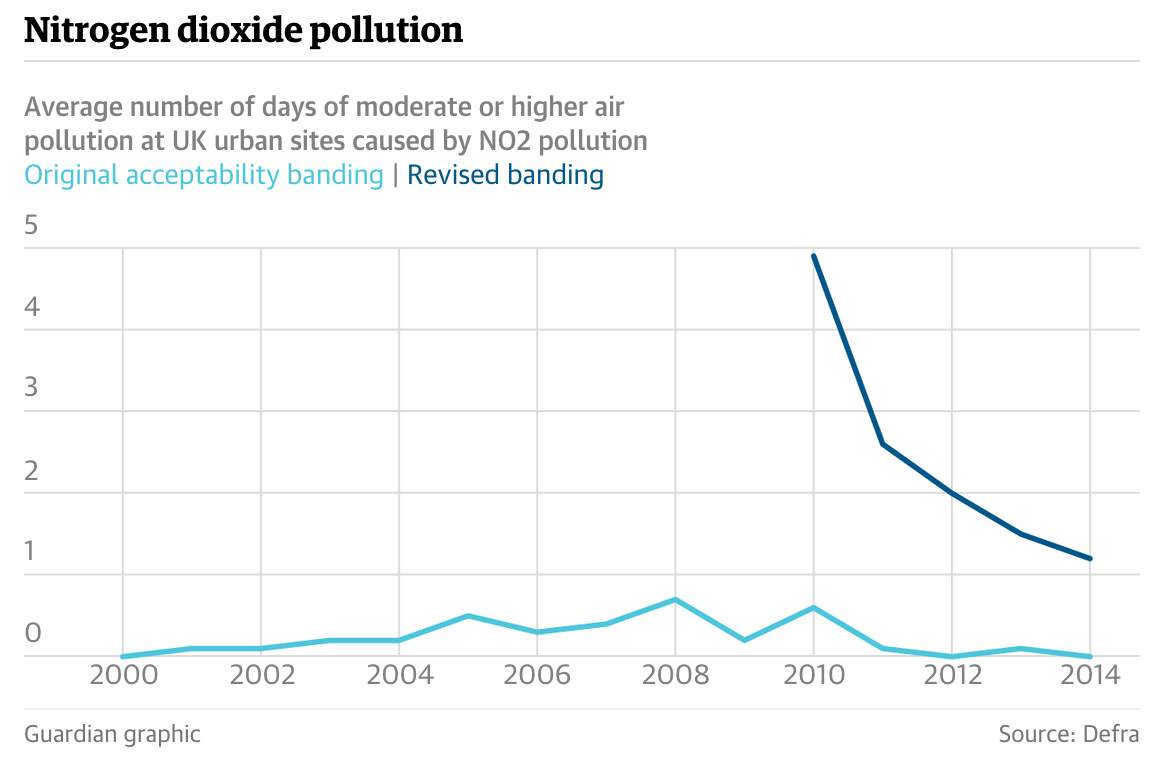
The new figure draws on early analysis from the UK Department for Environment, Food and Rural Affairs (Defra) on the impact of nitrogen dioxide (NO2).

Defra’s draft plan for improving air quality in the UK estimates that the effects of NO2 on mortality are equivalent to 23,500 deaths annually in the UK.

Previously only estimates for the impact of fine particles, known as PM2.5, was known.

A 2010 report by the Committee on the Medical Effects of Air Pollutants concluded that exposure to these particles had an effect on mortality equivalent to nearly 29,000 deaths, or around 2,000 in Scotland.

The charity produced a Scotland estimate for nitrogen dioxide by assuming a similar impact as that from fine particles.

Friends Of The Earth air pollution campaigner Emilia Hanna said: “Air pollution is probably killing more than 3,500 people in Scotland every year, which is nearly twice as many as previously thought.

“This new health evidence is truly shocking, hugely alarming and demonstrates that air pollution is a major public health disaster.”

The Supreme Court has set a deadline for the UK and Scottish Governments to produce plans for reducing air pollution levels in order to comply with European Union (EU) law on limits for nitrogen dioxide in the air with consultations ongoing.

Ms Hanna added: “The Scottish consultation on new air quality plans is incomplete, vague, and lacklustre.

“The law requires that the low-emission strategy and related regional air quality plans have a clear set of actions to reduce air pollution, specific timetables for action, and estimates of how much each measure will improve air quality.

“When the Scottish Government launches its low-emission strategy in November, the strategy needs to fully comply with the letter and the spirit of the law.”

The charity is calling for “fully funded” low-emission zones in major cities with air pollution problems by 2018.

A Scottish Government spokesman said: “Since 1990 nitrogen oxide emissions in Scotland have fallen by 67% but further progress is required.

“Following consultation earlier this year on a low-emission strategy, the Scottish Government is working with partners such as local authorities and Transport Scotland to finalise the strategy for publication later this year.

“This will draw together in one place a range of existing and additional actions which will support delivery of further improvement in air quality, supporting individuals and communities across Scotland.”

Sarah Boyack MSP, Labour’s environmental justice spokeswoman, said: “This is a major public health risk and the toll is unacceptable. In air pollution hot spots throughout our urban areas, EU limits are regularly breached.

“We need an effective strategy from the SNP Government, which is properly funded, addresses the need for low-emission zones and includes a timetable for action.

“The response from the SNP Government looks utterly complacent. The point is that current action is not working, so telling us what is currently happening in a glossy document doesn’t cut it. We need better than that.”

Source: Air pollution linked to 3,500 deaths in Scotland – The Scotsman

Posted in Air Quality, Europe, UK | Tagged , , , , , | Leave a comment

Volkswagen under investigation over illegal software that masks emissions 

California and EPA accuse VW of installing ‘defeat device’ software that reduces nitrogen oxide emissions while a car is undergoing official tests

The US government has ordered Volkswagen to recall almost 500,000 cars after discovering that the company deployed sophisticated software to cheat emission tests allowing its cars to produce up to 40 times more pollution than allowed.

The Environment Protection Agency (EPA) on Friday accused VW of installing illegal “defeat device” software that dramatically reduces nitrogen oxide (NOx) emissions – but only when the cars are undergoing strict emission tests.

“Put simply, these cars contained software that turns off emissions controls when driving normally and turns them on when the car is undergoing an emissions test,” Cynthia Giles, an EPA enforcement officer said. “We intend to hold Volkswagen responsible.

“VW was concealing the facts from the EPA, the state of California and from consumers. We expected better from VW,” she said. “Using a defeat device in cars to evade clean air standards is illegal and a threat to public health.”

The EPA accused Volkswagen of using the device in 482,000 four-cyclinder Volkswagen and Audi diesel cars in the US since 2008. VW must recall all the cars, remove the defeat device and improve the cars’ NOx emissions, which creates smog and has been linked to increased asthma attacks and other respiratory illnesses.

“A sophisticated software algorithm on certain Volkswagen vehicles detects when the car is undergoing official emissions testing, and turns full emissions controls on only during the test,” the EPA said in a statement. “The effectiveness of these vehicles’ pollution emissions control devices is greatly reduced during all normal driving situations. This results in cars that meet emissions standards in the laboratory or testing station, but during normal operation, emit nitrogen oxides, or NOx, at up to 40 times the standard.”

Richard Corey, executive officer of the California Air Resources Board (Carb), said: “Our goal now is to ensure that the affected cars are brought into compliance, to dig more deeply into the extent and implications of Volkswagen’s efforts to cheat on clean air rules, and to take appropriate further action.”

The EPA said Volkswagen could face other action and fines for the alleged breach of the Clean Air Act. The maximum fine for violations of the act is $37,500 per vehicle, which works out to a maximum possible fine as high as $18bn.

The EPA and Carb discovered the “defeat device” software following independent analysis by researchers at West Virginia University, who were promoted into action by the International Council on Clean Technology, an NGO.

When confronted with the EPA and Carb’s evidence, VW admitted that its cars were fitted with the “defeat device”.

VW refused to comment.

Source: Volkswagen under investigation over illegal software that masks emissions | Business | The Guardian

Posted in Air Quality, Europe, USA & Canada | Tagged , , , | Leave a comment

Indonesia arrests executives of ‘haze-causing’ companies

Indonesia arrests executives from seven companies accused of being behind illegal forest fires causing air pollution in the region.

Correspondents say such arrests are rare, but could result in fines and prison sentences of up to 15 years.

Haze caused by forest fires is an annual problem but this year has been one of the worst in Indonesia.

Indonesia has declared a state of emergency in Riau province, and nearby countries are also affected.

Malaysia and Singapore have seen deteriorating air quality from the haze, which stretches hundreds of kilometres across South East Asia.

The fires are said to be caused by corporations as well as small-scale farmers who use the illegal slash-and-burn method to clear vegetation for palm oil, pulp and paper plantations.

The problem has accelerated in recent years as more land has been cleared for expanding plantations for the lucrative trade.

Under Indonesian law, executives of companies which are accused of committing “environmental mismanagement” can be criminally prosecuted.

Indonesia has for many years promised to step up enforcement of laws on illegal fires.

But our correspondents say there have been few arrests, and none of those held responsible so far have been from large companies. The arrest of senior executives is thus a significant move.

Indonesia’s police chief Gen Badrodin Haiti said on Wednesday night that the seven companies were based on either Sumatra or Kalimantan on Indonesian Borneo, where most of the fires have taken place. He did not say how many executives were arrested.

Those arrested face charges of illegal burning of vegetation to clear land, which has a maximum penalty of 10 years in jail and a 10bn rupiah (£447,000; $692,000) fine, and illegal burning of forests, which has a maximum penalty of 10 years in jail and a 1.5bn rupiah fine.

Gen Badrodin said another 20 companies, and a total of 140 individuals, were also being investigated.

Indonesia’s President Joko Widodo has vowed to hold “disobedient” plantation companies responsible for illegally clearing land by burning, and for the first time the government has threatened to revoke the licenses of firms found guilty of environmental crimes.

Gen Badrodin has also said police investigations could target high-level executives and even shareholders.

But analysts and environmentalists say they have heard similar promises before and are waiting to see if these tough words result in prosecutions, say our correspondents.

Indonesia is facing pressure at home and abroad to quickly solve the issue. The haze has led to school closures in Malaysia and sparked regional authorities to issue health alerts.

The organisers of the Formula 1 Grand Prix in Singapore, a highlight on the city’s tourism calendar, have announced that the night races this weekend will continue as planned despite uncertainty over the air quality.

Source: Indonesia arrests executives of ‘haze-causing’ companies – BBC News

Posted in Air Quality, Asia, Singapore | Tagged , , , , , | Leave a comment

Diesel cars: What’s all the fuss about? 

Diesel cars are taking a right hammering at the moment, but how bad is the problem and why isn’t more being done to address it?

Diesel cars are taking a right hammering at the moment.

Dirty engines spewing out noxious fumes that are polluting our cities, causing all manner of health problems, is the principal charge laid out in various reports splashed across the media this summer.

Questions have even been asked about the previously unchallenged assumption that diesel engines produce less carbon dioxide (CO2) than their petrol counterparts and are, therefore, better for the environment.

But how bad is the problem and why isn’t more being done to address it?


Why are people concerned about diesel cars?

In a word, pollution, which has severe consequences for everyone’s health.


What is the main problem?

A number of studies have shown that diesel cars, unlike petrol cars, spew out high levels of what are known as nitrogen oxides and dioxides, together called NOx. Nitrogen dioxide (NO2) is particularly nasty – recent studies have shown it can cause or exacerbate a number of health conditions, such as inflammation of the lungs, which can trigger asthma and bronchitis, and increased risk of heart attacks and strokes.

In many European cities, NO2 levels are well above European Union legal limits – twice the limit in parts of London, Paris and Munich, according to the European Environment Agency (EEA).

Diesel vehicles are the single biggest contributor to these high levels of NO2.

Is it just NOx we should be concerned about?

No – particulate matter, which is belched out from diesel exhausts, has been shown to cause cancer. This has long been recognised, and modern diesel cars are fitted with extremely effective filters that stop almost all of this carcinogenic soot from escaping into the atmosphere.

But there are two problems. First, a lot of people remove these filters to improve fuel economy and performance. A number of specialist companies advertise removing them and it’s not illegal to do so, although your car should fail its MOT without one.

Second, NO2 forms something called secondary particulate matter when it enters the atmosphere, the effects of which are not yet fully understood.


How many people does this affect?

Studies suggest that air pollution as a whole causes hundreds of thousands of premature deaths in Europe.

When you consider that road transport, and diesel in particular, contribute a meaningful chunk, the gravity of the problem becomes immediately clear.

Indeed a recent study put the number of premature deaths in the UK attributed specifically to NO2 at 23,500.

The number of people generally affected by health problems will, of course, be much greater.

And the economic cost must not be underestimated. According to the latest figures available from the OECD, premature deaths and ill health caused by air pollution cost the UK $86bn (£56bn) in 2010.

Across OECD countries, the body says road transport accounts for half the total economic cost. Of course this cannot all be laid at the door of diesel engines.


What about carbon dioxide emissions?

We’ve always been told that diesel cars are better for the environment because they emit less CO2. This is simply because diesel engines are more efficient than petrol engines, so use less fuel to travel the same distance. Less fuel should mean lower emissions.

But data from the Society of Motor Manufacturers and Traders (SMMT) shows that average CO2 emissions from diesel cars are only fractionally lower than those from petrol cars.

This is largely due to the fact that diesel cars tend to be bigger and heavier than petrol cars, so any advantages in efficiency are wiped out. Equally, diesel fuel has more carbon than petrol for the same volume, according to the International Council on Clean Transportation (ICCT) – burning one litre of diesel produces 12% more CO2 than burning one litre of petrol, it says.

Petrol engines have also become far more efficient in recent years.

For its part, the car industry itself maintains that when comparing like-for-like models, diesels do emit noticeably less CO2 than their petrol counterparts.


Why has all this been allowed to happen?

Good question, especially when you consider that diesel cars emit far more pollutants than they should. Just how much more is quite shocking, according to some studies.

Tests conducted by the International Council on Clean Transportation (ICCT) show that modern diesel cars emit on average seven times the EU limit for NOx.

Another study published by green transport think-tank Transport & Environment and supported by data from Emissions Analytics, suggests that about nine in every ten new diesel cars exceed the legal limit. It showed that of the 24 cars tested, only three cars – an Audi A5, a VW Golf and a BMW 3-series – complied with EU regulations. At the other end of the scale, an Audi A8 emitted 22 times the limit.

The reason is very simple. Limits are based on tests conducted in laboratories where conditions do not reflect driving out on the open road.


Real-world emissions vs EU limits

Why aren’t carmakers doing more?

The car industry says it has done a great deal already, reducing both particulate matter and NOx emissions significantly over the past few years. It also acknowledges that the current way of testing “is outdated and the discrepancy does the industry no favours”, while agreeing that real-world tests are needed.

But it also seems carmakers could do a lot more. The ICCT says the technologies for real-world clean diesels already exist, but are not being used consistently by manufacturers. Transport & Environments says it’s simply a question of cost – carmakers save about £220 a car by not using clean technologies.

And the US experience suggests it may have a point. There, a concerted effort by carmakers and government agencies to clean up diesel vehicles has resulted in massive reductions in NOx, particulate matter and sulphur.


What is the government doing about it?

European regulators are in discussions with carmakers about the introduction of real-world testing. They want to bring these tests in by 2017, but they need the agreement of all member states. Carmakers would prefer more time.

Rather bizarrely, the new limits are likely to be less stringent than the current limits, to reflect real-world testing.

But individual countries are beginning to act. The UK is one of six European countries potentially facing hefty fines if it doesn’t get NO2 levels down by 2020.

To this end, the government launched a consultation document last weekend, suggesting that diesel drivers in London, Birmingham, Leeds, Nottingham, Derby and Southampton could be limited driving into the city centre.

London Mayor Boris Johnson has already announced that diesel cars will be charged an extra £12.50 on top of the congestion charge from 2020 if they fail to meet emissions standards.

Charging diesel drivers higher taxes has also been mooted.


What can I do to help?

Not a great deal, unfortunately, but there are some things you can do that will help to reduce emissions, many of which apply to all cars, diesel and petrol:

  • Don’t accelerate unnecessarily
  • Get your car serviced regularly
  • Turn your engine off if you are stationary for more than one minute
  • Stick to the speed limits, especially on the motorway
  • Check, or get your garage to check, your car’s levels of urea (effectively ammonia used to trap NOx)
  • Be very careful buying any retrofit solutions – none are fit for purpose according to Transport & Environment

Source: Diesel cars: What’s all the fuss about? – BBC News

Posted in Air Quality, Europe | Tagged , , , , , , , , , , , , | Leave a comment

More people die from air pollution than Malaria and HIV/Aids, new study shows 

More than 3 million people die prematurely each year from outdoor pollution and without action deaths will double by 2050

More than 3 million people a year are killed prematurely by outdoor air pollution, according to a landmark new study, more than malaria and HIV/Aids combined.

Wood and coal burning for heating homes and cooking is the biggest cause, especially in Asia, but the research reveals a remarkably heavy toll from farming emissions in Europe and the US, where it is the leading cause of deaths.

The report warns that, unless action is taken, the number of deaths – already equivalent to six deaths every minute – will double by 2050. “This projection should sound alarm bells for public health agencies around the world,” said environmental health expert Professor Michael Jerrett, at the University of California and who was not involved in the research.

Most air pollution deaths are caused by tiny particles that can be inhaled deep into the lungs. These cause heart attacks and strokes, which account for three-quarters of the 3.3 million annual deaths, with lung cancer and respiratory diseases responsible for the rest. The work did not include the effect of indoor air pollution, from cooking fires for example, which is estimated to cause an additional 3.4 million deaths a year.

Screen Shot 2015-09-17 at 07.30.19The new work, published in the journal Nature, is the first study to single out different outdoor air pollution sources and estimate the number of premature deaths they each cause, considering road traffic, fossil fuel power stations and other sources. The researchers used a detailed computer model of the global atmosphere to assess the impact of air pollution on different populations, including new information on how pollution affects people in China and India.

A third of all premature deaths were the result of using smoky fuels such as wood and coal for heating homes or cooking and using dirty diesel generators for electricity, all well-known hazards. This domestic energy use causes half the 645,000 annual deaths in India and a third of the 1.4 million annual deaths in China.

But the research found that agricultural emissions of ammonia had a “remarkable” impact, according to Professor Jos Lelieveld, at the Max Planck Institute for Chemistry in Germany, who led the research. A fifth of all global deaths resulted from these emissions, which come mainly from cattle, chickens and pigs and from the over-use of fertiliser.

The ammonia reacts with fumes from traffic and industry to produce tiny particles and is the largest cause of air pollution deaths in the eastern US, Japan and in Europe. “For London, agriculture is the main source,” said Lelieveld. Across the UK, 48% of the premature deaths were ultimately the result of agricultural pollution.

Traffic pollution was still important in developed countries, causing a fifth of deaths, despite crackdowns on dirty vehicles. It only caused 5% of deaths across the globe as a whole, but this is likely to rise as more cars take to the road in developing countries.

Air pollution from power stations, mainly coal-burning plants, was significant globally, causing one in seven deaths. It is the biggest single factor in the US, causing a third of the 55,000 annual deaths, compared to 16% in the UK.

Natural air pollution, mostly dust in arid regions, caused almost a fifth of global air pollution deaths. This source is a major factor in some dry countries, accounting for 92% of deaths in Egypt and 81% in Iran.

“The overlap of high pollution and large populations takes a huge toll on public health, but little [was] known about the pollution sources that are responsible for premature deaths,” said Jerrett. “The results are surprising and potentially important for protecting public health globally.”

Currently it is assumed that all particulates are equally toxic. But if those from fuel burning are more toxic, as some scientists suspect, the proportion of premature deaths attributable to farming emissions would be lower. Even so, Jerrett said, “the finding is highly valuable … because agriculture has generally not been seen as a major source of air pollution or premature death, and because it suggests that much more attention needs to be paid to agricultural sources, by both scientists and policymakers.”

Dr Oliver Wild, an atmospheric scientist at Lancaster University in the UK said: “The study really brings home the need for air quality controls to avoid these additional deaths, particularly in heavily populated parts of Asia.”

Source: More people die from air pollution than Malaria and HIV/Aids, new study shows | Environment | The Guardian

Posted in Air Quality, Health Effects of Air Pollution, Iran | Tagged , , , , , , , , | Leave a comment

Air Pollution Kills More Than 3 Million People Every Year 

Fine particulates and ozone have been linked to deaths from heart disease, stroke and lung cancer around the globe

Tiny particles and troublesome gases in the outdoor air are ultimately responsible for some 3.3 million premature deaths annually, according to a comprehensive new look at the health effects of air pollution.

The data suggest that globally, more people die from outdoor air pollution than from malaria and HIV/AIDS combined. And if there is no change to our current control measures, outdoor air pollution could cause around 6.6 million early deaths each year by 2050.

“Air pollution appears to be a very significant source of premature mortality,” the study’s lead author, Jos Lelieveld of the Max Planck Institute for Chemistry, said this week in a telephone press conference.

Low-altitude ozone and fine particulates in the air have been linked to heart disease, strokes, respiratory illnesses and lung cancer. But global data on this pollution has been lacking because air quality is not monitored in many parts of the world.

Lelieveld’s team combined atmospheric modeling with population data and health statistics to create estimates of air pollution levels, where it was coming from and how many people it was killing.

Particulates can come from natural sources such as dust as well as unnatural ones, including burning wood and charcoal, large-scale power generation, vehicles and agriculture. Agriculture may seem like an odd source of air pollution, but fertilizer and domesticated animals both produce ammonia, which mixes with other types of emissions in the atmosphere to produce particulates.

The source of the particulates—and thus deaths from air pollution—varies from region to region, the study demonstrates. In the United States, for instance, where air pollution accounts for some 55,000 deaths annually, traffic and power generation are big contributors. In the eastern half of the country, the combination of agricultural fields and dense cities and suburbs combines to produce many deaths, Lelieveld says.

But the majority of deaths from air pollution occur in China and India, mostly from residential heating and cooking, which is often inefficient and produces a lot of particle-filled smoke. Researchers already knew that this type of pollution, when breathed indoors, causes around 3.5 million deaths. But Lelieveld and his colleagues found this source is also a huge contributor to outdoor air pollution, responsible for killing another million people globally.

“You cannot stop people from eating and cooking, but you can provide better technologies,” Lelieveld said during the press conference. He noted, however, that though inventors have tried to lessen this source of pollution with more efficient cookstoves, it has often been difficult to convince people to give up their traditional methods.

Lelieveld admits that his group’s dataset is not perfect. For instance, there is some research that shows that black carbon—the main component in soot—is worse than other types of particulates. If that is true, than the scope of deaths from various sources of air pollution would change. But Lelieveld and his team hope that their research will help guide governments in creating better control measures.

Evidence that such measures can reduce deaths comes from another study published today in Nature Geoscience. Dominick Spracklen of the University of Leeds and colleagues looked at the health impact from a reduction in fires linked to Amazon deforestation. They estimate that fewer fires lessened airborne particulates enough to prevent some 400 to 1,700 premature deaths in South America each year.

Source: Air Pollution Kills More Than 3 Million People Every Year | Science | Smithsonian

Posted in Air Quality, Health Effects of Air Pollution | Tagged , , , , , | Leave a comment

Diesel vehicles could be banned from cities to clean up killer air pollution 

All Londoners must play their part in cleaning up the capital’s killer air pollution, former science minister Lord Drayson urged today.

He called for a quicker switch to electric cars, vans and buses and for more people to cycle and walk to work.

He also warned that diesel vehicles will have to be banned from some city centres to protect millions of people, particularly children, from being harmed by filthy air.

The Government has proposed that greater restrictions on cars, vans and lorries entering central London may be needed to improve air quality.

It suggested tighter rules for six cities in areas where air quality targets for 2020 are expected to be missed.

They are the capital, Birmingham, Leeds, Nottingham, Derby and Southampton.

“We are going to have to face up to the fact that removing diesel cars and diesel vans from the centre of cities at certain points is going to be necessary,” Lord Drayson told the BBC.

“But it’s not just about the policies that Government makes, what we are beginning to realise that it’s the contribution that we can all make to improving air quality.

“Making the choices around how we travel… choosing to walk, cycle to work, does make a difference.”

Environment Secretary Liz Truss was forced by the Supreme Court to publish new plans by the end of this year on how to tackle NO2 blackspots in Britain.

The consultation document, launched by the Department for Environment, Food and Rural Affairs, states that local authorities in six cities should “consider the role of access restrictions for certain types of vehicles” to reduce nitrogen dioxide emissions.

Mayor of London Boris Johnson has already announced plans for an ultra-low emission zone in the capital from 2020.

The RAC has warned it would be unreasonable to punish motorists who were encouraged by the taxation system to buy small fuel-efficient diesel vehicles with a low carbon footprint.

Source: Diesel vehicles could be banned from cities to clean up killer air pollution | UK | News | London Evening Standard

Posted in Air Quality, Europe, London, UK | Tagged , , , , , , , , , , , , | Leave a comment