Icelandic volcano’s toxic gas is triple that of Europe’s industry

A huge volcanic eruption in Iceland emitted on average three times as much of a toxic gas as all European industry combined, a study has revealed. Discharge of lava from the eruption at Bárðarbunga volcano released a huge mass — up to 120,000 tonnes per day — of sulphur dioxide gas, which can cause acid rain and respiratory problems.

A huge volcanic eruption in Iceland emitted on average three times as much of a toxic gas as all European industry combined, a study has revealed.

Discharge of lava from the eruption at Bárðarbunga volcano released a huge mass — up to 120,000 tonnes per day — of sulphur dioxide gas, which can cause acid rain and respiratory problems.

The eruption last year was the biggest in Iceland for more than 200 years. It released a river of lava across northern Iceland, and lasted for six months.

Researchers hope that their study will aid understanding of how such eruptions can affect air quality in the UK.

A team of European scientists, including from the Universities of Leeds and Edinburgh and the Met Office, used data from satellite sensors to map sulphur dioxide pollution from the eruption. These were reproduced by computer simulations of the spreading gas cloud.

As well as being given off by volcanoes, sulphur dioxide is also produced by burning fossil fuels and industrial processes such as smelting. Human-made sulphur dioxide production has been falling since 1990, and was recorded at 12,000 tonnes per day in 2010.

The study, published in the Journal of Geophysical Research, was supported by The Natural Environment Research Council and the Royal Society of Edinburgh, amongst others.

Dr John Stevenson, of the University of Edinburgh’s School of GeoSciences, who took part in the study, said: “This eruption produced lava instead of ash, and so it didn’t impact on flights — but it did affect air quality. These results help scientists predict where pollution from future eruptions will spread.”

Dr Anja Schmidt from the School of Earth and Environment at the University of Leeds, who led the study, said: “The eruption discharged lava at a rate of more than 200 cubic metres per second, which is equivalent to filling five Olympic-sized swimming pools in a minute. Six months later, when the eruption ended, it had produced enough lava to cover an area the size of Manhattan. In the study, we were concerned with the quantity of sulphur dioxide emissions, with numbers that are equally astonishing: In the beginning, the eruption emitted about eight times more sulphur dioxide per day than is emitted from all human-made sources in Europe per day.”

Source: Icelandic volcano’s toxic gas is triple that of Europe’s industry — ScienceDaily

Posted in Air Quality, Europe | Tagged , , , , | Leave a comment

Haze set to last till November as El Nino stretches dry spell

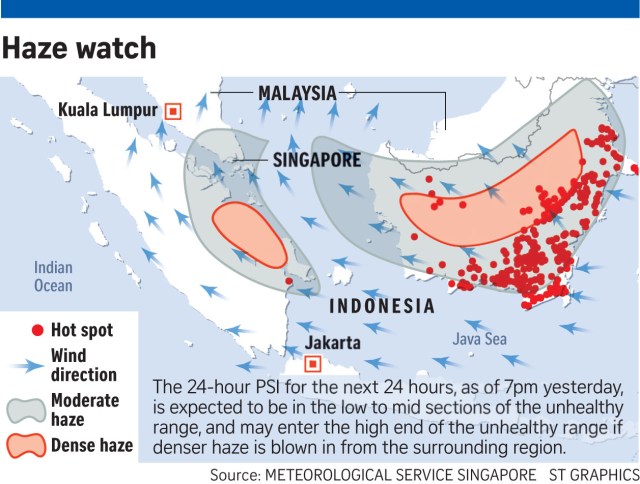
The haze, a result of forest fires in parts of Indonesia, is set to remain until November, due in part to the dry spell caused by the El Nino effect said to be among the strongest since records were kept in 1950.

Indonesia’s National Disaster Management Agency (BNPB) said that it will need not only more boots on the ground to fight the fires, but also more money to deal with the crisis.

“The number of forest and land fires still has the potential to rise until end-November,” said BNPB spokesman Sutopo Purwo Nugroho during a press briefing yesterday.

“As a result, BNPB may use up all 385 billion rupiah (S$38.5 million) in government funding earmarked to deal with the fires by end-September and it will have to turn to a 2.5 trillion rupiah ‘on-call fund’ set aside for other types of disasters.”

The Pollutant Standards Index (PSI) in the Central Kalimantan capital of Palangkaraya fluctuated from as high as 1,992 at 6am yesterday, to 1,096 later in the afternoon.

Other places fared better, but only slightly. Palembang in South Sumatra went from a high of 758 at 5am to 180 at 2pm yesterday.

Any PSI reading over 350 is rated as hazardous; while the range of 151 to 250 is considered unhealthy.

“Now, Central and West Kalimantan are seeing the worst (in air pollution),” said Mr Sutopo. “Merauke in Papua has also been burning.”

Indonesia has struggled to control the spread of forest fires that caused the smouldering haze, which has affected the lives of millions of people across Indonesia, Malaysia and Singapore in recent weeks.

There are now about 4,800 soldiers and policemen fighting fires in Sumatra and Kalimantan, but the BNPB says it wants an additional 600 troops to help.

President Joko Widodo yesterday visited emergency workers deployed to help fight the fires in Banjarbaru, South Kalimantan, before heading to Sumatra, where he will be spending two days inspecting ground conditions and fire-fighting efforts in Jambi, as well as visiting evacuees from the Mount Sinabung volcano eruption. The volcano in North Sumatra last erupted earlier this month.

His men, however, face a tall order, with climate experts warning that the extreme dry weather from the El Nino phenomenon will continue to cause peatlands to burn more readily.

El Nino typically lasts nine months but weather experts say the forecast this year indicates that it is set to peak only in November and could possibly last well into the first half of next year.

According to data from 2006 to last year, hot spots typically appear between June and October, but the prevailing dry weather means they may continue to burn until November, said Mr Sutopo. “The number of hot spots rose again, including fires in South Sumatra… that were previously doused but have re-emerged,” he said.

Border areas such as Jambi in South Sumatra – where fires occur in far-flung, hard-to-reach places – have also registered a spike in the number of hot spots, he added.

Indonesia’s Environment and Forestry Ministry on Tuesday said it suspended the operations of three plantation companies and revoked the business licence of a fourth over illegal land-clearing practices, which have led to forest fires and the haze in recent weeks. All are Indonesian-owned entities.

The ministry, which is planning to launch civil action against the companies, also said more are expected to be dealt with in the days ahead for breaching Indonesia’s environmental laws.

Source: Haze set to last till November as El Nino stretches dry spell, SE Asia News & Top Stories – The Straits Times

Posted in Air Quality, Asia, Singapore | Tagged , , , , , , , , , , , , | Leave a comment

Walking in side streets ‘reduces harm from air pollution’ 

Walking in quieter side streets in London can reduce the amount of harm caused by diesel fumes, according to the latest study.

A researcher used a hand-held monitor to measure levels of sooty black pollution while walking between Whitechapel and Moorgate.

By going on these quieter roads the toxic peaks of exposure to fine particles which can lodge into your lungs, was reduced.

When compared to doing the same journey by taking major roads the amount of black carbon exceeded 10,000 nanograms per cubic metre every five minutes.

UK pollution guidelines recommend that exposure to the particles should not exceed 35,000 nanograms over a 24-hour period.

Fine particles, known as PM2.5s, are mostly produced by diesel engines.

London is one of the most polluted cities for black carbon in Europe, ways that people might be able to reduce their own exposure are of interest, and we wanted to see whether walking quieter, side-street routes might help to do this.

Our study suggests that, in London, it is possible to reduce exposure to peaks of black carbon particles (mainly from diesel soot) by choosing to walk a less polluted route.

– LEE KOH, RESEARCHER FROM UNIVERSITY OF LONDON

The difference between non-peak pollution levels on main and side roads was not statistically significant.

But Mrs Koh added that peaks happen when higher pollution levels are present such as when you stop to cross a busy road compared to when you walk away from traffic.

The findings were presented at the European Respiratory Society’s International Congress in Amsterdam.

Source: Walking in side streets ‘reduces harm from air pollution’ | London – ITV News

Posted in Air Quality, Europe, Health Effects of Air Pollution, London, UK | Tagged , , , , , , , | Leave a comment

A mucky business 

HERBIE, a Volkswagen Beetle with a mind of its own in a series of Disney films launched in the 1960s, had its share of misadventures. But things had a way of ending up happily for both the car and its passengers. The German carmaker’s more recent attempts to give its cars the gift of thought have things headed in an altogether grimmer direction. Its use of hidden software to deceive American regulators measuring emissions from diesel-engined cars has plunged VW into crisis. And as the scandal provokes further investigations it seems likely to throw into question a wider range of claims about emissions and fuel efficiency. It could thus be a blow to much of the industry—one that might be large enough to reshape it.
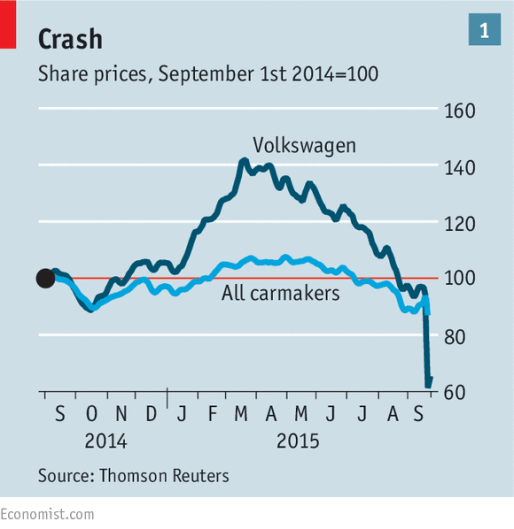
The damage to VW, the world’s biggest carmaker, is cataclysmic. The company’s shares have collapsed by a third since its chicanery surfaced (see chart 1). It faces billions of dollars in fines and other financial penalties. Lawsuits will be flying their way to its headquarters in Wolfsburg. Its strategy for the crucial American market is ruined; its reputation is in tatters. Its boss, Martin Winterkorn—who in 2009, when the misleading “defeat” software made its first appearance, was also directly responsible for the company’s R&D—resigned on September 23rd.

The company’s home country is in shock. Germany’s environment minister, Barbara Hendricks, spoke for many when she declared herself “more than astonished”—though the Greens, an opposition party, say that in its response to a parliamentary question earlier this year the government admitted that it knew manipulating emissions data was technically possible. Mixed in with this is some embarrassment that, as with the scandals over FIFA and the World Cup, it is falling to America to enforce rules that Europeans have been breaking.

There is also a certain apprehension. Sigmar Gabriel, the vice-chancellor and economics minister, said on September 21st that he hoped the export brand of Germany as a whole would not be tarnished. Germany’s economic strength rests in large part on the idea that anything stamped “Made in Germany” will offer a high level of reliability, trustworthiness and engineering prowess. Much of that reputation rests on the broad shoulders and sturdy tyres of the car industry, which directly or indirectly employs one in seven of the country’s workers; and with a stable of marques that includes Porsche and Audi, VW is that industry’s leader. Industrialists fret that consumers worldwide could exact reputational Sippenhaft—collective punishment, but literally “kin liability”—on all German engineering.

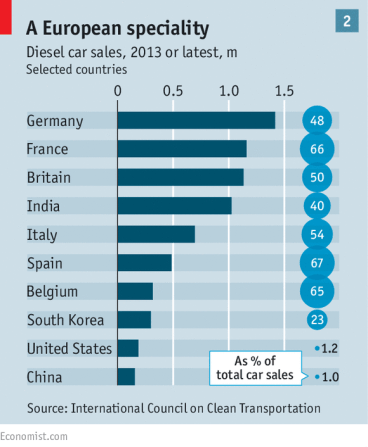
As well as being a threat to Germany’s export earnings, the scandal also menaces the brainchild of one of its most eminent engineers, Rudolf Diesel—at least as far as its future in cars is concerned. Diesel engines use fuel more efficiently than engines with spark plugs, and better efficiency reduces both drivers’ expenses and carbon-dioxide emissions. Those advantages have endeared diesel engines to thrifty Europeans with green governments; none too popular elsewhere in the world, they power half of Europe’s cars (see chart 2).
Unfortunately, the benefits come with costs. Diesel cars’ efficiency comes from burning their fuel at a higher temperature, and that means they turn more of the nitrogen in the air they use for burning into various oxides of nitrogen, collectively known as NOx. This does not have global climate effects on the same scale as those of carbon dioxide, which is the most important long-lived greenhouse gas. But it has far worse local effects, generating smogs and damaging plants and lungs. To make matters worse, the catalytic technologies used to deal with the NOx emitted by petrol engines are not well suited for use with diesels, requiring engine makers to deploy more complex and expensive alternatives. That is not a big problem for large engines like those of trucks and ships. But it is for small engines like those of cars.

In America NOx standards are more demanding than they are in Europe. Mazda and Honda, both accomplished producers of diesel engines, have had trouble complying with them. It now appears that VW, which has put a lot of effort into persuading Americans that diesels can be clean and green, would also have failed to comply if it had not cheated. The campaign to convince Americans of the merits of diesel may thus well be at an end. And if it turns out that under real-life conditions many diesels also break Europe’s less stringent NOx standards then the future of diesel cars worldwide will be bleak.

Nothing seems right

The scandal broke on September 18th, when America’s Environmental Protection Agency (EPA) revealed that several diesel-engined VWs and Audis had software which switched NOx-controlling technology on only when faced with the highly predictable sort of demands seen under test conditions. The NOx-emission limit for a fleet of cars is 0.07 grams per mile (0.04g/km); under normal conditions the cars were 40 times over the limit. The EPA ordered VW to recall around half a million cars in America to fix the software. On September 22nd the company admitted that in 11m vehicles worldwide there was a “noticeable deviation” between the NOx emissions seen in official testing and those found in real-world use.

On the basis of 482,000 cars sold and a maximum fine of $37,500 per vehicle under the Clean Air Act, the Department of Justice could in theory fine VW $18 billion. In practice the punishment may be a lot less severe. General Motors, which for years ignored problems with ignition switches that directly claimed 124 lives, was fined just $900m earlier in September. In 2014 Toyota paid $1.2 billion when it settled a criminal investigation into its handling of unintended acceleration problems that led to 8.1m recalls.

But fines are not the only losses involved. Class-action lawsuits from aggrieved motorists will arrive at the speed of a turbocharged Porsche. On September 22nd VW announced a €6.5 billion ($7.3 billion) provision to cover the costs of the scandal but that is likely to prove too little. By that stage the company’s value had fallen €26 billion.

The financial damage could go further. Hidden within the German firm is a big finance operation that makes loans to car buyers and dealers and also takes deposits, acting as a bank. Its assets have more than doubled in the past decade and make up 44% of the firm’s total. And it may be vulnerable to a run. In previous crises “captive-finance” arms of industrial firms have proven fragile. After the Deepwater Horizon disaster BP’s oil-derivative trading arm was cut off from long-term contracts by some counterparties. General Motors’ former finance arm, GMAC, had to be bailed out in 2009.

With €164 billion of assets in June, VW’s finance operation is as big as GMAC was six years ago, and it appears to be more dependent on short-term debts and deposits to fund itself. Together, VW’s car and finance businesses had €67 billion of bonds, deposits and debt classified as “current” in June. This means—roughly speaking—that lenders can demand repayment of that sum over the next 12 months. The group also has a big book of derivatives which it uses to hedge currency and interest-rate risk and which represented over €200 billion of notional exposure at the end of 2014. It is impossible to know if these derivatives pose a further risk, but if counterparties begin to think VW could be done for they might try to wind down their exposure to the car firm or demand higher margin payments from it.

If depositors, lenders and counterparties were to refuse to roll over funds to VW, the company could hang on for a bit. It has €33 billion of cash and marketable securities on hand, as well as unused bank lines and the cashflow from the car business. The German government would lean on German banks to prop up their tarnished national champion, 20% of which is owned by the state of Lower Saxony. So far the cost of insuring VW’s debt has risen, but not to distressed levels. Still, unless the company convinces the world that it can contain the cost of its dishonesty, it could yet face a debt and liquidity crisis.

Doubts about NOx emissions from VW’s four-cylinder TDI series of diesels (which can also be found in Seats and Skodas) first surfaced after testing by the International Council on Clean Transportation, a small NGO, two years ago. The tests—intended, ironically, to demonstrate the engines’ cleanliness—revealed that the cars’ emissions far exceeded what the company had previously stated. The ICCT brought the results to the attention of the California Air Resources Board (CARB), which badgered VW into a voluntary recall to fix what the company insisted were “technical issues”. When the recall failed to resolve things VW offered excuse after excuse before eventually confessing—it was still dithering when the EPA, with which CARB had shared its results, finally acted.

The image breaks down

Why did VW take the risk of cheating, given the devastation that has followed? There seem to be three parts to the explanation. The first is an overwhelming desire for size. The company has been obsessed with surpassing Toyota and becoming the world’s biggest car company, despite making little money from its most high-volume products (cars carrying the VW badge make up 60% of sales but the profit margin on them is just 2%). This required that the company increase its small share of the American market—the largest after China (see chart 3). Making more of the SUVs that Americans covet was one obvious strategy. Getting them keen on the fuel-efficient diesel engines that VW sells elsewhere was another. In a modest way it was succeeding; though diesels account for only 1% of the American market for cars, last year VW had half of that slim slice.

Though these cars were substandard when it came to NOx, they didn’t have to be. According to a British professor who specialises in the subject, “you can solve any emissions problem if you throw enough engineering and money at it”. As VW spends more on R&D than any other company on the planet—€13.1 billion in 2014—it is very well positioned for such throwing. But here the second part of the explanation comes into play: fixes to the NOx problem come with trade-offs. Exhaust-gas recirculation, one of the technologies VW uses, reduces both fuel efficiency and power, which drivers tend not to like. Reports indicate that this recirculation was something the software turned off when regulators were not looking. Selective catalytic reduction, used in some newer cars, reacts NOx with ammonia, reducing the eventual level of pollution by a great deal. But designing, installing and operating these systems all add to a car’s cost. Easier not to fix the problem, if you think you can get away with it.

Apparently some people at VW thought they could get away with it. And this leads to the third bit of the explanation: a large part of their reason for believing this would have been that carmakers, particularly European ones, are used to getting away with a great deal in such matters.Their trickery is an open secret within the industry; new scrutiny in the aftermath of the NOx revelations seems likely to make it an open scandal to the world at large. This may be why VW’s competitors, too, are seeing their share prices fall. Its crimes may be particular, but it is far from the only carmaker producing vehicles that fall far below the performance that regulators require of them.

The European Union (EU) is not as demanding in the matter of NOx as the Americans are. It concentrates more on fuel efficiency and carbon-dioxide emissions, where its standards are the highest in the world. The problem is that these tough limits bear little resemblance to what cars emit when on the road. According to Transport & Environment (T&E), a green pressure group, the gulf between stated fuel-economy figures (and by extension carbon-dioxide emissions) and those achieved by an average driver has grown to 40% in recent years (see chart 4)

It is possible that some companies are using software trickery to cheat on Europe’s tests on fuel efficiency. But as Nick Molden of Emission Analytics, a consulting firm in Britain, argues, the European testing regime is so out of date and open to abuse that carmakers do not have to bother with such subtlety. The companies test their own vehicles under the auspices of independent testing organisations certified by national governments. But these organisations are commercial enterprises that compete for business. Although obliged to put the vehicles through standard activity cycles both in a laboratory and on a test track—neither of which is remotely realistic—they are aware that their ability to “optimise” the test procedures is a way to win clients. In practice this means doing everything possible to make the test cars perform far better than the versions punters drive off the forecourt.

The cars that are tested have generally been modified to be as frugal as possible. Things that add weight, such as sound systems, are left out. Drag is reduced by removing wing mirrors and taping up cracks between panels. Special lubricants make the engines run more smoothly. Low-resistance tyres are overinflated with special mixtures of gas. Alternators are disconnected, which gives more power to the wheels but guarantees a flat battery in the end. The cars may be run in too high a gear, and conducting tests at the highest allowed ambient temperature—another efficiency booster—is commonplace.

Stable for days

Worst of all, though, is that once this charade has produced a claim as to the car’s efficiency, no one checks whether it is true or not. In America, too, carmakers are responsible for their own tests. But there the EPA goes on to acquire vehicles at random for testing at a later date, to see if the cars on sale to the public live up to the claims. If the numbers do not match up substantial fines can follow. In 2014 Hyundai-Kia was fined $300m for misstating fuel-economy figures. Europe has no such system for punishing those who transgress. As a result more than half Europe’s claimed gains in efficiency since 2008 have been “purely theoretical”, says T&E. And the industry as a whole has developed a gaming attitude to tests and regulations that it should take seriously. As Drew Kodjak of the ICCT observes, VW’s activities in America are part of a pattern of behaviour that the “European system created”.

A new level of scrutiny will change things. It may turn out that other manufacturers are using similar software to cheat on either NOx or carbon-dioxide tests. The NOx emissions from new diesel cars in Europe are on average five times higher on the road than in tests; some cars run at ten times the limit, according to T&E. But even if they are not, a wider understanding of the bogus way in which the system runs seems sure to provoke action, and weaken the power of the industry to keep the system lax. Carmakers have been lobbying against the EU’s plans to introduce more realistic cycles into their tests by 2017, saying it can’t be done until 2020. Their pleading is unlikely now to help; the changes may not just arrive in 2017 but also be more exacting than previously planned.

This all takes place against a background of increasingly strict controls on carbon emissions. Europe’s carbon-dioxide goal of an average of 95g/km across all a carmaker’s models by 2021 is already demanding. It will be even harder to achieve if it has to be reached honestly. The same goes for more stringent fuel-economy standards that are coming soon in other markets such as China, America and Japan.

The industry had built a continuing shift to diesel into its assumptions about how it would meet these requirements. But if diesels cannot deliver low NOx emissions while maintaining high fuel efficiency and staying affordable, that assumption will have to be jettisoned—quite possibly taking with it the whole idea of diesel engines for mass-market cars. They are difficult and expensive to develop, and there is already a backlash against them in Europe, where they are blamed for high particulates as well as NOx; both Paris and London have talked of banning them.

If diesels cannot deliver then carmakers will need to turn heavily towards hybrids and very efficient small petrol engines. All this at a time when, according to Mary Barra, boss of GM, carmaking already faces more change in five to ten years than in the previous half-century. On top of meeting environmental targets and pioneering new hybrid and all-electric drivetrains carmakers need to spend a lot on using the internet to make their machines smarter and preparing them for the advent of autonomous driving. The investment required will be monumental, and some will surely be unable to bear it.

Meanwhile cut-throat competitiveness is only going to get more intense as non-carmakers with deep pockets, such as Google and Apple (see article), eye up the industry. One answer is consolidation to tackle overcapacity. Big mergers have generally proved disastrous in the industry—but then so have attempts to become number one by other means. It was a devotion to size above all things that led to Toyota’s devastating outbreak of quality defects in the late 2000s, and the same ambition has played its role in the downfall of VW. If the gathering emissions scandal has any virtue it may lie in forcing a reshaping that the industry badly needs.

Source: A mucky business | The Economist

Posted in Air Quality, Europe, USA & Canada | Tagged , , , , , | Leave a comment

Singapore: Air Pollution Closes Schools 

Singapore will close all primary and secondary schools on Friday as worsening pollution causes air quality to deteriorate, the Ministry of Education said Thursday. Smoke from slash-and-burn farming methods in Indonesia has created a choking haze over Singapore for weeks. The three-hour Pollutant Standards Index reading rose to 314, and the 24-hour figure was 223 to 275 on Wednesday night. A reading over 300 indicates “hazardous” air quality, and 201 to 300 is “very unhealthy,” the National Environment Agency said.

Source: Singapore: Air Pollution Closes Schools – The New York Times

Posted in Asia, Singapore | Tagged , , , , | Leave a comment

Majority of Utahns in favor of changing behavior to cut air pollution — but actions might speak louder 

Three-quarters of Utah residents want to see air emissions decrease 40 percent by the year 2050 — even when they were told they would have to curtail their driving by 25 percent, enact new building codes, remodel their home and buy a new car to achieve that goal.

According to Envision Utah survey results released Wednesday, the majority of respondents chose one of two proposed versions of Utah’s future that saw air pollution decrease by 40 percent. Another 19 percent voted to decrease emissions by just 30 percent, and only 7 percent voted to reduce emissions by 20 percent — a scenario that would require little additional action from the average Utahn but would not bring the state into compliance with federal health standards.

That strong support for clean air and the willingness to change is good news, said Bryce Bird, director of the Utah Division of Air Quality. But it’s also surprising.

Utahns have become increasingly vocal in their calls for clean air, Bird said. But he has observed that when curtailing air emissions begins to affect individuals, Utahns rarely come to the table.

“This is maybe contrary to the pushback that we receive when we try to find a solution to our air quality problems,” Bird said. “The problem is any time we find a solution, it impacts somebody — somebody has to make a change, somebody has to make a choice.

“When you go through the regulatory process, that’s when the impact is realized, and those people oppose it or provide feedback that the impact is not fair in their eyes … whenever you put a regulation in place, that’s when you see more pushback.”

That has led the Air Quality Board to move toward incentives programs that use a carrot, rather than a stick, to convince residents to make choices that will improve air quality, Bird said.

For example, he said, a recent incentive program that allowed residents to trade their gas-powered lawn mowers for electric models was highly successful. As the state grows and its emissions increase with its population, incentives may be the way to go, Bird said.

At the same time, he said, there’s still a battle to be fought when it comes to education. An Envision Utah survey conducted in 2013 found that most Utahns underestimate the emissions contributions made by their homes. According to that survey, Utahns estimated that vehicles are responsible for 44 percent of Utah’s air emissions, industry for 39 percent, and homes and buildings for the remaining 17 percent. But the state’s scientific estimates put cars at 57 percent, industry at 11 percent and homes and other buildings at 32 percent.

The fastest-growing sources of air pollution in Utah aren’t industrial smokestacks, Bird said, but increased urban density and all the things associated with it — restaurants, homes, cleaning products, even nail polish.

Matt Pacenza, executive director of the advocacy group HEAL Utah, disputed the state’s low estimate of industry contributions, but he said residents’ misunderstanding of their own impact is a longstanding problem.

“The truth is our boilers and hot water heaters are basically invisible to us,” he said, “and the emissions they put out our chimneys literally are.”

But overall, Pacenza said, the 2015 survey results seem encouraging.

“I think what’s interesting is that people have been very supportive of policies that, let’s say, increase the cost of gas slightly,” he said. “Or that increase the cost of a car slightly, or increase the cost of a new home slightly, and those are the kinds of policies that we’re talking about. I think we can get to the 40 percent if we do stuff like that.”

Pacenza said he just hopes such programs’ public support translates for lawmakers. In the past, he said, bills that call for stricter building codes for new homes have been blocked by lobbyists.

“Some of the ways that we get to improving building policies require a willingness to take on powerful interests, including Realtors and homebuilders,” he said, “and so far, we haven’t seen that.”

Source: Majority of Utahns in favor of changing behavior to cut air pollution — but actions might speak louder | The Salt Lake Tribune

Posted in Air Quality, USA & Canada | Tagged , , | Leave a comment

India’s doctors blame air pollution for sharp rise in respiratory diseases 

Cases are up 30% since 2010 in country where decline in air quality is shifting from acute to chronic in more than just Delhi

A sharp rise in cases of chest and throat disease in India is being blamed by doctors on worsening air pollution in the country, which is now home to 13 of the 20 most polluted cities in the world.

According to India’s National Health Profile 2015, there were almost 3.5m reported cases of acute respiratory infection (ARI) last year, a 140,000 increase on the previous year and a 30% increase since 2010.

The number of ARI cases has risen steadily in India over the last 15 years, even when population growth is taken into account. In 2001, less than 2,000 cases per 100,000 people had an ARI. In 2012 the number was 2,600 per 100,000, statistics show.

The rise has occurred despite steady improvements in medical care and nutrition, as well as a shift away from using wood as fuel in rural areas. Together this has mitigated many factors long blamed for the high levels of respiratory diseases in India.

Doctors are blaming the increasing severity of the problem on unprecedented decline in air quality across India.

“Due to the awareness drives conducted about diseases like swine flu and influenza, people have become more aware … Yet air pollution is playing a major role in [increasing] the numbers of such diseases,” Dr Jugal Kishore, head of community medicine at Delhi’s Safdarjung hospital, told the local India Today news magazine.

Attention to the problem of air pollution in India has so far focused almost exclusively on the capital. One study found that half of Delhi’s 4.4 million schoolchildren would never recover full lung capacity.

But the rest of India has received less attention, though in many cases the problem is almost as acute, or possibly worse. The latest government figures show high numbers of lung and throat infections in the eastern state of West Bengal, the central state of Andhara Pradesh, as well as in tourist favourites Kerala and Rajasthan.

Mumbai also has pollution levels which, though lower than in Delhi, exceed safe limits set by the Indian government many times. Those limits are significantly higher than those set by international experts and western governments.

This summer, some reports suggested that Chennai experience worse pollution than anywhere else in India. Though the data has been challenged, it is clear that the levels of hazardous gases such as carbon monoxide, nitrogen dioxide and ozone, as well as of deadly fine particulates, in the southern city have consistently breached the World Health Organisation’s maximum safe limit.

“I always thought there was some washing off of pollution here due to the coastal breeze. But that seems to be wishful thinking,” said Prof Sudhir Chella Rajan, a specialist in urban air pollution at the Indian Institute of Technology Chennai.

Campaigners point out that the focus on Delhi has distracted from problems elsewhere. “Some reports are alarmist but in general, for sure, parts of Chennai are definitely worse than Delhi,” said Shweta Narayan, an activist.

Other major regional centres, such as Mumbai, Bangalore, or Bhopal are also badly affected.

“The older parts [of the Bhopal] have horrendous air. There’s no mass transit system, lots of very old substandard vehicles, open fires. It’s very serious,” said Nityanand Jayaraman, an environmental campaigner who regularly visits the Madhya Pradesh capital.

A report this summer highlighted the damage air pollution is causing the famous Golden Temple in Amritsar, Punjab.

Blackspots within individual cities around India are rarely identified by official figures, either on the prevalence of respiratory illness or air quality.

The worst affected areas of Chennai, which has a population of around 4 million people, lie on its northern rim, where petrochemical works, car factories and coal-burning power stations exist close to residential areas. In July, levels of deadly PM2.5 particulates in the Manali neighbourhood were four times the WHO safe limit. These particulates lodge in the lungs and allow heavy metals to enter the bloodstream.

In other cities across the country the problem was even worse. In Ahmedabad, in the west, levels of PM2.5s peaked at eight times the WHO limit for a 24-hour average. In Lucknow, in the north, levels reached seven times the limit. Levels of CO2, nitrogen dioxide and ozone in less known cities have also regularly exceeded WHO guidelines by huge margins.

India has the highest rate of death from respiratory disease in the world, according to the WHO,. The rate was 159 per 100,000 in 2012, about 10 times that of Italy, five times that of the UK and twice that of China.

Officials in Chennai say they are aware of the problem, and point to measures from the new $3bn (£2bn) metro to the construction of traffic islands as evidence of their intent to tackle it.

But similar mass transit systems across India do not have a significant immediate impact on pollution, experts say. Most are too small and have been built too late. Studies show that Delhi’s metro users previously travelled on buses, by bicycles or on foot, not in cars.

One effective, and considerably cheaper, scheme in Chennai has been the introduction of minibuses on smaller roads between the major bus routes. “It has worked and been very popular,” said Narayan.

The problem has a broader cultural aspect too. In India, as in the west in the 1950s and 1960s, cars bring not just mobility and convenience but are tangible symbols of social success.

On a sheet of paper pinned to a wall of the spotless Alandar station, contented passengers have scrawled their impressions of Chennai’s month-old metro. “Very wonderful, fantastic, unforgettable,” they gush.

Natarajan Ramesh, an off duty policeman buying a ticket in the station’s cavernous entry hall, was also impressed. “It is very nice. It is the need of the hour. It will help commuters travel in such a quick span of time and is very clean too,” he said.

However, Ramesh’s own ambitions are less environmentally sensitive. “My dream is to have a car,” he said. “Trains are all nice and useful but not the same as a car. I would like a Honda, or maybe a Volkswagen.”

The number of vehicles, including motorbikes, on Chennai’s roads has more than trebled in 15 years. In Delhi and many other cities the increase has been even greater. Hundreds of smaller towns, for which there are no reliable air quality figures available, have horrific congestion and pollution from ageing power stations and poorly regulated industry.

There is still hope for improvement, though only in the long term. Officials in India no longer deny there is a problem and air pollution is fast becoming a significant political issue for many wealthier urban residents.

On Tuesday, a joint initiative by police and local businesses led to a “car free day” in Gurgaon, a satellite city of Delhi. Though only a limited number of roads were shut, pollution levels dropped dramatically, local newspapers reported.

Pollution expert Raja worked for five years at the Californian Air Resources Board. The air in the US state, once infamous for its smoggy cities, is now cleaner than in decades, even though problems remain.

“They have done an enormous amount … but it took 40 years. Here [in India] air pollution is probably going to be very severe for a couple of decades before it gets any better,” he said.

Source: India’s doctors blame air pollution for sharp rise in respiratory diseases | World news | The Guardian

Posted in Air Quality, Asia | Tagged , , , , , , , , , , , | Leave a comment

The rise of diesel in Europe: the impact on health and pollution 

In a bid to reduce CO2 emissions in the 90s, Europe backed a major switch from petrol to diesel cars but the result was a rise in deadly air pollution

Volkswagen’s rigging of emissions tests for diesel cars comes after nearly 20 years of the technology being incentivised in Europe in the knowledge that its adoption would reduce global warming emissions but lead to thousands of extra deaths from increased levels of toxic gases.

Diesel was a niche market in Europe until the mid-1990s, making up less than 10% of the car fleet. Diesels produce 15% less CO2 than petrol, but emit four times more nitrogen dioxide pollution (NO2) and 22 times more particulates – the tiny particles that penetrate the lungs, brain and heart.

Following the signing of the Kyoto protocol climate change agreement in 1997, most rich countries were legally obliged to reduce CO2 emissions by an average of 8% over 15 years.

Japanese and American car makers backed research into hybrid and electric cars, but the European commission was lobbied strongly by big German car makers BMW, Volkswagen and Daimler, to incentivise diesel. A switch to diesel was said by the industry to be a cheap and fast way to reduce the carbon emissions that drive climate change.

Screen Shot 2015-09-23 at 09.10.53

The subsequent EC 1998 Acea agreement with all European car makers was backed by then EU transport commissioner Neil Kinnock and UK environment secretary John Prescott. It committed passenger car-makers to reduce CO2 emissions by 25% over 10 years.

“It was practically an order to switch to diesel. The European car fleet was transformed from being almost entirely petrol to predominantly diesel. Britain, along with Germany, France and Italy, offered subsidies and sweeteners to persuade car makers and the public to buy diesel,” said Simon Birkett, director of the Clean Air London group.

Screen Shot 2015-09-23 at 09.11.53The European auto industry ramped up diesel engine production. Under EU pressure, governments kept the diesel price below that of petrol. In the UK, the amount motorists paid in vehicle excise duty was linked to cars’ CO2 emissions, effectively incentivising people to buy diesels.

“Diesel cars should attract less vehicle tax than their petrol equivalents because of their better CO2 performance,” said then chancellor Gordon Brown in 1998.

The results were dramatic, says the Society of motor manufacturers and traders (SMMT). From being a quirky choice, diesel went mainstream in Europe. Its market share in the UK rose from under 10% in 1995 to over 50% in 2012. Britain now has 11.8m diesel cars in use, making up one of the greatest diesel car fleets in the world.

But the trade-off between reducing climate emissions and increasing health problems was not widely debated, say civil servants and politicians. In addition, they say, carmakers found it easy to cheat the system.

“Diesel was seen as a good thing because it produces less CO2, so we gave people incentives to buy diesel cars,” said Martin Williams, professor of air quality research at King’s College London since 2010, and former head of the government’s air quality science unit.

“The [emission] tests were simply not stringent enough. They were devised by a UN committee based in Geneva called the World Forum for Harmonisation of Vehicle Regulations, which was dominated by people from the car industry.

“What’s more, it was easy for some manufacturers to calibrate cars’ computers to spot when the car was being tested and reduce emissions until the test was over,”he told the Sunday Times in July.

Screen Shot 2015-09-23 at 09.12.49

David Fisk, chief scientist and policy director in the department of environment and transport in the 1990s, told the Guardian that there had been “concern” in government when it was proposed that diesel be backed over petrol.

“The motor manufacturers made a démarche to the department of the environment, showing that a major switch to diesels would lead to a substantial drop in CO2 emissions,” Fisk said. He added that the air quality division in the then-Department of the Environment, Transport and the Regions (Detr) saw there was a problem he said – that local air pollution would increase as a result – so a national system of air quality standards was created.

Former Greenpeace UK chief Stephen Tindale, who was working on air pollution in the department of the environment at the time, remembers a battle between environment and air pollution divisions.

“Air quality was just not on the political agenda in the late 1990s. In 1997, Labour’s policy was for a 20% cut in CO2 emissions by 2020. Tony Blair wasn’t obsessed with climate but he saw the political and soundbite advantage. The department of health was dozy, with Frank Dobson and then David Blunkett in charge.”

A senior civil servant, now retired, who worked in the department for transport but asked not to be named, said that cost-benefit studies of a switch to diesel were done by government but climate change was “the new kid on the block” and long-term projections of comparative technologies were not perfect.

“We did not sleepwalk into this. To be totally reductionist, you are talking about killing people today rather than saving lives tomorrow. Occasionally, we had to say we were living in a different political world and everyone had to swallow hard,” he said.

But Michael Meacher, environment minister 1997-2003, said he could not recall ever being consulted on the UK’s switch to diesel. “If it had been a question of a trade-off between carbon emissions and health, much as I would have wanted to reduce climate emissions, the medical effects would have trumped it. I would have been keen to see a major reduction in [carbon] emissions, but I would not have wanted that to be at the price of lives.”

As new research shows that diesel fumes are worse than expected for health, triggering cancers, heart attacks and the stunting of children’s growth, many politicians have admitted a major environmental mistake.

Shadow environment minister Barry Gardiner told C4 last year that that it was the “wrong decision” to incentivise diesel. “Hands up — there’s absolutely no question that the decision we took was the wrong decision. But at that time we didn’t have the evidence that subsequently we did have.”

Screen Shot 2015-09-23 at 09.13.23

Source: The rise of diesel in Europe: the impact on health and pollution | Environment | The Guardian

Posted in Air Quality, Europe, UK | Tagged , , , , , , | Leave a comment