Pollutionwatch: Beware the air we breathe

New research estimates that air pollution contributed to the deaths of as many as 9,400 Londoners in 2010; around 3,500 from particle pollution and up to 4,900 from nitrogen dioxide, which has been included in a health impact assessment for the first time.

Unlike road accidents or cancer in smokers, the impacts of air pollution are hard to see as it adds to the health burden from heart and lung problems, stroke and many other causes. This means that the impact cannot be worked out from counting death certificates. Instead, the estimates were made by taking the effect of pollution on survival rates of over 1.5m people living in places with different air pollution around Europe and North America, and combining the results with air pollution exposure data from London.

Scientists prefer to express the health burden as life lost; in this case up to 140,000 years in 2010. This is a whole lot of birthdays but is hard to understand. It is easier to think in terms of loss of life expectancy; the average Londoner exposed to 2010 levels of pollution through their lives could lose around nine months life from particle pollution and up to 16 months from nitrogen dioxide. For each week lived in London this is an hour and a half life loss from particle pollution and nearly three hours from nitrogen dioxide.

Although London is the first to assess air pollution in this way, cities around the UK and Europe have similar pollution. However improvements are slow. Imagine the outcry if poisoned tap water was contributing to the deaths of almost 10,000 Londoners annually.

via Pollutionwatch: Beware the air we breathe | Environment | The Guardian.

Posted in Air Quality, Europe, London, UK | Tagged , , , | Leave a comment

Toxic air choked 35,000 to death in 10 years: Ministry

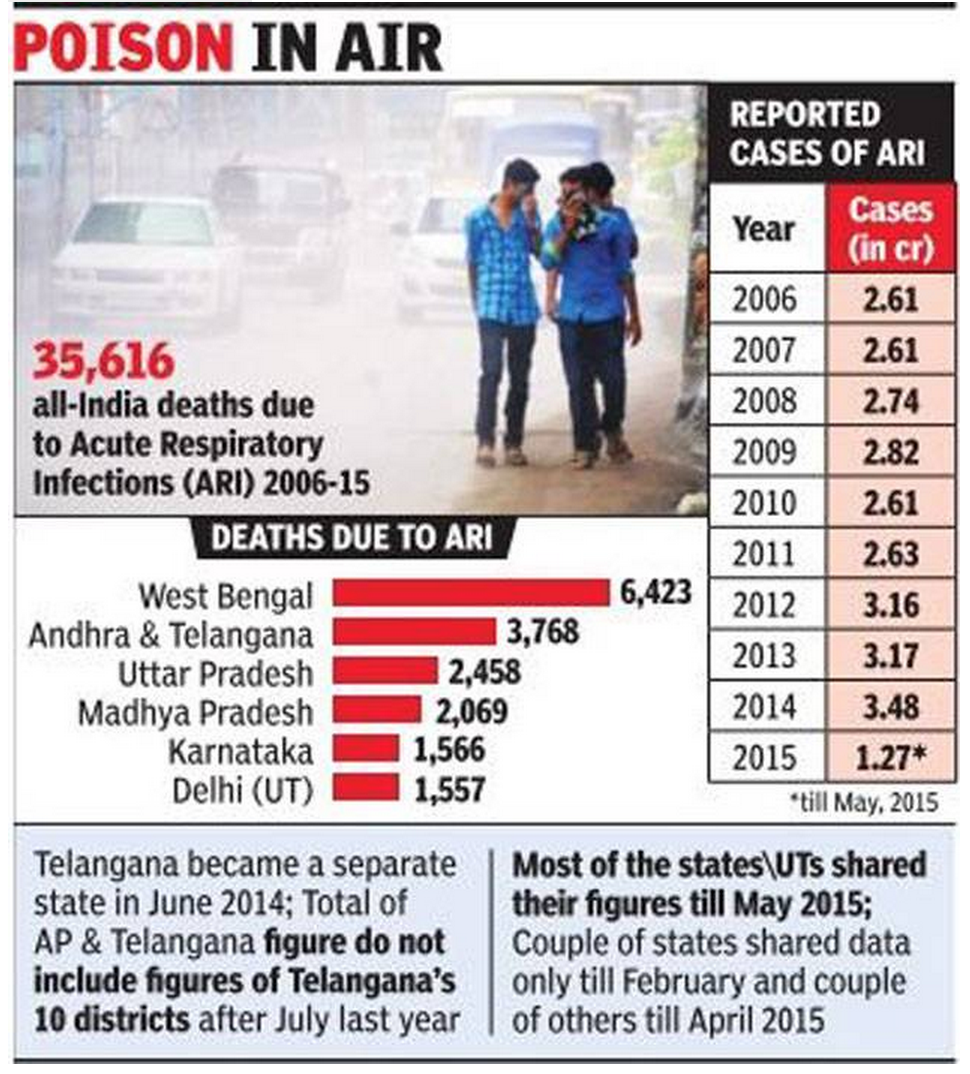
Union environment ministry, which generally avoids sharing details of air pollution-linked deaths, made an exception on Thursday when it said in Parliament that more than 35,000 people had died due to acute respiratory infections (ARI) across India in close to 10 years. More than 2.6 crore cases were reported every year during the period.

Although international studies have attributed far more deaths to air pollution in India, this was a rare official admission that pollution could be causing deaths on a large scale. The number of annual ARI cases reported by environment and forest minister Prakash Javadekar was high by any measure.

“Air pollution is known to be one of the aggravating factors for many respiratory ailments and cardiovascular diseases,” Javadekar stated, sharing the data provided by the health and family welfare ministry.

Screen Shot 2015-08-07 at 07.20.14

According to the data, 3.48 crore cases came to light in 2014, which means more than 95,000 Indians of all ages were reporting acute respiratory infection every day.

Responding to a Parliament question on impact of air pollution, the minister in his written response in Rajya Sabha stated, “Asthma, chronic obstructive pulmonary disease, chronic bronchitis etc are the diseases caused by exposure to increasing air pollution.”

The environment ministry had in the past maintained that there was no “conclusive evidence” that air pollution had led to loss of lives of patients suffering from respiratory diseases.

Although it continued to stress that air pollution may just aggravate the condition as it was not the only cause of respiratory diseases, this time the ministry shared statistics related to ARI deaths from 2006 to 2015. The ministry, at the same time, also listed a number of measures being taken by it to minimize the impact of air pollution.

The figures revealed that West Bengal reported the maximum number of ARI deaths, followed by Andhra Pradesh (along with Telangana), Uttar Pradesh, Madhya Pradesh, Karnataka and Delhi. These states also reported relatively higher number of ARI cases.

International studies have been indicating that India’s air pollution could be exacting a far higher toll in human lives. A recent study published in Environmental Science and Technology journal had claimed that foul air was killing up to 80 people a day in Delhi alone.

Screen Shot 2015-08-07 at 07.19.55

Similarly, findings of the ‘Global Burden of Disease’ (GBD) report, released two years ago, noted that about 6,20,000 premature deaths had occurred in India from air pollution-related diseases in 2010. It had ranked air pollution as one of the top 10 killers in the world, and the sixth most dangerous killer in south Asia. GBD is a worldwide initiative involving the World Health Organization which tracks deaths and illnesses from all causes across the world every 10 years.

The environment ministry, however, invariably rejected such conclusions. Even last week, Javadekar had told Parliament that “there is no methodology to establish direct correlation between toxic air and death of people. The impact of various pollutants on health is a result of complex mixture of pollutants. Also, there are several synergistic and addictive factors like heredity, socio-economic condition, medical health, habits, occupation etc contributing to it.”

via Toxic air choked 35,000 to death in 10 years: Ministry – The Times of India.

Posted in Air Quality, Asia, India | Tagged , , | Leave a comment

Summer Wildfires: Chemicals, and Effects on Air Pollution

Wildfires – such as those in California – can have substantial effects on both air pollution and human health. What are the most common pollutants resulting from the California wildfires, and other fire events – and how dangerous are these chemicals?

Wildfires: A Common Problem in Summer

Wildfires are becoming a common occurrence during summer months in many counties/areas. In the last weeks, for instance, many areas of California have been on fire, with flames expanding quickly to larger and larger areas.

Unfortunately, similar incidents take place every year in many places; in south European countries and in Australia, for example, large wildfires occur every summer.

Although the majority of the fires are caused by human activities, the meteorological conditions can significantly affect these wildfires. Periods of prolonged drought, like those in California for instance, can lead to wildfires, and strong winds can favor the expansion of the flames and make it more difficult to control the fires.

Pollution from Wildfires

Wildfires have a huge impact on the environment, as hundreds/thousands of hectares of forests get burned in each fire, with effects on the flora/fauna of the areas involved. If these fires occur close to inhabited areas, lives and belongings of the local people can also be at risk.

To fully assess the impact of the wildfires, however, pollution has also to be taken into account, as the smoke formed during the fires contains chemical compounds which may be toxic.

Particulate Matter
The expression “particulate matter” (PM) refers to the small particles, both solid and liquid, which can be present in the atmosphere.

The hazard of these particles depends on their size; smaller particles can penetrate more easily into the human respiratory system and, hence, cause more problems (irritations, respiratory difficulties, etc.).

PM10 and PM2.5 are particulates with diameters smaller than 10 and 2.5 micron (mm), respectively; their concentration in the atmosphere is usually monitored, especially in big cities.

Smoke from wildfires always contains PM, which comes from the incomplete combustion of the solid wood and/or from other parts of the trees/bushes.
Carbon Monoxide and Ozone
Wildfire smoke can also contain some hazardous gaseous compounds such as carbon monoxide (CO) and ozone (O3).

CO, if inhaled in high quantity, can be poisonous.

O3 is an irritant for the respiratory system. Moreover, being a very reactive molecule, ozone can react with other species present in the atmosphere and form more toxic compounds.

Wildfires and their Effect on Air Quality
The toxic compounds present in the wildfire smoke can significantly affect the quality of the air; this effect can be considerable not just in the areas of the fires themselves, but also at several miles distance from the fires.

Some data collected by the Climate Center association confirm this. In the city of Salmon (Idaho, US), for instance, in August 2012, PM2.5 concentration was as high as 80 mg/m3, due to the Halstead Fire; this value is eight times higher than the standard safe PM2.5 value. The concentration was extremely high even though the fire occurred more than 100 km – over 62 miles – away from the city.

Similarly, in the city of Reno (Nevada, US), in August 2013 the air quality was not considered safe for 4 days, due to the Rim Fires, taking place almost 250 km, or 155 miles away.

Wildfire Pollution: Risks of Dioxins?
Dioxins are organic molecules which contain chlorine, with very high toxicity; in fact they are teratogenic (i.e. they can cause birth defects) and carcinogenic (can cause cancer).

Dioxins can be formed during combustion if the compounds burnt contain chlorine atoms.

The presence of dioxins in wildfire smoke is not very likely; indeed, some Australian researchers showed that the dioxin emissions from bush fires were lower than originally estimated. However, if fires spread and reach inhabited areas, and if houses/buildings are burnt, there is the risk of dioxin emissions. The chances are especially high if plastic materials catch fire.

This happened for, instance, in Rome Fiumicino airport (Italy) in May 2015. Due to a fire inside the terminal, the dioxin level increased in some parts of the airport. Although the concentration was not considered worrying, some parts of the terminals were shut as a precaution measure, and workers used protective masks.

Long Term Effects on the Climate
In recent years scientists have started to investigate whether the emissions from wildfires can also have a long term effect on the climate.

One of the reasons for this is that carbon dioxide (CO2) is also emitted by wildfires; CO2 is a greenhouse gas whose increasing atmospheric concentration, according to some, is causing global warming and ocean acidification.

Some scientists think that, due to the more frequent and extended wildfires, higher CO2 amounts are emitted, and this can have a significant effect on the climate. As forests act as a carbon sink, the disappearance of large areas due to fires can also be crucial.

Further to this, however, some researchers from the US Forest Service also considered the possible interactions that the particles present in the smoke can have with solar radiation, and the possible long term effects on climate patterns at a local level. The topic is quite complex, and needs more in-depth study.
Wildfire: Effects on Human Health
As mentioned above, wildfire smoke may contain several toxic chemicals, especially for the respiratory system. Recent data, however, seem to show that the exposure to these emissions may also have an effect on cardiovascular health.

Researchers from Monash University (Australia), in fact, published a study in which they correlate the exposure to PM2.5 due to the wildfires in Victoria (2006-2007) and cardiovascular problems. They found that there was an increase in the cases of out-of hospital cardiac arrests and ischemic heart diseases.

According to the authors of the research, more studies like this should be performed, to have a better understanding of the effect particulate matter may have on the health of more vulnerable people (i.e. older people, people with chronic diseases, etc.)

Worrying over Wildfires
As wildfires become more and more common, it is important to be aware of the risks associated with them, not just for the ecosystem and for personal safety, but also for pollution and human health.

via Summer Wildfires: Chemicals, and Effects on Air Pollution.

Posted in Air Quality, USA & Canada | Tagged , , , , , , , , , , | Leave a comment

Breathe deep: Valley air quality has best July in two decades

July hasn’t been so nice since 1995 in the San Joaquin Valley. We’re talking about dirty air, and the lack of it last month.

For 21 days last month, the air did not exceed the eight-hour federal health standard for ozone — a corrosive gas that attacks the lungs, skin and eyes. That’s three weeks of healthy air in the Valley during a month when the average is just five or six good days.

Nobody else in the nation gets dirty air for as many days as the Valley gets it, except for the South Coast Air Basin in Southern California. But this year, people could let their children play outside in the afternoon most of the month. Why?

Weather and air quality are linked, federal scientists say. Meteorologists point to unsettled conditions that cause air to mix throughout the atmosphere, which breaks up ozone. The Valley had thunderstorms and steady breezes in July. Fresno got more than a third of an inch of rain in one storm.

Cloudy days make a difference, too, and the Valley had some last month. Sunshine and heat are needed to create ozone.

WEATHER IS ALWAYS A FACTOR. METEOROLOGISTS POINT TO UNSETTLED CONDITIONS THAT CAUSE THE AIR TO MIX THROUGHOUT THE ATMOSPHERE, WHICH BREAKS UP OZONE. THE VALLEY HAD THUNDERSTORMS AND STEADY BREEZES IN JULY. FRESNO GOT MORE THAN A THIRD OF AN INCH OF RAIN IN ONE STORM.

The unsettled weather also affected Southern California, which had only 15 bad days. The South Coast Air Basin commonly has 25 or more bad July days.

But it’s a mistake to attribute the cleaner air last month to weather, says the head of the San Joaquin Valley Air Pollution Control District.

District executive director Seyed Sadredin says the weather didn’t always cooperate, especially during short runs of triple-digit heat. There were also 20 wildfires in the region. Wildfires produce ozone-making gases called nitrogen oxides.

Instead of weather, Sadredin credits the nice July to some of the toughest air regulations in the nation, along with investments in clean-air technology by businesses and residents.

The last time the Valley had so many days of breathable air in July was 1995. There were 23 healthy days and only eight bad days that year. The cleanest July over the last 35 years was in 1983. It had 25 healthy-air days and only six bad ones.

What does it mean if this kind of air cleanup becomes a permanent feature here?

$90 million is what the Valley would save in health-related and other costs if ozone standard was met

If the Valley meets even an older federal ozone standard, health-related and other costs would drop by nearly $90 million a year, according to a study done several years ago by researchers at California State University, Fullerton.

But ozone is a persistent villain in the Valley. When bad-air episodes happen, ozone levels tend to simmer right about the health threshold for hours at a time, meaning people get lengthy exposures outdoors.

Ozone forms when nitrogen oxides (think of vehicles, industrial boilers or fires) combine with volatile organic compounds (vapors from fuels, paints or dairies). In the Valley, the gases can be trapped for days when the weather becomes nearly windless and stagnant.

How does it damage lungs?

Ozone chemically burns the lungs. As the American Lung Association puts it, “think of it as a sunburn on the lungs.” The stress and inflammation can trigger asthma and other lung ailments.

The people most susceptible are children, the elderly and those who already suffer lung problems. At its worst, ozone is blamed for premature deaths in the Valley.

via Breathe deep: Valley air quality has best July in two decades | Fresno Bee.

Posted in Air Quality, USA & Canada | Tagged , , , | Leave a comment

Greener, Not Cleaner: How Trees Can Worsen Urban Air Pollution

No one enjoys choking on smog, but are more trees really the answer for polluted city air? It’s not as clear-cut as you might think. Air pollution is clearly a problem for health and well-being – and as more and more people across the world move to live in megacities, they could miss out on the fresh air associated with the green countryside.

So far, many strategies have been put in place to try and mitigate urban air pollution: from introducing congestion charges to imposing car bans, promoting electric vehicles to providing more car-free zones. One group has even suggested making London a “national park city”. If you can’t escape to the countryside, then you can instead bring the countryside feel to the city.

Urban planners seem to be increasingly focused on promoting more green spaces in our towns and cities, creating a truly “urban jungle”.

More trees for everyone

Why not? After all, trees really do make you feel better, according to recent research published in the journal Scientific Reports. The study, in Canada, found ten extra trees in a city block meant local people’s health perceptions improved an amount comparable to being given a US$10,000 raise or suddenly being seven years younger. One of the reasons for this, the researchers suggested, was that “trees reduce air pollution”.

No one can deny that finding a quiet space in a bustling city is challenging, and that city parks offer a place for you to catch a breath of fresh air.

Thus given how trees improve our wellbeing, supporting the concept of making a city greener seems like a no-brainer … right?

Less fresh air for pedestrians

Work in which I have been involved considers how air flows in and around city streets, dispersing vehicle emissions on innocent pedestrians and cyclists. If you consider any wall, parked cars, hedges or trees as barriers that cause the natural pattern of air flow to be diverted, then you can see how trees may not always point transport pollutants in the “right” direction.

On the extreme side of things, your typical street with avenue trees, can almost lead to a “green” roof effect, when the canopy in full bloom. This can prevent pollutants from escaping the street and air quality can be greatly impacted.

In less extreme circumstances, a single tree in a street corner may break the wind flow and lead to pollution dropping into the breathing zone of pedestrians walking by.

To cut a long story short, trees can be as detrimental to air quality as a Slipknot concert in your apartment is to noise pollution. It’s all about their location.

Carbon dioxide is not the main health risk

Carbon dioxide is usually labelled as the “bad guy”, and it is – in terms of climate change at least. However when it comes to our health the range of other pollutants emitted from cars such as nitrogen oxides (NOx) and particulate matter (PM) present the greatest risk. Young children, the sick and the elderly are particularly vulnerable to harmful gases and particles released by fuel combustion in cars, lorries and buses.

Whatever impact trees may have on reducing carbon dioxide in cities, how they may, or may not, control these other pollutants is not too clear. The importance of trees is not in question, as protecting our green spaces is vital for the environment on a global scale. However, if we choose to plant trees in our city streets, at a local level, the outcome on air quality may be somewhat different. It is important to consider the type of tree you wish to plant, the shape of the street, what direction the wind blows, and where your pollutant source (cars) and receptors (pedestrians) are located.

Work by a Belgian research group entitled “Improving local air quality in cities: to tree or not to tree?” (… that is the question) sums things up. Sometimes, planting trees in cities is driven by people who may be informed of the benefits, but not all of the facts. I just want to make sure all the facts are looked at to make a well-informed decision. It’s what research is about.

It is the responsibility of urban planners and local authorities to ensure trees are not just planted where they look nice, but perhaps where they can do more good than bad for air quality on city footpaths.

I’m in no way saying trees in cities are bad, they do add some colour to our otherwise grey landscape, but I will say that “terms and conditions apply”. Before planting those urban trees, make sure you read the small print.

via Greener, Not Cleaner: How Trees Can Worsen Urban Air Pollution.

Posted in Air Quality, Health Effects of Air Pollution | Tagged , , , | Leave a comment

This Incredibly Detailed Map Shows Global Air Pollution Down to the Neighborhood Level

Screen Shot 2015-08-04 at 07.23.19

Hsu et al

If you’ve ever wondered how air quality in your neighborhood compares to the dirtiest cities in the world, this map is for you.

A team of Yale University environmental researchers just released a map tool that shows concentrations of fine particulate matter (PM 2.5) across the whole world in pretty astounding detail: each pixel represents a 10-by-10 kilometer square. They also included visual representations of the world’s dirtiest power plants—a timely feature as the U.S. announces a sweeping new plan to reduce carbon emissions from power plants, especially coal-fired ones.

PM 2.5 inflicts critical damage on populations exposed to it in high concentrations, says map co-creator Alisa Zomer, manager of the Yale Environmental Performance Index. “PM 2.5 is invisible to the human eye,” she says. “But it penetrates into blood and organ tissues, and can lead to cardiovascular and respiratory diseases.”

The map draws from satellite measurements to calculate average particulate matter. Users can also toggle on citywide PM 2.5 counts, which come from the WHO’s ambient (outdoor) air pollution in cities database from 2014. Power plants came from the database over at Carbon Monitoring for Action. The air pollution data represent averages, so Zomer notes that the best way to track particulate matter is to install more local sensors in at-risk neighborhoods. That can inform policies and political action to clean up the air.

A detail from the map shows air pollution and dirty power plants clustered around the dense East Coast.
Hsu & Wong/Yale

The new map marks a significant improvement on the one published last yearby Zomer and Angel Hsu, director of the Environmental Performance Measurement Program at Yale. The original map simply colored each nation based on its average PM 2.5 readings. The new map, when you click “Show Satellite Data,” illustrates just how much that pollution can vary within a country.

For instance, the expanse of land between the East Coast and the Missouri River appears red as an extremely rare steak, indicating higher concentrations of pollutants, whereas points out West fade to yellow. CityLab’s neighborhood in Washington, D.C., has a reading of 14 micrograms per cubic meter. That exceeds the World Health Organization’s standard of 10 for safe air, landing in the lower range of “moderate” health concern. In general, densely populated areas with lots of cars and high energy demand are host to higher PM 2.5 concentrations and more of the dirtiest power plants.

That pattern holds true around the world. For all the headlines about how bad the air is in Beijing or New Delhi—and their regions do stand out on the map—Europe, Japan, Korea, and the U.S. have their work cut out for them, too. The Obama administration’s new power plan could help get America on track; though it targets carbon dioxide rather than particulate matter, both emissions come from dirty coal plants.

“On most urban environment issues, like water and sanitation, the U.S. and the developed world tend to do really well,” Zomer says. “But air pollution is still problematic in developed countries.”

via This Incredibly Detailed Map Shows Global Air Pollution Down to the Neighborhood Level – CityLab.

Posted in Air Quality | Tagged , , , | Leave a comment

Highest levels of killer air pollution ‘at pushchair level’

Research by a community group worried about air quality has found that pollution levels are 30% higher at pushchair level than official recorded levels.

The group called hfcyclists worked with Healthy Air London and ClientEarth to monitor pollution levels at different heights. They attached pollution monitors at a variety of heights around two areas of west London.

Official readings are recorded three metres in the air but the study found levels of nitrogen dioxide (NO2) were higher at pushchair level.

Andrea Lee, Healthy Air London coordinator at ClientEarth, said:

A recent study from the Mayor of London has revealed that almost 10,000 early deaths each year in London are caused by air pollution.

Air pollution affects us all but some members of society, such as young children, older people and people with heart and respiratory conditions, are more vulnerable to the impacts.

The Mayor, councils and the UK Government need to do more to protect people from illegal levels of air pollution.

– ANDREA LEE, HEALTHY AIR LONDON COORDINATOR AT CLIENTEARTH

via Highest levels of killer air pollution ‘at pushchair level’ | London – ITV News.

Posted in Air Quality, Europe, London, UK | Tagged , , , , , | Leave a comment

The most polluted US national parks

Air pollution in many national parks, from Yosemite to Joshua Tree and Kings Canyon, means a hike in the ‘fresh air’ is not as healthy as it seems, reports Mother Jones

It’s late summer, and Americans are flocking to the country’s national parks for some recreation and fresh air.

But a study released this week by the National Parks Conservation Association (NPCA) found that air in some of the country’s most popular parks is not so fresh – and it’s potentially hazardous. The report rated the country’s 48 parks in three categories: levels of ozone (a pollutant that can irritate or damage lungs), haziness, and the impacts of climate change on the park. Here are the 12 worst contenders (full list available here):

Screen Shot 2015-07-31 at 09.07.04

Ozone is a pollutant common in smog, and it’s particularly prevalent on hot summer days. Seventy-five percent of the parks had ozone levels between 2008 and 2012 that were “moderate” or worse, according to the federal government’sAir Quality Index. Four national parks – Sequoia, Kings Canyon, Joshua Tree, and Yosemite – regularly have “unhealthy” ozone levels, meaning that the average hiker should reduce strenuous activity and those with asthma should avoid it altogether. (You can see the air quality in your area here.)

Jobs at Sequoia and Kings Canyon national parks, including those indoors, come with pollution warnings saying that at times the air quality “may pose human health problems due to air pollution,” according to the report.

Pollution doesn’t just make visitors and employees sick; it also ruins one of the parks’ main attractions: the views. Smog affects vistas in all of the parks; on average, air pollution obstructs 50 miles from view. Here are some examples of how far visitors can see in miles today compared to “natural” levels, when air isn’t affected by human activity.

The NPCA didn’t look into specific causes of air pollution in each location, but generally, the report attributes it to the usual suspects: coal-fired power plants, cars, and industrial and agricultural emissions. Under the regional haze program, developed by the Environmental Protection Agency in 1999, states are required to implement air quality protection plans that reduce human-caused pollution in national parks. The NPCA contends that loopholes prevent power plants and other big polluters from being affected by the rules.

Ulla Reeves, the manager of the NPCA’s clean air campaign, maintains that if enforcement for the regional haze program isn’t improved, only 10% of the national parks will have clean air in 50 years. “It’s surprising and disappointing that parks don’t have the clean air that we assume them to have and that they must have under the law.”

via The most polluted US national parks | Environment | The Guardian.

Posted in Air Quality, USA & Canada | Tagged , , , , , , | Leave a comment