India launches air quality index to give pollution information

India

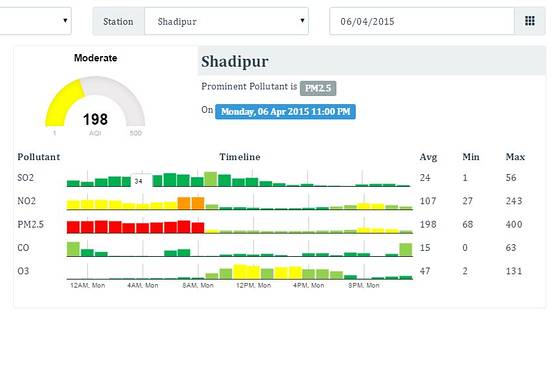
India has launched its first air quality index, to provide real time information about pollution levels.

The index, announced by Prime Minister Narendra Modi, will initially monitor air quality in 10 cities.

Last year the Environmental Preference Index ranked India 174 out of 178 countries for air quality.

The rising and health-endangering pollution has been mainly blamed on a huge increase in vehicles, particularly diesel-driven cars, on Indian roads.

Polluting industries, open burning of refuse and leaves, massive quantities of construction waste and substantial loss of forests have also led to high pollution levels in cities.

A World Health Organization (WHO) survey last year found that 13 of the most polluted 20 cities in the world were in India. The capital, Delhi, was the most polluted city in the world, the survey said.

It is a leading cause of premature death in India, with about 620,000 people dying every year from pollution-related diseases, says the WHO.

On Monday, Mr Modi said India “has to take the lead in guiding the world on thinking of ways to combat climate change”.

“The world thinks India doesn’t care about the environment, we must change that… India has always respected the environment,” he said. He also called on Indians to make changes to their lifestyle to help reduce pollution.

Environment Minister Prakash Javadekar said the air quality index “may prove to be a major impetus to improving air quality in urban areas, as it will improve public awareness in cities to take steps for air pollution mitigation”.

But he did not provide any details on what the government would do to curb air pollution except introducing new rules on disposal of waste from construction work.

The new index will initially cover 10 cities – Delhi, Agra, Kanpur, Lucknow, Varanasi, Faridabad, Ahmedabad, Chennai, Bangalore and Hyderabad – and will be extended to more than 60 cities, reports say.

Details of how the index’s data will be gathered were not immediately clear.

But officials say it will provide “composite and comprehensive” information on the air quality, which will be displayed publicly and uploaded on the internet. The public can then know whether it would be safer to stay indoors or to refrain from strenuous activity outdoors.

Environmental groups have welcomed the move.

“Right now, there are around 247 Indian cities that have some air-quality monitoring mechanisms and, of that, at least 16 have online real-time monitoring capabilities,” Anumita Roychowdhury of Delhi-based Centre for Science and Environment (CSE) told Mint newspaper.

“But the good part is the government for the first time is making a serious effort to tell people about the daily quality of their air, which people can understand in a simple way.”

China has also announced a “war on air pollution”, and recently began publishing figures for the air quality in its cities.


via India launches air quality index to give pollution information – BBC News.

Posted in Air Quality, Asia, India | Tagged , , , , , , , , , , , , | Leave a comment

Call for action on pollution as emissions linked to respiratory illnesses double

Study shows over the past five years industry doubled its emissions of a type of fine particle called PM10, linked to asthma and bronchitis

Environment and health groups have called for a rapid crackdown on air pollution after a new analysis showed that emissions of a key pollutant linked to respiratory illness have doubled over the past five years.

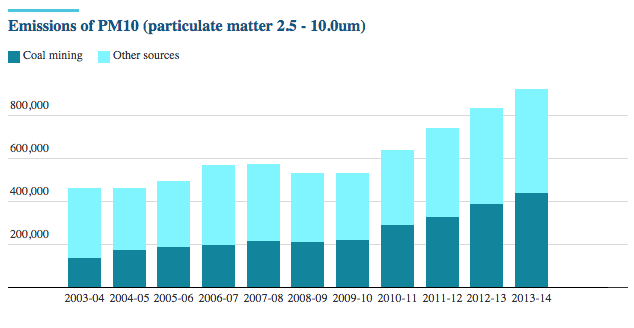
A study of the federal government’s annual national pollutant inventory, which was released this week, showed that 435,000 tonnes of a type of fine particle called PM10, named because it is just 10 micrometres in diameter, was emitted by coal companies in 2012-13.

Screen Shot 2015-04-02 at 08.56.23

This level of pollution represents a doubling in PM10 emissions in the past five years, according to Environmental Justice Australia, which compiled the comparative figures. The inventory covers dozens of pollutants emitted by more than 4,300 heavy industry facilities across Australia.

The 10 highest emitting mines increased their PM10 output by between 48% and 1,030% over the past five years, with hotspots including the Latrobe Valley in Victoria, where PM10 levels increased by 27% over five years, and the Hunter Valley in New South Wales.

The increase in PM10, which Environmental Justice Australia puts down to an increase in mining activity, was accompanied by increases in lead, arsenic and fluoride emissions over the past five years.

via Call for action on pollution as emissions linked to respiratory illnesses double | Environment | The Guardian.

Posted in Air Quality, Australia & Oceania | Tagged , , , , | Leave a comment

Air pollution: We haven’t seen the stars in a while

The chief minister of what is today the most polluted city in the world suffers from a notorious asthmatic cough. While Arvind Kejriwal’s cough is widely discussed, what is not, and what should be, is the cause of his chronic ailment.

The data suggests that Delhi’s air has been 45% more polluted than that of Beijing for the past few years. Today, air pollution is one of the leading causes of deaths in India.

A study released last month by Michael Greenstone, an economist at the University of Chicago, revealed disturbing numbers — the 660 million people who live in India’s most polluted cities will lose an average of 3.2 years of life because of toxic air; put together, that is 2.1 billion lost years because of India’s pollution problem.

Over the last four decades, air pollution, degraded lands, depleted forests and declining biodiversity have cut agricultural yields in India by almost half. According to the World Bank, each year environmental degradation costs India $80 billion, or 5.7% of GDP.

Air pollution is an invisible problem and did not even figure on the election manifesto of any political party during the recently concluded Delhi elections. That, when the leader of the ruling party himself so acutely, and visibly, suffers from the symptoms of the problem.

As India embarks on its ambitious mission to transform itself into a global manufacturing hub, we must remember what a wise man once said: “The  foes that are unseen are often stronger than those that are seen.” Take the example of Vapi, an industrial city in Gujarat — today it is the most polluted city in the world due to industrial and chemical waste. The scary question then arises — is Vapi the future of the industrialised Indian city?

Many economies have gone through severe pollution and then effectively taken systematic steps to fix the damage, including parts of Europe after the industrial revolution, Japan after World War II and, most recently China as it strove to become the manufacturing hub of the world. India’s late entry into the manufacturing sector in some ways can be seen as a blessing in disguise for we can learn from the mistakes of those who walked before us.

So what can India do to solve her suffocating problem?

India needs to focus on making her fast-growing cities green. Building reliable public transportation systems and introducing mandatory vehicular fuel efficiency standards are two important steps toward reducing toxic air.

Currently, India has one of the worst emission standards for power plants in the world. Shockingly, the country does not even have emission standards for hazardous pollutants like mercury, nitrogen oxide and sulphur dioxide. India needs to set firm targets to reduce emissions. Reducing hazardous particulate matter by 30% would cut average annual GDP growth by 0.04%, but it would also cut CO2 emissions by 30-60% and save $47–105 billion from reduced damage to human health.

The Supreme Court has played a key role in reining in air pollution. For example, mandating the use of compressed natural gas in public-service vehicles in Delhi, or taking vehicles older than 10 years off the road, have led to an improvement in air quality. The court must persevere as the national watchdog of pollution.

I haven’t seen a starry sky in any major Tier 1 or Tier 2 city in the past few years. The harsh reality is India’s problems are likely to get worse before they get better. But even the stars can’t shine without some darkness, so we must focus on correcting the problem while we can, and before it gets too late.

via Air pollution: We haven’t seen the stars in a while.

Posted in Air Quality, Asia, India | Tagged , , | 1 Comment

Air pollution may be tied to anxiety

Women who live in areas with higher air pollution may also have higher anxiety, according to a new analysis.

“It’s a really interesting finding and definitely suggests that air pollution may be related to mental health,” said lead author Melinda C. Power of Johns Hopkins University in Baltimore.

“If this is truly causal this is going to have a huge effect on the population because everyone is exposed, but we need more research to build this body of evidence,” Power added.

The researchers used data on more than 70,000 women in the Nurses’ Health Study who filled out an eight-question anxiety survey between ages 57 and 85.

Overall, about 15 percent of the women had high anxiety symptoms.

Using their previous home addresses from before they filled out the anxiety questionnaire, the researchers were able to estimate the women’s exposure to so-called particulate matter in the air during the past 15 years, based on factors like distance to major roadways, population density, local sources of emissions and wind speeds.

The researchers found no link between anxiety levels and large air pollution particles, but exposure to fine particles was tied to increasing anxiety levels, according to results in BMJ. The more recent the exposure, the higher the level of anxiety tended to be.

For example, women who were exposed to the most small particles in the air one month before their anxiety test were about 12 percent more likely to have high anxiety symptoms, compared to those estimated to be exposed to the least particles one month previously.

Fine particulates come from combustion sources, including cars and power plants, Power told Reuters Health by phone. The smaller the particle, the deeper it may travel into the lungs.

“Our study can only comment on the population level, on average people who were more highly exposed had a higher level of anxiety,” she said. It did not assess distance to pollution sources or the amount of air pollution an individual would need to experience to have increased anxiety.

Since it was an observational study, it does not necessarily indicate that pollution causes anxiety, she said. Women living in more polluted areas may experience other sources of stress that would be linked to anxiety as well.

The authors suspect that fine particulate pollution may be linked to certain subtle conditions, like inflammation, which may increase the risk of anxiety. Further research will need to explore this possibility, and to look for a similar link among men and people of a younger age, Power said.

It is too soon to think about intervening or giving individuals recommendations based on this result, she said.

However, there is substantial evidence that lowering air pollution would improve cardiovascular health and respiratory health and reduce the risk of stroke, she said. Short-term exposure to particulate pollution is tied to an increase in stroke risk according to an analysis of all published research on the subject, which appears in the same issue of BMJ.

The relationship between atmospheric pollution and risk of heart attack and heart failure had already been established, and this new paper, supported by the British Heart Foundation, adds stroke risk to that category, said lead author Dr. Anoop Shah of the University of Edinburgh in the U.K.

There’s not much an individual can do to decrease their exposure to air pollution as it’s ubiquitous, Shah told Reuters Health by phone. But policymakers do have the power to improve public transport systems in urban areas and reduce the number of vehicles on the roads, which are the major source of damaging pollution, he said.

In fact, as reported by Reuters today, Beijing has introduced measures to limit the number of motorists on heavily polluted days. It’s the latest move by authorities there to battle the choking smog that has blanketed the city in recent years.

via Air pollution may be tied to anxiety | Reuters.

Posted in Air Quality, Health Effects of Air Pollution | Tagged , , | Leave a comment

Kolkata air quality fails safety test

The city has always been polluted but the rate at which its level is increasing has turned menacing. A series of tests of ambient air quality at five crossings — carried out by TOI in association with Saviors and Friends of Environment (SAFE) last week — has found some startling facts. It calls for greater monitoring and stringent enforcement against polluting vehicles.

Fine particulates and nitrogen oxides dominate the list of major pollutants in the city air. The annual average of PM10 — fine particulate matter that invades the lungs and triggers respiratory diseases and cancer — has been around 1.5 times, or even more, the national limit. The annual average of nitrogen oxides is also above the limit, test results revealed.

“The particulate pollution in winter is generally twice or even higher than the national standard. But we are getting the same reading in spring, when the pollution level goes down due to weather conditions. This is something to worry about. It shows the vehicular pollution goes rather unchecked,” said Sudipta Bhattacharya, an environmentalist and head of SAFE.

Even more dangerous is the presence of finer particulates PM2.5 that constitutes around 75% of the total respirable particulate matter in the air. “Though we have not measured it, the high level of PM10 also indicates high level of PM2.5. The PM2.5 count by the American Consulate also shows the alarming state of the ambient air,” he added.

But monitoring of ambient air has got a beating with the number of air quality monitoring stations declining from 17 to 11. Of these, only two automated stations — at Victoria Memorial Hall and Rabindra Bharati University — take readings 24×7. The other nine manual stations at Ultadanga, Moulali, Baishnabghata, Salt Lake, Minto Park, Paribesh Bhawan, Dunlop Bridge, Shyambazar and Behala Chowrasta are operated only twice a week.

“Despite a court order directing all air quality monitoring stations be in operation, the pollution board continues to keep most of the stations shut for a major part of the week. Moreover, with numbers being reduced, fewer parts of the city’s air is being monitored. With no data, there is no warning to citizens who are breathing the toxic fumes,” said legal activist Subhas Datta, whose petition on air pollution led to the court directive.

PCB chairman Kalyan Rudra acknowledges the need for more monitoring stations to cover a larger section of the city but points to two eternal hurdles: manpower and funds. “We are trying to get around the stumbling blocks and widen coverage,” he said. In fact, SAFE readings echo the central pollution control board study which finds greater Kolkata as the topper in nitrogen-oxide pollution. On certain days, the presence of these pollutants spikes twice, putting the air we breathe in the category of “extremely critical”.

A closer scrutiny of the study revealed that pollution level becomes quite unbearable where the Metro corridor is being constructed. In Ruby and Behala Chowrasta, where an elevated Metro corridor is under construction, the level of particulate matter is quite high. Particularly at Behala Chowrasta, the particulate matter is 3.5 times the national standard.

via Kolkata air quality fails safety test – The Times of India.

Posted in Air Quality, Asia, India | Tagged , , , , , | Leave a comment

Beijing introduces new air pollution response

Beijing introduced new rules to deal with air pollution on Monday.

According to the city’s environmental protection bureau, the new heavy air pollution emergency response program will replace the current version, launched on Oct. 2013.

Four-tier alerts–blue, yellow, orange and red–will be issued on “heavy pollution” days. Red alert, the highest, will be issued for heavy pollution that is expected to last more than three days. An air quality index of over 200 is defined as “heavy pollution”.

Orange and red alerts will be issued 24 hours before the heavy pollution days, according to Yao Hui, deputy head of the bureau.

Drivers with odd and even license plates will be allowed on alternating days during red alerts.

Heavy vehicles including construction vehicles will be banned from the roads during orange or red alerts.

When an orange alert is issued, all the industrial factories will be closed except those necessary to maintain the operation of the city. Construction sites will be shut down.

In 2014, Beijing issued blue alert 11 times, yellow alert five times, and orange alerts twice.

via Beijing introduces new air pollution response – CCTV News – CCTV.com English.

Posted in Air Quality, Asia, China | Tagged , , | 1 Comment

Luxembourg and Lisbon prop up air pollution list

Luxembourg and Lisbon have come last in a ranking of European cities, which rates efforts to fight air pollution caused by transport.

Zurich topped the Sootfree Cities ranking, which grades the efforts of 23 cities in 16 countries to improve air quality. Copenhagen was the runner-up.

Berlin was the winner in 2011, the last time the ranking was published by the European Environmental Bureau and Friends of the Earth Germany. It slipped to fifth this year. London and Paris were equal, at sixth place.

There are 400,000 premature deaths in the EU every year because of air pollution, which kills ten times more people than road accidents. Swiss air quality standards are far stricter then those in the EU.

The report showed progress in cutting back dangerous PM10 (Fine Dust) particles and nitrogenic oxide concentrations in the air.

“Although 90% of Europeans living in cities today are still breathing unhealthy air, Copenhagen, Stockholm, Vienna (and) Berlin have either met, or are due to meet, the EU limit values within the next two years,” Arne Fellermann, transport policy officer at Friends of the Earth Germany, said.

Researchers concentrated on measures put in place over the last five years and looked at air quality plans for the next five. They looked at categories such as the promotion of sustainable transport, traffic management, public procurement and other parts of the policy mix.

EU level

Cities across Europe were fighting air pollution because of the EU’s air quality standards, said Fellermann, but there was not enough action at EU level.

Louise Duprez, senior policy officer for Air Pollution at the European Environmental Bureau said,  “Cities can do a lot to improve air quality, but they are left exposed to some pollution they can’t control. This includes pollution which comes from outside the city, like emissions from agriculture or industry.”

The EU’s overall air pollution limits for 2020, 2025 and 2030 needed to be tightened, the campaigners said. That would cut long-distance pollution, which cities are helpless to deal with.

The limits, part of the National Emissions Ceilings Directive, are currently being discussed by policymakers. Members of the European Parliament will debate the limits ahead of a vote in mid-July.

Other legislation should reflect the emissions of road vehicles under real driving conditions and introduce strict norms that limit emissions from construction machinery, according to the NGOs.

Cutting cars

Zurich and Copenhagen had substantially reduced the number of cars in their cities. Restrictions on highly-polluting vehicles and construction machines were introduced.

Cleaner forms of transport, such as cycling and walking, were pushed by city policymakers, the report by European Environmental Bureau and Friends of the Earth Germany, said.

But Luxembourg was a “highly car centric city with a staggeringly high shares of 72.5% car or motorcycle use.”

It had not introduced any low emission zones or a congestion charge, despite an OECD recommendation to do so.

Lisbon has high pollution levels consistently above EU limit values.  Although it introduced a low emission zone, there was virtually no enforcement until 2014.

Watch this video about levels of air pollution in Brussels’ EU quarter. Brussels was ranked 14 on the list.

via Luxembourg and Lisbon prop up air pollution list | EurActiv.

Posted in Air Quality, Europe, France, UK | Tagged , , , , , , , , , | Leave a comment

Spike In California Air Pollution Brings Reminder Of Bad Old Days

The brown haze over California’s San Joaquin Valley breadbasket on some winter days has been an unwelcome reminder of the bad old days, when pollution hung so thickly that people were warned to stay inside.

Years of tight environmental rules improved California air quality so much that the state has not issued a smog alert in a dozen years. But prolonged drought and warmer temperatures have triggered a spike in the number of winter days thick with soot and dirt, while summer days have been marred by smog.

“It’s shocking sometimes to see the valley on a bad day,” said Mike Kleeman, a professor at the University of California, Davis, who studies air quality.

The uptick in pollution over California’s cities and farms is not enough to undo decades of environmental progress against smog, which is characterized by high levels of ozone in the atmosphere caused by an interaction of heat with pollutants.

But Karen Magliano, chief of the state’s Air Quality Planning and Sciences Division, said it has caused California to miss a key federal deadline for improving the air in the San Joaquin Valley, and could lead the state to tighten rules on emissions from cars, trucks, factories and even backyard barbecues.

“We’re tracking it very closely,” Magliano said.

Last summer, California was out of compliance with federal ozone rules for 99 days in the San Joaquin Valley, up from 89 the year before. Sooty particulates, which cause brown haze in the late fall and winter, were up throughout the state last winter.

Rain helped ameliorate the problem of particulates this past winter, but the storms, though intense, have been relatively few.

For December 2014-February 2015, the South Coast Air Quality Management District, which covers Los Angeles, reported 24 days that failed to meet federal pollution rules. That was up from 19 days during the same three months in 2013-2014, and 16 in 2012-2013, state figures show.

To be sure, California air remains much cleaner today than in 1975, when authorities issued 120 Stage 1 smog alerts that warned the elderly and young children they might have trouble breathing, and urged people with heart and respiratory problems to stay inside.

The state’s last Stage 1 alert was issued in 2003, and California has not had a stage 3 alert – the worst – since 1974.

“We are continuing to make progress but we are going to continue to have bad years when the weather is unfavorable for us,” said Kleeman. “What last winter showed is that we’re still vulnerable to those events.”

Smog has been a problem in California since at least 1943, when residents of Los Angeles sometimes could not see for more than three blocks and suffered burning eyes.

The haze was first blamed on a chemical factory. But the problem did not diminish when the plant was shuttered, and scientists later realized the bad air was caused by a combination of geography, weather and emissions from factories and a burgeoning number of cars.

California enacted its first air quality standards in 1959 and decades of restrictions on emissions meant the state led the nation in cleaning its air.

via Spike In California Air Pollution Brings Reminder Of Bad Old Days.

Posted in Air Quality, USA & Canada | Tagged , , , | Leave a comment