Review: Return Of The Smog

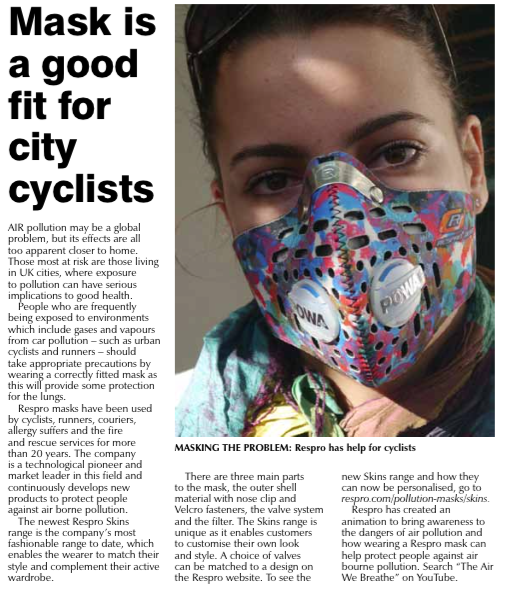
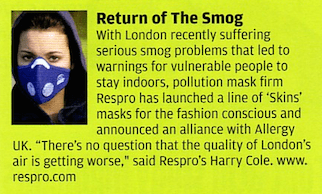
Screen Shot 2015-02-02 at 13.23.55With London recently suffering serious smog problems that led to warnings for vulnerable people  to stay indoors, pollution mask firm Respro® has launched a line of ‘Skins™’ masks for the fashion conscious and announced an alliance with Allergy UK™. “There’s no question that the quality of London’s air is getting worse.” said Respro’s Harry Cole. respro.com

via www.naturalhealthcareinthecommunity.co.uk

Posted in Respro® Mask Reviews | Tagged , | Leave a comment

Bristol City Council given £30,000 to improve air quality

Thousands of pounds are to be spent in Bristol in a bid to improve air quality.

The government has given the council £30,000 to monitor the movements of heavy goods vehicles in the city.

The research will look at the frequency of deliveries to shops and the current methods used.

Labour’s Mark Bradshaw, Bedminster councillor and assistant mayor, admitted the “rising issue” of air pollution was a “challenge”.

“We’re committed to working with the business community. This is not about imposing any solutions,” he added.

“We’ve really got to understand what businesses need to make them thrive, for them to serve their customers and their clients.

“But equally we have a responsibility as a city to look at every measure that we can take to reduce air pollution.

“Recent studies have shown that diesel vehicles are a major contributor.”

Last April, the government estimated there were 29,000 deaths annually in the UK from air pollution.

via BBC News – Bristol City Council given £30,000 to improve air quality.

Posted in Air Quality, Europe, London, UK | Tagged , , | Leave a comment

Boris launches ‘Breathe Better Together’ campaign to tackle air pollution

London mayor Boris Johnson has launched a new air quality campaign called ‘Breathe Better Together’. Over the next months, posters and radio adverts will appear giving advice on how to avoid health problems.

The campaign will include warning parents to choose less polluting routes while they take children to school and asking drivers to turn their engines when their cars are stationary for long periods. Information about pollution levels will also be available online.

This is about promoting small simple steps we can all make to help improve air quality, protect ourselves from pollutants and indeed breathe better together.

– BORIS JOHNSON, MAYOR OF LONDON

But the campaign has been heavily criticised by his opponents on the London Assembly who think the Mayor should have done more with his plan to introduce an Ultra-Low Emissions Zone.

Today’s air quality campaign launch is over a year later than promised and amounts to one phrase on repeat – “Hold Your Breath!” Whilst this is a step forward making Londoners able to be better informed about when smog incidents occur, it’s frankly hypocritical for the Mayor to launch a campaign telling Londoners to avoid polluted streets whilst simultaneously watering down measures to tackle the problem in his own Ultra-Low Emissions Zone.

– MURAD QURESHI, LABOUR, LONDON ASSEMBLY

The Breath Better campaign is really disappointing and inadequate compared to the scale of London’s air pollution challenge. It appears to be about advising the victims of air pollution rather than the polluters. The Mayor’s small, simple steps fail to properly include action to be taken by drivers who cause the pollution in the first place.

via Boris launches ‘Breathe Better Together’ campaign to tackle air pollution | London – ITV News.

Posted in Air Quality, Europe, London, UK | Tagged , , , , , | Leave a comment

Watch Asia’s air pollution spread across the globe

One problem with air pollution is it doesn’t stay put.

Rather, particles in the air—also known as aerosols—move around the atmosphere, affecting the global climate in complex ways, and perhaps strengthening storms and cyclones.

Here’s a video produced by NASA’s Goddard Space Flight Center using data detected by the Earth Observing System, that shows those aerosol movements from September 2006 to April 2007:

Due to rapid development, air pollution in many places is worse today than ever before. Scientists at NASA’s Jet Propulsion Laboratory are trying to figure out what effect that increased aerosol pollution has on the rest of the world. Since most of the countries with the worst air pollution are in Asia, they focused on Asian pollution.
The scientists, Jonathan Jiang and Yuan Wang, made two models of global aerosol movement: one that assumed aerosol levels before the Industrial Revolution, and one with current levels.
They found that the current pollution patterns, such as heavy pollution from China, lead to stronger cyclones outside of tropical regions. That’s because when storms form across the Pacific, more water condenses onto the increased aerosols. This condensation releases energy, making the storms even more powerful.

via Watch Asia’s air pollution spread across the globe – Quartz.

Posted in Air Quality, Asia | Tagged , , | Leave a comment

Centre wants to restrict car use as air pollution hits worrying levels

With air pollution rising to alarming levels, especially in the National capital, the Environment Ministry has urged the Supreme Court to ask the Delhi government to consider drastic steps, which includes the plying of private cars only on alternate days and a complete ban on “visible” smoke-emitting vehicles.

Other suggestions made by the ministry were making public transport free, and making the wearing of masks compulsory on highly polluted days.

These suggestions were made in an affidavit filed before the court, which is monitoring various measures being taken to reduce pollution.

“All these are crucial aspects in which the views of government of Delhi and Health Ministry may be sought”, the ministry told the court.

The report said the major source of air pollution in the Capital is dust particles and not vehicular emissions.

“Road dust emerged as the most prominent source with contribution in the range of 14.5 per cent to 29 per cent, whereas the contribution of vehicles was in the range of 8.7 per cent to 20.5 per cent,” it said.

The affidavit came in response to various suggestions mooted by the Central Pollution Control Board and the Environment pollution (Prevention and Control) Authority in a report submitted to the Apex court in November.

The panels said pollution was the fifth-biggest killer in India after high blood pressure, indoor air pollution from cooking fuels, tobacco smoking and poor nutrition.

As per the EPCA report, residents of Delhi and Ghaziabad in Uttar Pradesh have more reasons to worry as the two are among the five critically polluted cities.

Other measures suggested also include the closure of all schools and a ban on plying of private cars (only public transport to be allowed), and complete prohibition on the entry of commercial vehicles on days air pollution is very severe and toxic for human health.

via Centre wants to restrict car use as air pollution hits worrying levels | Daily Mail Online.

Posted in Air Quality, Asia, India | Tagged , , | Leave a comment

What Delhi’s air pollution says about India and climate change

The thick winter haze that settles over Delhi – a nasty mix of smog, vehicle exhaust and smoke from cooking fires – abated somewhat when President Obama arrived in India this week for talks. A bit of rain came and cleared the air. Even so, the air quality index hovered around 200 when the president arrived at the viewing stand to watch India’s Republic Day Parade on Monday. That’s approaching what’s deemed a “very unhealthy” level of the microscopic 2.5 particulate matter, which causes respiratory disease and other ailments.

The Americans were prepared. Delhi police had kept traffic to a minimum around the parade route, and the Embassy ordered 1,800 Swedish air purifiers in the weeks preceding the American delegations’ arrival. (It’s not clear whether any of those air filters actually made it into Obama’s specialbullet-proof parade enclosure, as the Indian media had reported.)

Bloomberg published a story Monday titled “Mr. President, World’s Worst Air is Taking 6 Hours Off Your Life,” which argued that Delhi’s toxic air was so harmful that it could shorten the president’s longevity.

“I think in Delhi, I think particularly at this time of the year, the air quality deteriorates,” John Podesta, counselor to the president, said to reporters in Delhi on Sunday. “But I think we weren’t concerned about bringing the president here for these meetings.”

The air in New Delhi is the worst in the world, according to a World Health Organization report last year. Environmentalists say that efforts to control it – such as a switch to clean-burning natural gas for auto rickshaws – have made little long-term impact as the city has sprawled, eight coal-fired power plants chugged out more power and more than 7 million cars clogged the roads.

The situation is hardly better in in other parts of the country. Earlier this year, a report by a Yale University research team showed that India ranked 174th of 178 countries in air quality, somewhere close to China and Pakistan.

On Sunday, the president and Prime Minister Narendra Modi announced that the two countries would work to battle pollution in India’s cities by implementing the Environmental Protection Agency’s international air quality forecasting system AIRNow. It’s part of an overall climate deal that includes a pledge for “concrete progress” on a pact to phase out a class of widely used refrigerants called hydrofluorocarbons, and support for solar energy initiatives to help India reach its goal of expanding its solar energy capacity to 100 gigawatts by 2022, an amount equal to the energy of about 100 nuclear power plants.

Administration officials acknowledged that Modi-Obama did not produce a breakthrough like the deal with China on emissions last fall. But they said that it represented significant progress from a still-developing country that has long balked at agreeing to significant curbs on its emissions.

They say the rapport that seemed to develop between Obama and Modi during this trip – Modi served Obama’s tea, and Obama kidded him about being attacked by a crocodile – may go a long way in helping the United States achieve a strong a global climate agreement in Paris with India’s help later this year.

“This signals that India sees the Paris agreement as a priority, and establishes a direct channel that could prove absolutely essential to delivering the final deal,” said Elliot Diringer, vice president of the Center for Climate and Energy Solutions, a Washington environmental group.

At a meeting with chief executives Monday, Modi called for “global action on renewable energy,” saying the world “should take a lesson from past efforts to tackle hunger and many diseases.”

However, other environmentalists expressed disappointment that the agreement between the two countries did not specifically target carbon emissions, especially as India doubles its coal production to try to  meet unrelenting power needs. India is the third largest emitter of greenhouse gases, behind the United States and China.

Raymond T. Pierrehumbert, a professor of geophysical sciences at the University of Chicago, pointed to Modi’s somewhat short response to a reporter’s question about whether he felt pressured to agree to a China-style climate deal with the United States.

“The sad thing for India is that while in rejecting a China-type deal, Modi said, ‘There is no pressure on us from any country or any person, but there is pressure when we think about the future generations and what kind of world we want to give them,’ ” Pierrehumbert said. “In attempting to provide adequate energy, if India goes with coal to the extent in current plans, Modi will be leaving future generations in India — already one of the hottest populous countries — to suffer under oppressive warming so severe that, according to some projections, mammals (and that includes people) will not be able to survive outdoors,” he said.

via What Delhi’s air pollution says about India and climate change – The Washington Post.

Posted in Air Quality, Asia, India | Tagged , , , | Leave a comment

Study finds deprived communities are hit hardest by air pollution

A new study has found big differences in air pollution across communities in England, with deprived and ethnic minority areas the worst affected.

Air pollution levels are linked to many forms of ill health, including higher risk of respiratory and cardiovascular diseases, especially for more vulnerable groups such as children and the elderly.

Researchers at Imperial College London and the National Institute for Public Health and the Environment in the Netherlands examined data on two types of air pollution: particulate matter (PM10) and nitrogen dioxide (NO2). They compared air pollution exposures for small areas in England and the Netherlands with population characteristics including deprivation, ethnic makeup, and proportions of children and elderly people.

The EU Ambient Air Quality Directive set limits of 40 micrograms per cubic metre (µg/m3) at monitoring stations for both PM10 and NO2 pollution. Concentration averages across all neighbourhoods in England and all but two neighbourhoods in the Netherlands were within this limit for PM10, but 11 per cent of neighbourhoods in England and nine per cent in the Netherlands exceeded the NO2 limit, accounting for an affected population of 5.4 million and 2.7 million respectively.

In England, the most deprived 20 per cent of neighbourhoods had higher air pollution levels than the least deprived neighbourhoods – 1.5 µg/m3 higher PM10 and 4.4 µg/m3 NO2 after adjusting for other factors – but this was not the case in the Netherlands. The biggest differences in air pollution levels according to socioeconomic status were in London.

The worst air pollution levels were seen in ethnically diverse neighbourhoods, defined as those where more than 20 per cent of the population are non-white. Even after allowing for the fact that some of these neighbourhoods are more deprived, in England, this difference was 3.0 µg/m3 for PM10 and 10.1 µg/m3 for NO2. In the Netherlands, differences were lower, with 1.1 µg/m3 higher PM10 and 4.5 µg/m3 NO2.

The findings are published in the journal Environmental Pollution.

The lead researcher, Dr Daniela Fecht from the School of Public Health at Imperial College London, said: “The study highlights the fact that inequalities in exposure to air pollution are mainly an urban problem, suggesting that measures to reduce environmental air pollution inequality should focus on cutting vehicle emissions in deprived urban neighbourhoods.”

The reasons for the associations between ethnic minorities and air pollution are unclear. “England and the Netherlands have a long history of immigration. It’s possible that immigrants settled in particular areas may tolerate poorer air quality for the benefits of living close to friends and family, even when their communities become less deprived,” said Dr Fecht.

The study used data from 2001, which was the most recent year for which high resolution data were available for both countries. “Pockets of deprivation tend to be quite stable, and air pollution levels haven’t fallen dramatically in this time, so it’s likely that the relationships we observed are still present,” said Dr Fecht.

The work relating to England was undertaken by staff working at the UK Small Area Health Statistics Unit (SAHSU) at Imperial College London. SAHSU is part of the MRC-PHE Centre for Environment and Health, which is funded by the Medical Research Council and Public Health England.

Ongoing work at the MRC-PHE Centre for Environment and Health will examine differences in exposure to traffic pollution by deprivation and ethnicity using more recent air pollution data in London.

via Study finds deprived communities are hit hardest by air pollution > Trends > Research | Click Green.

Posted in Air Quality, Europe, London, UK | Tagged , , , , | Leave a comment

Why is Air Pollution in London’s Oxford Street so Bad?

London

One of the busiest roads in the City of Westminster and an ever-popular destination for shoppers and tourists alike, London’s Oxford Street has breached its legal limit for air pollution per annum in just the first four days of this year. Clean Air in London – a London action group campaigning to achieve full compliance with World Health Organisation (WHO) air quality guidelines as sustainably as possible, has reported that the levels of nitrogen oxide (NO2) surpassed the legal limit set by the EU by January 4 this year. Founder of Clean Air in London, Simon Birkett told The Independent that NO2 levels must not exceed 200 micrograms per cubic metre for more than 18 hours in an entire year in compliance with the EU and UK regulations.

Why has Oxford Street already exceeded its air pollution limit?

Since announcing the Ultra-Low Emission Zone (ULEZ) two years ago – a zone where almost all the vehicles running during working hours are either zero or low emission, Simon Birkett believes that Mayor of London, Boris Johnson has taken a number of backward steps. Simon Birkett said: “The gap between what the Mayor says and what he needs to do and actually does has never been wider. “Meanwhile, concerns about air pollution, particularly NO2 and diesel exhaust, have risen exponentially. Leading scientists say that many roads in central London will tend to have the highest NO2 concentrations in the world.”

Simon Birkett and Clean Air in London are calling for a ban on diesel in the most polluted areas of London by 2020, saying that the Mayor’s ‘love affair’ with diesel must come to an end. How have City Hall responded? City Hall claims that the Mayor is driving the most “ambitious and comprehensive package of measures in the world” in order to improve the air quality in London. A Mayor of London spokesperson said: “At the heart of his plans is the world’s first Ultra Low Emission Zone in central London from 2020, and already, progress is being made.

The oldest and most polluting vehicles have been taken off the streets, and around Oxford Street alone, the Mayor’s measures have reduced emissions by a third in two years. “Unlike many cities, London has met EU rules on particulate matter. The number of Londoners living in areas above NO2 limits has halved since 2008. Under this Mayoralty, emissions of NOx (nitrogen oxides) are down by 20 per cent and PM10 by 15 per cent. Furthermore, the Mayor has set out how, with government and EU support, London can meet targets for nitrogen dioxide (NO2) emissions by 2020, ten years ahead of government predictions.”

Step Back in Time

The effects of air pollution have been a concern for city dwellers since the thirteenth and fourteenth centuries. In 1273, the use of coal was prohibited, then in 1306 a law was passed to stop the use of certain types of coal due to complaints about air quality in London.

via Why is Air Pollution in London’s Oxford Street so Bad? – Jan 24 2015 08:00 AM – Breaking News – Pollution Solutions Online.

Posted in Air Quality, Europe, London, UK | Tagged , , , , , , , , | Leave a comment