Top 20 most polluted cities in the world

Air quality in most cities that monitor their pollution levels exceed what the World Health Organization deems as safe.

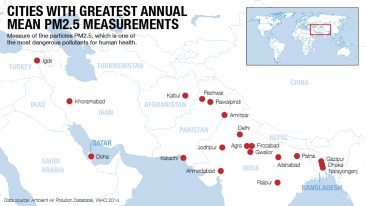
Delhi has the highest level of the airborne particulate matter, PM2.5 considered most harmful to health, with 153 micrograms. Not far behind is another Indian city, Patna with 149 micrograms. These figures are six times what the WHO considers a “safe” limit — which is 25 micrograms.

Half of the top 20 cities in the world with the highest levels of PM2.5 were in India, according to the pollution data released by the WHO, which included 1,600 cities. Other cities with high levels were located in Pakistan and Bangladesh.

PM2.5 refers to the diameter measured in microns of particulates such as ammonia, carbon, nitrates and sulfate — which are small enough to pass into the bloodstream and cause diseases such as emphysema and cancer.

The WHO data echoes an earlier study this year which found that air pollution in New Delhi is now worse than Beijing.

No Chinese cities ranked in the top 20 most polluted cities, despite thick, gray smog filling its cities and millions of residents commuting behind surgical masks. Beijing reported 56 micrograms of PM2.5. This year, Chinese leaders have declared “war on pollution.”

Beijing’s emergency measures amid fog of pollution

Delhi has been described as having weak enforcement of pollution controls by India’s Center for Science and Environment, a public interest group.

“Originally designed as compact entities to reduce the length of travel … (Indian cities) are becoming victims of killer pollution, congestion … and a crippling car-dependent infrastructure,” according to the group.

And the world’s most polluted city is…

Air pollution has spread by increasing reliance on fossil fuels, coal-fired power plants, cars and the use of biomass for cooking and heating.

Cities with the lowest level of pollution were located in Canada, the United States, Finland, Iceland and Sweden.

via Top 20 most polluted cities in the world – CNN.com.

Posted in Africa, Air Quality, Asia, Australia & Oceania, China, Europe, India, Japan, Latin America, London, Middle East, UK, USA & Canada, World News | Tagged , , , , , , , , , | Leave a comment

Walk away from kerb to avoid fumes in London, adviser urges

Londoners should keep away from the kerb as they walk along  busy roads to avoid traffic-polluted air blamed for thousands of premature deaths, a  Government adviser urged today.

Dr Iarla Kilbane-Dawe said air pollution levels can be a third lower on the inside of the pavement on roads such as Putney High Street, in south-west  London, compared to the kerbside.

He also recommended that drivers keep the air vents in their car closed when they are in heavy traffic to keep out fumes. “It’s really important people understand the simple things they can do to protect themselves from air  pollution,” said Dr Kilbane-Dawe, who led a study for the Department for the Environment on communicating the public health risks from it.

“Walking or cycling along quiet rather than busy roads can reduce your  exposure by half or even more,  especially if you avoid pollution hotspots at the busiest junctions.

“Even walking further from the kerb on a busy road has been shown to make a difference.”

He added: “Studies repeatedly show that drivers and passengers in vehicles are exposed to the highest levels of pollution in the middle of the road.

“Professional drivers are likely to be exposed the most, but keeping air vents closed in busy traffic could help reduce exposure.”

A recent report estimated nearly 3,000 Londoners are dying prematurely every  year due to polluted air.

Further studies  by Dr Kilbane-Dawe showed that in a string of London  boroughs long-term exposure to  particulate pollution — an airborne mixture of diesel soot, brake dust and tyre fragments — is the fifth biggest killer after causes such as cancer and  cardiovascular diseases.

These boroughs include Kensington & Chelsea but also several in outer London such as Bromley, Barnet,  Bexley, Havering, Sutton and  Richmond. In many boroughs, the particulate pollution mortality rate is double that for people killed or  seriously injured in traffic accidents.

Mayor Boris Johnson insists he is “militant” on improving the city’s air.

The Green Party said Londoners overwhelmingly back demands to clean up the city’s “dangerously dirty” air.

Launching their campaign for the local and European elections, MEP Jean Lambert unveiled a poll showing 73 per cent support tougher enforcement of emission limits in the capital.

But only 43 per cent of Londoners support more 20mph zones.

“When people hear about our worked-through policies – cleaning up our dangerously dirty air, turning the minimum wage into a living wage and providing more affordable housing for Londoners – they vote Green,” claimed Ms Lambert.

via Walk away from kerb to avoid fumes in London, adviser urges – London – News – London Evening Standard.

Posted in Air Quality, Europe, London, UK | Tagged , | Leave a comment

India admits Delhi matches Beijing for air pollution threatening public health

India’s state air monitoring centre has admitted that pollution in Delhi is comparable to that of Beijing, but disputed a World Health Organisation (WHO) finding that the Indian capital had the dirtiest atmosphere in the world.

A study of 1,600 cities across 91 countries released on Wednesday by the WHO showed Delhi had the world’s highest annual average concentration of small airborne particles (known as PM2.5) of 153.

These extremely fine particles of less than 2.5 micrometres in diameter are linked with increased rates of chronic bronchitis, lung cancer and heart disease as they penetrate deep into the lungs and can pass into the bloodstream.

Indian officials in the past have bristled at research showing the capital as being worse than Beijing where thick smog has triggered public health warnings and public concern that are mostly absent in Delhi.

“If we compare yearly averages for each year from 2011-2014 then both cities [Delhi and Beijing] are almost comparable,” Gufran Beig from India’s state-run System of Air Quality Weather Forecasting and Research (SAFAR) acknowledged in an email sent to AFP.

He disputed the figure cited by the WHO for PM2.5 in Delhi, however, saying it should have been in the range of 110-120 micrograms per cubic metre instead of 153.

Beijing’s was underestimated at 56, he said, and should have been double this, according to an analysis of readings given out by the US embassy in the city.

“Delhi’s air quality is better than Beijing in summer and much better in monsoon season,” he added. “It is winter pollution in Delhi and sudden spikes – which is quite high as compared to Beijing – triggered by meteorology.”

Beig maintained that the WHO figures contained in a searchable database released on Wednesday were biased and misleading.

But even with an annual average PM2.5 reading of 110-120, Delhi would still be among the world’s most polluted cities, if not the outright worst.

Rivals would be the Pakistani city of Karachi with an annual reading of 117, while the regional Indian cities of Gwalior, Patna and Raipur reported 144, 149 and 134 respectively.

By comparison, London had an annual PM2.5 reading of 16.

“The latest urban air-quality database released by the World Health Organisation reconfirms that most Indian cities are becoming death traps because of very high air pollution levels,” said an Indian campaign group, the Centre for Science and Environment.

The centre said that 13 of the 20 most polluted cities in the world were in India.

The small particles blighting the air of Delhi and other leading developing cities around the world are often dust from construction sites, pollution from diesel engines or industrial emissions.

The Indian capital also suffers from atmospheric dust blown in from the deserts of the western state of Rajasthan, as well as pollution from open fires lit by the urban poor to keep warm in winter or to cook food.

While Delhi ranked as worst on the PM2.5 scale in the WTO data, measurements of larger PM10 particles showed others as far more polluted.

Peshawar and Rawalpindi in neighbouring Pakistan trumped all other cities with readings of 540 and 448 respectively. WHO says concentrations of PM10 particles should remain below 20 micrograms per cubic metre, averaged out over the year.

Delhi has had its air quality under scrutiny for some time now with research by Yale University scientists in January this year also suggesting that it was worse than Beijing.

A World Bank report last year that surveyed 132 countries ranked India 126th for environmental performance and worst for air pollution.

The WHO stressed that its new air pollution database, which relies mainly on data gathered by the cities themselves, did not aim to rank cities, pointing out that “some of the worst ones … are not collecting data regularly.”

via India admits Delhi matches Beijing for air pollution threatening public health | Environment | theguardian.com.

Posted in Air Quality, Asia, India | Tagged , , , , , , , , , | Leave a comment

New Delhi has most polluted air in the world: WHO

An effort by the World Health Organization (WHO) to measure pollution in cities around the world has found New Delhi, India admits to having the dirtiest air, while Beijing’s measurements, like its skies, are far from clear.

The study of 1,600 cities found air pollution had worsened since a smaller survey in 2011, especially in poorer countries, putting city-dwellers at higher risk of cancer, stroke and heart disease.

Air pollution killed about 7 million people in 2012, making it the world’s single biggest environmental health risk, the WHO, a United Nations agency, said last month.

Thirteen of the dirtiest 20 cities were Indian, with New Delhi, Patna, Gwalior and Raipur in the top four spots. New Delhi had an annual average of 153 micrograms of small particulates, known as PM2.5, per cubic metre.

Beijing, notorious for the smog that has prompted some Anglophone residents to dub it “Greyjing”, was in 77th place with a PM2.5 reading of 56, little over one-third of Delhi’s pollution level.

WHO experts said the Chinese data was from 2010, the most recent year made available to them by China. But Beijing’s city government began publishing hourly PM2.5 data in January 2012.

A year after it started publishing data, Beijing’s air quality hit the “worst on record” according to Greenpeace, with a PM2.5 reading as high as 900 on one occasion.

Beijing’s government said last month that PM2.5 concentrations stood at a daily average of 89.5 micrograms per cubic metre in 2013, 156% higher than national standards. Such a reading would put Beijing 17th in the WHO database. The WHO says there is no safe level for PM2.5 pollution.

At the cleaner end of the table, 32 cities reported a PM2.5 reading of less than 5. Three-quarters of those were Canadian, including Vancouver, one was Hafnarfjordur in Iceland and the other seven were American.

WHO experts insisted the survey was not intended to name and shame the dirtiest cities, since the cities involved were volunteering the information to try to help themselves clean up.

Maria Neira, WHO Director for Public Health, Environmental and Social Determinants of Health, said the aim was to “challenge” cities and thought the survey would help them to become more open about their dirty air, which is often caused by burning coal, smokestack industries and heavy traffic.

She rejected any suggestion that China might be cheating and said it was becoming much more sophisticated about collecting air pollution data, with a new push to clean up the big cities.

“We are very much discussing with China putting on the table the issue of air pollution. Our director general (Margaret Chan) was recently there and she declared that China was one of the countries with major problems with air pollution. We will continue discussions on that to make sure that relevant measures are in place to reduce air pollution.”

via New Delhi has most polluted air in the world: WHO – Livemint.

Posted in Air Quality, Asia, India, World News | Tagged , , , , , , , | Leave a comment

WHO names and shames UK cities breaching safe air pollution levels

British towns and cities have been named and shamed by the World Health Organisation for breaching safety levels for air pollution.

Nine urban areas in the UK have been named by the global health body for breaching safe health levels of air quality.

WHO said that across the world most cities that measure outdoor air pollution are failing to meet its guidance for safe levels and are putting residents at risk of respiratory disease and other health problems. Overall, only 12% of the people living in cities reporting on air quality reside in places which comply with WHO’s safety levels.

A spokesman said that it appears that air pollution is “getting worse”.

WHO’s air quality database monitors 1,600 regions around the world, including 36 in Britain.

Earlier this year it estimated that outdoor air pollution was responsible for the deaths of 3.7 million people globally during 2012. Air pollution is associated with deaths from heart disease and stroke, as well as respiratory illnesses and cancers, a spokesman said.

One way to measure air quality is to asses the levels of a type of pollution known as particulate matter (PMs).

WHO sets out a safe annual average level for PMs and its latest data shows that nine British towns and cities breached these limit set for particles known as PM10. These include Birmingham, Chesterfield, Leeds, London, Nottingham, Sheffield, Southampton, Stoke-on-Trent and Thurrock.

However, of the British towns measured, not all provided data for the levels of PM10 including Manchester, Bournemouth and Northampton.

Cities and towns in other parts of the world including China, Pakistan, and India had much higher levels of pollution.

“Too many urban centres today are so enveloped in dirty air that their skylines are invisible,” said Dr Flavia Bustreo, WHO’s assistant director-general for family, children and women’s health. “Not surprisingly, this air is dangerous to breathe. So a growing number of cities and communities worldwide are striving to better meet the needs of their residents – in particular children and the elderly.”

Dr Carlos Dora, coordinator for interventions for healthy environments at WHO’s Department of Public Health, Environmental and Social Determinants of Health, added: “We cannot buy clean air in a bottle, but cities can adopt measures that will clean the air and save the lives of their people.”

Recently English health officials called on local authorities to do more to protect people from harmful air pollution. Long-term exposure to air pollution led to around 25,000 deaths in England in 2010, Public Health England (PHE) said.

PHE said that air quality has improved “considerably” in the UK in recent decades due to new, cleaner technology and tighter environmental legislation. But it said that local action can be taken to reduce the emissions of these man-made particles and people’s exposure to air pollution.

via WHO names and shames UK cities breaching safe air pollution levels | Environment | theguardian.com.

Posted in Air Quality, Europe, London, UK | Tagged , , , , , , , , , , , , | Leave a comment

US Supreme Court air pollution ruling will save lives

Citizens of the US, breathe easier. The Supreme Court has ruled that the US Environmental Protection Agency (EPA) can regulate air pollution that drifts across state lines. The ruling means about 1000 power plants will be forced to reduce their emissions.

The states hit hardest by the rules include Texas and Ohio, where coal-fired power plants are still big business. But small states in the east like Connecticut, where 93 per cent of air pollution comes from out of state, will benefit.

The EPA tried to impose the regulations in 2011, but energy firms and polluting states sued to block the move. A 2011 impact-analysis report by the EPA argued that the regulations would save at least $110 billion in social benefits like health and visibility, while costing just $0.8 billion to implement.

“All of the air pollution control regulations turn out to be very cost effective,” says Jason West at the University of North Carolina at Chapel Hill.

In 2005, particulate matter in the atmosphere over the US was responsible for between 130,000 and 320,000 premature deaths, while ozone accounted for another 4700 deaths, according to the EPA analysis. If the regulations had gone into effect in 2011 as planned, the EPA estimates that by 2014, between 13,000 and 34,000 deaths would have been prevented. “There’s a big benefit associated with saving those lives that would otherwise be lost,” says West.

And now, the climate

Next the EPA will propose new controls on greenhouse gases, probably in June. But the case for that is less clear-cut because their effects are indirect, West says.

The EPA’s authority to regulate emissions comes from the 1990 Clean Air Act, which mandates it to regulate pollutants that affect human health and welfare within the US. “For air pollutants, we’re emitting something that then somebody breathes in: that’s a pretty direct effect,” says West.

By contrast, greenhouse gases first heat up the planet, and this then has knock-on effects on things like extreme weather, food supply and air quality – which in turn affect humans. “It’s a less direct linkage with the things the EPA has the ability to control,” says West. That means the EPA will have a harder time convincing the courts it should regulate greenhouse gases.

via US Supreme Court air pollution ruling will save lives – health – 06 May 2014 – New Scientist.

Posted in Air Quality, USA & Canada | Tagged , , , , , | Leave a comment

Salamander Street first in Edinburgh to break annual air pollution limits

Air quality campaigners are demanding action after Salamander Street air pollution breached government ‘safe’ limits.

Salamander Street has become the first street in Edinburgh, and only the second in the whole of Scotland, to breach annual air pollution limits – with more than seven months of the year still to go.

Air pollution laws set a threshold for the amount of tiny dust particles, known as PM10s, permitted to be in the air.

If this threshold is breached more than seven times in a year, a street is considered to have broken air quality laws. On Salamander Street, early monitoring data shows that the threshold has already been broken eight times this year. Only Market Street in Aberdeen has breached the limit more often this year.

The latest pollution breaches come just a weeks after a government report estimated that poor air quality causes 205 early deaths in Edinburgh alone.

Now environmental campaigners, who liken the health problems caused by PM10s to passive smoking, are insisting more should be done to tackle what they call the ‘silent killer.’

Emilia Hannah, an air pollution campaigner for Friends of the Earth Scotland said: “Air pollution kills more than 205 people each year in Edinburgh, with people dying from asthma attacks, strokes, heart attacks and lung cancers. This silent killer is like passive smoking because people cannot control what they breathe in.

“Traffic fumes are the main cause of air pollution, so we need to see the council working together with the government to clean up transport. We need better provision for pedestrians, cyclists, and cheaper public transport. People deserve to breathe clean air rather than being forced to inhale toxic fumes.”

The campaign group has recently released a video illustrating how PM10 pollution varies as a cyclist travels through traffic around the centre of Glasgow.

Salamander Street was also the fifth most polluted street in Scotland last year for PM10s.

Despite this, the local authority has yet to include the street in any of the city’s Air Quality Management Areas, although documents released through Freedom of Information legislation show that both the council and Scottish Environmental watchdog SEPA have undertaken studies to try to identify the source of the pollution problems.

None of these studies have proven conclusive, but both agencies appear convinced that the problem is not just caused by heavy levels of traffic on the street.

Environment watchdog SEPA (the Scottish Environment Protection Agency), says their findings rule out industrial activities on the docks as a chief source.

But, a City of Edinburgh Council official confirmed action had already been taken to move a cement batching plant and stockpiles of “grey sandy material” away from the area.

Officials have also suggested large piles of scrap metal on the docks “may give rise to fugitive emissions of PM10 when handled or moved.”

A council spokesperson said: “As a major city, improving air quality is a huge challenge in Edinburgh and Salamander Street is one area we are looking at as part of our Local Air Management framework.

“We are working hard to achieve better air quality, and as a Capital Coalition have pledged to investigate low emissions zones. The Scottish Government has stated they will bring forward a consultation on this later in the year.”

via Salamander Street first in Edinburgh to break annual air pollution limits | Feed | Edinburgh.

Posted in Air Quality, Europe, UK | Tagged , , , , , | Leave a comment

When air becomes a public health hazard

A new report from the American Lung Association lists the cities that have the worst air pollution in the U.S.

Places in Southern California and the Central Valley, including Los Angeles, Fresno, Visalia and Modesto, top the list. But Las Vegas, Salt Lake City and even Fairbanks are also offenders.

Part of the problem stems from policy failures in Washington. Of course, local governments are at fault as well.

In California, cars and trucks contribute heavily to the problem, as is also true in cities like Dallas. LA pioneered urban sprawl and the car culture and is now paying the price. But it’s not alone: Atlanta, Charlotte, and others are also sprawled across the countryside.

American cities have not done enough to get people out of cars and onto mass transit. LA exemplifies the problems. As detailed in “Railtown,” a recent book by Ethan Elkind, LA focused too much on subways and not enough on trolleys and dedicated bus lanes. To make matters worse, the routes were often in the wrong places due to political interference from the city council through the state capital to Congress.

It’s not realistic to expect that something as major as transportation infrastructure will be immune from politics, but rational planning needs to play a bigger role than it has in the past. LA’s specific problems were its own, but mass transit is in need of more support and better implementation across the nation. All too often, support for mass transit is portrayed as a wasteful subsidy because its benefits to the public are misunderstood.

The federal government has sometimes failed to do enough to fight air pollution. Under the Bush administration, especially, industry succeeded in using federal laws as a shield against state regulation. For instance, cities have been blocked from addressing pollution from older, dirtier trucks.

When one port authority tried to prohibit dirtier trucks from using its facilities, the Supreme Court held this effort violated a federal law deregulating prices and routes in the trucking industry. It was probably a surprise to Congress that the effort to allow markets to control this industry gave the industry special immunity from the kinds of pollution regulations that apply to every other industry. Obviously, other cities also have their own high-polluting trucks, and they are similarly stymied.

Lawsuits have also prevented cities from modernizing fleet vehicles such as cabs. When one West Coast air quality district tried to make fleet vehicles such as cab companies buy only the cleaner vehicles on the market. Although this would have been a significant step toward improving air quality in a heavily polluted area, the Supreme Court ruled that the air district was violating federal law. This ruling has had ripple effects elsewhere in the country, like New York City, where federal courts have blocked efforts to upgrade its cab fleet.

Some say electric cars are the future. But when electric cars were first introduced, the Bush administration took the very unusual step of getting involved and siding with industry. It wasn’t until Bush left office that California was able to make a bigger push for electric cars. The delayed introduction of electric vehicles is bad for the U.S.

State regulators, even with the best intentions, can’t go it alone. They need local governments to help combat sprawl and support mass transit.

The Environmental Protection Agency has an obvious role to play in addressing pollution, and it needs to be more effective. New federal regulations on pollution from electric power plants are a long-overdue step in the right direction. Hopefully, EPA will also tighten ozone standards during its next review. But at the same time that the federal government is trying to do more, it is ironic to see federal law used to block state pollution controls.

Air pollution these days is a deceptive problem. People know that some days are hazy and leave their eyes irritated. What they don’t realize is that these problems are only the tip of the iceberg. Air pollution results in more respiratory illness, more trips to the ER, and more deaths. According to EPA estimates, its program to reduce cross-state pollution (which the Supreme Court upheld recently) will save 14,000-34,000 lives per year. We’ve made real progress should not become complacent over this major public health issue. We need to redouble our efforts.

via Opinion: When air becomes a public health hazard – CNN.com.

Posted in Air Quality, USA & Canada | Tagged , , , , , , , , , , | Leave a comment


