Can China Win the War on Air Pollution? 

When Deng Xiaoping introduced market reforms in the late 1970s, the country started its steady rise from the economic doldrums, largely through investment in heavy industrialisation. Since then, its GDP has grown about 10 per cent annually, and its economy has displaced Japan’s as the world’s second largest.

Industrialisation, the foundation of China’s economic upsurge, has relied on tremendous energy reserves — and most of this energy, about 70 per cent, comes from coal. Today, China consumes slightly more coal than all other countries in the world combined. And each ton of coal that is burnt there produces more than one ton of pollutants, including carbon dioxide, particulate matter, sulfur dioxide and mercury.

The economic prosperity generated by China’s industrialisation has given rise to a burgeoning middle class, which is consuming, heavily — buying televisions, washers, refrigerators, air-conditioners, heaters, larger homes and cars (all significantly increasing the demand for energy resources). In 1978 there wasn’t a single privately owned car in China; today, China is the world’s largest car market, purchasing about 20 million units in 2013 alone. Emissions from these cars spew toxins of all variety into the air.

Coal and cars are the culprits largely responsible for the thick, soupy air that frequently envelops cities like Beijing, Harbin and Shanghai — rendering their skylines invisible and turning day into night. Not surprisingly, this air is dangerous to breathe.

Scientific studies released just this past year show: 1) that pollutants in the outdoor air led to 1.2 million premature deaths in China in 2010; 2) that between 1981 and 2001 average life expectancy in north China was a full 5.5 years shorter than in south China, owing simply to the higher burden of particulate matter there (55 per cent higher) — a result of the region’s heavier dependence on coal for heating; and 3) that while China’s rate of tobacco smoking has remained level over the past three decades the rate of lung cancer has increased 465 per cent, because fine particles (PM2.5) suspended in the country’s air can make their way deep into lungs and lodge there.

These astonishing figures point to a simple fact: China’s air is wreaking havoc on the health and wellbeing of the people there.

The economic costs of air pollution are considerable too. As mortality and morbidity rates rise, so obviously do medical costs and the number of missed working days, leading to lost productivity. In addition, polluted air results in resource depletion: soil acidification from acid rain reduces the amount of China’s arable land and crop productivity; mercury emitted by coal combustion enters the water systems, contaminating water and affecting fish, rice, vegetables and fruits; and airborne pollutants kill off trees and forests.

Chinese citizens are making their displeasure known. In the past few years they have increasingly taken to the streets to express their opposition to the building of coal-fired power plants, waste incinerators, chemical plants, oil refineries, battery factories and the like that pollute the atmosphere, water and soil, and endanger people’s lives and livelihoods. Indeed, just this month thousands took to the streets to protest a paraxylene plant in Maoming city in Guangdong.

The Communist Party now finds itself caught in an irony of its own making: the economic prosperity it has fostered for the people over the past 30 years is a powerful source of its ongoing legitimacy; but the polluted environment spawned by that prosperity is putting the people’s support for the party — the party’s legitimacy — at some risk. The challenge the leaders in Beijing face is finding the right balance between economic development and environmental protection. They must curb environmental pollution without putting a halt to the country’s economic progress.

Taking this challenge on, the Chinese government has recently promoted a range of policies and measures intended to protect the environment and clean up the pollution. These include shutting down small and inefficient coal plants, banning the building of new coal-fired power plants in key economic zones, putting caps on coal consumption, introducing trial carbon-trading programs in four major regions, and placing a limit on the growth of emission-intensive industries. And recently it was announced that the legislature is considering the implementation of an environmental pollution tax.

To offset the reduced dependence on coal, the government is also looking to expand the energy reserves coming from other fuel sources, namely, natural gas, wind, solar, hydroelectric, and nuclear power (each of which presents its own set of challenges). And to cut vehicle emissions it plans to remove from the roads all cars registered prior to 2005, require the use of the much cleaner China V gasoline, promote the development and use of green vehicles, and expand the public transit systems.

But such plans and measures, in the end, are not likely to count for much unless Beijing confronts what has proved to be the biggest obstacle in its battle against pollution: ineffective implementation and enforcement of environmental laws and regulations.

Ineffective implementation results in part from contradictory messages Beijing sends the country’s lower officials. The government in Beijing determines environmental policies and measures, and then places the responsibility for their implementation on local officials. But, these local officials, at the same time, are pressed by Beijing to pursue economic growth above all else; in assessing official performance, in deciding promotions and demotions, the Beijing government gives heaviest weight to success — or failure — in developing the local economy. As a consequence, local officials are naturally far more dedicated to “growing” the economy than to protecting the environment. Thus, if Beijing is genuinely committed to cleaning up the country’s polluted air, water, and soil, it must refine its calculus for grading and rewarding the performance of local officials. Yes, the leadership routinely proclaims its intention to give greater weight to stewardship of the environment, but, in practice, environmental protection continues to count for relatively little.

A closely related problem is enforcement of environmental policy and law. The government can propose, legislate and talk of a ‘war on pollution’ all it wants, but if there is no central supervisory body or mechanism with real authority, power and resources to monitor and enforce compliance, and to press for the resolution of environmental problems that arise, the war will not easily be won.

Bold structural reform is needed. Today, responsibility for environmental monitoring is divided among at least six state ministries and agencies, with often competing agendas and goals. Environmental authority is simply too disparate, too weak. It is time for Beijing’s leaders to give the Ministry of Environmental Protection (MEP) the sort of comprehensive supervisory power that would transform it into a forceful national environmental protection agency. As the youngest ministry of the 25 in the State Council (elevated from state agency status only in 2008), with a meagre staff of 300 (the US EPA has more than 17,000), the MEP presently has little real capacity to take command of the nation’s environmental challenges. Nor, it might be added, can it do much to enforce local compliance with environmental regulations.

If the Chinese government is genuinely committed to winning the war on pollution, it is time to endow the state ministry responsible for environmental protection with the level of staffing, funding and authority that reflects that commitment.

via Can China Win the War on Air Pollution? | Daniel K. Gardner.

Posted in Air Quality, Asia, China | Tagged , , , , | Leave a comment

Air quality board considers easing diesel rules

California air quality officials are considering giving small trucking operations more time to comply with new rules to clean up diesel emissions.

The proposal would push back deadlines by a few years for small fleets, lightly used trucks and those in rural areas with cleaner air, and offer other adjustments to assist truck owners, the Los Angeles Times reported Sunday (http://lat.ms/1rfppR1 ).

The state Air Resources Board said even with the changes the state could still achieve 93 percent of pollution cuts envisioned through 2023. A vote is planned for Thursday.

The changes under consideration come in response to pressure from small trucking firms and owner-operators who have pleaded for more time to comply with rules requiring them to install costly new diesel particulate filters or upgrade to cleaner models. The rules took effect this year.

“We’re all struggling,” Allen Forsyth told the Times. Forsyth operates a three-truck fleet that hauls local freight near Los Angeles International Airport. “I used everything I had to buy a 2012 truck. But I’m absolutely broke now.”

Environmentalists and other clean-air advocates have urged the board to limit amendments to the regulation and preserve what they call the single biggest step California has taken to reduce health risks from air pollution.

The proposed changes would slow the pace of cutting soot and smog-forming gases from the nation’s most polluted basins in Southern California and the San Joaquin Valley, air quality officials acknowledge. But they say diesel emissions would fall to the same level as the existing regulation by 2020, when nearly every truck in the state will be required to have a filter to remove soot from its exhaust.

Diesel soot is by far the largest contributor to cancer risk of any air pollution source in California and was declared a toxic air contaminant by the state in 1998.

via Air quality board considers easing diesel rules | Visalia Times-Delta and Tulare Advance-Register | visaliatimesdelta.com.

Posted in Air Quality, USA & Canada | Tagged , , , , | Leave a comment

Too many smoke-spewing vehicles go scot-free in city

The number of vehicles in Bangalore is hovering close to 50 lakh. As on January, as many as 49.67 lakh vehicles were registered in the city. The annual increase in vehicle density is between March 2012 to 2013 has been 10.46 percent, with the numbers jumping from 41.56 lakh to 45.91 lakh in that period.

While this boom translates to increased air pollution, the city lacks a mechanism to strictly monitor vehicular emission. Statistics provided by the transport department reveals that the numbers of vehicle owners penalised for violating emission norms is too low (see graphics).

A study funded by the Ministry of Forests and Environment in 2012, conducted by The Energy and Resource Institute (TERI), says that 42 per cent of the Bangalore’s air pollution is caused by vehicular emissions.

About 12.47 lakh vehicles have been checked in the city and 10,617 cases booked during 2013-2014 for not possessing emission test certificates or having outdated certificates. A total of 40.10 lakh fine was collected in Bangalore. However, an official of the regional transport office said that besides regular checks of vehicles for emission test, checks of certificates was done at the time of transfer of ownership of a vehicle and renewal of registrations.

The official also pointed out that checking of emission certificate for transport vehicles such as buses, taxis and lorries was regular but that of four-wheelers and two-wheelers in the city was difficult. An official of the transport department conceded that the motor vehicle inspectors who check emission test certificate are overburdened, in turn affecting checking of vehicles.

Transport Commissioner K. Amarnarayana said that the number of vehicles on road in the city was a huge there was severe shortage of motor vehicle inspectors. “The post of 270 motor vehicle inspectors has not been filled for the last five years. We need more manpower to tackle this issue,” he said.

Chairman of the Karnataka State Pollution Control Board, Vaman Acharya, said that the board had submitted a 14 point action plan to improve air quality in Bangalore City. He said that vehicle pooling and ensuring that proper emission tests are done could go a long way in reducing vehicular pollution.

via Too many smoke-spewing vehicles go scot-free in city – The Hindu.

Posted in Air Quality, Asia, India | Tagged , , | Leave a comment

One-third of Beijing pollution comes from outside the city, figures show

Around one-third of the air pollution in China’s smog-hit capital comes from outside the city, official media reported on Wednesday, citing a pollution watchdog.

Chen Tian, chief of the Beijing Environmental Protection Bureau, said that 28-36% of hazardous airborne particles known as PM2.5 came from surrounding provinces like Hebei, home to seven of China’s 10 most polluted cities in 2013, according to official data.

The central government has identified the heavily industrialised Beijing-Hebei-Tianjin region as one of the main fronts in its war against pollution, and it is under pressure to cut coal consumption and industrial capacity.

Decades of unrestrained growth have hit China’s environment hard and Beijing’s often choking air has become a symbol of the pollution crisis.

Public anger over pollution in different places has sparked protests and while the government has announced plans to fight it, authorities often struggle to bring big polluting industries and growth-obsessed local authorities to heel.

Chen said that of the smog generated in Beijing, 31% came from vehicles, 22.4% from coal burning and 18.1% from industry, according to China Environmental News, a publication of the Ministry of Environmental Protection.

Wang Junling, the vice head of the Beijing Environmental Protection Research Institute, said that while pollution from outside Beijing was a main component of its smog, the rapid growth of the city’s population, energy use and economic output were also to blame for worsening air quality.

He told China Environmental News last month that from 1998 to 2012, Beijing’s economic output rose 6.5 times and the number of vehicles rose 2.8 times. Over the same period, the city’s population soared 66% while energy consumption rose 90%.

The city plans to cut coal consumption by 13 million tonnes by 2017, down from about 23m tonnes in 2013. Hebei province used about 280m tonnes of coal last year and aims to cut the total by 40m tonnes over the same period.

Beijing also plans to limit the number of cars on its roads to 5.6m this year, with the number allowed to rise to 6m by 2017. It is also trying to enforce a ban on old vehicles with lower fuel standards.

The city government said in a report last week it failed to meet national standards in four of the six major controlled pollutants in 2013. It said its PM2.5 concentrations stood at a daily average of 89.5 micrograms per cubic metre, 156% higher than national standards.

In 2013, PM2.5 concentrations in 74 cities monitored by authorities stood at an average of 72 micrograms per cubic metre (cu m), more than twice China’s recommended national standard of 35 mg/cu m.

via One-third of Beijing pollution comes from outside the city, figures show | Environment | theguardian.com.

Posted in Air Quality, Asia, China | Tagged , , , | Leave a comment

Joggers are at higher risk of air pollution than walkers are

joggerJoggers who run near busy roads may be putting themselves at a higher risk of breathing in air pollution compared to if they walked at an average pace, say scientists.

The researchers wanted to know how the risk of inhaling air pollution changes depending on how long a journey takes.

They found that the longer someone is exposed to air pollution is finely balanced with how much an individual inhales in each breath.

‘How much you’re breathing in depends on how long you’re in a heavily polluted environment for,’ says Gemma Davies, a PhD student at Lancaster University and lead researcher on the study. ‘You might think that walking faster from a-to-b will mean less exposure, but that’s only if your breathing rate is constant. In actual fact, as you walk faster your breathing rate increases, so you inhale more.’

Air pollution has been shown to cause headaches, an increase in people diagnosed with asthma, and long-term, it can cause heart disease and even cancer.

A standard walking pace turned out to be best way to reduce exposure, going slower meant more time spent in the environment while going faster meant breathing more air pollution in.

Joggers who run near roads could be inhaling up to a third more air pollution than if they just walked at a normal rate.

‘The health benefits of running probably outweigh the inhaled dose, but on heavily polluted days jogging by busy roads could make a difference,’ says Davies.

Weight, height and gender were all shown to make a difference in how much air pollution people inhaled.

‘We also found that generally exposure increases with age. So if two people – one aged 25 and the other 65 – are walking at the same pace, the 65 year old is more vulnerable and will have a greater inhaled dose,’ says Davies.

‘People who are heavily overweight also inhale more,’ she adds.

To test how much air pollution people breathed in, Davies used the city of Lancaster as a case study. She mapped both the fastest route people might take between their schools or work and home and the route with the least exposure to air pollution. She found that the route with least exposure changed each day depending on a number of factors.

‘Much of the time you can help reduce your exposure by choosing alternative low exposure routes, unless you are talking about extreme conditions such as the recent pollution episode where man-made and natural sources combined to produce an environment in which anyone doing vigorous exercise should probably have had to take care,’ says Davies.

The team also found that a small change in your journey, such as walking on a different side of the road, could make a difference as to how much pollution you inhale.

‘Mostly it’s a question of wind direction. It doesn’t always make a difference, but whether you’re upwind or downwind of pollution source, normally road-based pollution, can change how much pollution you’re breathing in. On a completely still day it will have little impact,’ Davies explains.

via Joggers are at higher risk of air pollution than walkers are.

Posted in Air Quality, Exercise & Air Pollution, Health Effects of Air Pollution, Sports | Tagged , , | Leave a comment

Measuring Africa’s Air Pollution

When Jenny Linden, an air quality scientist, tried to measure the pollution in Burkina Faso’s capital city, one of her instruments clogged up. It was designed for road dust in Arizona, but the dust in Ouagadougou far exceeded the machine’s limit, and it had to be sent to the United States for repair.

The instrument “could not take the level of pollutants they had there,” recalled Dr. Linden, who took measurements in Ouagadougou between 2003 and 2007 and is now a research associate in urban climatology at the University of Mainz, in Germany. So intense was the dust, she added, that “you don’t have a cold but you have an irritated nose the whole time.”

Air pollution in Asia and Europe has grabbed headlines. But as Dr. Linden’s experience suggests, the problem is pervasive across Africa as well. Africa is urbanizing quickly, and pollution from sources like vehicle exhaust, wood burning and dusty dirt roads has reached worrisome levels in many cities. Equally or more troubling is air pollution inside homes, caused by cooking with wood or other sooty fuels. But few nations outside South Africa have imposed regulations to address the problem, experts say.

“We do know that in Africa, there’s a very major problem with indoor air pollution,” said Dr. Carlos Dora, an official with the World Health Organization’s Department for Public Health and Environment. Data for outdoor air pollution in cities, he added, is less available and may not capture the scope of the problem.

Dirty air can cause lung damage as well as heart disease, strokes and cancer. Last month the W.H.O. estimated that one in eight deaths worldwide resulted from air pollution. The organization found that air pollution in African homes contributed to nearly 600,000 deaths in 2012. Africa had the third highest level of deaths per capita from indoor air pollution of any region of the world, though it was still well behind areas of the western Pacific region (including China) and Southeast Asia.

The W.H.O. figures for deaths per capita from outdoor air pollution in Africa are well below the world average, but the lack of data is a barrier. Pollution monitoring is minimal on a continent that is mostly focused on other problems. Instruments are expensive, and academics say they often struggle to get grants to study the problem. The W.H.O. assesses outdoor pollution in Africa by drawing from satellite data, inventories of pollution sources, air-current modeling and occasional ground monitors, Dr. Dora said. Continentwide data is stronger than that for individual countries, he added.

In Nairobi, the Kenyan capital, normal levels of fine dust (meaning particles less than 2.5 micrometers in diameter, about 1/30 of the width of a human hair and a significant health threat) are usually five times as high as those in Gothenburg, Sweden, according to Johan Boman, a professor of atmospheric science at the University of Gothenburg. The Nairobi pollution doubles near the central business district, he said, reflecting high pollution from vehicle exhaust.

“It’s certainly not as bad as what we see from China,” he said. “On the other hand, in China it’s very much seasonal,” whereas Nairobi, with its relatively stable climate, has less variation.

A survey several years ago by the W.H.O. showed Gaborone, Botswana, as having the eighth-highest level of particulate pollution (particles of up to 10 micrometers in diameter) among a list of world cities. But the W.H.O. stresses that it is an incomplete list, since many cities did not provide data — including some of the most polluted.

The outdoor pollution problem is growing, as more Africans move to cities. Ms. Linden, who did research in Burkina Faso until 2007, said that “the situation is likely worse now” because Ouagadougou’s population has swelled by more than 50 percent since then. Major outdoor sources of pollution include old vehicles; the burning of wood and trash; industrial activities; and even dust from dirt roads, a serious issue in Ouagadougou. In West Africa, a wind called the harmattan adds to the problem in the winter, coating the region in Saharan desert dust.

One recent study, published in the journal Environmental Research Letters, estimated that Africa could generate 20 percent to 30 percent of the world’s combustion-driven sulfur dioxide and nitrogen oxides by 2030, up from about 5 percent each in 2005. Other pollutants are growing too: Organic carbon from Africa could rise to over 50 percent of the world’s combustion output, from 20 percent, the study said. The authors did their calculations using estimates about fuel consumption, growth and other emissions factors, and warned of “a considerable increase in emissions from Africa” in the absence of regulations.

via Measuring Africa’s Air Pollution – NYTimes.com.

Posted in Africa, Air Quality | Tagged , , , , , , , | Leave a comment

People of Color Are Disproportionately Hurt by Air Pollution

In America, your race affects everything from your job to your commute to your brush-ups with the police. Why should it be any different with the amount of nasty air pollution you inhale?

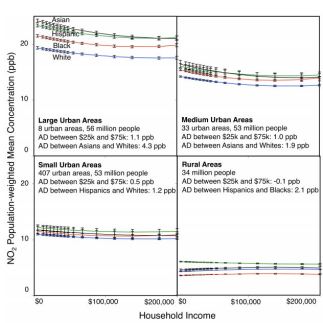
Of course it isn’t different, as shown by an eye-opening new study from the University of Minnesota. By overlaying Census data with a recent map of air pollution, the researchers discovered that in most places in the country lower-income non-white people breathe more airborne foulness than higher-income whites. On average, non-white people inhale 38 percent higher levels of air pollution than whites, they say. If non-white people were brought down to the levels of pollution enjoyed by whites, it would prevent 7,000 deaths from heart disease in their communities each year.

Income also plays a role in pollution exposure, but not as much as you might think. “Both race and income matter, but race matters more than income,” says Julian Marshall, a professor of environmental engineering at the University of Minnesota. “And that’s a really important point, because when you start talking about differences by race people say, ‘Oh, that’s just income.'”

The discrepancy is so great that even high-earning nonwhites are sucking in relatively larger quantities of pollution. For a clear illustration of that, take a look at this graph showing (at top left) pollution/income differences for large urban areas. Notice how low-income whites are exposed to less pollution than even the highest-income blacks, Asians, and Hispanics:

“Even considering high-income individuals only, the fact that you still see environmental injustice is a little surprising to me,” says Marshall. As to why this is occurring, that’s still a subject for further investigation; Marshall notes that one theory is that more non-whites tend to live in pollution-rich downtown areas and near freeways.

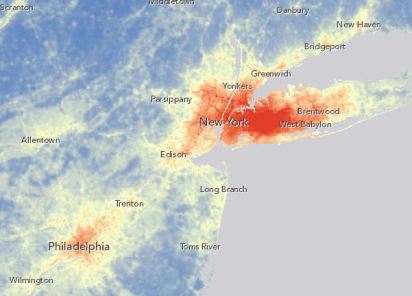
The specific pollutant that the researchers investigated is nitrogen dioxide, whose man-made sources include automobile engines and power plants. People who breathe more NO2 are at greater risk of a horde of ailments, from asthma to heart and lung disease to low birth weights. The researchers got a bead on how much NO2 is floating over America using satellite and land-use data from this study, which also inspired this interactive map of pollution levels. Look at how NO2 hovers over major metropolitan regions:

They also built their own maps of the America’s pollution landscape, such as this one showing the “difference in population-weighted mean NO2 concentrations (ppb) between lower-income nonwhites and higher-income whites for U.S. cities.” By their measurements the urban areas with the greatest gaps in pollution exposure between whites and nonwhites are New York-Newark, Philadelphia, and Bridgeport-Stamford, Connecticut, respectively:

And here’s their list of the spots with the highest pollution disparity between whites and nonwhites (note that “urban areas” relates to a Census definition that can include parts of various neighboring states):

New York–Newark; NY–NJ–CT

Philadelphia; PA–NJ–DE–MD

Bridgeport–Stamford; CT–NY

Boston; MA–NH–RI

Providence; RI–MA

Detroit; MI

Los Angeles–Long Beach–Santa Ana; CA

New Haven; CT

Worcester; MA–CT

Springfield; MA–CT

Rochester; NY

Chicago; IL–IN

Birmingham; AL

Hartford; CT

Milwaukee; WI

via People of Color Are Disproportionately Hurt by Air Pollution – John Metcalfe – The Atlantic Cities.

Posted in Air Quality, USA & Canada | Tagged | Leave a comment

Asian air pollution strengthens Pacific storms

Air pollution in China and other Asian countries is having far-reaching impacts on weather patterns across the Northern Hemisphere, a study suggests.

Researchers have found that pollutants are strengthening storms above the Pacific Ocean, which feeds into weather systems in other parts of the world.

The effect was most pronounced during the winter.

The study is published in the Proceedings of the National Academy of Sciences (PNAS).

Lead author Yuan Wang, from the Jet Propulsion Laboratory at the California Institute of Technology, said: “The effects are quite dramatic. The pollution results in thicker and taller clouds and heavier precipitation.”

Toxic atmosphere

Parts of Asia have some of the highest levels of air pollution in the world.

In China’s capital, Beijing, pollutants frequently reach hazardous levels, while emissions in the Indian capital, Delhi, also regularly soar above those recommended by the World Health Organization.

This has dire consequences for the health of those living in these regions, but there is growing evidence that there are other impacts further afield.

To analyse this, researchers from the US and China used computer models to look at the effect of Asia’s pollution on weather systems.

The team said that tiny polluting particles were blown towards the north Pacific where they interacted with water droplets in the air.

This, the researchers said, caused clouds to grow denser, resulting in more intense storms above the ocean.

Dr Yuan Wang said: “Since the Pacific storm track is an important component in the global general circulation, the impacts of Asian pollution on the storm track tend to affect the weather patterns of other parts of the world during the wintertime, especially a downstream region [of the track] like North America.”

Commenting on the study, Professor Ellie Highwood, a climate physicist at the University of Reading, said: “We are becoming increasingly aware that pollution in the atmosphere can have an impact both locally – wherever it is sitting over regions – and it can a remote impact in other parts of the world. This is a good example of that.

“There have also been suggestions that aerosols over the North Atlantic effect storms over the North Atlantic, and that aerosols in the monsoon region over South Asia can affect circulation around the whole of the world.”

via BBC News – Asian air pollution strengthens Pacific storms.

Posted in Air Quality, Asia, China | Leave a comment