Africa’s air pollution underestimated in climate change models

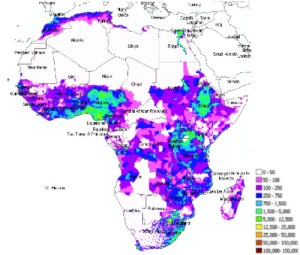
AfricaHuman activity in Africa significantly contributes to air pollution. However, no detailed data regarding country-by-country pollutant emissions in the continent was available until now. To remedy this, a joint French-Ivory Coast team headed by the Laboratoire d’Aérologie (CNRS / Université Toulouse III — Paul Sabatier) mapped these emissions in Africa for 2005, before estimating them for 2030, using three scenarios. The researchers showed that the climate change models used by the IPCC underestimate Africa’s emissions, which could account for 20-55% of global anthropogenic emissions of gaseous and particulate pollutants by 2030. This work, published on 11 March 2014 in the journal Environment Research Letters, will help not only to improve existing climate models, but also to assess the health impacts of pollution in Africa’s urban areas.

Air pollutant emission inventories are essential in measuring the impact of pollution on air quality and the climate, as they are fed into atmospheric and climate models to make projections for the future. Although regional inventories for Europe, Asia and North America are extremely detailed, those for Africa were only global until now.

In order to fill this gap, the researchers drew up anthropogenic emission maps for 2005 for every country in Africa. To do this, they used a variety of data, such as fuel consumption questionnaires submitted to the authorities of various countries, field surveys, and the results of research programs such as AMMA (West African Monsoon program) and POLCA (African Capitals Pollution program). The scientists also included highly polluting gas and particle emission sources in Africa, such as two-wheeled vehicles and old cars and trucks in cities, as well as charcoal making for cooking. Today, depending on the particles and gases considered (black carbon, organic carbon, sulfur dioxide, nitrogen oxide, carbon monoxide, etc), all these anthropogenic emission sources account for between 5 and 20% of the world’s pollution. Africa’s contribution to climate change cannot therefore be overlooked.

On the basis of the inventories for 2005, the researchers estimated African pollutant emissions for 2030 using three scenarios. Two of these, featured in the POLES economic model, either describe a world with no environmental policy, or one that includes the commitments of the Kyoto Protocol (in other words, a 5.5% reduction of greenhouse gas emissions over the 2008-2012 period compared to 1990 levels). The scientists constructed a third scenario involving specific emission reductions.

The main conclusion of the assessment is that, in the absence of any effective regulatory measures, the African continent could contribute 20-55% of global anthropogenic emissions of gaseous and particulate pollutants by 2030.. These figures significantly exceed the estimates on which climate change models are currently based.

This work, which will be used in future publications by the IPCC (Intergovernmental Panel on Climate Change), will help develop improved models. The researchers also aim to rely on the inventories to better assess the impact of pollutant emissions on the health of Africa’s urban populations. They hope that their findings will enable African decision-makers to make enlightened choices about vehicle populations and fuels used, so as to improve air quality in African cities.

via Africa’s air pollution underestimated in climate change models — ScienceDaily.

Posted in Africa, Air Quality | Tagged , , | Leave a comment

Strawberry plants measure air quality

In Antwerp, researchers of the AIRbezen project are using strawberry plants to measure the amount of fine dust in the city. It’s the first time this kind of bio-monitoring has been applied on such a large scale.

The initiative is the result of a co-operation between StadsLab2050, a think-tank for sustainable city ideas from citizens, and the department of bio-engineering sciences at Antwerp University. The partners are looking for at least 500 inhabitants who want to care for a strawberry plant from March until May. Participants can keep the fruit, as the researchers are only interested in the leaves.

“The amount of fine dust on and in the leaves is a good indicator of the local air quality,” researcher Jelle Hofman told Flemish science magazine Eos. Hofman co-ordinates the project as part of his PhD research. On the basis of the analyses of the plants, he wants to create a detailed map of the air quality in Antwerp.

Antwerp’s air quality is currently monitored through three measuring stations in the city. “These stations are actually insufficient, because the concentration of fine dust can be different 10 metres away from the installation,” said Hofman. “Installing extra measuring equipment would be expensive, but plants measure the fine dust just as well while being both cheap and easy to distribute.”

Strawberry plants have the advantage of being popular with the general public, but the leaves are also convenient because they contain many hairs that collect the fine dust. Previously, Hofman and his colleagues have used moss, grass and other leaves to measure local air quality.

“Plants take up fine dust particles superficially in their leaves,” explained Hofman. “We can detect the magnetisable particles, like iron, and on the basis of their concentration estimate the air quality to which the plant was exposed during its growth. The higher the magnetic signal, the more fine dust.” The map should be ready in August 2014.

The researchers have already identified several problem areas in Antwerp. Ivy leaves at Park Spoor Noord, for example, contained high concentrations of metal, probably due to the historically polluted soil. Where the park is now, there used to be a marshalling yard. Currently, large construction works are being carried out, which probably brought the polluted soil to the surface where it was then spread by the wind.

via Strawberry plants measure air quality | Flanders Today.

Posted in Air Quality, Europe | Tagged , , | Leave a comment

Paris restricts car use after pollution hits high

Alternative driving days are being introduced in the French capital, Paris, in an attempt to tackle dangerous levels of air pollution.

From Monday, drivers will only be able to use their vehicles every other day.

This is only the second time since 1997 that such a restriction has been enforced.

The French government made the decision after air pollution exceeded safe levels for five days running in Paris and surrounding areas.

Motorcycles will also be covered by the ban, which will allow only vehicles with number plates terminating in an uneven digit to take to the roads, beginning at 05:30 (04:30 GMT) on Monday.

On Friday, public transport was made free of charge for three days in an attempt to encourage people to leave their cars at home. This measure will continue on Monday.

The smoggy conditions have been caused by a combination of cold nights and warm days, which have prevented pollution from dispersing.

The capital’s air quality has been one of the worst on record, French environmental agencies say, rivalling the Chinese capital, Beijing, one of the world’s most polluted cities.

On Friday, pollution levels hit 180 microgrammes of PM10 particulates per cubic metre, more than double the safe limit of 80.

PM10 particulates are emitted by vehicles, heating systems and heavy industry.

The government will review pollution levels on Monday, before deciding whether to extend the driving restrictions for longer.

via BBC News – Paris restricts car use after pollution hits high.

Posted in Air Quality, Europe, France | Tagged , , | Leave a comment

A warning to all Parisians: Breathing can damage your health – and could possibly kill you

Avoid going outdoors in the early morning if you’re in Paris. Avoid going out in the late afternoon. If you are over 65, or under five, you should stay indoors.

Do not drive. If you have to drive, drive slowly. Cancel, or reduce, all “intensive sporting activity”. (Question: does that include Saturday evening’s France-Ireland rugby international?)

An invisible but potentially lethal enemy assailed Paris and most of northern France on Friday – the air.

Paris is in the grip of its worst atmospheric pollution for seven years, caused by a mixture of good weather and stubbornly bad public policy.

A run of unseasonably warm, windless days and cold clear nights has clamped a lid of warm air over northern France. Under that lid, minuscule particles of pollution – partly generated by France’s long love-affair with the diesel-powered car – have accumulated to dangerous levels.

The Eiffel tower and Paris roofs glimpsed through a haze of pollution The Eiffel tower and Paris roofs glimpsed through a haze of pollution (Getty) The level of official “pollution alert” – 80 microgrammes of tiny particles for every cubic metre of air – has been exceeded each day since Wednesday in 30 départements (counties) across northern France.

In an attempt to keep traffic to a minimum, all public transport has been declared free until Sunday in Paris, Rouen and Caen Even the Velib’, the Parisian help-yourself, short-term-hire bikes which fathered the Boris Bikes in London, have been declared free.

Is that sensible? In the midst of one of the most intense and prolonged pollution scares northern France has ever seen, is cycling still good for your health?

With the naked eye, it was difficult yesterday to see what all the fuss was about. Paris was basking for the send week in a row in bright, near-summer weather. The daffodils were gleaming in the Tuileries gardens. Women were wearing summer dresses.

If you looked just above the roofs of the buildings, however, there was a fat, smudgy, grey layer before the sky shaded into pale blue. The Eiffel Tower, and the skyscrapers in the La Défense office ghetto west of the city, were cloaked in a faint, grey-yellow haze.

France is especially vulnerable to this kind of pollution because it is 60 per cent dependent on diesel cars. In the 1960s, French government and industry made a strategic decision that diesel engines were less polluting and would gradually supersede petrol.

Exhaust gases are partly blamed for the fine particle pollution affecting Paris and several French cities Exhaust gases are partly blamed for the fine particle pollution affecting Paris and several French cities (Getty) The French car giants, Renault and Peugeot-Citroen invested heavily in diesel engines. Diesel fuel was taxed less heavily than petrol – and still is.

For nearly two decades France has been aware that this was a terrible mistake. Diesel engines are more polluting, not less. Fumes from diesel cars, as well as industrial emissions and agricultural fertilisers, are blamed for increasing the micro-particles in the French atmosphere to potentially dangerous levels.

Successive governments have lacked the courage to steer the French car-makers away from diesel engines or to increase taxes on the diesel fuel which is used by two out of three motorists (and voters).

According to on study, there are 40,000 premature or unnecessary deaths in France each year because of the high level of atmospheric pollution. The European Commission has brought a legal action against France in the European Court of Justice for its failure to respect EU anti-pollution laws.

Corinne Lepage, environment minister from 1995 to 1997, now an independent ecological activist, said: “There has never been the political will to attack the problem. I tried to set the ball rolling with a clean air law in December 1996, which put into effect European clean air directives.”

“That law has never been applied. Governments of both Left and Right have been scared of the car industry and motorists’ lobbies.”

via A warning to all Parisians: Breathing can damage your health – and could possibly kill you – Europe – World – The Independent.

Posted in Air Quality, Europe, France | Tagged , , | Leave a comment

Riyadh in list of cities with worst air pollution

Riyadh to get $186.6mn special needs medical city | New cement plant to be built in Riyadh | Downtown Riyadh set for massive redevelopment

A report by the World Health Organization has included the Saudi Arabian capital of Riyadh in the list of cities around the world that are suffering from the worst levels of air pollution.

While the WHO report has singled out the city of Ahvaz in Iran as having the highest levels of air pollution, Riyadh’s inclusion in the list has been owed to its frequent sandstorms and pollutants arising from heavy traffic and industrial waste in the city.

Besides Ahvaz and Riyadh, other cities mentioned in the WHO’s list included Ulan Bator in Malaysia, Lahore in Pakistan, New Delhi in India and Cairo in Egypt.

According to Arab News, Riyadh’s governor, Prince Khalid Bin Bandar, ordered the creation of a committee last week to look into sources of pollution in southern Riyadh, with committee members including the Higher Commission of Development of Riyadh, the Riyadh Governorate, the Ministry of Health and other government agencies.

via Riyadh in list of cities with worst air pollution | ConstructionWeekOnline.com.

Posted in Air Quality, Middle East | Tagged , , , | Leave a comment

Paris makes its bike share free to cut down on air pollution

The bad news: Air pollution in northern France has been at a dangerous high for three days running now, with nearly a third of the country’s 22 regions on maximum alert. Concentrations of PM2.5 Thursday in Paris reached 100mg/m3 — four times the level deemed safe by the World Health Organization.

The good news: Public transportation is free for the rest of the weekend! Due to ”significant risks to the health of residents,” transport authorities said Thursday, they’re opening access to all non-automobile methods of getting around the city, including both its bike-share system and, for an hour each day, its electric car-share system.

Warm days, cold nights and a lack of wind have contributed to the heavy pollution, RFI reports, which is expected to last through Friday. Since the alert first began, police have been cracking down on drivers, issuing over 16,500 tickets to those who didn’t follow newly lowered speed limits, along with pulling unnecessary municipal vehicles off the roads

The free public transportation is an additional bid to keep city dwellers off the roads. In a best-case scenario, they’ll like it enough to keep going even after the fares are restored.

via Paris makes its bike share free to cut down on air pollution – Salon.com.

Posted in Air Quality, Europe, France | Tagged , , | 1 Comment

Nine Chinese cities suffered more days of severe smog than Beijing

Photographs of a smog-wreathed Tiananmen Square and the iconic headquarters of China Central Television dominated reports of Chinese pollution last year, but analysis shows nine other Chinese cities suffered more days of severe smog than the capital in 2013.

The worst was Xingtai, a city of more than 7 million people south-west of Beijing, which was hit by 129 days of “unhealthy air” or worse – the threshold at which pollution is considered at emergency levels – and more than twice as many days as the capital experienced.

Beijing suffered 60 days of pollution above emergency levels, sparking reports of an “airpocalypse”, a boom in sales of air purifiers and masks and measures to tackle the problem including the destruction of open-air barbecues and a crackdown on fireworks for Chinese new year.

Last week, the Chinese premier, Li Keqiang, “declared war” on pollution, saying it was “nature’s red-light warning against the model of inefficient and blind development.”

The new analysis by Energy Desk, a site published by Greenpeace, is based on Chinese government data of fine particulates (PM2.5s), that have been linked by studies to increases in lung cancer and heart failure. It ranked cities against the US air quality index, based on how many experienced “very unhealthy” days or worse, roughly equivalent to levels the Chinese government considers an emergency.

Fang Lifeng, Greenpeace east Asia climate and energy campaigner, said: “China’s air pollution crisis usually makes the headlines when the smog cloud hits Beijing, but this research shows just how widespread this problem really is. There are now millions of Chinese people living in cities with air pollution above emergency levels for a third of the year, while other urban areas have gone a whole 12-month period with hardly any days of good-quality air.”

Most of the cities in the top 10, including Shijiazhuang, Baoding, and Langfang, are in the Hebei province south of Beijing, which is home to a large number of coal-fired power plants and industries including steel and cement that burn coal. Harbin, a city north-east of Beijing, which made headlines in October due to a choking smog that forced schools and the airport to close, comes in below Beijing on the ranking, at number 17.

Beijing only had 13 days considered “good” on the US index last year, with 70 days of moderate air pollution, 64 at unhealthy for sensitive groups, 148 unhealthy days, 45 very unhealthy, 14 deemed hazardous and one day that registered at “beyond index”, ie off the scale. Weather conditions in Beijing and the surrounding regions often compound the particulates generated by coal burning, cars and industry, with cold winter air trapping the pollution.

China is not the only country suffering air pollution problems, and far from the worst. Iran is home to four of the world’s most polluted cities, with Quetta and Peshawar in Pakistan also in the top 10 alongside Kanpur and Ludhiana in India, data from the World Health Organisation shows.

via Nine Chinese cities suffered more days of severe smog than Beijing | Environment | theguardian.com.

Posted in Air Quality, Asia, China | Tagged , , , , , | Leave a comment

Air pollution alert issued for central, southern Taiwan

The Environmental Protection Administration (EPA) yesterday issued a warning over bad air quality in several areas in central and southern Taiwan beginning last night, but said it is expected to ease tomorrow.

According to the EPA’s Taiwan Air Quality Monitoring Network, PM2.5 (particles under 2.5 micrometers in diameter) readings at most monitoring stations in Yunlin and Chiayi counties as well as Greater Tainan exceeded 100 micrograms per cubic meter as of 5pm yesterday.

The PM2.5 daily average standard is set at 35 micrograms per cubic meter and the yearly average standard is set at 15 micrograms per cubic meter.

The pollutant standards index showed the air quality in the areas was at the “unhealthy” level.

Chang Shun-chin (張順欽), deputy director of the EPA’s Department of Environmental Monitoring and Information Management, said that although haze was affecting Beijing, the reason for the bad air quality in Yunlin, Chiayi and Greater Tainan was not cross-border pollution, but poor dispersion in the area.

He said that since there was less wind because of the change in seasons, pollutants tend to remain in areas on the lee side of the Central Mountain Range (中央山脈).

As a cold front and a northeast monsoon were forecast to arrive last night, the pollution levels in central and southern Taiwan are expected to drop today and return to normal tomorrow, the EPA said.

The EPA said that people who are sensitive to air pollution should wear face masks and use public transportation instead of riding motorcycles if outdoor activity is unavoidable.

via Air pollution alert issued for central, southern Taiwan – Taipei Times.

Posted in Air Quality, Asia, Taiwan | Tagged , , , | Leave a comment