Swathes of France on alert over air pollution

Nearly a third of the 22 regions in mainland France on Wednesday were on a maximum pollution alert including a swathe of the country’s north, centre-east and the Paris region.

The prevalance of particles with a diameter of less than 10 microns were reported by regional air monitoring centres in the affected areas.

On Tuesday The Local reported how environmental campaigners said the pollution levels in the French capital had reached such high levels that people’s lives were being put in danger.

Ecology without Borders (Écologie sans Frontière), Breath (Respire) and Unity for the Planet (Rassemblement pour la Planète) have lodged a legal complaint in Paris, on the grounds that pollution levels are endangering people’s lives.

“We are sick of this air pollution,” Nadir Saifi, spokesman of Ecology with Borders told France Info. As soon as the weather is good, and as soon as it’s dry in winter you have these peaks in pollution and the emergency wards at hospitals fill up. Slogans and small demonstrations are no longer enough.”

A lack of wind during the anticyclonic period and cold nights followed by balmy days triggered the phenomenon, they said. In addition, there were emissions from cars and from heating in buildings and factories.

In general, the smaller and lighter a particle is the longer it stays in the atmosphere and can remain suspended for weeks.

Particles less than 2.5 microns in diameter are also the most dangerous to health as they can pierce the lungs and the blood system. They can also lead to asthma, allergies and respiratory ailments.

Alerts have been declared in Haute Normandie, Pas de Calais and Calvados in the north, the Ile-de-France region where Paris is located and the centre-east including some Alpine areas and in some parts of the west.

Alerts are issued in France when the concentration of small particles reaches 80 micrograms per cubic metre.

Measures to fight the advanced pollution level include orders to drive vehicles slowly, a ban on chimney fires and an advice to residents to eschew physical activity either indoors or outdoors.

Airparif, an official monitor and a federation of regional watchdog for air pollution in France, said the pollution threshold would be breached on Thursday in the Paris region.

The levels of PM 10 – or small particles which easily penetrate the lungs – were reported at 50 micrograms per cubic metre in several areas such as Brittany, the Loire region and parts of wine-producing Burgundy.

via Swathes of France on alert over air pollution – The Local.
Posted in Air Quality, Europe | Tagged , , , , , | Leave a comment

Traffic-related air pollution associated with changes in right ventricular structure, function

Exposure to high levels of traffic-related air pollution is associated with changes in the right ventricle of the heart that may contribute to the known connection between air pollution exposure and heart disease, according to a new study.

“Although the link between traffic-related air pollution and left ventricular hypertrophy, heart failure, and cardiovascular death is established, the effects of traffic-related air pollution on the right ventricle have not been well studied,” said lead author Peter Leary, MD, MS, of the University of Washington Medical Center in Seattle. “Using exposure to nitrogen dioxide as a surrogate for exposure to traffic-related air pollution, we were able to demonstrate for the first time that higher levels of exposure were associated with greater right ventricular mass and larger right ventricular end-diastolic volume. Greater right ventricular mass is also associated with increased risk for heart failure and cardiovascular death.”

The findings were published online ahead of print publication in the American Thoracic Society’s American Journal of Respiratory and Critical Care Medicine.

The study involved 3,896 participants who were free of clinical cardiovascular disease in the Multi-Ethnic Study of Atherosclerosis and who underwent cardiac magnetic resonance imaging (MRI). Using estimated exposure to outdoor oxides of nitrogen at the homes of participants over the year preceding MRI, the authors found that increased exposure to nitrogen dioxide was associated with an approximately 1.0 g (5 percent) increase in right ventricular mass and a 4.1 mL (3%) increase in right ventricular end-diastolic volume.

These relationships remained after accounting for differences among participants in cardiovascular risk factors, left ventricular mass and volume, markers of inflammation, lung disease and socioeconomic status.

The authors note that this type of study can be limited in several ways. Specifically, estimates of air pollution exposure are not perfect and it remains possible that something related to air pollution, but not air pollution itself (known as confounding), was responsible for the association. For these reasons and others, this study cannot prove that traffic-related air pollution causes changes in the right heart, but does strongly suggest the relationship.

“The morphologic changes in the right ventricle of the heart that we found with increased exposure to nitrogen dioxide add to the body of evidence supporting a connection between traffic-related air pollution and cardiovascular disease,” said Dr, Leary. “The many adverse effects of air pollution on human health support continued efforts to reduce this burden.”

via Traffic-related air pollution associated with changes in right ventricular structure, function — ScienceDaily.

Posted in Air Quality, Health Effects of Air Pollution | Tagged , | Leave a comment

Labour calls for action on air pollution after targets missed

GlasgowThe Scottish Government should set out a clear timetable for tackling air pollution, Labour has said.

The party is using its debating time at Holyrood to highlight the problem.

Labour members will call on the Government to work closely with local authorities to tackle air pollution, and ensure and that a planned national low-emissions strategy is “robust”.

Labour also wants the SNP administration to use national planning guidance and transport policy to ensure air quality targets are met.

The Government said there has been “excellent progress” in improving air quality but recognises that there is more to be done.

Speaking ahead of the debate, Labour’s environment spokeswoman Claire Baker said: “We are seven years into a SNP Government in Scotland and once again we are faced with dealing with environmental targets that they are continually missing.

“The 2013 air quality monitoring results highlight the lack of leadership there has been from the SNP in tackling consistent breaches of air quality safety standards.

“With the poor quality of air contributing to 1500 deaths annually in Scotland we need urgent action to ensure the air we breathe is safe.”

She added: “Scotland is currently failing to meet our own standards on nitrogen dioxide and small particles and coupled with that we have the European Commission taking the UK Government to court over their failure to tackle the issue.

“This is a serious problem that impacts on people from across Scotland. We must work together to address the current failures and Labour has called for today’s debate to begin that process.”

Earlier this year environmental charity Friends of the Earth said levels of air pollution in some parts of Scotland were missing EU and UK standards.

It used air monitoring data to identify the streets with the highest levels of nitrogen dioxide, fine particles, and particulate matter.

These forms of air pollution have been linked to health problems such as asthma and other respiratory conditions. Friends of the Earth Scotland said new research has also linked exposure to fine particles with heart attacks.

A Scottish Government spokeswoman said: “The Scottish Government, working in partnership with Scotland’s 32 local authorities, continues to make progress in improving our air quality. Data shows that significant reductions in air pollutants have been achieved since 1990 and further decreases are predicted in the future, given our knowledge of the likely impacts of planned investment.

“Although there has been excellent progress, we recognise that there is more to be done to deliver further benefits for human and environmental health where areas of poorer air quality remain.

“We recognise that air pollution disproportionately affects the health of the most vulnerable members of society — the very young, the elderly and those with existing cardiovascular and respiratory conditions — and can have a very real impact on quality of life for these individuals.

“Our Low Emission Strategy, which is currently in development, will set out the contribution that reduced air pollution can make to delivering sustainable economic growth and enhancing the quality of life for communities across Scotland, with a focus on progress in Scottish towns and cities over the coming years.”

via Labour calls for action on air pollution after targets missed | Politics | News | STV.

Posted in Air Quality, UK | Tagged , | Leave a comment

New research shows air pollution might make you bad at your job

In 2011 researchers at UC San Diego and Columbia University were the first to demonstrate a link between air pollution and reduced productivity among outdoor agricultural workers. Now those researchers are back with a new study, entitled “Particulate Pollution and the Productivity of Pear Packers.” The study shows, for the first time, a significant link between air pollution and the productivity of indoor workers.

The pollutant in question is fine particulate matter, or PM2.5. It’s notable for its tiny size (less than 1/30th the width of a human hair), which allows it to infiltrate deep into your lungs and potentially even your bloodstream, where it can cause all sorts of health problems. The authors note that PM2.5 can easily enter buildings: “Unlike other pollutants, which either remain outside or rapidly break down once indoors, going inside may do little to reduce one’s exposure to PM2.5.”

To figure out how this affected indoor workers, the authors drew on data from an indoor pear-packing factory in northern California. “We focused on pear packing for this study since it was located near an air pollution monitor and paid workers piece rate, which allowed us to measure individual worker productivity on a daily level,” author Joshua Graff Zivin told me.

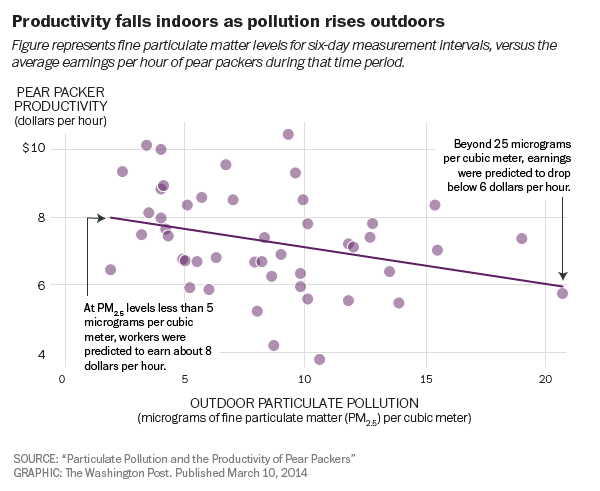
What they found was that every 10-microgram per cubic meter increase in PM2.5 levels decreased worker productivity by 0.6%, as measured by the number pear boxes packed by each worker. Since workers were paid piecemeal, this translated to a decrease of roughly 41 cents per hour, per 10 micrograms of PM2.5.

packer productivity

Moreover, the effect increased at higher PM2.5 levels: levels between 15 and 20 micrograms reduced earnings by $0.53 per hour, levels between 20 and 25 micrograms decrease earnings by $1.03 per hour, and when levels exceed 25 micrograms/cubic meter earnings shrink by $1.88 per hour. One key point is that these levels are all well below current U.S. air quality standards for PM2.5, which stand at 35 micrograms/m3. The U.S. didn’t even start regulating this pollutant until 1997.

Across the U.S., PM2.5 levels routinely cross this 35 microgram threshold every day. Airnow.gov, an EPA website that tracks air quality in U.S. cities, is currently showing PM2.5 levels of 69 micrograms in Atlanta, 72 in Cleveland, and a whopping 140 in Albuquerque, NM. If those figures seem high be thankful you don’t live in Beijing, where PM2.5 levels topped 250 micrograms today.

One major implication of the study is that reductions of PM2.5 can have significant economic benefits. The authors estimate that across the entire U.S. manufacturing sector, reductions in PM2.5 since 1997 has led to an aggregate labor savings of $19.5 billion – a previously-unknown benefit of fine particulate regulation.

The larger question, of course, is whether these findings extend even to workers in retail and other regular office settings. “We are very curious about this,” Givin told me. “Whether more cognitive indoor activities are subject to similar effects is an important area for future research, but there is certainly a plausible channel through which these could occur.”

via New research shows air pollution might make you bad at your job.

Posted in Air Quality, Health Effects of Air Pollution | Tagged , , | Leave a comment

Warm spring weather triggers London smog alert

Warm spring weather over the weekend triggered a smog alert in London from the Department for the Environment, Food and Rural Affairs (Defra), with moderate particulate matter levels also forecast for the remainder of the coming week.

Defra is also warning that there is a risk of high levels of particle air pollution this week, partly due to warm weather and also winds arriving from central and northern Europe impacting on southern England.

The Defra forecast states that this is ‘expected to continue through this week as a stable anticyclone lingers over the UK’ leading to ‘recirculation of air masses over the southern regions’ and causing elevated concentrations of PM10 and PM2.5 when coupled with ‘poorly dispersed local emissions’.

Green Party

But, the Green Party is calling for more to be done by the UK government to meet clean air targets and tackle public health problems resulting from pollution, adding that Londoners ‘deserve better than a smog alert when the weather warms up’.

EU Green Party candidate Caroline Allen said: “I love the sunshine but wish it didn’t always seem to be accompanied by a toxic smog cloud, resulting in watering eyes and a sore throat, or worse.

“Mayor Boris Johnson’s failure to act over our dangerously poor air quality is seriously affecting Londoner’s health as well as risking millions in fines from Brussels. Greens are pushing for much faster action, so we can enjoy these sunny days unspoilt by toxic air.”

And, Caroline Russell, Green Party Local Transport spokesperson, criticised the what she called the London Mayor’s ‘cost-cutting plans to close vital air monitoring stations across the capital’.

She said: “Primary traffic emissions are known to play a key role in air pollution incidents. London authorities must get serious about making London a safer place for people to cycle and walk. Only then can we create a more liveable and less vehicle-dominated city.”

The Green Party claims it is ‘the only party with workable policies in place to tackle air pollution’ adding that it is calling for 20mph speed limits across London, a tightening up of Low Emission Zone standards and creating walking and cycling routes across the city.

via Warm spring weather triggers London smog alert | AirQualityNews.

Posted in Air Quality, London, UK | Tagged , , , , | Leave a comment

Review: Primavera e allergie! by United Runners

Ci siamo. Manca pochissimo. Ormai la Primavera è alle porte, ed anche se l’Inverno non è ancora ufficialmente finito, in alcune giornate già si percepiscono alcuni segnali che la stagione più bella dell’anno sta arrivando.

La Primavera è la stagione che preferisco per correre perché la temperatura si fa più mite e gli scenari che si creano sono davvero pittoreschi: intorno a noi un’energia ci travolge, le rondini fanno il loro ritorno e ci accompagnano nella corsa, gli odori ci riportano a momenti meravigliosi ma purtroppo ricordano anche a quelli che sono allergici al polline, che tutto ciò che hanno intorno potrebbe avere aspetti assai negativi…

In questo periodo correre all’aperto è dover fare i conti con la natura: l’impollinazione è un fenomeno naturale, e si manifesta nel periodo in cui le piante producono il loro polline e tramite il vento danno via all’evoluzione.

L’allergia al polline può provocare cefalee, prurito alla gola, congiuntiviti, asma, irritazioni cutanee e problemi allo stomaco e nei casi più gravi è fondamentale consultare un medico per farsi consigliare il rimedio ed il farmaco più idoneo per non trasformare in “tragedia” la nostra session di corsa.

Se il vostro caso di allergia, invece, non è così grave, vi consigliamo alcuni trucchetti per soffrire il meno possibile:

Sconsigliato correre nelle ore più fresche mattino e sera, il caldo non è un buon amico del polline e se sei allergico qualche alleato bisogna averlo!

Correre con la pioggia o subito dopo è un’ottimo antistaminico così come correre in riva al mare dove l’aria è meno ricca di pollini;

Usare occhiali da sole sempre!

Cercare di respirare con il naso in quanto l’aria che respireremo sarà più calda, più umida e filtrata dai pollini;

Evitare di correre quando c’è molto vento (potrebbe essere un problema); in quei giorni meglio scegliere un allenamento indoor.

Durante il cambio di stagione la spirulina può essere un buon ricostituente che non vi farà sentire fiacchi bensì forti ed energici.

Non è finita.

I nostri trucchetti non vi sono bastati?Bene. Lo sapevate che esiste un rimedio meccanico per combattere il problema dell’allergia?Esistono infatti maschere specifiche antipolline per chi fa sport, facilmente reperibili online su Amazon , Ebay ed altri siti web di e-commerce: oltre a combattere le allergie potremo spaventare i passanti che incontreremo correndo, ed incuteremo timore agli altri runners che non tenteranno di superarci scambiandoci per il temibile Hannibal Lecter. Se poi la mascherina funziona anche proteggendoci e facendoci sentire meglio…why not?

Non sono riusciti a fermarci il lungo freddo, il buio, la pioggia e di certo non ci lasceremo limitare da bellissimi fiori profumati. Non dimenticate: keep on running!

via United Runners Beginners – Primavera e allergie!.

Posted in Respro® Mask Reviews | Tagged , , , , | Leave a comment

New PSI reporting system to see more days with “moderate” air quality

From May 1, Singapore will see more days with the air quality being classified as in the “moderate” range, as concentrations of smaller polluting particles of PM2.5 will be included in the Pollutant Standards Index (PSI) readings.

“As a result of PM2.5 being incorporated into the PSI, more days will be classified as ‘moderate’ compared to before, even though the actual concentration of pollutants has not changed.

“This is purely due to the integration of the PM2.5 concentrations into the PSI scale,” the National Environment Agency (NEA) said in a statement on Tuesday.

NEA added that people can carry on normal activity if air quality is in the “good” or “moderate” range and there will be no change to normal routines on the ground.

PM2.5 are tiny particles that can travel deep into the respiratory tract, and get embedded in lung tissue.

It is currently reported separately from the PSI.

Minister for Environment and Water Resources Vivian Balakrishnan on Tuesday told Parliament that Singapore will move to an integrated air quality reporting index, where PM2.5 will be incorporated into the current PSI as its sixth pollutant parameter.

In explaining the change, Dr Balakrishnan said as far as public health is concerned, PM2.5 concentrations are more often a cause for concern.

He said the move would also simplify the air quality reporting system.

Going forward, he said PM2.5 levels are expected to determine the PSI “almost all the time”.

Since August 24, 2012, NEA has been reporting 24-hour PM2.5 concentrations alongside the PSI, which was done as the first step in the transition to the new air quality reporting system.

NEA will now complete the transition by incorporating the 24-hour PM2.5 concentrations into the PSI.

From May 1, the PSI will reflect a total of six pollutants — sulphur dioxide (SO2), particulate matter (PM10) and fine particulate matter (PM2.5), nitrogen dioxide (NO2), carbon monoxide (CO) and ozone (O3).

The 3-hour PSI will also take into account PM2.5 concentrations.

NEA will also publish the 1-hour PM2.5 concentrations every hour.

Previously, health advisories issued by the government were based on 24-hour PSI and 24-hour PM2.5, whichever was worse.

Under the new air quality reporting system, the health advisory will be based on the new 24-hour PSI as it now directly takes into account PM2.5.

NEA said air quality information will be reported every hour from 7am to 11pm during non-haze periods, and around the clock during haze periods.

The information will be made available on the NEA website, the haze microsite, NEA Facebook, NEA Twitter and smart phone app, MyENV.

NEA will continue to regularly review Singapore’s air quality reporting index to ensure that it remains a relevant and useful guide for the public to help plan their daily activities.

Dr Balakrishnan also announced the setting up of an International Advisory Panel on transboundary pollution, which will be co-chaired by Professor S Jayakumar and Professor Tommy Koh.

via New PSI reporting system to see more days with “moderate” air quality – Channel NewsAsia.

Posted in Air Quality, Asia, Singapore | Tagged , , , , | Leave a comment

UAE experts call for more awareness of air pollution

ABU DHABI // Air quality in the UAE is generally good – but the issue will probably need more attention as the country grows, a prominent researcher has said.

“There are national guidelines and most pollutants are within these standards but some pollutants are above the standards,” said Dr Alena Bartonova, research director of the Abu Dhabi branch of the Norwegian Institute for Air Research.

“I definitely think we should pay attention. We have great cities here, which are growing and every time there is growth in human activity, there is an increase in pollution,” she said.

“In general, I do not think people should be scared, but they should be aware that some of their activities – like driving a car or building a new house – contribute to air pollution,” she said, adding that some industrial activities were also significant sources of pollution.

Particulate matter (PM) – tiny particles of sand, dust or chemicals – is one pollutant that registers elevated levels.

Nitrogen oxide, usually released in the combustion of fossil fuels, and ground-level ozone, or smog, which is formed when some chemicals released from human activities react with substances already in the atmosphere in the presence of sunlight, are two other substances that show elevated concentrations, Dr Bartonova said.

Reem Deed, a project manager for a Dubai-based supplier of air-quality monitoring equipment and services, Enviro & Industrial Solutions, also said that PM and ground-level ozone, especially in the summer, were the two pollutants most commonly registering high concentrations in Dubai.

Local authorities have taken steps to measure pollution levels with Abu Dhabi and Dubai providing real-time information, publicly available online, on the concentration of common pollutants, with measurements taken regularly at stations throughout the two cities.

In the capital, the Environment Agency – Abu Dhabi (Ead) has also started detailed monitoring of particulate matter pollution, looking at levels of particles, known as PM10, which are only 10 micrometres in size, with a micrometre being a millionth of a metre.

There are also monitoring levels of the even smaller PM2.5 particles, which experts believe are especially harmful as they are able to penetrate in the lungs when inhaled.

“PM is a difficult pollutant because it is directly emitted by natural sources and man-made sources but it is also formed in the atmosphere,” said Dr Bartonova, explaining that more studies are necessary into the subject as well as into the formation and transport of other pollutants.

“A lot has been done, there is a number of things we do know, a number of entities working, but things take time and we need to build up,” she said.

Overall, there is a need to know more about how air pollution is tied to human activities, what are the processes that contribute to forming it in the atmosphere and how much of it is generated locally and how much from abroad, she said.

Both ozone and particulate matter are what scientists call secondary pollutants – substances that form in the atmosphere through reactions with primary pollutants. This is why the issue needs to be looked at in the context of the whole region, not just the UAE. But, at the same time, “ozone-forming or particle-forming substances” are emitted locally by the transport, mineral excavation and hydrocarbon industries, she said.

Dr Bartonova recommended setting up a framework within which local governments, research bodies and industries that contribute to pollution coordinate their efforts to share data.

A similar approach was adopted when Ead drafted Abu Dhabi’s first inventory of greenhouse gases. Achieving cleaner air for the UAE would also require regional cooperation to make sure other countries also better understand their responsibilities and contributions, she said.

via UAE experts call for more awareness of air pollution | The National.

Posted in Air Quality, Middle East | Tagged , , , , , | Leave a comment