Air pollution in Riau city soars to hazardous levels

Air pollution in Dumai, the epicentre of last year’s extreme haze, soared to very hazardous levels on Tuesday morning, as the dry season – and open burning – started much earlier this year.

The Air Pollutant Index in Dumai, Riau province, surged on Tuesday to 449, close to levels seen at the peak of the haze last June, when Indonesia was forced to dump water from airplanes to douse forest fires.

Dumai, some 270km northwest of Singapore, was at the centre of the worst haze in years last year as farmers slashed and burned to clear land, causing air pollution to hit record highs in nearby Singapore and Malaysia.

On Tuesday, the number of hot spots in Sumatra more than doubled to over 450, from about 190 a day earlier, according to the National Oceanic and Atmospheric Administration satellite.

For now, winds are blowing away from Singapore and Peninsular Malaysia, said Agus Wibowo, head of the data department at Indonesia’s disaster mitigation agency (BNPB). He said there were no reports of the two neighbouring countries being affected by haze so far.

In Siak district, south-east of Dumai, 210 schools were closed and students sent home on Tuesday. Schools are expected to remain closed at least until Wednesday, after fire raged in a sago plantation owned by PT Nasional Sago Prima in a neighbouring district of Meranti Islands.

Flights in Pekanbaru, Riau and Palembang, South Sumatra, were delayed this week due to low visibility.

Farmers and plantation companies in Sumatra and Kalimantan, faced with unusually dry weather over the past few weeks, have been burning to clear land, the cheapest way to do so.

Open burning is against the law but the rule is widely flouted.

Provincial heads of the disaster mitigation agency from eight haze-affected provinces, including Riau, North Sumatra and West Kalimantan, called on the government on Tuesday to begin water bombing.

“Most of the fires were caused by deliberate burning by residents, not fire accidents,” said BNPB head Syamsul Maarif in an interview, citing reports from the disaster agency’s provincial heads. “Many of the fires were near the main roads, access roads, indicating the starting of the fires was deliberate.”

The BNPB will help with water bombing and cloud seeding operations by deploying air force aircraft and hired helicopters, said Syamsul.

The agency is gearing up for an especially hot and dry season starting from April, he added.

“Learning from last year’s experience, we don’t want to be late this time round,” he told The Straits Times.

Syamsul said the agency will rent Russian Kamov helicopters with belly tanks that can carry 8,000 litres of water, compared with the 500 litres helicopters in Indonesia can carry. The agency also plans to rent helicopters from Australia, he added.

Meanwhile in Malaysia, Johor’s fire department told The Star newspaper that it recorded 1,226 cases of open burning in the southern state between January 1 and February 8, including bushfires, forest fires, fires in plantations and burning of garbage.

That compared with only 1,856 open-burning cases for the whole of last year.

Penang, too, has seen bushfires in the past few weeks due to the dry weather.

In Australia, climate models indicate an increased chance of an El Nino weather pattern emerging later this year, the country’s weather bureau said on Tuesday.

El Nino can cause flooding and heavy rains in the United States and South America and trigger drought conditions in Southeast Asia and Australia.

via Air pollution in Riau city soars to hazardous levels | The Jakarta Post.

Posted in Air Quality, Asia, Singapore | Tagged , , , | Leave a comment

Royal Borough forced to declare air pollution zone on junction of road heading to Legoland

LEGOLAND traffic has been singled out for causing an area of Windsor to experience air pollution levels usually reserved for places near motorways and congested town centres.

An Air Quality Management Area (AQMA) has been declared by the council around the St Leonards Road/Imperial Road junction as the amount of Nitrogen Dioxide (NO2) in the air around the area have far exceeded nationally-set benchmarks.

The issue was raised at a meeting of the council’s Highways and Transport Panel on Monday last week by the Royal Borough’s environment protection team leader Chris Nash.

Speaking at the meeting, Clewer North councillor John Fido said: “Clearly peak time at Legoland is going to exacerbate this pollution.”

The discussion came after an earlier presentation about ways to combat the crippling traffic chaos during peak periods at the theme park.

Mr Nash said: “As you can imagine, this report is very relevant to what we have been talking about earlier.”

An AQMA is declared after extensive monitoring of NO2 levels and if they exceed annual targets. National legislation states an AQMA must be declared if the annual mean measurements taken from an area exceeds 40 microgrammes per cubic metre (μg/m3).

This has been exceeded every year since 2007 in the St Leonards Road/Imperial Junction area and was 50% higher at one monitoring point in 2012 – the most recent figures published.

There are only four other AQMAs in the Royal Borough – in Wraysbury close to the M25, Maidenhead town centre, the M4/A308 junction in Bray and West Windsor.

Resident Helen Price had spoken about measures needed to curtail congestion earlier in the meeting.

Speaking after the meeting, she said: “I spoke in December [at a planning meeting where Legoland was on the agenda] about air pollution issues caused by the traffic and it was ignored.

“It is not a pleasant thing to have. You certainly wouldn’t recommend a friend to buy a house in Imperial Road because of the air pollution and the traffic.”

The council will now prepare an Air Quality Action Plan tying in with their Local Transport Plan to combat the issue.

A heated discussion earlier in the meeting at the Town Hall, in St Ives Road, Maidenhead, revolved around traffic congestion policies being adopted by Legoland and the Royal Borough.

Speaking at the meeting, councillor Michael John Saunders said: “I am stunned that you can manage the queuing within your park so extraordinarily well and yet you clog up the roads of the Royal Borough without thought or consideration.”

In response, Legoland divisional director Sue Kemp said: “The difference between the queues in the park with queuing cars is that we have 100% control of what goes on in our park.”

A series of traffic calming measures and trials will be in place ahead of the Winkfield Road park re-opening during the Easter holidays.

via Royal Borough forced to declare air pollution zone on junction of road heading to Legoland | Windsor | News | Royal Borough Observer.

Posted in Air Quality, UK | Tagged , , , , | Leave a comment

Study: Idling hurts air quality

A local study of air emissions in the Barnett Shale suggests that trucks serving the oil and gas field spend an average of six hours per trip in extended idling, contributing to air pollution and ozone levels in North Texas.

The study, conducted by the North Central Texas Council of Governments, was part of a broader study that estimated five air pollutants from oil and gas-related vehicles over three benchmark periods: 2006, 2012 and 2018.

Emission levels for each pollutant were broken down by phase of work in the Barnett Shale — drilling, completion, production and extended idling. According to the report “Development of Oil and Gas Mobile Source Inventory in the Barnett Shale,” extended idling occurs during loading and unloading of cargo, and data show that this phase contributes to the majority of emissions.

Between 2006 and 2012, the number of completed oil and gas wells in six North Texas counties more than doubled, from about 5,900 to more than 14,700. So did the amount of idling time, from 4.7 million hours in 2006 to 10.7 million hours in 2012, according to the study.

Although the town of Little Elm enforces anti-idling provisions, Denton County is not among the four North Texas counties with idling restrictions. Those counties with restrictions are Collin, Dallas, Kaufman and Tarrant counties.

Denton County Commissioner Hugh Coleman said an idling restriction might be something for the county to consider. Coleman said he does not recall the county ever considering a restriction in the 20-plus years he has worked for the county.

“I can’t remember it ever being considered,” Coleman said. “Anything we can do to improve air quality would be a good thing to look at.”

Air emissions data from the Environmental Protection Agency was used to help determine the amount of pollutants created by each truck, according to Lori Pampell Clark, a principal transportation planner at the regional agency. She co-authored the final report with fellow staff members Shannon Stevenson and Chris Klaus.

Combined with the average distance traveled and average number of trips completed per day, Clark, Stevenson and Klaus were able to estimate how much carbon monoxide, nitrogen oxides, volatile organic compounds and other particles are being pumped into the North Texas atmosphere by oil and gas trucks.

Funded by the Texas Commission on Environmental Quality, the study acquired data via interviews and surveys from a small sample of trucking contractors that transport cargo, including produced water, to and from the Barnett Shale. The survey responses were highly consistent with one another, including those regarding the amount of time per trip spent idling, the study found.

Twelve North Texas counties were part of the air quality study, including Denton, Tarrant and other core counties of the Barnett Shale. In addition to conducting its own survey and research, the agency staff also gathered data from the Texas Railroad Commission and the Texas Department of Motor Vehicles, along with interviews and meetings with industry participants.

Clark said the agency is working on a number of potential strategies to reduce idling, from community awareness websites to more tangible solutions such as trucks with cleaner engines and more efficient truck stops.

The agency’s “Engine Off North Texas” initiative, for example, seeks to educate and inform residents and local governments as well as drivers. A map shows idle restrictions by city and county, and offers information on how and when to report idling vehicles.

With personal vehicle charging stations appearing more frequently at gas stations and parking garages, a similar technology for commercial trucks has been shown to significantly reduce both the number of hours spent idling and the amount of emissions produced.

Traditional truck stops can be upgraded with external heating and air conditioning connections, called “electrification.” Individual hookups function similar to window units, which are then connected to the trucker’s rig. Drivers who idled because of the weather or the perishable cargo they were hauling can now maintain cabin and trailer temperatures and reduce air pollution simultaneously.

With the agency’s ambitious plan to significantly reduce North Texas air pollution over the next five years, electrification could be a step in the right direction.

“We’ve devoted grant funding to all of [the truck stops] because this type of idle reduction project is particularly cost-effective,” Clark said.

Currently, five stops in Dallas, Tarrant, Johnson and Wise counties are equipped with electrification. Additional future electrified truck stop sites are expected to be announced later this year, she said.

As of December, there were 17,494 active wells in the Barnett Shale, which covers about 25 counties. Most of the wells are located in Denton, Johnson, Tarrant and Wise counties.

North Texas has not been able to meet the eight-hour standard for ozone under the Clean Air Act when it was set in 1997. State environmental officials must write and submit to federal officials a new plan to meet a far stricter standard, 75 ppb, for 10 North Texas counties, including Wise County, which was added this year.

via Study: Idling hurts air quality | Denton Record Chronicle | News for Denton County, Texas.

Posted in Air Quality, USA & Canada | Tagged , , , , | Leave a comment

Should I be worried about air pollution?

I wasn’t about for the great smog of 1952, but naturally I’ve heard a lot about this fabled pea-souper. There’s a suggestion we’ve moved on from air pollution, that we’ve somehow solved it. Not so. We might not have smog, but we still have chronic pollution. Road transport remains the largest single source of nitrogen-dioxide pollution.

Fresh stats are emerging for 2013 and they’re not pretty. In Scotland 17 sites have failed to meet 2010 targets set in the Climate Change Act for air pollution (12 failed in 2012). In Northern Ireland 502 avoidable deaths were attributable to pollution – 10 times the number of road deaths. And there are similar pollution pockets all over the country.

Incredibly there’s no obligation for local authorities to tackle the fine particulates air pollution that can be taken deep into the body and are thought to do the greatest amount of damage. (In Scotland, fine particulate matter is only monitored in six sites.)

According to campaigners (Friends of the Earth remain the most vociferous group on this), EU levels on particulate air pollution are set too high. This conclusion was backed by a large-scale study published recently in the British Medical Journal. But the EU’s not planning substantive changes until 2030.

So it’s up to us not to bang a drum but rather a bucket. Bucket brigades (gcmonitor.org) are a US invention. Community groups learn how to measure local pollution, collecting air samples in a bucket and then using their findings as evidence to fight for clean air. They have been used in the UK, but I want to see more of them, especially now that citizen science is all the rage. Check Defra information online to find out if your air falls below standards, at uk-air.defra.gov.uk.

Some neighbourhoods have quietly been designated pollution hotspots and forced to implement an action plan. Is your neighbourhood one of these? If so, unlikely inspiration comes from the M1: more specifically Junction 28 at Matlock, Derbyshire, to Junction 35a north of Rotherham. This passes through a critical pollution pocket where unacceptable levels have been monitored. Consequently proposals are afoot to bring in a “green” speed limit, reducing it to 60mph. This is one of the first incidences I can think of where the right to breathe has been put ahead of the right to drive.

via Should I be worried about air pollution? | Environment | The Observer.

Posted in Air Quality, London, UK | Tagged , , , | Leave a comment

Respro® Masks FAQ: Can the mask be washed?

Can the mask be washed?

It is recommended that you wash the neoprene shell of the mask every month under normal use. To do this it is necessary to remove the filter and the valve first. Although spare valves and filters are available from your retailer, please be careful not to misplace any of the components during maintenance.

For more FAQ,  see Respro® Mask FAQ or visit our YouTube channel youtube.com/ResproMasks

All Respro® products are available from our website respro.com

Respro® will ship your order to anywhere on the planet free of charge.

Posted in Air Quality | Tagged | Leave a comment

When rain stops falling, particle concentrations rise

Brief respite from January’s recording breaking wet weather caused air pollution problems over eastern England. Cold still nights on the 20th and 21st meant that air pollution built up in towns and cities. In Leeds airborne particle concentrations reached 8 on the government’s ten point air quality index. Hull and York experienced similar problems, along with Chesterfield and Nottingham.

The same cold nights caused air pollution to reach level 6 across much of London with Brixton Road being a hotspot, reaching level 7. Here air pollution is linked to the high number of buses using the road. One solution being pursued in London is to fit clean-up technology to older buses along the most polluted routes. A different solution is planned for Brighton and Hove where older buses will be banned from the city centre. Although aimed at the central shopping and tourist areas, the cleaner buses will travel throughout the city reducing air pollution exposure for several thousand residents who live alongside roads that exceed legal limits.

Although windy weather is good for dispersing air pollution it is not beneficial everywhere. Strong westerly winds can blow air pollution from Port Talbot steel works into the nearby town. This caused airborne particles to reach level 9 at the start of January. Although technology can be fitted to clean up pollution from tall chimneys it is harder to clean up the pollution from the open processes used to make steel and to handle slag, and also to stop the wind blowing dust from stockpiles and from the many tonnes of materials that are moved around the site.

via Pollutionwatch: When rain stops falling, particle concentrations rise | Environment | The Guardian.

Posted in Air Quality, UK | Tagged , , , , , | Leave a comment

‘Hazardous’ air pollution in New Delhi now seen to rival Beijing’s

Think twice before taking a deep breath in New Delhi, where worsening air pollution has drawn comparisons with Beijing, the world’s pollution poster child.

On bad days in India’s congested capital, the air is so murky it slows traffic to a crawl. Conversations are punctuated with rasping coughs. Weak bands of sunlight filter through a grainy sky.

Air monitoring sensors around the landlocked Indian capital have routinely registered levels of small airborne particles at “hazardous” levels in recent months—three to four times New Delhi’s own sanctioned limit, rivaling Beijing.

While it’s uncertain which city has worse smog—there are various toxins to measure and methods differ, among other things—one thing is clear: China’s capital is taking steps to improve air quality but New Delhi hasn’t done much in recent years to tackle the problem, largely because there’s been little public outcry.

Doctors overwhelmingly agree that more people in New Delhi are getting sick from the air pollution, although there is scant data to show it. Air pollution is proven to exacerbate chronic lung ailments, and there is mounting evidence it also leads to stress, coronary diseases and inflammation.

“It seems incredible that the politicians and judges living in Delhi would not be worried about how their families and children are suffering from the bad air,” said Dr. K. Srinath Reddy, head of the Public Health Foundation of India. “People have to recognize the extent of the damage happening. That’s where the outrage will come in. That’s when the action will happen.”

This week, Reddy co-chaired the first meeting of a new Health Ministry committee, formed two months ago with academics, officials and health workers, tasked with recommending ways to protect the public from dirty air.

Their report is due in a year.

Comparing pollution levels between the two megacities, home to a combined 29 million people, seems natural given their iconic status representing Asia’s opportunity and growth. They both have gone through breakneck economic development that has transformed their landscapes within a generation, raising living standards but also spewing out loads of pollution.

Decades of policies that favored economic decisions over environmental concerns have taken their toll. Cars now represent the middle-class dream for thousands digging out of poverty, and decades of booming construction has kicked up countless clouds of dust.

There are various ways to measure pollution, but comparisons have generally focused on the microscopic particulate matter, sometimes called black carbon or soot, which can lodge in a person’s lungs and fester over time.

In New Delhi, levels of PM 10—particulate matter that is 10 micrometers in size—have routinely bounced around 400 micrograms per cubic meter the past several months. That’s four times the city’s legal limit of 100, and well above the World Health Organization’s recommended limit of 20. In 2011, the average level rose to about 280.

In Beijing, average annual PM 10 levels have declined to just above 100 last year, according to the Center for Science and Environment, a Delhi-based research and advocacy group that crunched the official numbers.

The Chinese capital is way ahead of its Indian counterpart in terms of in informing citizens about the dangers of pollution. Beijing has launched a health alert system that advises caution on smoggy days, and the term PM 2.5—particles even smaller than PM 10 and considered more dangerous to health—has become a common part of the vocabulary among citizens.

via ‘Hazardous’ air pollution in New Delhi now seen to rival Beijing’s – The Japan News.

Posted in Air Quality, Asia, India | Tagged , , , | Leave a comment

Air quality index shows cities that up health risk

US

The U.S. Environmental Protection Agency (EPA) has issued a new Public Service Announcement (PSA) to educate the public and healthcare providers about the risks of air pollution to the heart.

“Over more than four decades of EPA history, we’ve made tremendous progress cleaning up the air we breathe by using science to understand the harmful effects of air pollution,” said EPA Administrator Gina McCarthy. “While EPA continues to fight for clean air, Americans can take further action to protect their heart health by following the advice in our new PSA.”

February is American Heart Month, and one of EPA’s commitments in the U.S. Surgeon General’s National Prevention Strategy is to educate health care professionals on the health effects of air pollution, including heart risks. This PSA supports the Million Hearts initiative, launched by the U.S. Department of Health and Human Services in September, 2011 to prevent one million heart attacks and strokes by 2017.

Air pollution can trigger heart attacks, stroke, and worsen heart conditions, especially in people with heart disease. One in three Americans in the United States has heart disease. Very small particles are the pollutants of greatest concern for triggering health effects from exposure to air pollutants. These particles are found in transportation exhaust, haze, smoke, and dust and sometimes in air that looks clean. Particle pollution can be found in the air at any time of the year.

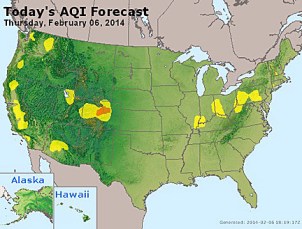
People with heart disease should check the daily Air Quality Index forecast, which is color coded, to protect their health. At code orange or higher, particle pollution can be harmful to people with heart disease. On bad air quality days, it is recommended to reschedule outdoor exercise or exercise indoors instead, and avoid exercising near busy roads.

Air Quality Index forecasts for more than 400 cities are available on the forecast map through the free AirNow app for iPhone and Android phones, and through the free EnviroFlash e-mail service. To sign up, visit here and click on the “Apps” or “EnviroFlash” icons.

via Joplin Independent: Air quality index shows cities that up health risk.

Posted in Air Quality, USA & Canada | Tagged , , | Leave a comment