Air pollution worsened by climate change set to be more potent killer in the 21st century

This century, climate change is expected to induce changes in air pollution, exposure to which could increase annual premature deaths by more than 100,000 adults worldwide. Based on the findings from a modelling study published in Springer’s journal Climatic Change, lead author Dr. Yuanyuan Fang, formerly at Princeton University and now at the Carnegie Institute for Science at Stanford, urges, in the face of future climate change, stronger emission controls to avoid worsening air pollution and the associated exacerbation of health problems, especially in more populated regions of the world.

Fang and her colleagues ran various present and future simulations using the Geophysical Fluid Dynamics Laboratory Atmospheric Model version 3 (AM3), one of the first fully coupled global chemistry-climate models to integrate atmospheric dynamics, chemistry and physics. An earlier version of this model was ranked among the best in the Intergovernmental Panel on Climate Change Fourth Assessment Report (IPCC AR4). The research team examined the impact of climate change on surface air quality, and how this influences global health statistics. Under a moderate climate change scenario, the simulated global surface temperature and precipitation increased by 2.7⁰C and 6 percent respectively, consistent with findings from the recent IPCC AR4 report.

Climate change is believed to harm human health in a variety of ways, including through adverse changes in food production, heat stress, sea level rise, increased storm intensity, flooding and droughts, and increased incidence of vector-borne diseases. In addition, climate change indirectly impacts health by influencing concentrations of air pollutants, such as surface ozone and fine particulate matter (smaller than 2.5 micrometers in diameter), including sulphate, nitrate, fine dust particles and black carbon. These pollutants are linked with increased risks of lung cancer and respiratory, cardiopulmonary, cardiovascular and all-cause deaths.

This study shows that climate change will exacerbate air pollution and associated health risks globally and especially over heavily populated and polluted regions of East Asia, South Asia and North America. The increased health risks are mainly driven by an increase in fine particulate matter under climate change. Weaker cyclones and more stagnation over the northeastern United States under future climate conditions are found likely to increase levels of harmful surface ozone over this region.

Assuming emissions of air pollutants remain constant, Fang and her colleagues predict that 21st century climate changes will increase air pollution-related premature mortality from all causes worldwide by approximately 100,000 deaths annually. Deaths associated with respiratory diseases because of ozone inhalation could increase by 6,300 deaths annually. The corresponding years of life lost annually (an estimate of the number of years of life lost for each premature death relative to life expectancy) was calculated to be an extra 900,000 years, based on regional statistics provided by the World Health Organisation.

Co-author Prof. Denise Mauzerall, Dr. Fang’s post-doctoral advisor at Princeton, said, “This climate penalty indicates that stronger emission controls will be needed in the future simply to meet current air quality standards and to avoid higher health risks associated with the worsening of air quality as a result of climate change.”

“In the future, to improve air quality and protect human health, environmental policies that reduce emissions of greenhouse gases and warming aerosols, in addition to traditional air pollutants, will be beneficial,” Fang advised.

via Air pollution worsened by climate change set to be more potent killer in the 21st century.

Posted in Air Quality | Tagged , , , , | Leave a comment

London’s worst performing boroughs for air pollution revealed

Three quarters of main roads in London have illegal levels of air pollution.

The figures have been released by London Assembly Green Party Member Jenny Jones and show all of Camden’s main roads break the European legal limits for nitrogen dioxide, along with the City of London and Kensington and Chelsea.

Bromley was the only borough with fewer than half of its main roads below the legal limit for air pollution.

Here is the list in full:

City of London – 100% over European legal limit

Westminster – 100% over European legal limit

Kensington and Chelsea – 100% over European legal limit

Camden – 100% over European legal limit

Tower Hamlets – 97% over European legal limit

Hammersmith and Fulham – 100% over European legal limit

Islington – 99% over European legal limit

Southwark – 95% over European legal limit

Lambeth – 96% over European legal limit

Hackney – 98% over European legal limit

Wandsworth – 95% over European legal limit

Newham – 87% over European legal limit

Lewisham – 88% over European legal limit

Ealing – 88% over European legal limit

Brent – 82% over European legal limit

Hounslow – 84% over European legal limit

Greenwich – 79% over European legal limit

Waltham Forest – 75% over European legal limit

Barnet – 78% over European legal limit

Haringey – 88% over European legal limit

Enfield – 77% over European legal limit

Kingston-upon-Thames – 76% over European legal limit

Redbridge – 81% over European legal limit

Barking and Dagenham – 76% over European legal limit

Hillingdon – 66% over European legal limit

Merton – 74% over European legal limit

Richmond-upon-Thames – 66% over European legal limit

Croydon – 62% over European legal limit

Bexley – 56% over European legal limit

Sutton – 51% over European legal limit

Havering – 57% over European legal limit

Harrow – 56% over European legal limit

Bromley – 45% over European legal limit

via London’s worst performing boroughs for air pollution revealed | London – ITV News.

Posted in Air Quality, London, UK | Tagged , , , , , , , | Leave a comment

Beijing fires up new air pollution regulations

Beijing has this week made good on the government’s pledge to launch a crackdown on air pollution following the deadly smog that afflicted the city earlier this year.

In a widely anticipated move, the municipal government unveiled a new five year plan designed to reduce levels of PM 2.5 pollution by at least 25 per cent by 2017 through tough new restrictions on vehicle emissions, power plants and outdoor barbecues or boilers.

The new plan, which was reported through the state-backed Xinhua news agency, pledges to ensure that vehicle ownership in the city does not increase from current levels of 5.35 million to over six million, while also ensuring that fuel consumption across the fleet falls five per cent against 2012 levels.

It also confirms that time and area restrictions will be imposed on passenger cars from next year, while some officials are also calling for higher parking charges and fuel levies.

“In order to curb vehicle emissions, we have to introduce a market mechanism to reduce intensity of vehicle use,” Li Kunsheng, an official in charge of vehicle emission management with the Beijing Municipal Environmental Protection Bureau, was quoted as saying.

The business community could also face major new air quality restrictions, with 1,200 companies set to face official orders requiring them to upgrade equipment or close parts of their facilities by 2016. Xinhua reported that companies that fail to meet new pollution targets would be ordered to shut down completely.

In addition, those regions that have the worst air pollution will not be able to grant planning permission to new industrial facilities, while promised energy and water market reforms are expected to drive up costs for industrial users, providing them with a further incentive to improve their efficiency.

via Beijing fires up new air pollution regulations – 04 Sep 2013 – News from BusinessGreen.

Posted in Air Quality, Asia, China | Tagged , , , | Leave a comment

Respro® Masks FAQ: Can the mask be washed?

Can the mask be washed?

It is recommended that you wash the neoprene shell of the mask every month under normal use. To do this it is necessary to remove the filter and the valve first. Although spare valves and filters are available from your retailer, please be careful not to misplace any of the components during maintenance.

For more FAQ,  see Respro® Mask FAQ

Posted in Air Quality | 2 Comments

Shanghai begins forecasting air pollution

Shanghai’s Air Quality Index AQI will range from 40 to 60 in the afternoon Monday, indicating good or excellent air quality, according to the city’s first air pollution forecast.

The Shanghai Environmental Monitoring Center and the Shanghai Meteorological Bureau began Sunday releasing a 24-hour forecast for the AQI, the city’s primary gauge of air pollution, to inform residents what kind of air quality to expect for the day to come.

The two agencies will release the forecast around 5 pm each day, according to the Shanghai Environmental Monitoring Center. The forecast will predict the levels of air pollution over three periods: from 8 pm on the day of the forecast to 6 am the following day, from 6 am to noon and from noon to 8 pm. It will also disclose which of the air pollutants it tracks is most prevalent over each period.

The forecast is based on computer models that crunch weather and pollution data from the past, said Li Juan, an engineer from the Shanghai Environmental Monitoring Center. “Apart from the weather information, mostly related to wind and temperature, we will look at historical pollution data,” Li told the Global Times.

The center has built several models for the AQI based on the data it has collected.

“These models can show us what causes certain types of pollution and will also help us analyze the index’s forecast,” she said.The pollutant known as PM 2.5 has been the most difficult to predict. “The PM 2.5 index can drastically change in accordance with emissions and temperatures,” she said.

The monitoring center plans to extend the forecast to 48 hours in the near future.

The forecast can be found at http://www.semc.gov.cn.

via Shanghai begins forecasting air pollution – CHINA – SHANGHAI – Globaltimes.cn.

Posted in Air Quality, Asia, China | Tagged , , , , | Leave a comment

Yosemite Wildfire Update: Smoke Prompts Bad Air Warnings in Nevada

The giant wildfire burning at the edge of Yosemite National Park has not only destroyed buildings and threatened water supplies, electricity and sequoias, it has also unleashed a smoky haze that has worsened air quality more than 100 miles away in Nevada.

The plume from the Rim Fire in California triggered emergency warnings in the Reno and Carson City area. Schoolchildren were kept inside for the second time in a week, people went to hospitals complaining of eye and throat irritation and officials urged people to avoid all physical activity outdoors.

“It’s five hours away,” said 22-year-old bartender Renee Dishman in disbelief after learning that the source of the haze was more than 150 miles away. “I can’t run. I can’t breathe. It makes me sneeze.”

The Rim Fire, so far, has burned through 280 square miles, destroyed 23 structures and threatened water supplies, hydroelectric power and giant sequoias. On Tuesday night, authorities said the blaze was 20 percent contained.

Winds over the next few days will not help contain the spread of smoke and fire.

“Into Thursday, breezy conditions are expected with winds of 10 to 20 mph in the higher terrain,” said weather.com meteorologist Chris Dolce.

“Although a slight chance of an afternoon thunderstorm cannot be ruled out, it appears the greater chances will be south of the fire. Lightning strikes from any storms that do form have the potential to start new fires in the region.”

In Nevada, the biggest impact of the Rim Fire was on the air. The air quality index briefly surpassed the rare “hazardous” level east of Lake Tahoe before improving slightly. It hovered around the next-most serious stage of “very unhealthy” for all populations in the Reno-Sparks area 30 miles north.

Dennis Fry, a Reno auto body specialist for nearly 30 years, remembered smoke this thick when he worked on a logging crew and helped fight fires in Oregon during the 1970s.

“But never in Reno, not this bad,” he said. “You could actually see the smoke inside my body shop.”

Everyone should avoid all physical activity outdoors when the air quality index reaches “hazardous,” considered “emergency conditions,” the Nevada Division of Environmental Protection said on its website. “People with heart or lung disease, older adults and children should remain indoors and keep activity levels low.”

Renown Regional Medical Center in Reno has experienced a “slight increase” in emergency room visits as a result of the smoke, said Jennifer Allen, the hospital’s clinical nursing supervisor.

“Patients are experiencing shortness of breath, eye and throat irritation, cough and headache due to the heavy smoke and poor air quality,” she said, adding that people with asthma and other respiratory ailments were most affected.

The pollution levels are among the worst ever recorded for small particulates around Carson City in the state’s air monitoring records dating to 2000, according to JoAnn Kittrell, public information manager for Nevada Division of Environmental Protection. The air quality briefly moved into the “hazardous” level in some areas on Friday as well, she said.

“It’s very unusual,” she said. “We just happen to be in the direct path of the plume from Yosemite.”

The previous peak reading in Reno came on Friday when the air quality index closed in on the “very unhealthy” stage. Schoolchildren were kept indoors during recess, high school football practices and scrimmages were canceled through the weekend and an annual air show at Lake Tahoe was canceled due to low visibility.

Carol Chaplin, executive director Lake Tahoe Visitors Authority, said some hotels and motels reported cancellations earlier in the week, but so far there hasn’t been any major impact for the upcoming Labor Day weekend. “I could lie and say it’s not affecting anything, but it is,” she said. She said visibility in the scenic Tahoe Basin ebbs and flows with the shifting winds.

“I still see people out on the lake,” she said. “At least we’re not on fire.”

The fire caused air pollution problems in California cities far away from the fire, including those in the Sacramento region.

Two dozen competitors in the 25th annual Best in the West Nugget Rib Cook-Off were taking it in stride as they prepped their grills for the barbeque festival running Wednesday through Labor Day in Sparks. The air around the event is usually filled with smoke, albeit a different kind when the barbeque festival’s in town.

“You can’t have too much smoke at a barbeque,” said Mike Peters of Springfield, Mo., a member of the Kansas City Barbeque Society’s Great American Barbeque Tour Team. “We’re just going to add a little hickory smell to it.”

via Yosemite Wildfire Update: Smoke Prompts Bad Air Warnings in Nev. | Weather Underground.

Posted in Air Quality, USA & Canada | Tagged , , , , , , | Leave a comment

Study: Air pollution causes 200,000 early deaths each year in the U.S.

us

Researchers from MIT’s Laboratory for Aviation and the Environment have come out with some sobering new data on air pollution’s impact on Americans’ health.

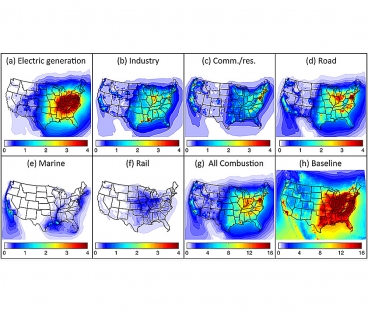
The group tracked ground-level emissions from sources such as industrial smokestacks, vehicle tailpipes, marine and rail operations, and commercial and residential heating throughout the United States, and found that such air pollution causes about 200,000 early deaths each year. Emissions from road transportation are the most significant contributor, causing 53,000 premature deaths, followed closely by power generation, with 52,000.

In a state-by-state analysis, the researchers found that California suffers the worst health impacts from air pollution, with about 21,000 early deaths annually, mostly attributed to road transportation and to commercial and residential emissions from heating and cooking.

The researchers also mapped local emissions in 5,695 U.S. cities, finding the highest emissions-related mortality rate in Baltimore, where 130 out of every 100,000 residents likely die in a given year due to long-term exposure to air pollution.

“In the past five to 10 years, the evidence linking air-pollution exposure to risk of early death has really solidified and gained scientific and political traction,” says Steven Barrett, an assistant professor of aeronautics and astronautics at MIT. “There’s a realization that air pollution is a major problem in any city, and there’s a desire to do something about it.”

Barrett and his colleagues have published their results in the journal Atmospheric Environment.

Barrett says that a person who dies from an air pollution-related cause typically dies about a decade earlier than he or she otherwise might have. To determine the number of early deaths from air pollution, the team first obtained emissions data from the Environmental Protection Agency’s National Emissions Inventory, a catalog of emissions sources nationwide. The researchers collected data from the year 2005, the most recent data available at the time of the study.

They then divided the data into six emissions sectors: electric power generation; industry; commercial and residential sources; road transportation; marine transportation; and rail transportation. Barrett’s team fed the emissions data from all six sources into an air-quality simulation of the impact of emissions on particles and gases in the atmosphere.

To see where emissions had the greatest impact, they removed each sector of interest from the simulation and observed the difference in pollutant concentrations. The team then overlaid the resulting pollutant data on population-density maps of the United States to observe which populations were most exposed to pollution from each source.

continue reading Study: Air pollution causes 200,000 early deaths each year in the U.S. – MIT News Office.

Posted in Air Quality, Health Effects of Air Pollution, USA & Canada | Tagged , , , , | Leave a comment

Haze in Penang worsens, air quality almost at ‘unhealthy’ level

The haze detected in several areas in Penang yesterday has worsened, with the air quality almost at the unhealthy level today.

State Health, Welfare, Caring Society and Environment Committee chairman Phee Boon Poh said the air pollution index in Perai was 80; in Seberang Jaya, 92, and in Universiti Sains Malaysia, 88, as at 9 am today compared to between 58 and 63 yesterday evening.

The air pollution level is categorised as hazardous when the reading is 301 or more; very unhealthy at 201 to 300; unhealthy at 101 to 200; moderate at 51 to 100 and good at zero to 50.

Phee said the state government had made available face masks for distribution free to school children.

He advised the people to reduce outdoor recreational activities and drink plenty of water.

Those who had a cough and experienced breathing difficulties should seek medical treatment, he said.

via Haze in Penang worsens, air quality almost at ‘unhealthy’ level | Malaysia | The Malay Mail Online.

Posted in Air Quality, Asia | Tagged , , , | Leave a comment