Death in every breath you take: Air pollution in Delhi at its most lethal level ever

Air pollution has returned to haunt Delhiites and this time it appears to be more lethal than ever.

Residents of the national Capital, who were breathing easy after the introduction of CNG and green vehicles in the past few years, have reason to worry about the air they inhale.

A recent study by Jawaharlal Nehru University (JNU) has revealed that the air in Delhi is full of carcinogenic (cancer causing) particles. JNU’s department of environmental sciences has come out with a toxicological risk assessment report that points out alarming levels of aerosol and heavy metals in the city’s air.

The study was sponsored by the University Grants Commission and supported by the Ministry of Environment and Forests and published by the National Academy of Sciences recently.

The presence of particulate matter (PM), inhalable particles, in both diameter – PM2.5 and PM10 – and cancercausing heavy metals such as nickel and cadmium in the Capital’s air has been found to be exceeding the permissible limits at peak traffic hours.

continue reading Death in every breath you take: Air pollution in Delhi at its most lethal level ever | Mail Online.

Posted in Air Quality, Asia, India | Tagged , , , , | Leave a comment

Respro® Masks FAQ: What filters do I need for the X-treme™ masks?

What filters do I need for the X-treme™ masks?

Essentially the filters in the X-treme™ function in the same way as the City™ and Sportsta™ filters do. The X-treme™ mask for sports utilises the particulate filtration ability of the Sportsta™ and the X-treme™ mask for urban use, uses activated carbon as its filtration medium.

For more FAQ,  go to Respro® Mask FAQ

Posted in Air Quality | Tagged | Leave a comment

Bradford Council reveals plan to tackle air pollution

Low emission zones, bio-fuels and car-sharing initiatives are just some of the ideas being suggested to tackle pollution in Bradford.

Around one in 20 deaths in Bradford is caused by air pollution, it has been revealed.

Although much of the district enjoys some of the best air quality in the UK, pollution on urban roads exceeds safe levels set by the European Union and traffic fumes are named as the main culprit.

Air quality is particularly bad on Mayo Avenue, Thornton Road, Manningham Lane and the Shipley-Airedale Road, all in Bradford, a new Bradford Council report says.

Diesel fumes are particularly dangerous, with high-risk groups such as truck drivers being 40 per cent more likely to get lung cancer than the average person.

Separately, results of a new international study by The Lancet were revealed yesterday, which showed air pollution was harming, and even killing, people with weak hearts. Experts estimate the toll includes thousands of Britons each year.

The EU is expected to take action against the UK Government for breaching the Air Quality Directive in a number of areas, including West Yorkshire, which has the fourth- highest level of the pollutant nitrogen dioxide in the UK.

Bradford Council fears if the Government is fined for these breaches, these fines could be passed down to local authorities for not doing enough to improve air quality in their areas.

Now the Council has begun a public consultation into the ways it can reduce air pollution. In a new ‘Low Emission Strategy’, it has put forward a number of suggestions, including:

* Considering low emission zones, which only allow buses or HGVs to enter certain areas if they meet green standards.

* Helping bus and freight companies to invest in greener fleets, such as hybrid or electric vehicles.

* Promoting the development of plants producing the vehicle fuel biomethane.

* Applying for grants to fund a network of new charging points for electric cars across the district.

* Supporting the uptake of car clubs and car sharing initiatives.

Councillor Andrew Thornton, executive member for the environment, said: “Transport is now the major contributor to our air quality problems. We are currently having a consultation on low emission strategies which the public can comment on.

“Our objective is to look at all areas of the Council’s activities and see where we are capable of influencing vehicle emissions and reducing them.”

He said the Council was committed to protecting the health of its residents and the new strategy outlined how it hoped to reduce the impact of emissions on public health. The public consultation runs until July 31. To have your say, visit bradford.gov.uk.

via Bradford Council reveals plan to tackle air pollution (From Bradford Telegraph and Argus).

Posted in Air Quality, UK | Tagged , , , , | Leave a comment

China to Report Air Pollution Monitoring Data in 116 More Cities

China widened its air-quality monitoring rules, asking more cities to report data as the nation seeks to combat high levels of pollution.

A State Council notice told 116 more of its cities to disclose air quality monitoring data, including readings for pollutants such as PM2.5 and ozone, adding to 74 cities that already do so. PM2.5 refers to fine air particles that pose risks for lung and heart diseases.

The country will rank its major cities by the severity of their air pollution, according to the statement, posted on the State Council website yesterday and dated July 1.

The planned disclosures comes as a study by researchers from the Massachusetts Institute of Technology and Peking University found that people in northern China may be dying five years sooner than expected because of diseases caused by air pollution, an unintended result of a decades-old policy providing free coal for heat.

The study’s conclusion “is biased and not credible as there were not a lot of samples,” Liu Zhiquan, the Ministry of Environmental Protection’s deputy director of technology standards, was citing as saying by China News Service in a report on its website yesterday.

China plans also to increase the number of cities curbing auto purchases to fight pollution and congestion, the government-backed car association said yesterday.

Eight cities — Chengdu, Chongqing, Hangzhou, Qingdao, Shenzhen, Shijiazhuang, Tianjin and Wuhan — will probably introduce measures limiting auto purchases, Shi Jianhua, deputy secretary general of the China Association of Automobile Manufacturers, said at a briefing in Beijing, without being more specific about the timing.

via China to Report Air Pollution Monitoring Data in 116 More Cities – Bloomberg.

Posted in Air Quality, Asia, China | Tagged , , , | Leave a comment

Air pollution ‘harmful for those with failing hearts’

Air pollution is harming people with weak hearts – even killing them, a big international study reveals.

Experts estimate the toll includes thousands of Britons each year.

The British Heart Foundation, which funded The Lancet work, says the UK must clean up its air – many of its cities often exceed safe levels set by the European Union.

The government has already admitted that in 15 regions, air quality will breach EU limits until 2020.

But Defra says it is committed to improving air quality and that most parts of the UK meet EU air quality limits for all pollutants.

Air pollution, largely from traffic fumes, has previously been linked to heart attacks but not heart failure.

This happens when the heart muscle becomes weak and less good at its job of pumping blood around the body. It is often the consequence of a heart attack and affects more than 750,000 people in the UK.

Deep into lungs

The Lancet research looked at 35 studies with data for thousands of patients in 12 countries, including the UK, the US and China.

The strongest link was found with gases such as carbon monoxide and nitrogen dioxide, as well as fine particulate air pollution – fumes from buses, taxis and lorries that can get deep into the lungs and, from there, into the bloodstream.

People with already weakened hearts who were exposed to high levels, by living near to or travelling along busy roads, for example, were particularly susceptible.

And the increased risk seems to be strongest on the day of exposure.

Dr Anoop Shah and colleagues who carried out the work say moderate reductions in air pollution could avoid 8,000 US hospital admissions for heart failure each year.

“There’s no reason why the impact wouldn’t be similar in the UK.”

Alan Andrews of the lobby group Client Earth said: “The UK has a big problem with air pollution, particularly from road traffic, and the government response sadly has been worse than useless.”

He said people should be alerted when pollution levels are high so that they can take measures to protect themselves, by staying indoors when possible and avoiding busy roads.

According to the World Health Organization, air pollution in towns and cities kills 1.3 million people globally each year.

UK estimates suggest nearly 30,000 people die prematurely each year as a direct result of exposure to air pollution. Air pollution has been linked to asthma and other lung diseases, including cancer, as well as heart problems.

The Chief Medical Officer recently highlighted the impact of air pollution in her first annual report on the state of the nation’s health – air pollution was highlighted among the top 10 causes of mortality in the UK.

via BBC News – Air pollution ‘harmful for those with failing hearts’.

Posted in Air Quality, Health Effects of Air Pollution, UK | Tagged , , , , , , , , , , | Leave a comment

Northern China’s air pollution reduces life expectancy by 5.5 years – study

Air pollution causes people in northern China to live an average of 5.5 years shorter than their southern counterparts, according to a study released on Monday which claims to show in unprecedented detail the link between air pollution and life expectancy.

High levels of air pollution in northern China – much of it caused by an over-reliance on burning coal for heat – will cause 500 million people to lose an aggregate 2.5 billion years from their lives, the authors predict in the study, published in the journal the Proceedings of the National Academy of Sciences.

The geographic disparity can be traced back to China’s Huai River policy which, since it was implemented between 1950 and 1980, has granted free wintertime heating to people living north of the Huai river, a widely-acknowledged dividing line between northern and southern China. Much of that heating comes from the combustion of coal, significantly impacting the region’s air quality.

“Using data covering an unusually long timespan – from 1981 through 2000 – the researchers found that air pollution … was about 55% higher north of the river than south of it,” the MIT Energy Initiative said in a statement.

“Linking the Chinese pollution data to mortality statistics from 1991 to 2000, the researchers found a sharp difference in mortality rates on either side of the border formed by the Huai River. They also found the variation to be attributable to cardiorespiratory illness, and not to other causes of death.”

The researchers, based in Israel, Beijing, and the Massachusetts Institute of Technology, gauged the region’s air quality according to the established metric of “total suspended particulates (TSP),” representing the concentration of certain airborne particles per cubic meter of air.

The study concluded that long-term exposure to air containing 100 micrograms of TSP per cubic meter “is associated with a reduction in life expectancy at birth of about 3.0 years.”

Air pollution has been the subject of widespread public outrage in China since January, when Beijing’s air quality index (AQI) – a similar metric to TSP – regularly exceeded 500, the scale’s maximum reading, for weeks on end. On 12 January, Beijing’s AQI hit a record 755, 30 times higher than levels deemed safe by the World Health Organisation.

Past studies have established a link between air pollution and reduced life expectancy. One recent large-scale study concluded that air pollution contributed to 1.2 million premature deaths in China in 2010.

Yet according to Michael Greenstone, an economics professor at MIT and one of the study’s authors, this study is the first to precisely quantify their relationship. “Demonstrating that people die a bit earlier [because of pollution] is interesting and helps establish that pollution is bad,” he said. “But the most important question, the next question that needed to be answered, is what’s the loss of life expectancy? How much should society be willing to pay to avoid high levels of pollution? This study was structured so we could answer that question.”

China’s central authorities are keenly aware that environmental degradation has become one of the country’s leading causes of social unrest. Last month, China’s cabinet revealed 10 new measures intended to combat air pollution, and state media reported that Chinese courts can now impose the death penalty on serious polluters.

via Northern China’s air pollution reduces life expectancy by 5.5 years – study | Environment | guardian.co.uk.

Posted in Air Quality, Asia, China, Health Effects of Air Pollution | Tagged , , , , , , | Leave a comment

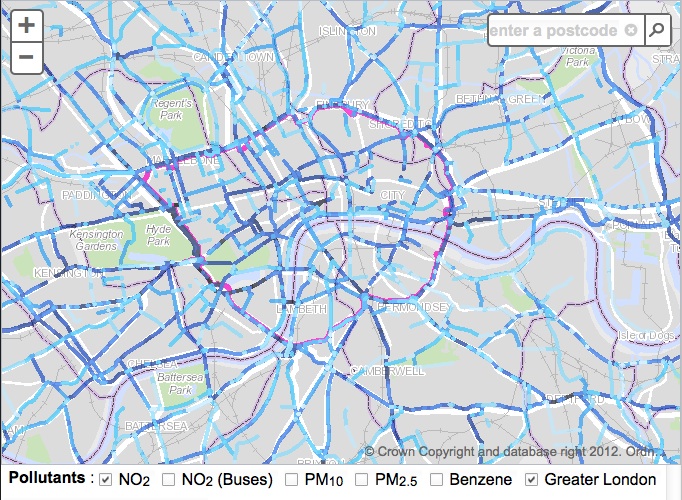
Interactive guide to pollution in London

UntitledWith the highest levels of nitrogen dioxide of any capital city in Europe, London’s air pollution from traffic is linked to strokes, heart and respiratory diseases as well as some cancers and asthma. Enter a postcode to see how polluted your road is

Interactive guide to pollution in London | Environment | guardian.co.uk.

Posted in Air Quality, London, UK | Tagged , | Leave a comment

Respro® Sportsta™ Mask Review by webBikeWorld

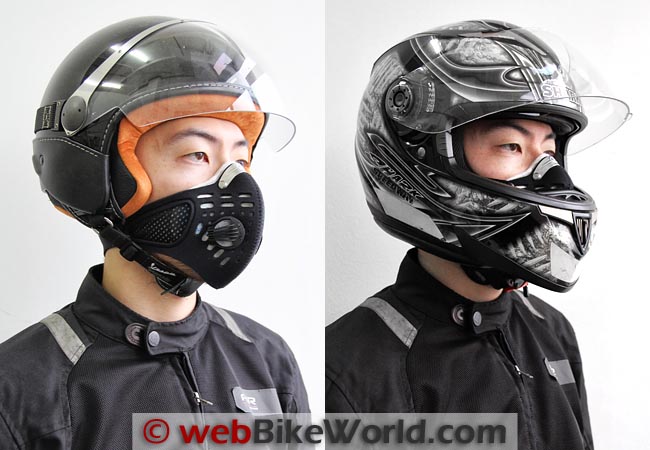
respro-sportsta-mask-with-helmetsSummary

Riders who commute regularly in urban environments with lots of congestion and/or air pollution have to take extra steps to protect their long-term health.

UK company Respro makes masks to help you breathe a little easier.

Introduction

Motorcycles are superior commuting devices in almost every respect.

They’re light, efficient and fun.

As a biker, once you get over the weather and danger issues (or if you do) then there’s not much else to think about.

But the world is getting more crowded. Cities especially see more airborne pollution from all types of vehicles and many different industries too.

While all the car drivers are stuck in their death boxes, bikers are out there having all the fun — except when it comes to being exposed to airborne pollution.

Do You Need a Sportsta?

According to the U.S. Environmental Protection Agency (EPA), the major constituents of airborne pollutants are particulate matter, which are “a mixture of microscopic solids and liquid droplet suspended in the air”.

These tiny particles can have a number of origins, including acids (of nitrate and sulfur), organic chemicals (a broad term for any chemicals with carbon), metals, soil, dust and allergens (pollen, fungi, mold spores). It all sounds like a nasty cocktail and it is, since all these substances can have an effect on your personal health.

The EPA says that particles less than 10 micrometers in diameter (known as PM 10s) are the most dangerous, since they can be inhaled easily and penetrate deep into the lungs. Things like dust and ash are around this size.

One micrometer is equal to 0.0001 millimeter, so even at 10 micrometers, these are very, very small particles. The Pima County, Arizona (U.S.A.) Department of Environmental Quality has a very good web page with a simple description of particulate matter and health effects.

Particles smaller than 2.5 micrometers (PM 2.5) in diameter are even more dangerous, and can even get into where gas exchange (blood and oxygen/carbon dioxide) occurs between the lung and bloodstream. PM 2.5s include soot, smog and fine dust.

Short term effects include eye irritation, bronchitis, respiratory infections, while long term effects include reduced lung function, chronic lung/heart diseases and respiratory diseases such as asthma.

According to the British medical publication The Lancet, exhaust pollution is the singular biggest, and most preventable, cause of heart attacks to the general public — 7.5 percent of the total.

Respro Sportsta Mask With Helmets

The Sportsta isn’t specifically designed for motorcycling but can fit in open- or full-face helmets.

The Respro Sportsta Mask

British safety equipment company Respro makes products to help you avoid most of this nasty stuff. Respro makes a wide range of respirator products for industry (hence the name, we guess) but also some interesting motorcycle-related products also, like the high-viz “Hump” backpack cover, the Respro Foggy anti-fog mask and raincoats for leather racing suits.

But it’s the filtration masks we’re most interested in here, which is why we purchased a Respro Sportsa mask and an additional Respro “Techno” filter to test for use during commutes.

Respro lists three different masks as being most applicable for bikers: the City, the Sportsta and the Techno (there is a Techno mask and and a Techno filter, which is a bit confusing). Each mask has a replaceable filter unit inside; the filters are standardized so any filter can be used in any mask type.

In brief, the Respro City mask is for cycling, walking or urban commuting, while the Sportsta is designed with rural use in mind, including sports such as adventure-touring, off-road riding, motocross, mountain biking, horseback riding, snowboarding and others.

The Respro City mask has less ventilation and is equipped with a “Techno” filter, which has more filtering properties. The Techno mask combines characteristics of both the City and Sportsta masks, taking the Sportsta’s breathability and combining it with the extra filtering capacity (activated charcoal layer) of the City.

According to Respro, the Sportsta mask is equipped with a filter that has “sub-micron” capability, which (supposedly) means that it can filter out particulates less than 1.0 micrometer in size, up to a quoted minimum of 0.3 microns. This filter is of the HEPA type, or “High-Efficiency Particulate Air” and made of fibreglass fibres, which trap particulate matter and/or pollutants.

Compared to the City mask, the Respro Sportsta also has higher ventilation rates, which helps if it’s used during rigorous activities. The two breathing valves (one on each side) on the Sportsta mask are of the high-flow “Powa” type.

The Sportsta mask will filter out most of the bad stuff in air pollution, with the exception of gaseous pollutants, such as sulphur dioxide and nitric oxide. Those are atom-sized gases, so you can’t really filter them out with a particulate filter.

Respro says the Sportsta mask meets the requirements for filtering as set down by the ECE directive number EN 149FFP1(S) for solid aerosol products and is “usable in all outdoor sports pursuits requiring respiratory protection”.

The Techno filter in the Respro City and Techno masks (again, it’s a bit confusing) has the same sub-micron properties as the Sportsta, but it also includes an activated charcoal cloth layer and valves with lower flow.

The charcoal cloth layer is what makes it more effective, and can remove benzene, pyrene, oxides of sulphur and nitrogen (significant components of exhaust fumes) lead oxide and soot, as well as volatile organic compounds.

continue reading Respro Sportsta Mask Review – webBikeWorld.

Posted in Respro® Mask Reviews | Tagged , , | Leave a comment