MPCA issues air pollution advisory through Monday

The Minnesota Pollution Control Agency has issued a health advisory for the Twin Cities and Rochester areas as ozone pollution nears levels considered unhealthy for sensitive groups.

The advisory became effective on Sunday and will last through Monday as mostly-sunny skies, temperatures in the low 90s and light winds from the south continue to enhance ozone formation.

On Sunday, the Air Quality Index was expected to reach 97 in both the Twin Cities and Rochester, with concentrations expected to peak between 1 p.m. and 9 p.m. and fall overnight. Officials expect the ozone concentration will rise to 93 on Monday afternoon.

continue reading MPCA issues air pollution advisory through Monday – KMSP-TV.

Posted in Air Quality, USA & Canada | Tagged , , , | Leave a comment

Colorado, Arizona, Indonesia: Wildfires and Air Quality Concerns

Recent wildfires in Indonesia and the USA have been making the headlines – how will these deadly and destructive blazes affect us?

In Colorado, a series of fires have been blazing across the state since June 10th resulting in deaths, damage to property and displacement from homes. Over 115,000 acres of the Centenniel State have been affected.

In Arizona, the fire which was sparked by lightning on June 28th captured public hearts after 19 elite fire fighters perished in the blaze.

The fires in both states are still not yet fully under control.

Illegal slash-and-burn forest clearance in Indonesia caused the Pollution Standards Index in Singapore to reach 401 out of 500, the highest level in the country’s history. The public were recommended against any excessive activity and advised to stay indoors.

The most obvious effects of wildfires on humans are direct loss of life and destruction of property. Less direct, and therefore less obvious, is the effect of wildfire air pollution on humans. While research investigating the health effects of urban air pollution is now commonplace, studies looking at wildfires in particular are more scarce.

This is largely due to the unpredictable nature of wildfires, and has consequences for the public perception of the hazard. Importantly, the frequency and magnitude of these events appear to be increasing. A study at the University of California identified a fourfold increase in wildfire occurrences in the Western USA, and a six fold increase in affected areas since the mid 1980s.

What’s Wildfire Smoke Made Of?

Wildfire smoke is a complex mixture of water vapour, carbon dioxide, particulate matter, carbon monoxide, hydrocarbons, nitrogen oxides and trace minerals. Dr Kelly BéruBé, head of the Lung and Particles Research Group at Cardiff University, UK, told Decoded Science that of all wildfire smoke constituents particulate matter is commonly observed to be of most concern. This is due to its well-substantiated links with adverse health effects and large increases during vegetation burning. Dr BéruBé told us that burning vegetation creates the smallest particles, PM2.5 (particles with a diameter of less than 2.5 μm). These particles are small enough to evade our defense mechanisms, and reach far into the lung, to the gaseous exchange region.

While European law states that daily PM10 (particles with a diameter of less than 10 μm) levels should not exceed 50 μg/m3 (with some exceptions), during wildfire episodes, PM10 is often at levels of hundreds of micrograms.

continue reading Colorado, Arizona, Indonesia: Wildfires and Air Quality Concerns.

Posted in Air Quality, Asia, Health Effects of Air Pollution, Singapore, USA & Canada | Tagged , , , , , , , , , | Leave a comment

Europe must tackle air pollution, warn UN scientists

The health effects of air pollution have been underestimated and Europe should review its laws to tackle the problem, UN scientists have concluded after a major review of new evidence.

Sixty international scientists, commissioned by the World Health Organisation, analysed eight years of studies to see how minute specks of soot, gases such as ozone and nitrogen dioxide (NO2), and other pollutants from road and rail traffic, industry and indoor fires harm human health.

In addition to premature deaths from respiratory and heart diseases, they found links to new conditions such as diabetes and still births and adverse effects on the cognitive development of children born to mothers exposed to even small levels of air pollution.

Studies on NO2, said the report, produced new evidence of long-term effects, “including harm to health at levels below existing EU limit values. The consequences for entire populations, including people with existing respiratory and heart problems, would be significant”, said the report.

The scientists, who included cardiologists, epidemiologists, toxicologists and other public health experts, said that wood fires in the home, and even commuting to work by train and tube could significantly increase exposures to particulate matter, NO2, CO and benzene. Underground rail systems, such as the tube in London, were found to be a major contributor to the exposure to ultrafine particles, black carbon and some metals. Indoor sources of pollution, such as wood fires, also significantly harmed people’s health.

Anne Stauffer, deputy director at the Health and environment alliance (Heal), said the results “are a wake-up call for decision-makers in Europe to take air pollution more seriously. The new findings provide evidence-based science that EU policies are inadequate. Twice as many people suffer from asthma today compared to 30 years ago”.

The study is particularly embarrassing for European governments, which have tried to water down or delay existing air pollution laws. Earlier this year, the supreme court declared that the UK government was failing in its legal duty to protect people from the harmful effects of air pollution.

“Air pollution causes 29,000 early deaths a year in the UK – more than obesity and alcohol combined. This shows the UK is not just on the wrong side of the law, but also on the wrong side of the science. All the evidence tells us we need much stricter legal standards, yet the UK is fighting tooth and nail in the courts to avoid them and lobbying the EU to weaken them,” said Alan Andrews of campaign group Client Earth.

“With the World Health Organisation research now calling for stronger EU air pollution policies, our government must finally take its public health responsibilities seriously. They must take bold action to clean up the dirty air blighting many areas of the UK – at the very least making sure current EU legal limits are met by the dates required,” said Jenny Bates, Friends of the Earth air pollution campaigner.

Air pollution is now recognised by doctors as one of the world’s 10 greatest killers. The Global burden of disease study, published in The Lancet last December, showed exposure to air pollution was associated with more than 430,000 premature deaths a year worldwide.

London, with 4,300 deaths a year, is one of the worst cities in Europe for some pollutants. The city has 2,500 schools and 180,000 children within 150 metres of roads carrying 10,000 or more vehicles a day. Massachusetts Institute of Technology research earlier this year found car exhaust fumes in Britain now caused more premature deaths than road accidents.

via Europe must tackle air pollution, warn UN scientists | Environment | guardian.co.uk.

Posted in Air Quality, Europe, UK | Tagged , , , , , , | Leave a comment

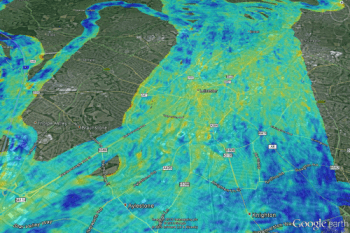
Airborne pollution-scanning device maps Leicester’s air quality

Leicester

University of Leicester physicists used their sophisticated air quality measuring spectrometer to produce striking “heatmap” style images of pollution levels in Leicester as part of the Airborne Air Quality Mapper (AAQM) project.

The images show how levels of nitrogen dioxide (NO2) vary around the city – revealing the differences in air quality between green, wooded areas and busy road junctions and areas of industry.

The results could help draw attention to polluted areas – and help inform future environmental planning decisions.

NO2 comes primarily from traffic emissions in urban environments and can cause health problems – including increased risk of respiratory illnesses such as heart attacks and bronchitis.

The European Commission is pressing the UK Government to find a solution to NO2 in large cities across the country. Large fines may be imposed and new legislation allows these to be passed down to Councils which don’t take urgent action to improve their air quality.

While not among the worst-affected cities, Leicester City Council is in the forefront of developing local and national solutions to this problem through collaborative projects with the University of Leicester and DEFRA. The aim is to develop smart traffic management schemes and reduce vehicle emissions.

As part of the process of developing advanced solutions to this national problem, scientists at the University’s Earth Observation Science group, based in the Space Research Centre, have used their world-leading Compact Air Quality Spectrometer (CompAQS) device to map air quality around the city.

The device monitors visible light – and measures how much light is lost at specific wavelengths absorbed by NO2. Development of the instrument took place with Surrey Satellite Technology Ltd and was funded by the UK’s Centre for Earth Observation Instrumentation and the Natural Environment Research Council. The instrument is part of a major initiative to improve the UK’s technological leadership in space instrumentation for Earth Observation.

continue reading Airborne pollution-scanning device maps Leicester’s air quality.

Posted in Air Quality, UK | Tagged , , , , , , , | Leave a comment

Pollution killing many in Balochistan capital

Stakeholders were not playing their due role to reduce air pollution that was making a large number of people suffer respiratory and skin diseases in Quetta.

This was said by experts who were talking to APP, here on Wednesday.

Dr Munir Ahmed Raisani, chest specialist and former programme manager TB Control Programme Balochistan said ” ongoing construction work on bridges and roads, installation of crushing machines on mountains surrounding Quetta valley and plying of old vehicles were damaging air quality”.

He said that thousands of carbon emitting vehicles in the city that was once called little Paris in past but now not only causing air pollution but noise pollution too that making citizens suffering from depression and respiratory diseases. A large number of patients suffering from respiratory disease, asthma, Tuberculosis and other, daily visit hospitals and private clinics he said adding that carbon, nitrogen, smoke and dust particles in the air causing diseases among people. He revealed that presently, every third person of the city was suffering from respiratory disease because of non-availability of healthy air and environment.

He said that Provincial TB Control Programme conducted a contacted observation survey that unveiled that every 10 to 15 persons out of total 100 might be vulnerable to TB and other fatal respiratory diseases due to air pollution. He said that air pollution could be controlled and improved if attention paid to complete ongoing work on road and bridge construction as early as possible, making the vehicles in dilapidated condition off road, and implementation of rules and regulations strictly to control road traffic. When contacted, renowned scientist and former manager of International Union of Conservation of Nature (IUCN) Balochistan chapter, Zabardast Khan Bangash said that Quetta is narrow valley surrounded by mountains and air enters the city through narrow passage of mountains with speed that also brings dust.

” When carbon dioxide mixes with dust particles and it hovers on the city with rising of temperature at daytime while it could not leave the city because of surrounding high mountains and resultantly, at evening time, it comes down, causing respiratory, skin and lungs diseases,” Bangash said.

He said that Government Vehicular Examiner System had totally failed as the official concerned were allegedly issuing vehicle fitness certificates from their office instead of testing the fitness of vehicle whether it was meeting the standard or emitting carbon, contributing into surging level of air pollution.

continue reading Pollution killing many in Balochistan capital.

Posted in Air Quality, Asia | Tagged , , , | Leave a comment

Air quality diminishes in Treasure Valley due to ozone and smoke, triggering orange air quality alert

The skies over the Valley have become hazy, and the Idaho Department of Environmental Quality is warning those who are sensitive to air pollution to avoid extended periods outdoors.

The alert was issued at 2:35 p.m., and it’s in effect for the remainder of Tuesday. An increase in ozone concentration levels, as well as wildfire smoke, have impacted air quality. The AQI was 115, in the “orange” or unhealthy for sensitive groups category.

Children and the elderly should consider postponing activities outdoors until air quality improves. All others are encouraged to limit driving, combine errand trips, and avoid woodstove and fireplace use.

All open outdoor burning is prohibited in Ada and Canyon counties, as well as all the incorporated cities in those counties.

The air quality forecast for tomorrow is better, though not in the “good” range. A yellow air quality alert for moderate pollution levels has been issued.

via Air quality diminishes in Treasure Valley due to ozone and smoke, triggering orange air quality alert | Boise, Garden City, Mountain Home | Idahostatesman.com.

Posted in Air Quality, USA & Canada | Tagged , , , , , | Leave a comment

Respro® Masks FAQ: How long does the Bandit™ last before it needs replacing?

How long does the Bandit™ last before it needs replacing?

Under normal conditions the Bandit™ will provide the user with approximately six months protection. The Bandit incorporates D.A.C.C. which is specially coated so that it can be washed. It should be washed on a regular basis to maintain optimum performance. Immerse in a pan of boiling water (this releases the petroleum compounds pounds which are attracted to the D.A.C.C.) and leave to cool. Then wash in warm water using a non-automatic washing powder, rinse and leave to dry.

For more FAQ,  go to Respro® Mask FAQ

Posted in Air Quality | Tagged | Leave a comment

Possible hazardous air quality in county

Air quality in portions of Cochise County could be considered hazardous because of the potential for heavy smoke from three fires burning near Cananea, Mexico. Air quality in part is defined by measuring the amount of particulate matter (a measurement of solid and liquid droplets in the air), or by using visibility guides. Any areas that experience visibility less than one mile would be considered to have hazardous concentrations of particulate matter. Excessive, persistent air pollution is a health threat, especially to children, the elderly, and those with pre-existing health problems.

While the fires remain approximately 15 miles south of the US-Mexico border, windy conditions could continue to transport smoke into various areas of Cochise County. People who experience heavy smoke throughout the duration of the fires should stay indoors with doors and windows closed. If the home has air conditioning, people can use it, but should keep the fresh air intake closed and the filter clean. No one should use an evaporative cooler when air quality is poor. For information on determining air quality by visibility, please see the Arizona Department of Health Services guidelines.

Symptoms from short-term exposure to smoke include scratchy throat, cough, irritated sinuses, headaches, runny nose and stinging eyes, and more serious reactions among those in high-risk groups. Elevated levels of particulate matter also increase the potential for asthma attacks and other asthma-related symptoms in children.

Air quality will likely be a concern as long as the fires continue to burn. Anyone who feels they are at risk may want to consider limiting outdoor exposure. People with health issues (heart or lung disease, COPD, emphysema, or asthma) should contact their personal physician if they feel ill as a result of poor air quality. Those wishing to exercise outdoors are cautioned to use good judgment and perhaps choose alternate methods of exercise. Remember, if it looks smoky outside, it is generally not a good time for anyone to engage in outdoor activities.

via Possible hazardous air quality in county – Arizona Range News: News.

Posted in Air Quality, USA & Canada | Tagged , , , , , | Leave a comment