Boris Johnson announces plans for Ultra Low Emission Zone

London could have the world’s first Ultra Low Emission Zone, according to Mayor Boris Johnson who has announced plans to improve air quality.

Only zero and low-emission vehicles would be allowed in the central London zone by 2020, said Mr Johnson.

The AA said it was an ambitious timetable and that the practical and economic impacts needed to be examined.

Clean Air In London said it was a wish list Mr Johnson wants others to do as he would only be mayor until 2016.

London is among the worst in Europe for air pollution.

Environmental Organisation ClientEarth has warned that in terms of European Union rules, London will have “illegal levels of air pollution until 2025”.

A London Assembly report last December found that 9% of deaths in the city were down to air pollution.

In a speech to City Hall, Mr Johnson said: “Creating the world’s first big city ultra low emission zone has the potential to be a game changing moment in the quality of life of our great capital.

“My vision is a central zone where almost all the vehicles running during working hours are either zero or low emission.

“This would deliver incredible benefits in air quality and stimulate the delivery and mass use of low emission technology.”

continue reading… BBC News – Boris Johnson announces plans for Ultra Low Emission Zone.
Posted in Air Quality, London, UK | Tagged , , , , , | Leave a comment

Concern over increasing air pollution in Newhaven

Newhaven

Report to go before Lewes councillors tomorrow which suggests that East Sussex town should be declared an Air Quality Management Area

An Air Quality Management Area (AQMA) is expected to be declared in Newhaven due to increasing air pollution from traffic in the East Sussex town.

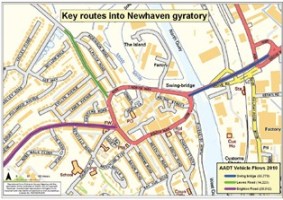
According to detailed assessment of the town’s air quality due to go before Lewes district council’s cabinet tomorrow (February 13), annual mean concentrations of nitrogen dioxide at three monitoring sites in Newhaven may have breached national objectives in 2010.

Lewes district council map of the Newhaven gyratory road in East Sussex

Lewes district council map of the Newhaven gyratory road in East Sussex

The national objective for annual mean concentrations of nitrogen dioxide is 40 micrograms per cubic metre. However, raw diffusion tube monitoring data shows that the annual average breached this objective at several roadside sites: Lewes Road (42.9 micrograms); 9 Southway (60.2 micrograms); and 16 Southway (52.8 mirograms).

The ‘Detailed Review and Assessment of Air Quality in Newhaven’ and an accompanying report will recommend that councillors at tomorrow’s meeting give approval for the assessment to be sent to Defra.

Defra is then ‘likely’ to require the district council to declare an Air Quality Management Area (AQMA) in Newhaven due to increasing traffic pollution, according to the report.

Declaration of an AQMA enables local authorities to more closely monitor pollution levels as well as allowing them to bid for special government funding for schemes to improve air quality.

via Concern over increasing air pollution in Newhaven | AirQualityNews.

Posted in Air Quality, UK | Tagged , , , , | Leave a comment

FAQ: How long does the Bandit™ last before it needs replacing?

How long does the Bandit™ last before it needs replacing?

Under normal conditions the Bandit™ will provide the user with approximately six months protection. The Bandit incorporates D.A.C.C. which is specially coated so that it can be washed. It should be washed on a regular basis to maintain optimum performance. Immerse in a pan of boiling water (this releases the petroleum compounds pounds which are attracted to the D.A.C.C.) and leave to cool. Then wash in warm water using a non-automatic washing powder, rinse and leave to dry.

For more FAQ,  go to Respro® Mask FAQ

Posted in Air Quality | Tagged | Leave a comment

FAQ: What size mask do I need?

With the exception of the Bandit™, the Allergy™ mask (small available) and the FB-1 mask (XL available), there are two sizes available, medium and large. Generally, medium will be suitable for the average size women and large for the average size man. Please use the table below for guidance.

If in doubt, email us the following dimensions and we should be able to guide you to the correct size.

Height:
Weight:
Neck size:
Other notable features to be considered:

See also Respro® Mask Sizing

To find answers to any other questions, see Respro® Mask FAQ

Posted in Air Quality | Tagged | Leave a comment

The new Respro® Cinqro™ mask has finally arrived!

RESPRO® CINQRO™ MASK

RESPRO® CINQRO™ MASK

The Cinqro™ mask focuses on the ‘urban trainer’, the ‘home runner’ or the multi-sport end user where breathing rates are typically higher than your average commuter. Improved comfortability are key to this level of personal endeavor.

For improved air flow and comfortability the two Powa Elite™ valves on the Cinqro™ mask allow faster air flow characteristics when breathing out at elevated breathing patterns, ie when you are giving it the beans from A2B which equates to less back pressure, less dampness in the filter, improved filtration, lower inhalation resistance all of which result in improved comfort and performance.

The Cinqro™ package incorporates a complete mask fitted with a Hepa-Type particle filter for filtering submicron particles like diesel smoke, pollen, brake lining dust and any aqueous water vapor particles that can carry various chemicals in the air. A spare DACC chemical/particle filter is also supplied as part of the package allowing filter interchangeability making the Cinqro™ mask suitable for use in a wider variety of environments from inner cities to the countryside. A graphics rebuild for the look of the mask fits it squarely in the sports arena rather than the ‘scare the hell out of everyone’ arena.

Buy your Respro® Cinqro™ mask here: www.respro.com

Posted in Respro® Masks, Respro® Products | Tagged | 10 Comments

Managing mega-cities’ pollution levels

The pollution monitor on the roof of the US Embassy in Beijing was catapulted into the international spotlight as air pollution deteriorated in the Chinese capital in mid-January.

The instrument broadcasts a Twitter bulletin each hour providing a record of the airborne particle pollution. This peaked at 25 times the World Health Organisation (WHO) guidelines on the 13th implying an increased daily death rate of around 50%. This was a classic example of wintertime smog with cold air settling over the city trapping pollution. Managing Beijing’s air pollution is not easy, typical pollution composition in the Chinese capital reveals fumes from coal burning as well as traffic and heating in the city itself. Beijing is not alone among developing mega-cities; Tehran reported air pollution problems in 2012, with estimates of 4,400 deaths annually.

In the UK cold, settled, weather conditions also lead to brief periods of wintertime smog in many UK cities in January with pollution reaching two to three times the WHO Guidelines. High particulate pollution was measured in Derry on the 10th and 13th January, in London on the 16th and 17th and in the east Midlands in Chesterfield on the 17th and in Nottingham on the 24th. Almost all towns and cities across England and south Wales experienced particulate pollution on the 24th and 25th, ahead of January’s last bout of snow, but a change to wet and windy weather brought low air pollution to end the month.

via Pollutionwatch: Managing mega-cities’ pollution levels | Environment | The Guardian.

Posted in Air Quality, Asia, China, Middle East, UK | Tagged , , , , , | Leave a comment

Krakow’s Air Quality Among the Worst in the World

It is impossible not to notice the thick smogs that periodically blanket Krakow, or to wonder what they are doing to your lungs, but even on seemingly clear days the city’s air is among the most polluted in Europe with levels of contaminants frequently exceeding World Health Organisation safe limits.

Krakow is now firmly established as one of Europe’s top tourist destinations, attracting nine million visitors in 2012. Multinational companies are flocking here, as are young people unable to find jobs elsewhere in Europe. How long before awareness of the city’s poor air quality begins to make the city unattractive, threatening its economic health as well as the health of the people who live here?

According to the air-pollution activism group Krakowski Alarm Smogowy (Krakow Smog Alarm), the city has some of the poorest air quality in the world. They point to figures from the World Health Organisation that rank Krakow as eighth worst among 575 cities globally that record annual mean concentrations of PM2.5 in their air.

PM2.5 (particulate matter smaller than 2.5 microns) and PM10 (smaller than 10 microns) are monitored because they have been shown to be a major cause of asthma, lung cancer, cardiovascular problems, respiratory diseases, birth defects and premature death. Krakow’s standing in the PM 10 rankings is an alarming 145 out of 1,100 cities where annual mean concentrations are recorded.

Placing these figures in perspective, it is important to note that many cities in the world that probably have worse air quality than Krakow’s do not officially record pollution levels. In other words: ‘where annual mean concentrations are recorded’ does not include what are probably the most polluted cities globally.

Despite this small consolation, Cracovians have become increasingly aware, and angry, about the quality of their air. Krakowski Alarm Smogowy was formed in December 2012, and has already gathered over 9,000 followers on Facebook. Describing itself as an: “apolitical, public initiative of Cracovians who want to live in the city and breathe air that is safe for their health and life,” the group has also created an online petition demanding action from the Małopolska Regional Assembly that now has more than 6,500 signatures.

via Krakow’s Air Quality Among the Worst in the World » Krakow Post.

Posted in Air Quality, Europe | Tagged , , , , , | Leave a comment

Air pollution increases chances of low birth-weight babies

Sooty air pollution in towns and cities increases the chances of women giving birth to small babies, new research has shown.

A study involving millions of births around the world found that higher pollution levels raised the risk of low birth-weight.

Although small, the effect is said to be statistically significant. At national population scales it could have an important impact on child health, said the researchers.

Babies are underweight at birth if they tip the scales at less than 2.5kgs, or 5lbs 8oz.

They face an increased risk of dying in infancy, as well as chronic poor health and impaired mental development.

The new study, the largest of its kind ever conducted, focused on tiny sooty carbon particles called PM10s and even smaller PM2.5s which are known to be linked to heart and lung problems and early death.

They originate from a number of sources, including diesel exhausts and the chimneys of coal-fired power stations and factories.

Professor Tanja Pless-Mulloli, who led the UK arm of the study at the Newcastle University, said: “As air pollution increases we can see that more babies are smaller at birth, which in turn puts them at risk of poor health later in life.

“These microscopic particles, five times smaller than the width of a human hair, are part of the air we breathe every day. What we have shown definitively is that these levels are already having an effect on pregnant mothers.”

via Air pollution increases chances of low birth-weight babies | Environment | guardian.co.uk.

Posted in Air Quality, Health Effects of Air Pollution, UK | Tagged , , , , | Leave a comment