FAQ: Do I need to replace the valves?

Do I need to replace the valves?

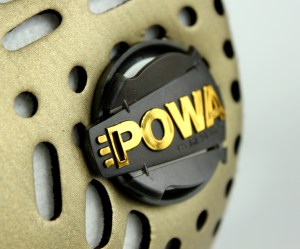
The valves should not need replacing on a regular basis assuming that they are maintained properly. On a monthly basis, it is advisable to flush the valves through with warm water, allow to dry and apply a little talcum powder to prevent the valve from sticking. On the Powa valve, it is essential that you locate the two pins, nearest the hinge, properly into the body of the valve, and check that they are seated properly.

For more FAQ,  go to Respro® Mask FAQ

Posted in Air Quality | Tagged | Leave a comment

Reducing traffic speeds below 40mph may increase toxic pollution, says Transport Research Laboratory report

Reducing the speed of traffic in Britain’s towns and cities would increase pollution, a study by a Scottish carbon reduction group has found.

The Edinburgh Centre for Carbon ­Innovation ECCI has commissioned research by the Transport ­Research Laboratory TRL that showed that, while reduced traffic speeds encourage walking and cycling and reduce the number of crashes, they are linked to higher levels of toxic emissions.

It said: “Reducing urban speed limits has concomitant health, community and safety benefits, but is likely to raise greenhouse gas emissions..”

The report shows that cutting speeds to below 40mph was likely to increase pollution, such as nitrogen oxides and particulates. Carbon dioxide emissions would also go up.

The reason for the air pollution is the increased amount of acceleration and braking in stop-start driving, although crucially, these could be reduced if a way was found for traffic flow was smoothed see the video below for how this was successfully achieved in the Cheshire town of Poynton. The report said 40mph was the optimum speed for minimising vehicle emissions and pollution.

via Reducing traffic speeds below 40mph may increase toxic pollution, says Transport Research Laboratory report | road.cc | Road cycling news, Bike reviews, Commuting, Leisure riding, Sportives and more.

Posted in Air Quality, UK | Tagged , , | Leave a comment

Diesel-powered motor vehicles blamed for most of Philippines air pollution

More than 500,000 diesel-fueled jeepneys, buses, trucks and other vehicles in Metro Manila are responsible for about 70 percent of the total soot or black carbon emissions in the Philippines, according to Climate Change Commissioner Heherson Alvarez.

In a speech before the just-ended 2013 Sustainable Development Summit in New Delhi, a copy of which was furnished to the Philippine Daily Inquirer, Alvarez also reported that “public utility vehicles, mostly jeepneys, produce 22,000 metric tons of soot emissions per year” in the country.

The conference was held from Jan. 31 to Feb. 2 in the Indian capital.

Citing Philippine Environment Monitor figures, the former senator and environment secretary noted that “air pollution costs the Philippine economy some $1.5 billion annually, in large part due to diesel vehicles.”

“The World Bank estimates that some 5,000 annual premature deaths make up 12 percent of all deaths in Metro Manila, the highest of any region in the Philippines, due primarily to respiratory and cardiovascular diseases from exposure to air pollution,” he said.

via Diesel-powered motor vehicles blamed for most of PH’s air pollution | Inquirer News.

Posted in Air Quality, Asia, Philippines | Tagged , , , , , | 2 Comments

NASA Measures Air Pollution Above Bay Area to Determine Effect on Humans

NASA plans to measure hydrocarbons and nitrous oxide by flying as low as 1,000 feet and as high as 26,000 feet

NASA will measure air pollution levels at different heights above the Bay Area in an effort to detect whether they are close to the Earth’s surface — where humans breathe.

Satellites are typically used to measure air quality, but a major issue with this method is that they cannot tell whether pollution is close to the ground where people breathe or if it’s higher in the atmosphere.

NASA is working to change that now with its DISCOVER-AQ campaign, which stands for Deriving Information on Surface conditions from Column and Vertically Resolved Observations Relevant to Air Quality. The program was launched by NASA in 2011.

NASA, which partnered with the Bay Area Air Quality Management District for this particular flight, will use planes to fly at various altitudes over the Bay Area to predict air pollution levels in regards to wind patterns, time of day, etc. It plans to measure hydrocarbons and nitrous oxide by flying as low as 1,000 feet and as high as 26,000 feet.

The Bay Area Air Quality Management District paid $28,000 for the Bay Area flight.

via DailyTech – NASA Measures Air Pollution Above Bay Area to Determine Effect on Humans.

Posted in Air Quality, USA & Canada | Tagged , , , , | Leave a comment

Delhi chokes as air quality plummets

Residents of the Indian capital, who thought they had conquered air pollution a decade ago, are once again choking on exhaust fumes and dust and New Delhi has regained its status as one of the world’s dirtiest cities, according to environmental campaigners and official air quality data.

Scientists have sounded the alarm after three “extreme” air pollution episodes last year showed that Delhi could no longer boast that its air was consistently cleaner than Beijing’s.

Poor air quality is a problem for urbanites across Asia, whether they live in wealthy cities such as Hong Kong or poorer ones such as Manila. A report by the Organisation for Economic Co-operation and Development last year said air pollution was set to become the biggest environmental cause of early death if no action is taken.

“By 2050, the number of premature deaths from exposure to particulate matter is projected to more than double to reach 3.6m a year globally, with most deaths occurring in China and India,” it said.

Residents of Delhi had been enjoying a few years of respite. Pollutants fell sharply after the state of Delhi switched buses and taxis from diesel to compressed natural gas CNG, a cleaner fuel; built metro lines to serve a conurbation of 22m people; and moved factories from the city centre.

Today, however, progress is being reversed, with 1,400 cars a day being added to the 6.5m already on the streets. Anumita Roychowdhury, an executive director at the Centre for Science and Environment CSE, a non-government group, says vehicles are responsible for over 70 per cent of the “cocktail of deadly pollutants” people breathe.“

Since 2006, the air pollution data out there is very clear,” she says. “It’s showing that the pollution levels are rising now, steadily, consistently, and they have gone up much beyond pre-CNG days. That’s the most scary part.”

…

via Delhi chokes as air quality plummets – FT.com.

Posted in Air Quality, Asia, India | Tagged , , , , , | Leave a comment

Scotland’s most polluted streets revealed

Parts of Scotland are failing to meet targets on air pollution, according to figures highlighted by an environmental campaign group.

Friends of the Earth Scotland (FoES) has drawn up a list of the most polluted streets in the country.

It said Scotland has yet to meet air quality targets that should have been achieved by 2005, in spite of the risks to health.

The government said “most of Scotland” was meeting the targets.

FoES director Dr Richard Dixon said: “Air pollution is the biggest environmental threat to people’s health, killing off at least 10 times the number who die in road crashes every year.

“Some of these targets were set in the late 90s and supposed to be met in 2005, yet we still have air pollution at dangerous levels on streets across Scotland.

“Both the Scottish Government and our local authorities have failed to take this issue seriously and, between them, they need to do more than make promises they don’t deliver.”

Continue reading: BBC News – Scotland’s most polluted streets revealed.

Nitrogen dioxide pollution “top 10”

Glasgow Kerbside

South Lanarkshire Raith Interchange

Aberdeen Wellington Road

Edinburgh St John’s Road

Dundee Lochee Road

Perth Atholl Street

Aberdeen Union Street

Edinburgh Queensferry Road

Dundee Meadowside

Paisley Central Road

Posted in Air Quality, UK | Tagged , , , , , , , , | Leave a comment

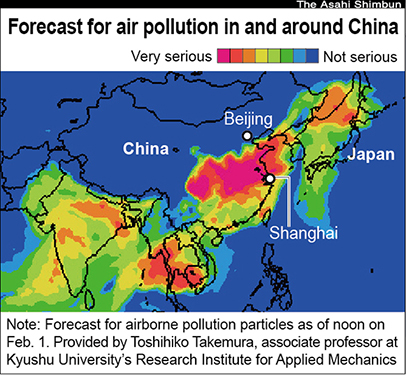
Air pollution from China reaches Japan, other parts of Asia

Traces of China’s air pollution have reached southwestern Japan, alarming residents and leading government officials to consider international cooperation to deal with the problem.

Beijing has been suffering severe air pollution this winter, with thick smog blanketing the capital and concentrations of PM 2.5 pollutants exceeding hazardous levels on more than 15 days in January.

Experts say China has failed to regulate air pollutants such as vehicle emissions, which have grown amid the country’s rapid economic development.

PM 2.5 stands for particulate matter with a diameter of 2.5 micrometers or less, which can reach deep into the lungs and blood vessels and cause asthma, heart disease and an increased risk of death.

In Nagasaki Prefecture, PM 2.5 concentrations at four locations, including Sasebo and Isahaya, averaged 41 micrograms per cubic meter on Jan. 31, based on data available by 3 p.m.

It exceeded the standard daily average of 35 micrograms set by the Basic Environment Law.

“The concentration is about one-tenth of that in China and is not expected to immediately affect the body,” a prefectural government official said. “But we may issue an alert if the figure rises substantially.”

The Nagasaki prefectural government has been measuring PM 2.5 concentrations at the four locations since April, and the readings are usually about 20 micrograms per cubic meter a day.

The Fukuoka city government has received about 20 inquiries from citizens since mid-January, when the media reported air pollution coming from China over the East China Sea.

The PM 2.5 concentration measured at six locations in the city all exceeded the government standard of 35 micrograms per cubic meter a day on Jan. 31.

Readings usually exceed the standard on 20 to 30 days a year, according to a city government official.

via Air pollution from China reaches Japan, other parts of Asia – AJW by The Asahi Shimbun.

Posted in Asia, China | Tagged , , , , , , , , , | Leave a comment

FAQ: What size particles does the Techno™ mask filter out?

Techno maskWhat size particles does the Techno™ mask filter out?

The Techno™ filter has sub-micron filtration capability. What this means is that it is able to trap particles less than one micron in size which is more than capable of the removal of 2.5 micron particulate material (PM).
Typically particulate pollution in the cities appears to be in the 2.5 micron size range and above. Particles smaller than this are known as respirable dusts, which can lodge deep within the lungs and air sacs. This is the more dangerous type of particle pollution as chemicals from vehicle exhaust gases combustion known to be toxic, are carried by means of the respirable particles. Hence the need for a Hepa-type submicron particle filter.

The DACC Activated charcoal layer within the Techno™ filter has excellent adsorption properties when it comes to SO2 and NO2 uptakes. With this capability and its capability of filtering VOC’s it is the best filter available in our range for dealing with the broad spectrum of pollutants commonly found in major cities across the globe.

For more FAQ,  go to Respro® Mask FAQ

Posted in Air Quality | Tagged | Leave a comment