OK!
This article is written for the benefit of the end user to be able to differentiate between one mask and another and the essential features required for a mask to work properly in filtering out urban pollution.
POINT 1 – Does it seal effectively?
The single most important point:
For a mask to work properly, it has to seal the area of nose and mouth from the external environment. The inhaled air has to pass through the filter material in order to remove pollution by physically trapping or adsorbing (different from absorption) gas or vapour molecules. A nose clip of some fashion, usually a strip of aluminum to bend between the bridge of the nose and the cheekbone is a vital component required to assist in making an effective seal.
Failure to create an effective seal will allow unfiltered air to pass around the sides of the mask and into the respiratory system. This is known as Inward Leakage.
A ‘one size fits all’ mask will invariably offer a poor fit and an ineffective seal and will place the mask squarely in the useless product bin. Like shoe sizing, one size does not fit all.
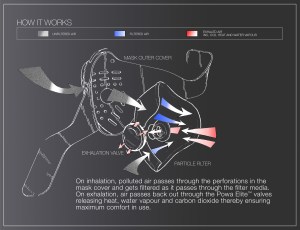 POINT 2 – Is the filter material up to spec?
Filter materials come in two categories:
The first is the ability to remove particulate matter. Typically that would be diesel particulates and pollen. The type of filter is usually a non-woven material made from zillions of fibres bonded together. They are electrostatically charged, both positively and negatively (like combing your hair makes a charge), so that particles, which are passing through the filter structure, are attracted and physically held in the matrix of the material. The smaller the particle, the greater the attractive force, which means that materials which are electrostatically charged can readily trap fine respirable dusts that over populate the air in our towns and cities.
Having first been developed by the Defence Establishment in the UK, these types of filter materials are not cheap. So if you are purchasing a product which appears to be ‘cheap’ and it says ‘removes particles down to 0.3 microns’, then the chances are that it might stop one or two particles but not the millions that are actually passing through. Watch out! If the material cannot be backed up by industrial test data then it probably doesn’t do the job effectively.
The second type of filter is Activated Charcoal material. It has the ability to filter (adsorb) gases and vapours. Well, like everything, if it’s cheap, then the chances are that the material is either black cloth appearing to look like Activated Charcoal (Far Eastern copy products are known for this) or a cloth that is impregnated with carbon powder. There is a big difference between the filtering capacity of a carbon powder impregnated cloth and a piece of Charcoal Cloth that is 100% Activated Charcoal.
Carbon powder impregnated cloths are used in the industry for cheap nuisance odour type products, like ‘odour eaters’ ; you know the things you put in your husband/wife or girlfriend/boyfriend’s trainers/shoes because his/her trainers stink after a while. These are good for air that is not moving i.e. static air, but of little use when air is travelling like when you are inhaling air into your lungs. For urban pollution, the best material to use would be what’s known as DACC™ (Dynamic Activated Charcoal Cloth). This material is 100% Activated Charcoal Cloth, which can absorb gases and vapours on a molecular level and very quickly too. It is manufactured under licence and is another decedent of the UK Defence Establishment. It has been tested on a range of gases and vapours that are listed on our website.
 POINT 3 – Comfort
The ideal mask would be one that you forget that you have it on:
Well that isn’t quite going to happen. The best we can do is to ensure that the levels of discomfort are kept to a minimum. Materials need to be soft not hard, edges need to be curved not cornered.
Exhaled breath contains three components that are not good to re-inhale and only increase discomfort. On exhalation, heat, water vapour and carbon dioxide are all produced and need to be expelled before inhaling again. So rather than these components passing through the filter, it is best to channel them out through exhalation valves. These are valves that open one way only. They close automatically when you inhale and open when you exhale. They are simple but effective parts of a mask and do not need to be replaced. The reason why we want the air to travel out through the valves is so they don’t saturate the filter with water vapour as it makes it harder to breathe in again and the relative back pressure of the speed of exhaled air including heat and water vapour, will hit you back in the nose and mouth area like hot air when getting off a plane at an airport in a really hot climate.
Comfort is important and if the mask is not comfortable for the duration of your journey you probably will give up on it. So choose your mask with the following points in mind:
1. Covers both nose and mouth.
2. Provides an effective seal
3. Quality filter materials
4. Exhalation valve or valves
[The mask in the picture is the Respro® Allergy Mask™, available on www.respro.com]
Copyright© Respro® June 2012
51.491302
-0.114407








 Respro® Masks are reusable

