Scientists warn air pollution is climbing back to pre-COVID levels

Cleaner air connected to pandemic lockdowns won’t last forever.

This ESA Copernicus Sentinel-5P data shows the concentrations of nitrogen dioxide over central and eastern China in February 2019, February 2020 and February 2021.Contains modified Copernicus Sentinel data (2019-21), processed by ESA

The devastating coronavirus pandemic had a notable side effect early on: less air pollution. Satellites monitored the changes over the last year as people stayed at home and factories shut down. With lockdowns easing comes an unfortunate but expected rise in air pollution.

The European Space Agency said Monday that nitrogen dioxide levels have returned to pre-COVID levels in China. According to the EPA, nitrogen dioxide is mainly traced to the burning of fuel and emissions from vehicles and power plants. The gas is connected to lung irritation, acid rain and hazy air quality.

ESA’s Copernicus Sentinel-5P satellite zeroed in on China and tracked nitrogen dioxide levels there between 2019 and 2021. China implemented its first strict lockdown in Wuhan in January 2020 and soon expanded the restrictions to more areas. Later, other countries followed suit to try to slow the deadly virus.

A dip in air pollution due to the lockdowns appeared in satellite data. “Now, more than one year later, as restrictions have eased, the average level of air pollutants has rebounded and is on the rise again,” said ESA in statement. 

The agency released a series of satellite maps showing nitrogen dioxide levels (seen in red) in central and eastern China from February 2019, February 2020 and February 2021. The changes are stark. 

ESA Copernicus Sentinel-5P mission manager Claus Zehner said the air pollution rebound was expected, and that while weather conditions can impact nitrogen dioxide concentrations, the lockdowns have played a large role in the fall and rise of air pollution. 

The noticeable dip in pollution during the pandemic spurred some lawmakers and environmentalists to push harder for clean air measures — such as clean energy investments and the extension of work-from-home policies — aimed at a more permanent reduction in pollution.

Just as China led the first lockdowns, it has been among the first countries to ease restrictions. The air pollution pattern seen there is likely to be mirrored by the rest of the world. Said Zehner, “In the coming weeks and months, we expect increases of nitrogen dioxide concentrations also over Europe.” 

via https://www.cnet.com/news/scientists-warn-air-pollution-is-climbing-back-to-pre-covid-levels/

Posted in Air Quality, Asia, China | Tagged , , , | Leave a comment

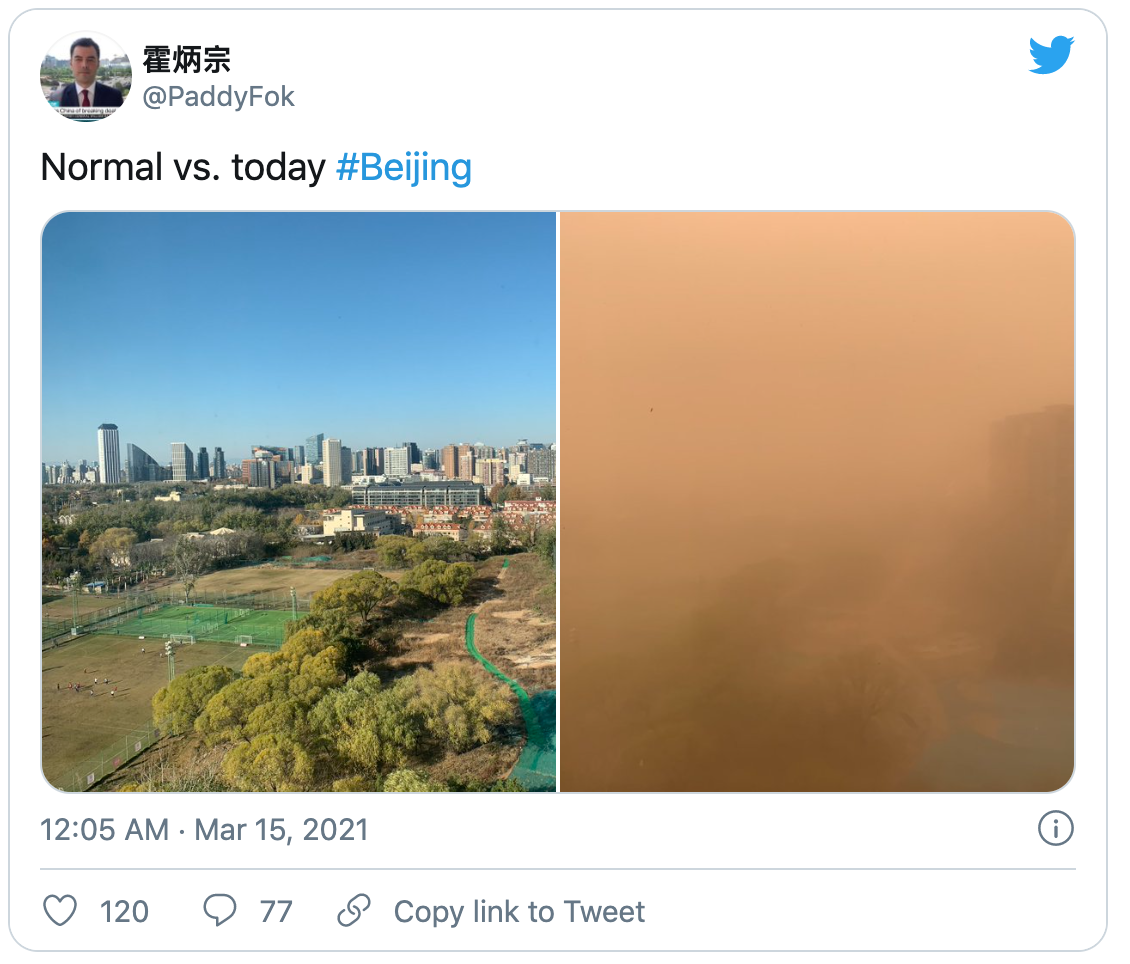
Beijing skies turn orange as sandstorm and pollution send readings off the scale

Capital of China suffers ‘hazardous’ levels of air pollution with authorities issuing second-highest safety alert

A massive sandstorm has combined with already high air pollution to turn the skies in Beijing an eerie orange, and send some air quality measurements off the charts.

Air quality indexes recorded a “hazardous” 999 rating on Monday as commuters travelled to work through the thick, dark air across China’s capital and further west.

Chinese meteorological authorities issued its second highest alert level shortly before 7.30am, staying in place until midday. A broader warning for sand and dust blowing in from the western desert regions was put in effect until Tuesday morning.

When Beijing’s realtime air quality index (AQI) showed a reading of 999, Tokyo recorded 42, Sydney 17 and New York 26. Hong Kong and Taiwan recorded “moderate” readings of 66 and 87, respectively.

Levels of PM2.5, the small air pollution particles that infiltrate the lungs, were recorded above 600 micrograms in many parts of the city, reaching a 24-hour average of 200 before midday. The World Health Organization recommends average daily concentrations of just 25.

The sandstorm blown in from the desert stretching into Inner Mongolia saw concentrations of the larger PM10 particles surpass 8,000 micrograms according to state media.

State media reported at least 341 people were reported missing in neighbouring Mongolia, which was also hit by sandstorms, and flights were grounded out of Hohhot in inner Mongolia.

On social media several people shared screenshots of other air quality indexes showed readings of more than 9,000, officially “beyond index”.

Some residents in Ningxia, in China’s west, said they woke up in the middle of the night feeling as though they couldn’t breathe. One commenter on Weibo joked that they felt like they needed to learn how to ride a camel.

Sandstorms are relatively common at this time of year, and usually attributed to winds blowing across the Gobi desert, but long-term residents said they had not seen one of this severity in years.

Large-scale deforestation is also considered a factor in the spring dust storms, and China has been trying to reforest and restore the ecology of the region in order to limit how much sand is blown into the capital.

Beijing has planted a “great green wall” of trees to trap incoming dust, and tried to create air corridors that channel the wind and allow sand and other pollutants to pass through more quickly.

Beijing and surrounding regions have been suffering from high levels of pollution in recent weeks, with the city shrouded in smog during the national session of parliament which began earlier this month.

Tangshan, China’s top steelmaking city and a major source of pollution in Beijing and Hebei, said on Saturday it would punish local enterprises for failing to carry out emergency anti-smog measures.

via Beijing skies turn orange as sandstorm and pollution send readings off the scale | Air pollution | The Guardian

Posted in Air Quality, Asia, China | Tagged , , , , , | Leave a comment

Pollutionwatch: how much Sahara desert dust do we breathe?

Dust that swept Europe in February affects weather systems but also contains many allergens

Saharan dust high in the skies over Europe caused some spectacular sunsets in February. Many of us found dust on our cars, and Alpine snow has been stained orange, but finding out how much Saharan dust we are breathing has always been difficult. For decades we have been measuring the amount of particle pollution in the air, but not what it is made of. However, university-run air observatories in London, Birmingham and Manchester are now making real-time chemical analysis. They showed that silicon, aluminium, calcium and iron particles from Saharan dust were the main particle pollutants in all three cities on Saturday 20 February and that the dust was breathed by Londoners for the next two days.

Saharan dust events are common in Mediterranean countries. It is also carried west on Atlantic trade winds. Dust from north Africa fertilises the Amazon, but it also causes air pollution problems in Caribbean islands and the southern US.

Desert dust is not like builder’s sand; it contains many biological particles and allergens. A recent study in Miami found increased hospital visits for people with chronic obstructive pulmonary disease during Saharan dust events. Other studies have found problems for asthmatics, too. In June 2020 authorities in Cuba asked islanders to wear face masks and urged vulnerable people to stay indoors as a massive Saharan dust cloud travelled westwards. Alerting systems are being established across Spain and Portugal but there is need for more research into the health impacts of desert dust.

Saharan dust can have a major effect on weather systems, suppressing hurricane formation and, by darkening snow, bringing forward spring thaws in the Alps. It is unclear if events will increase in the future. A dryer climate in north Africa may lead to more airborne dust but changes in weather patterns may reduce its spread. However, alpine ice cores covering the past two millennia suggests that Saharan dust has increased in the past 100 years. Also notable in the ice core record are the Saharan dust events between 1315 and 1365, a time that includes the Great Famine, when about 10% of Europe’s population perished, and the Black Death. This has led to speculation that poor air quality from Saharan dust may have contributed to a decline in human health and made the population more vulnerable.

Pollutionwatch: how much Sahara desert dust do we breathe? | Air pollution | The Guardian
Posted in Africa, Air Quality, Allergies, Asthma, Europe, Latin America, World News | Tagged , , | Leave a comment

Thailand’s Chiang Mai Has Once Again the Worst Air Quality in the World

Thailand’s northern province of Chiang Mai was reported to have the worst air quality on the planet due to brush fires and agricultural burning.

The grim news from the IQ AirVisual air monitoring website came as authorities in Chiang Mai revealed that the situation had caused up to 30,000 people to go to hospital because of respiratory illnesses.

The Chiang Mai provincial public health office said 31,788 patients suffering from air pollution-related illnesses from January to March 5 this year, said Dr Suwanchai Wattanayingcharoen, director-general of the Department of Health under public health ministry.

Chiang Mai’s air quality has been ranked one of the planet’s three worst cities for pollution since the start of March. it also saw this ranking last year.

IQ AirVisual on Tuesday announced that the city had in fact been the very worst place in the world for many straight days with a USAQI of 195, followed by Beijing on 182. USAQI is an Air Quality Index used by the United States Environmental Protection Agency (US EPA).

Poor Air Quality from fire smoke

Tuesday’s morning, the level of PM2.5 in Chiang Mai rose above 200 microgrammes per cubic metre (µg/m3), according to IQ AirVisual and the Thailand Pollution Control Department (PCD)’s air monitoring station gave similar findings.

At noon, the level of PM2.5 recorded at Chang Puek road in Muang district rose to almost 200 µg/m3. Thailand Meteorological Department (TMD) on Tuesday warned the air pollution would last for another week.

That is because the southern west wind current would be too weak to blow away the dust particles and these were trapped by the cool weather in the evenings.

The main contributor of the deteriorating situation in the North is said to be the considerable heat from wildfires caused by open burning in Myanmar forests and locally.

The northern region on Tuesday had 926 hotspots, 617 in protected areas and and 293 in reserved forests. Mae Hong Son had the most hotspots at 442, followed by Chiang Mai at 211 and Tak 108.

Wildfires and haze in the upper North has started to impact people’s health in six provinces: Chiang Rai, Chiang Mai, Lampang, Mae Hong Son, Tak and Phayao.

Deputy commander of the Third Army Area, Maj Gen Thanadpol Kosaisewee, said a taskforce responsible for controlling wildfires and haze in the northern region had deployed 60 patrol officers to five districts in Chiang Mai from Tuesday until tomorrow. The 35th Ranger Forces Regiment has also deployed 35 rangers to extinguish wildfires on Phrabat Mountain in Lampang province.

Thailand’s Chiang Mai Has Once Again the Worst Air Quality in the World
Posted in Air Quality, Asia, Thailand | Tagged , , , , | Leave a comment

California’s wildfire smoke could be more harmful than vehicle emissions, study says

Toxic particles spewed by wildfires resulted in 10 times as many respiratory-illness related hospitalizations as other types of pollution, researchers found

The thick, grey wildfire smoke that shrouds California each autumn and winter could be more harmful to humans than pollution from cars and other sources, a new study has found.

Coming at the heels of the state’s worst wildfire season on record, the findings add to growing evidence that extreme fires, fueled by climate change, will have increasingly dire health consequences for residents in the western US.

Tiny, toxic particles spewed by wind-whipped wildfires resulted in 10 times as many hospitalizations due to respiratory illness as compared to other types of pollution, researchers found in the study, which was published Friday in Nature Communications.

“We know wildfires are going to become more extreme, due to climate change,” said Rosana Aguilera, a postdoctoral scholar who co-authored the research. “And it’s important that we start to reckon with the health effects of that.”

Aguilera and her colleagues looked at hospital admissions over a 14-year period, from 1999 through 2012, and found that spikes in air pollution during peak fire season in southern California – when fierce Santa Ana winds usually stoke the most destructive wildfires – were correlated with a 10% increase in hospitalizations for respiratory issues.

Since then, wildfires in the west have only gotten more ferocious and destructive – spewing up even more toxic smoke. Six of the largest wildfires on record burned in 2020. And while particulate pollution across the US has been generally declining in recent years due to stricter environmental regulations, pollution in the north-west increased due to wildfires.

The pollution disproportionately impacts low-wage workers, and poor communities of color across the state who are already exposed to high levels of pollution from other sources including factories, highways and refineries. In southern California’s Riverside and Imperial counties, southeast of Los Angeles, farmworkers regularly breathe in pesticide-laden smog. “In our region, the majority of workers have asthma,” said Luz Gallegos, the executive director of the advocacy group Todec. “Their kids have asthma, their parents have asthma. This has been an ongoing crisis.”

During last year’s record-setting wildfires, workers continued to harvest crops under smoke-filled skies. “One woman in our community just collapsed in the field, as she was working,” Gallegos said. She had asthma, and once she was rushed to the hospital, tested positive for Covid-19. “Thank God, she survived,” Gallegos said – but it’s uncertain whether her lungs will be able to handle the continued strain.

“These stories are very, very common,” Gallegos added.

Recent research has shown that wildfire smoke can exacerbate not only respiratory illnesses but also heart conditions – triggering heart attacks and strokes, said Mary Prunicki, a Stanford researcher who studies the health impact of air pollution.

Prunicki, who was not involved in the recent study, said there is a growing body of evidence that smoke from the megafires California has seen in recent years is not only bad for our health, it’s “extra-bad – probably worse than some other types of pollution”.

Part of the problem is what’s being burned. Due to development in California wildlands, fires are increasingly likely to burn through homes and infrastructure, spewing up a noxious mix of plastics, metals, household cleaning chemicals and other unnatural char. Megafires – blazes that are so massive they create their own wind and microclimate – are also more likely to pump smoke higher up, where it often lingers for long periods of time, oxidizing and becoming more toxic.

More research is required to understand the long-term dangers of exposure to smoke. “But I think we know already enough about the impacts to mandate emergency action,” Prunicki said.

In a different study, published last month, Prunicki found that just one day of exposure to elevated air pollution, including from wildfires, can affect children’s immune and cardiovascular systems. Her research, which analyzed blood samples from children ages six to eight-years-old in California’s Central Valley, found that exposure to particulate pollution was linked to higher blood pressure, and could predispose kids to heart disease in adulthood.

Although wildfires are a natural part of California’s landscape, global heating and decades of forest mismanagement have left the region increasingly vulnerable to bigger, more destructive blazes. Researchers said that officials should immediately take steps to curb greenhouse gas emissions to address the climate crisis, and recognize Indigenous ecological expertise in managing fire-prone landscapes.

Solutions could include a return to “prescribed burns” – a technique that hundreds of California’s Native people have used for thousands of years, setting small controlled burns to clear out fire-fueling vegetation and prevent the larger, more toxic blazes that have obliterated homes and neighborhoods.

“We are seeing the impacts of climate change today and thy are severe,” said Tom Corringham, who co-authored the study released Friday. His research, he added, “is really another sign that we need to be taking action”.

via California’s wildfire smoke could be more harmful than vehicle emissions, study says | California | The Guardian

Posted in Air Quality, Health Effects of Air Pollution, Medical Studies, USA, USA & Canada | Tagged , , , , , , , | Leave a comment

UK found guilty of dirty air breach by EU court

The UK has been found guilty by the European Court of Justice of “systematically and persistently” breaching air pollution limits.

The court ruled that, since the 2010, the UK had failed to tackle the problem of toxic NO2 gas emissions in the shortest possible time.

The EU court has continued to oversee the case because proceedings started before Brexit.

The government believes the judgement is unfair and is mulling its next move.

The UK has been ordered to pay costs to the European Commission; the amount could run to millions of pounds. Nitrogen dioxide (NO2) is emitted by gas heating boilers and cars, and the main hotspots are next to busy city streets.

That’s why the government has told 61 councils to clean up pollution on a local level.

Ministers admitted to the court that pollution limits had been breached, but they argued that other nations had broken limits too – indeed the UK was backed by Germany in this case.

The government laid part of the blame on the emissions test scandal, in which car makers cheated measurements of NO2 produced by their vehicles.

The court news comes soon after a coroner confirmed that the UK’s illegal levels of air pollution contributed to the death of nine-year-old Ella Adoo-Kissi-Debrah in south London.

Today’s ruling relates to failures that have also been the subject of successful legal challenges. These have been brought by the campaign group ClientEarth against the UK government in domestic courts since 2011.

A government statement said a UK High Court judge previously found the approach in its 2017 NO2 plan to be sensible, rational and lawful.

But the EU judges said the UK hadn’t moved fast enough to protect people’s health.

Following today’s ruling, if the UK still fails to comply within a “reasonable” period, the European Commission could issue formal notice requiring the UK to remedy the situation.

If the UK fails again, the Commission could bring the matter before the court a second time.

If that happens, fines may be imposed – although it’s not clear legally whether the UK could be forced to pay, following Brexit.

In any future cases where the government has breached legal limits, the case would be dealt with by a new UK Office for Environmental Protection – although environmental campaigners claim that this watchdog is being weakened before it even becomes law.

The government’s latest data shows that NO2 limits are being exceeded in 33 out of 43 air quality assessment zones.

Client Earth spokeswoman Katie Nield said: “The government has said that Brexit is an opportunity to take back control and to develop ‘the most ambitious environmental programme of any country on Earth’.

“There is now a clear opportunity to not only establish stronger laws protecting people’s health and the environment.”

The group wants the UK to adopt World Health Organization (WHO) air quality guidelines, which are stronger than EU rules.

A government spokesperson said: “We are considering this judgment from the European Court of Justice. We continue to work at pace to deliver our ambitious NO2 Plan and our 2019 Clean Air Strategy, which was praised by the WHO as ‘an example for the rest of the world to follow’.

“Air pollution at a national level has reduced significantly since 2010, and now we are out of the EU, we are continuing to deliver our £3.8bn air quality plan to tackle nitrogen dioxide exceedances in the shortest possible time.”

via UK found guilty of dirty air breach by EU court – BBC News
Posted in Air Quality, Europe, UK | Tagged , , | Leave a comment

Tehran Air Pollution Persists

Air quality monitoring stations in the namesake capital city of Tehran Province show people continued to breathe more polluted air in February, compared with the same period of last year. 

A close analysis of Air Quality Index during the period makes this very clear. AQI is used by government agencies to announce the prevailing level of air pollution, or forecast future days.

The index categorizes conditions dictated by a measure of polluting matters into good (0-50), moderate (51-100), unhealthy for sensitive groups (101-150), unhealthy (151-200), very unhealthy (201-300) and hazardous (301-500).

In February, people in Tehran did not see clear blue skies even for a single day. Instead, the moderate status was recorded for 22 days, as the index hovered between 51 and 100.

Those with respiratory disorders, cardiovascular diseases, the elderly, pregnant women and children were warned of their outdoor exposure for six days, as AQI remained unhealthy for sensitive group.

Tehran Air Pollution Persists | Financial Tribune
Posted in Air Quality | Tagged , , | Leave a comment

New anti-idling campaign targets drivers in London

Drivers who leave their engines idling are being targeted in a new campaign led by the City of London Corporation and Camden Council

The ‘Engine Off, Every Stop’ campaign, which is being funded by the Mayor of London,  features posters and billboards on roadside sites and petrol stations across the capital.

Drivers are also being reached with radio adverts, videos and social media, in a bid to change behaviour.

The four-week project highlights air pollution as an ‘invisible killer’ and is part of Idling Action London, which sees 30 London local authorities and the City of London Corporation joining forces to drive down toxic air.

Chairman of the City of London Corporation’s environmental services committee, Keith Bottomley, said: “This campaign carries a very clear call to action for London’s drivers to safeguard public health.

“Air pollution is the largest environmental risk to public health with up to 36,000 people dying prematurely every year in the UK.

“Switching off when parked is one of the easiest ways to drive that number down.

“This simple change in behaviour will make a real positive difference. We need all of the capital’s drivers to play their part in ridding this city of toxic air and saving lives.”

Businesses, residents, schools, and community groups can get involved by signing the Engines Off pledge and using free toolkits and other resources, which provide easy and practical steps to tackling idling engines.

Sadiq Khan, Mayor of London said: “Engine idling is completely unnecessary and threatens the health of anyone close by.

“Air pollution is not just a central London problem, which is why I’m glad London boroughs have joined this call to promote ‘Engine Off, Every Stop’.”

New anti-idling campaign targets drivers in London | Environment news
Posted in Air Quality, Europe, London, UK | Tagged , , , , , , , | Leave a comment