Delhi’s economy suffered the most due to severe air pollution last year: Lancet study

Delhi suffered the highest per-capita economic loss due to air pollution last year in India, according to a study published in peer-reviewed medical journal Lancet on Tuesday.

The economic loss due to lost output from premature deaths and illness attributable to air pollution (outdoor and household) as a percentage of state GDP was 1.08% in Delhi. The highest loss to GDP was recorded by Uttar Pradesh at 2.15% followed by Bihar at 1.95% and Madhya Pradesh and Rajasthan lost 1.70% each. When it comes to impact of outdoor air pollution alone on state GDP, Delhi recorded a loss of 1.06% to its GDP. The highest loss to GDP was recorded by Uttar Pradesh at 1.34% followed by Punjab at 1.22%. The paper has highlighted that India is bearing massive losses to its GDP and productivity due to health impacts of air pollution. Overall deaths and disease due to air pollution is linked to loss of 1.36% of India’s GDP according to the paper.

Delhi’s per-capita GDP loss was to the tune of $62 followed by neighbouring Haryana ($53.8).

In 2019, 1.67 million deaths in India were attributable to air pollution. They accounted for 17·8% of the total deaths.

Between 1990 and 2019, the death rate per 100,000 population has increased by 115.3% due to exposure to high outdoor air pollution levels. The death rate due to exposure to household air pollution has decreased by 64.2% due to a reduction in the use of solid fuels.

But death rate due to exposure to the ground-level ozone also increased by 115% during the 29-year period.

CAUSES OF DALYs (A) AND DEATHS (B) ATTRIBUTABLE TO AIR POLLUTION IN INDIA, 2019
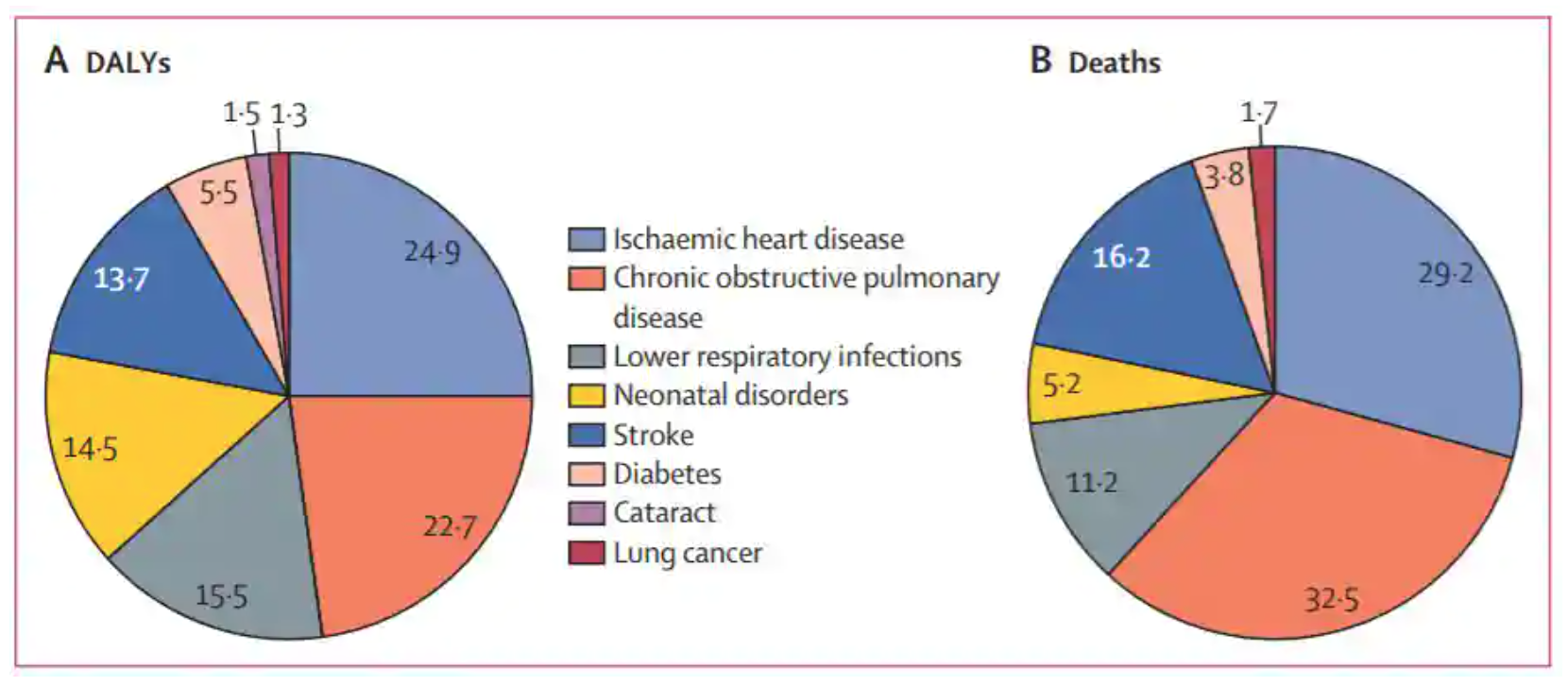
The study has estimated that economic loss due to lost output from premature deaths due to air pollution in India last year was US$28·8 billion and from morbidity due to air pollution was $8·0 billion. Of the total economic loss of $36·8 billion, 36·6% was from lung diseases, which included chronic obstructive pulmonary disorder (21·1%), lower respiratory infections (14·2%), and lung cancer (1·2%). The rest was from ischaemic heart disease (24·9%), stroke (14·1%), diabetes (8·4%), neonatal disorders (13·3%), and cataract (2·7%).

The economic impact of air pollution was estimated by the authors of the study based on output per worker. The output per worker in each state in 2019 was calculated as the labour share of GDP multiplied by GDP in 2018–19 divided by the number of people who were employed. The labour share of GDP in each state was estimated using data from the Penn World Tables. To factor in the number of people per age group who were working, data from the National Sample Survey on employment and unemployment for 2011–12 was used.

“Air pollution has the potential to impede accumulation of future human capital by reducing children’s survival, undermining their health, and reducing their ability to benefit from education. The cost savings resulting from the prevention of productivity losses attributable to air pollution would contribute to the formation of new human capital,” the study said. It cited the example of the US, where every dollar invested in the control of air pollution since 1970 is estimated to have yielded an economic benefit of $30. There has been a substantial reduction in air pollution in the US over the past few decades along with significant economic growth, the study said.

The annual average population-weighted mean PM2·5 concentration in India was 91·7 micrograms per cubic metres last year. Exposure to outdoor PM 2.5 ranged from 15·8 micrograms per cubic metres in Kerala, to 217·6 micrograms per cubic metres in Delhi—a 13·8 times difference. Higher concentrations were found in the northern states.

Prof Lalit Dandona, Director of the India State-Level Disease Burden Initiative, and an author of the study said, “The economic impact of this health loss due to lost productivity is huge at 1.4% of the country’s GDP in 2019, besides a roughly estimated expenditure of 0.4% of the GDP on the treatment of air pollution-related diseases. The health and economic impact of air pollution are highest in the less developed states of India, an inequity that should be addressed.”


Delhi’s economy suffered the most due to severe air pollution last year: Lancet study – environment – Hindustan Times

Posted in Air Quality, Asia, India | Tagged , , | Leave a comment

Delhi Air Pollution: Air Quality in National Capital Remains in ‘Very Poor’ Category As Overall AQI Reaches 329

The air quality in Delhi continued to be in the ‘very poor’ category on Tuesday as the overall air quality index (AQI) was recorded at 329. The concentration of PM10 and PM2.5 pollutants increased since Monday and as a result, the AQI rose up to this this level the following day. According to System of Air Quality and Weather Forecasting & Research (SAFAR), the overall Air Quality Index (AQI) in the national capital on Tuesday stood at 329. In its forecast, SAFAR had said that the PM10 pollutants would increase to 293 on Tuesday and PM2.5 would rise up to 168, which comes under the ‘very poor’ category.

According to the index, an AQI between zero and 50 is considered ”good”, 51 and 100 ”satisfactory”, 101 and 200 ”moderate”, 201 and 300 ”poor”, 301 and 400 ”very poor”, and 401 and 500 ”severe”. On Monday, the AQI in the national capital had entered the ‘very poor’ category. The average air quality remained also remained ‘very poor’ in Ghaziabad, Noida and Greater Noida, and ‘poor’ in Gurgaon and Faridabad. According to CPCB’s Sameer app, the AQI was 391 in Ghaziabad, 366 in Greater Noida, 363 in Noida, 289 in Faridabad and 271 in Gurgaon.

On Sunday, the average AQI was 346 in both Ghaziabad and Greater Noida, 333 in Noida, 294 in Faridabad and 262 in Gurgaon. According to the Central Pollution Control Board (CPCB), if the AQI in any region is in the ‘very poor’ category, it may cause respiratory illness on prolonged exposure, while “poor” may lead to breathing discomfort to people.

Delhi Air Pollution: Air Quality in National Capital Remains in ‘Very Poor’ Category As Overall AQI Reaches 329

Posted in Air Quality | Tagged , , | Leave a comment

#Pakistan Citizens avoid outdoor exertion as capital’s pollution soars

The air quality of the federal capital on Sunday was unhealthy as hazardous pollutants were recorded beyond permissible limits where the health experts warned citizens to avoid prolonged outdoor exertion.

The air quality in the metropolis was unhealthy for people belonging to sensitive groups particularity lungs and heart disease patients, older people, children and teenagers as air pollutant ratio was recorded beyond safer limits. Health experts advised citizens belonging to sensitive groups to wear face masks or coverings, avoid unnecessary prolonged exertion outdoors and immediately contact health physician or doctor in case of serious respiratory issue.

latest data released by Pakistan Environmental Protection Agency (Pak-EPA), the particulate of 2.5 (PM2.5) microns which was a hazardous ambient air pollutant causing chronic respiratory diseases and premature deaths was higher than safer limits.

The PM2.5 not only exceeded National Environmental Quality Standards (NEQS) of 35 micrograms per cubic meter rather World Health Organization (WHO) standard of 20 micrograms per cubic meter.

Citizens avoid outdoor exertion as capital’s pollution soars – Pakistan Observer
Posted in Air Quality, Asia, World News | Tagged , | Leave a comment

Air pollution may take a toll on the kidneys, Chinese study suggests

Tiny particles of air pollution were already known to raise people’s risk of developing heart and lung disease, but a new study suggests they might also raise the risk of developing chronic kidney disease.

Researchers from Peking University in Beijing, China, found that the risks from this fine particulate matter was significantly stronger in urban areas, and among males, younger adults and adults without other health conditions.

The investigators analyzed survey data from more than 47,000 adults in China and estimated the two-year air pollution levels at each person’s residence from satellite-based information.

They found that 10.8% of participants had chronic kidney disease. Each increase of fine particulate matter of 10 micrograms per cubic meter of air was associated with 1.3 times higher odds of having the disease.

The research was published online this week in the Journal of the American Society of Nephrology.

“Although ambient air quality has improved substantially during the past five years in China, the national annual particulate matter level in China exceeds the World Health Organization’s guideline,” study author Dr. Luxia Zhang said in a journal news release.

The findings provide evidence to policymakers and public health officials for the need for stricter air quality control measures to help protect individuals’ kidney health, the researchers said.

Air pollution may take a toll on the kidneys, Chinese study suggests – UPI.com
Posted in Air Quality | Tagged , , | Leave a comment

Air pollution a cause in girl’s death, coroner rules in landmark case

A coroner has made legal history by ruling that air pollution was a cause of the death of a nine-year-old girl.

Philip Barlow, the inner south London coroner, said Ella Kissi-Debrah’s death in February 2013 was caused by acute respiratory failure, severe asthma and air pollution exposure.

He said she was exposed to nitrogen dioxide and particulate matter (PM) pollution in excess of World Health Organization guidelines, the principal source of which were traffic emissions.

The coroner said the failure to reduce pollution levels to legal limits possibly contributed to her death, as did the failure to provide her mother with information about the potential for air pollution to exacerbate asthma.

“Ella died of asthma contributed to by exposure to excessive air pollution,” said the coroner on Wednesday.

He said that during Ella’s life, nitrogen dioxide emissions in Lewisham, where she lived, exceeded legal limits, both EU and national levels. Particulate matter levels were above the WHO guidelines, he said.

“The whole of Ella’s life was lived in close proximity to highly polluting roads. I have no difficulty in concluding that her personal exposure to nitrogen dioxide and PM was very high.”

The coroner said the health effects of air pollution had been known for many years, and children and those with asthma were particularly at risk.

He found that air pollution both induced and exacerbated Ella’s particular form of severe asthma.

The ruling is the first of its kind in the UK and is likely to increase pressure on the government to tackle illegal levels of air pollution across the country.

Ella’s mother, Rosamund Kissi-Debrah, a former teacher, spent years fighting to have her daughter’s death examined by a second coroner. Her resilience was repaid on Wednesday when Barlow agreed with expert medical evidence provided by the family which said Ella’s particular form of acute asthma was exacerbated by air pollution.

Kissi-Debrah’s lawyers submitted that air pollution was a public health emergency and there was a pressing need for it to be recorded as a cause of death to ensure public health programmes to tackle toxic air were prioritised.

In evidence to the two-week inquest, Prof Stephen Holgate, an immunopharmacologist and consultant respiratory physician of the University of Southampton and Southampton general hospital, said a biological cause of Ella’s disease getting worse in the winter months was the seasonal worsening air pollution.

He said it was the cumulative effect of the toxic air Ella was breathing in living within 30 metres of the South Circular road that caused her final acute asthma attack.

Holgate said Ella was like a canary in a coalmine, signalling the risk to other Londoners from the toxic mix of pollutants such as nitrogen oxides in the air.

Ella had had numerous seizures and been taken to hospital almost 30 times in the three years before her death.

An inquest ruling from 2014, which found that she died of acute respiratory failure, was quashed by the high court following new evidence about the dangerous levels of air pollution close to her home.

During the hearing, Holgate, who was a member of the royal commission for environmental pollution until it was closed in 2011, heavily criticised the Department for Environment, Food and Rural Affairs and the Department of Health and Social Care for failing to work together on toxic air.

Ella’s family argued there was sufficient evidence to conclude there were failures by the state to take steps to protect the public from dangerous levels of air pollution, which amounted to a violation of article 2 of the Human Rights Act, concerning the right to life.

The mayor of London, Sadiq Khan, said the coroner’s conclusion was a “landmark moment” and called pollution a “public health crisis”.

“Today must be a turning point so that other families do not have to suffer the same heartbreak as Ella’s family. Toxic air pollution is a public health crisis, especially for our children, and the inquest underlined yet again the importance of pushing ahead with bold policies such as expanding the ultra low emission zone to inner London.”

“Ministers and the previous mayor have acted too slowly in the past, but they must now learn the lessons from the coroner’s ruling and do much more to tackle the deadly scourge of air pollution in London and across the country.”

A government spokesperson said: “Our thoughts remain with Ella’s family and friends.

“We are delivering a £3.8bn plan to clean up transport and tackle NO2 pollution, and going further in protecting communities from air pollution, particularly PM2.5 pollution, which we know is particularly harmful to people’s health. Through our landmark environment bill, we are also setting ambitious new air-quality targets, with a primary focus on reducing public health impacts.”

Air pollution a cause in girl’s death, coroner rules in landmark case | London | The Guardian

Posted in Air Quality | Tagged , , | Leave a comment

New study shows link between hot and dry weather and air quality in Korea

While ozone in the stratosphere acts as a barrier that protects the Earth from ultraviolet radiation, ground-level (or tropospheric) ozone is a dangerous trace gas that can cause serious health problems. This ozone is the result of photochemical reactions between nitrogen oxides and volatile organic compounds, which are two major air pollutants.

Over the past decades, East Asia has witnessed a marked degradation of air quality, especially in terms of ground-level ozone, that is consistent with human activity. However, in Korea, the specific reasons behind increases in ozone levels during warm seasons remain a mystery among atmospheric scientists.

To shed light on this issue, a team of scientists, including Prof Jin-Ho Yoon from Gwangju Institute of Science and Technology, Korea, recently conducted a study that was published in Atmospheric Environment. They focused on the relationship between large-scale weather patterns (called synoptic-scale weather) and surface ozone concentration. To do this, they used synoptic weather data from 17 airport meteorological stations and hourly observations of ground-level ozone concentrations from 306 monitoring sites.

One of the main findings of the study was that a particular synoptic weather pattern called ‘dry tropical’ was consistently associated with high ozone concentration. This is because ozone formation requires sunlight—which implies that dry and warm atmospheric conditions are favorable for its formation.

Most importantly, the researchers found that dry tropical weather had steadily become more frequent in Korea over the past 50 years, which is consistent with the gradual increase in tropospheric ozone levels. “We estimate that tropospheric ozone concentration could increase by 3.5% if the frequency of dry tropical weather doubles, and by an alarming 7.5% if it triples,” comments Prof. Yoon. “Our results imply that future air quality regulations in Korea should be issued together with those related to global and regional warming,” he adds.

Overall, this study provides valuable insights to tackle the long-standing mystery of tropospheric ozone in Korea. Lead author Dr. Hyun Cheol Kim from the National Oceanic and Atmospheric Administration and the University of Maryland, U.S., remarks: “Understanding the relationship between synoptic weather patterns and surface ozone concentration will help us assess the contribution of meteorological conditions to regional air quality and establish an effective early warning system.” Let us hope this study brings more attention to the serious and interlinked issues of air pollution and climate change so that decisionmakers can act in time.

New study shows link between hot and dry weather and air quality in Korea
Posted in Air Quality | Tagged , , | Leave a comment

Study connects diabetes, air pollution to interstitial lung disease

People with pre-diabetes or diabetes who live in ozone-polluted areas may have an increased risk for an irreversible disease with a high mortality rate. A new study published in the Environmental Health Perspectives connects insulin resistance and repetitive ozone exposure to the development of interstitial lung disease.

“Our findings are especially important today as we’re in the midst of the COVID-19 pandemic, where we have great concern regarding the convergence of health effects from air pollution and SARS-CoV-2 in susceptible populations like people with diabetes,” said James Wagner, lead author and associate professor for the MSU College of Veterinary Medicine’s Department of Pathobiology and Diagnostic Investigation.

Ozone — a gas often referred to as “smog” — is known to exacerbate certain lung diseases, such as asthma and rhinitis, which are primarily upper airway diseases. But recent epidemiology (Johannson et al. and Sesé et al.) suggests an association between high ozone concentrations and adverse health effects in the deep lung, which cause difficulty breathing due to lung restriction and stiffness.

“More than 170,000 people in the U.S. suffer from interstitial lung disease. Furthermore, type 2 diabetes and insulin resistance are recently suggested risk factors for developing pulmonary fibrosis,” said Jack Harkema, University Distinguished Professor, Albert C. and Lois E. Dehn Endowed Chair in Veterinary Medicine, and director of the Laboratory for Environmental and Toxicologic Pathology and the Mobile Air Research Laboratories at MSU.

In the study, Wagner, Harkema and their collaborators, Robert Tighe and Christina Barkauskas from Duke University’s Department of Medicine, studied healthy mice, mice with mild insulin resistance and mice with marked insulin resistance. The study found a direct relationship between insulin resistance levels and the severity of lung inflammation and scarring (fibrosis); diabetes-prone mice were particularly susceptible to inflammation and tissue remodeling caused by repeated ozone exposure.

“Evidence suggests that ozone exposure could exacerbate pulmonary fibrosis, particularly in individuals that are diabetic,” said Tighe, a pulmonologist who specializes in interstitial disease at Duke. “Poorly controlled diabetes, in particular, may be an important co-morbidity for worsened lung damage.” According to Wagner, these findings are of critical importance for public health.

“Our results propose a causal link for ozone exposure to preferentially promote early pulmonary fibrosis and interstitial lung disease in pre-diabetic mice. We only exposed these mice for three weeks, but there are millions of people living in cities like Los Angeles and New York who are exposed to high levels of ozone day after day,” he said. “Then, you must consider the prevalence of pre-diabetes people — approximately 33% in this country. Our study results suggest that people who are borderline insulin resistant — or diabetic — and living in areas with high levels of ozone pollution might be at an increased risk for developing interstitial lung disease.”

This study is just the latest in Wagner and Harkema’s research efforts, which describe pre-diabetes as a risk factor for multiple possible adverse responses to air pollution. Wagner has previously shown deleterious effects on heart rate, blood pressure, and adipose tissue inflammation in pre-diabetic rodents that were exposed to ozone (Wagner et al. and Zhong et al.).

The authors believe this study is the first of its kind, as it describes exacerbated pulmonary inflammation and remodeling due to repetitive, short-term ozone exposures in insulin-resistant rodents that also exhibit other manifestations of type 2 diabetes. The work was supported in large part by the researchers’ grant from the Environmental Protection Agency’s Great Lakes Air Center for Integrative Environmental Research (GLACIER) at MSU. For more information about this research, contact Dr. James Wagner.

Study connects diabetes, air pollution to interstitial lung disease — ScienceDaily
Posted in Air Quality | Tagged , , | Leave a comment

Kolkata air pollution: worst week in two years

The average PM2.5 level in the city’s air was 10 micrograms per cubic meter of air in a week in August

The city suffered its worst air pollution in two years in the first week of December, says a study by the Delhi-based Centre for Science and Environment (CSE).

According to the study, the average PM2.5 level in the city’s air was 10 micrograms per cubic meter of air in a week in August, when the air was the cleanest compared with other months of the year. It jumped to 130 in the first week of December.

Across the river, in Howrah, too, the December air has been found to be critically polluted. The corresponding PM2.5 level are 19 and 136.

Environment scientists said August was the cleanest because of a combination of reasons, including limited economic activity in early stages of unlocking and meteorological factors such as rain, which had considerably neutralised the pollution load.

“In the first week of December, Calcutta has experienced its worst week and peak in last two years so far with PM2.5 level,” the report states.

“There were a few days when Calcutta and Howrah air pollution levels were higher than Delhi,” it says.

Experts associated with the study — which analysed the winter air data from October 1 to December 6, generated at all automatic air pollution measuring stations in the city —  pointed out that the combination of heightened economic activity and meteorological factors have contributed to the jump in pollution.

Indian Meteorological Department (IMD) said visibility had dropped considerably, a tell-tale indicator of heightened pollution. The wind speed has been low, a typical winter phenomenon, leading to slow dispersal of pollutants.

“The visibility in Alipore this morning was between 60 and 100 metres. Under normal circumstances it remains about 1,000 metres. The wind speed also remained relatively low,” said G.K. Das, of IMD Calcutta.

The CSE study found that the air quality recorded by the automatic monitoring station on the BT Road campus of Rabindra Bharati University reached “severe” in the first week of December. At the other six stations in the city, the quality was “very poor”.

According to the study, the average PM2.5 level in the city’s air was 10 micrograms per cubic meter of air. It jumped to 130 micrograms in the first week of December. 

“The disturbing part is the finding that the share of PM2.5 has increased significantly within PM 10,” said Anumita Roy Choudhury, an air pollution expert of the CSE who led the study.

Ultrafine PM2.5 is considered much more lethal compared with the relatively coarser PM10. “The percentage share of PM2.5 in overall PM10 has gone up to 60 per cent during high pollution episodes from around mid-November and remained high at over 50 per cent since then,” the report says.

“The spike in pollution can be attributed to anthropogenic well as meteorological factors. The cooler December air leads to an inversion phenomenon that results in trapping pollutants closer to the ground. Heightened economic activity, too, has contributed to the rise in pollution,” said Roy Choudhury.

“This is a typical and predictable winter trend when continuous emissions from local sources, including vehicles, industry, construction and episodic pollution from biomass burning, get trapped because of meteorological changes,” said Avikal Somvanshi, from the CSE air pollution team.

Roy Chowdhury stressed the need for “systemic changes” to reduce the city’s air pollution. “Systemic changes like switching public transport to cleaner fuels or phasing out old commercial vehicles will take time, but these changes will lead to a drop in the city’s air pollution level,” she said.

The report published by the CSE said that the three-year annual average of Calcutta’s air quality was 41 per cent poorer than the standards set by the Central Pollution Control Board for the country. For Howrah, it was 42 per cent poorer.

Asked about the study, Kalyan Rudra, the chairman of the state pollution control board, said: “I have not seen the CSE report. Unless one critically considers the impact of meteorological factors, it becomes a one-sided report.”

Kolkata air pollution: worst week in two years – Telegraph India
Posted in Air Quality | Leave a comment