Wood-burning stoves largely offset fall in particulate pollution from roads in UK

Pollution from heating homes using solid fuel such as wood increased by 19% from 2012 to 2022, data shows

A rise in harmful emissions from wood-burning stoves has largely offset decreases in particulate pollution from road and energy sources in the UK, government data reveals.

Emissions of PM2.5 and PM10 from domestic combustion – heating homes using solid fuel such as wood – increased by 19% between 2012 and 2022, counteracting efforts made to travel and produce commercial energy in less polluting ways.

Government statisticians said: “This reflects the greater popularity of solid fuel appliances in the home such as wood-burning stoves.”

Despite the environmental menace caused by wood-burning stoves, they are soaring in popularity, partly because of their “cosy” appearance, which has become increasingly fashionable. According to figures from the Stoves Industry Alliance, sales were up by 67% in the last three months of 2022 compared with the previous year. SIA says an estimated 1.5m homes in the UK have one.

PM2.5 particles are those which are less than 2.5 micrometres in diameter, which is small enough to make its way into the human lung. According to a growing body of research, they are responsible for a wide range of health problems. These include heart and lung disease, as well as diabetes, cancer, brain function and premature births.

It is estimated that they lead to the early death of more than 400,000 people across Europe each year. Last year, a study from Prof Chris Whitty, the chief medical officer for England, found that even “eco design” wood-burning stoves produced 450 times more toxic air pollution than gas central heating, while older stoves, now banned from sale, produced 3,700 times more.

Dr Gary Fuller, an air pollution scientist at Imperial College London, said: “Smoke from home fires feels like a problem from a Dickens novel but the rising popularity of solid fuel heating is slowing progress in cleaning our air and undermining the major investments in reducing air pollution from traffic and industry.

“Government advice is framed around burning the right fuels, such as dry wood, and manufacturers are encouraging the sale of less polluting stoves to solve the problem but we need to be clear in our messages: any use of solid fuel is the most polluting way to heat your home.

“The latest update from Defra points to successes in some areas but also that some sources of air pollution are being overlooked. These include burning solid fuels at home and also air pollution from farming. Ammonia lost from fertiliser and manure is polluting both our air and our rivers. There is a big opportunity to work with farmers to improve our environment and our health but they are rarely at the table when we talk about air pollution solutions.”

Home emissions are a large source of PM2.5; the statistics found that emissions from the domestic combustion of wood contributed 22% of emissions of the tiny particles.

Another growing source of it comes from the industrial combustion of biomass, statistics show. There has been recent anger at the government’s decision to offer the Drax power plant extra subsidies to burn trees for electricity.

Wood-burning stoves largely offset fall in particulate pollution from roads in UK | Air pollution | The Guardian
Posted in Air Quality, Europe, Research on Air Pollution in the UK, UK | Tagged , , , , , | Leave a comment

Death toll shows extreme air pollution events are a growing urban threat

New Curtin University-led research has estimated that 1,454 avoidable deaths (one person every five days) occurred in Australian capital cities in the past 20 years because of fine particle air pollution from extreme events such as bushfires and dust storms, wood-heater smoke or industrial accidents.

The study also found that nearly one-third of deaths from extreme air pollution exposure days could be prevented if pollution events were reduced by as little as 5%. The study, “Mortality burden attributable to exceptional PM 2.5 air pollution events in Australian cities: A health impact assessment,” was published in the journal Heliyon.

Lead researcher Dr. Lucas Hertzog from Curtin’s World Health Organization Collaborating Center for Climate Change and Health Impact Assessment said the findings highlighted the urgent need for effective strategies to manage air quality, particularly during extreme weather events like bushfires and dust storms, which are becoming more common due to climate change.

“Using data from 2001 to 2020 from air pollution monitoring sites, combined with a range of satellite and land use-related data, we modeled the exposure to exceptional levels of particulate matter air pollution (PM2.5) for each extreme pollution exposure day,” Dr. Hertzog said.

“Despite relatively low daily PM2.5 levels generally (compared to global averages), Australian cities experience days with extreme pollution levels where PM2.5 concentrations exceed the WHO Air Quality Guideline standard.

“Sydney and Melbourne reported the highest number of deaths attributable to extreme air pollution events, with 541 and 438 deaths respectively, followed by Brisbane and Perth with 171 and 132 deaths.”

“Adelaide and Hobart were the cities that showed, across the 20-year period, fewer days exceeding WHO air quality exposure recommendations, with Adelaide recording only five days and Hobart 11 days above the threshold.

“Darwin, despite its relatively low number of deaths due to PM2.5 exposure events, experienced a high number of days exceeding WHO recommendations, 10 times more than cities like Melbourne.”

Dr. Hertzog said the findings show how extreme air pollution events could seriously affect health in urban areas, and understanding this link was crucial, as climate change may increase the frequency and intensity of such pollution events.

“Diseases associated with particulate matter air pollution include asthma and COPD (chronic obstructive pulmonary disease) as well as cardiovascular disorders,” Dr. Hertzog said.

“Our study’s insights can aid in protecting public health by helping to inform policy development and actions to reduce impacts from extreme air pollution events.

“While responding to bushfires and dust storms is an increasingly challenging task, authorities have a crucial role in land use management. They also regulate energy policy and control wood heater regulations. Additional strategies to reduce emissions from industrial accidents or road transport-related smog events could enhance the control of sources of air pollution and improve well-being.

“It is also possible to reduce the burden of mortality by improving public health warnings and increasing community awareness of smoke avoidance behaviors.”

https://phys.org/news/2024-01-death-toll-extreme-air-pollution.html

Posted in Air Quality, Australia & Oceania, Health Effects of Air Pollution | Tagged , , | Leave a comment

Bangkok battles severe PM2.5 pollution, health warnings issued

Bangkok and several provinces across Thailand are currently grappling with dangerously high levels of PM2.5 particulate matter, exceeding standard pollution values and posing a significant health risk. Bangkok’s Phra Khanong district recorded the highest levels, urging the public to wear masks outdoors at all times for protection.

The situation monitored hourly, is a collaborative effort involving the Ministry of Higher Education, Science, Research and Innovation (MHESRI), the Geo-Informatics and Space Technology Development Agency (GISTDA), the National Research Council, the Pollution Control Department, Kasetsart University, and Chiang Mai University.

Data from satellite imagery and applications has revealed that 20 provinces are experiencing orange-level air quality, indicating a detrimental impact on health. Notable examples include Phetchaburi with 74.2 micrograms, Ratchaburi with 71.2 micrograms, and Samut Songkhram with 70.6 micrograms of PM2.5.

In Bangkok, 46 districts are affected by poor air quality, with Phra Khanong at 56.5 micrograms, Bang Na at 52.9 micrograms, and Klong Toey at 49.4 micrograms of PM2.5. Some areas are at a yellow level, indicating moderate health effects, including Lak Si, Bang Kapi, Bang Sue, and Wang Thonglang.

Bangkok battles severe PM2.5 pollution, health warnings issued | Thaiger

Posted in Air Quality, Asia, Thailand | Tagged , , , , | Leave a comment

Research finds evergreens with smaller leaves offer better air pollution mitigation

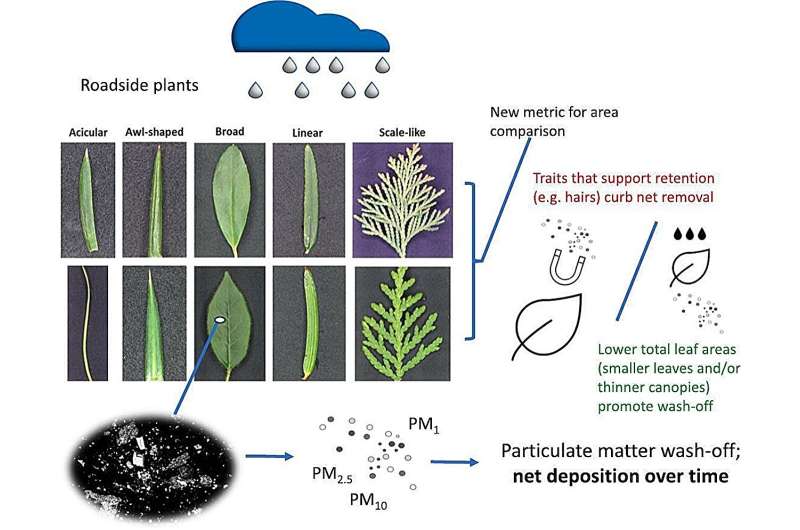
Graphical abstract. Credit: Science of The Total Environment (2023). DOI: 10.1016/j.scitotenv.2023.169713

If you’re trying to take pollution out of the air, choose evergreen trees with smaller leaves. That’s according to a new study from the University of Surrey.

Researchers from Surrey’s Global Center for Clean Air Research (GCARE) tested 10 trees beside a busy main road. They studied which caught the most particles of pollution and which best allowed the rain to wash those particles safely to the ground.

The paper, which helps promote the UN Sustainability Goals 3, 11, 13 and 15, is published in the journal Science of the Total Environment.

It had been thought that leaves with rougher surfaces and minute hairs would catch more pollutants. Yet that wasn’t borne out by the evidence.

Yendle Barwise, former forester and University of Surrey researcher, said, “When tackling air pollution, the ideal leaves cling on to particles when it’s windy—but let go of them in the rain. That means the wind blows less pollution back into the air—but rain can wash it safely to the ground.

“Being rough and hairy isn’t all it’s cracked up to be. To remove more particle pollutants over time, leaves need to be washed by rainfall, and it seems that the size and shape of the leaf is much more important from this perspective.”

Many planting projects use deciduous trees, which lose their leaves in winter—even though that’s when air pollution is worst in towns and cities. For that reason, scientists chose ten evergreen specimens and placed them in plant pots beside the A3 in Guildford. Some 80,000 vehicles drive past every day.

Of those studied, Yew (taxus baccata) was the plant which removed most air pollution. The most effective leaf types were awl-shaped. They were found on Japanese cedar (camellia japonica) and Lawson’s Cypress (chamaecyparis lawsoniana).

The study also suggested that stomata—the ‘pores’ of the leaf—could help plants ‘catch’ particles. For Yew, more particles of pollution gathered on the porous underside of the leaf. That’s despite the other side of the leaf being 47% rougher, and despite previous research suggesting roughness mattered more.

Professor Prashant Kumar, founder of the University of Surrey’s Global Center for Clean Air Research, said, “We know that planting trees by roadsides can make a big difference to air quality. Our study shows that by choosing your trees carefully, that difference can be even bigger.”

“We’ve shown that smarter choice of plants can take even more pollution out of the air. We just studied the shapes and textures of the leaves themselves. Other factors, like the tree’s height, leaf chemistry, or how many trees you plant, could also make a big difference. Those are well worth investigating in the future.”

Research finds evergreens with smaller leaves offer better air pollution mitigation

Posted in Air Quality, World News | Tagged , | Leave a comment

Exposure to air pollution associated with increase in sedentary time, study finds

Long-term exposure to current levels of UK air pollution has been found to be associated with an annual increase of up to 22 minutes of sedentary time each day, in a study published in the Journal of Public Health.

Researchers based at the NIHR Leicester BRC discovered this trend in what is thought to be the first study of its kind to closely examine the relationship between the levels of background pollution people are regularly exposed to in the UK environment, and their levels of physical activity and sedentary behaviour.

Sedentary behaviour is the amount of time spent lying, reclining, sitting or standing still. Higher levels of sedentary behaviour are known to be linked to poorer health including heart disease, several types of cancer and an earlier death.

Dr Jonathan Goldney from the University of Leicester explained: “We know that air pollution is associated with cardiometabolic and respiratory diseases, and in 2019 the World Health Organization estimated that 99% of the global population breathe air containing high levels of pollutants.

“Levels of air pollution may affect people’s ability to exercise, or their enjoyment of exercise. It may also be considered a risk factor for increasing levels of sedentary behaviour  by encouraging sitting time indoors and discouraging active time outdoors, further increasing the risk of chronic disease in a feedback loop.”

In this study, the team, which included Director of the NIHR Leicester BRC, Professor Melanie Davies CBE, took a close look at observations made on 644 people at risk of type 2 diabetes taking part in the ‘Walking Away from type 2 diabetes’ behavioural intervention, which aimed to increase physical activity through walking. 

Dr Goldney added: “The participants in the study wore accelerometers around their waists for seven consecutive days during waking hours. This gave us their daily minutes of moderate-to-vigorous physical activity and sedentary time on three occasions over a three year period – and an incredible opportunity to look for any long term trends.”

Annual average levels of the most measured air pollutants in health research (long-term particulate matter with diameter of less than or equal to 2.5 μm (micrometres), less than or equal to 10 μm, and nitrogen dioxide) from the year the participant entered the study and the preceding two years (sourced from the Department for Environment Food and Rural Affairs’ Pollution Climate Mapping model) were then compared to the annual change in accelerometer-measured sedentary time.

After taking into account important factors like social deprivation and measures of the built environment, the associations between long-term particulate matter with diameter less than or equal to 2.5 μm (micrometres), 10 μm, and nitrogen dioxide and annual change in accelerometer measured sedentary time and physical activity were examined.

Dr Goldney said: “Although the levels of pollutants we measured were not associated with a change in moderate-to-vigorous physical activity or number of steps taken, we found that they were associated with an annual increase in sedentary time.

“An increase of 1 μgm−3 in the average concentration of atmospheric nitrogen dioxide was associated with an increase in sedentary time of 1.52 minutes per day per year in the most conservative model. And across the group, our findings suggest that high levels of exposure to nitrogen dioxide were associated with up to 22 minutes per day of increased sedentary time per year.

“We observed this association regardless of how concentrations of pollutants were measured, including as a three-year average (year of start of observation with the two preceding years), or as the average pollutant concentration during the 12-month observation period.”

“If levels of air pollution are causing this increase in sedentary time, interventions to reduce ambient air pollution concentration such as low emissions zones could have a really positive impact on individual’s levels of sedentary behaviour, and a significant effect on public health,” Dr Goldney concluded.

The NIHR Leicester BRC is part of the NIHR and hosted by the University Hospitals of Leicester NHS Trust in partnership with the University of Leicester, Loughborough University and the University Hospitals of Northamptonshire NHS Group. The Leicester Real World Evidence Unit is part of the Leicester Diabetes Centre. 

Exposure to air pollution associated with increase in sedentary time, study finds – NIHR Leicester Biomedical Research Centre
Posted in Air Quality, Health Effects of Air Pollution | Tagged , , | Leave a comment

Fines for idling engines start today

Drivers who leave their engines running when parked risk a £40 fine from today.

Signs went up across the city in December ready for enforcement to start in the new year.

Drivers can be fined if their idling cars are in a parking bay, taxi rank and other parts of the road, but the new rule doesn’t apply to sitting in traffic.

The fine is reduced to £20 if paid within 10 days.

Councillor Tim Rowkins, chair of the City Environment, South Downs and The Sea Committee said last year: “Improving the city’s air quality is extremely important, especially for those who suffer from long term respiratory conditions like asthma and lung disease.

“Enforcing engine idling is something we hope will deter motorists from releasing harmful emissions unnecessarily. We’re asking those parked up to switch off their engines and reduce air pollution.”

If an environmental enforcement officer witnesses a car idling, they’ll speak to the driver to let them know they’re committing an offence.

They’ll take the drivers details, including their registration number, and issue them with a fixed penalty notice.

If the driver refuses to give their details or drives off, the council will contact Sussex Police to collect the details and the FPN will be sent in the post.

An idling engine can produce up to twice as many exhaust emissions as an engine in motion. Exhaust emissions contain a range of air pollutants such as carbon monoxide, nitrogen dioxide, and particulate matter.

Fines for idling engines start today – Brighton and Hove News
Posted in Air Quality, Europe, UK | Tagged , , | Leave a comment

Study underlines impact of air pollution on people with asthma

New research by the University of Stirling has offered a greater understanding of how people with asthma in Scotland are affected by air pollution.

The study could offer an opportunity to improve the effectiveness of advice aimed at helping individuals to reduce their personal exposure to air pollution.

Asthma is the world’s most widespread chronic respiratory condition and more than 368,000 people receive treatment for asthma in Scotland, 7% of the population.

Meanwhile, air pollution causes seven million premature deaths every year, with an estimated 2500–3500 of those in Scotland.

Exposure to air pollution is a known asthma trigger and University of Stirling researchers interviewed 36 people in Scotland who spoke in detail about the impact on their lives.

One woman was advised by her GP that her health would only improve if she moved house while another said if air quality is poor, she does not go out.

Another participant from Glasgow said she consciously walks quickly through Charing Cross, which is next to the busy M8 motorway, while another woman said she closes every window in her house if traffic is heavy outside.

The new study comes after previous research by the University of Stirling’s Faculty of Natural Sciences found that better air quality monitoring is needed to assess the acute impacts of air pollution on people with asthma.

PhD researcher Amy McCarron who led both studies said: “While the physiological connections between air pollution and asthma have been extensively studied, this study sought to explore the nuanced perspectives, daily experiences and management strategies of individuals.

“This research offers a greater understanding of the challenges faced by at-risk groups, such as individuals with asthma, in managing their condition relating to air pollution exposure.”

Behavioural change

Previous research has found that current advice often proves ineffective in promoting behavioural change to minimise personal exposure, as it tends to be generic and overlooks individual circumstances and past experiences.

Ms McCarron said “By better understanding how air pollution impacts those most vulnerable in their day to day lives and how they practically manage this, we can work towards creating more effective communications and advice aimed at encouraging behaviour change, taking into account these experiences.

“In turn, this could encourage greater uptake of behaviour change, ultimately reducing personal exposure to air pollution.”

Researchers interviewed 36 non-smoking adults living in Scotland who been diagnosed with asthma by a healthcare professional. Interviews took place between September 2021 and September 2022.

The paper “I have to stay inside …”: Experiences of air pollution for people with asthma was published in the journal Health and Place.

It was funded by NERC IAPETUS2 and the Scottish Environment Protection Agency.

Study underlines impact of air pollution on people with asthma in Scotland | About | University of Stirling

https://www.stir.ac.uk/news/2023/12/study-underlines-impact-of-air-pollution-on-people-with-asthma-in-scotland/

Posted in Air Quality, Asthma, Health Effects of Air Pollution | Tagged , , , , | Leave a comment

Three quarters of high streets have air pollution levels above WHO annual recommendations

Around three quarters (76%) of British high streets may exceed the World Health Organisation’s recommended annual level of air pollution.

That’s according to a new study from sustainable energy provider GRIDSERVE, which used an air quality measuring device to conduct air pollution spot checks on the main high streets of the 25 largest towns and cities in Britain over a two-week period.

Specifically, researchers measured the level of PM2.5 pollutants in the air, meaning particulate matter that is less than 2.5 micrometres in diameter. Particulate matter (PM) is everything in the air that’s not gas and consists of many chemical compounds and materials. Because of their small size, they can enter the bloodstream and cause illnesses such as asthma, heart disease and lung cancer.

The World Health Organisation’s recommendation, acknowledged by the Government’s Committee on the Medical Effects of Air Pollutants, is that annual levels of PM2.5 should not exceed 5 micrograms per cubic meter air (µg/m3).

Only six of the 25 high streets in the study recorded an average reading of 5 µg/m3 or lower. Stoke-on-Trent had the highest average level of PM2.5 in the air (11.7), followed by Newcastle (11.5) and Leicester (11.2). Newcastle also registered the highest single reading of 20.5.Conversely, Glasgow was shown to have the cleanest air with a PM2.5 reading of just 2.2 µg/m3, followed by Edinburgh (2.7). Interestingly, Scotland was the first country in Europe to adopt the WHO recommended limit for PM2.5 in 2016.

While no pattern was found regarding whether the high streets were pedestrianised or not, high streets were found to have on average 53% more PM2.5 in the air than the closest park (park average 4.7 µg/m3 compared to high street average 7.2).

Additional research among 2,000 adults reveals 40% of adults are concerned about the air quality on the street where they do most of their shopping, with emissions from cars being the main reason (60%). Nearly half of people think more plants (46%) or fewer cars (44%) would improve air quality, while a third think more electric vehicles would help (36%).

As a result, more than a third of people (36%) have concerns over the health of the local community due to air pollution, or the health of their family or themselves (26%/25%). Around a quarter of people are trying to find greener ways to travel (26%), while just over one in 10 avoid shopping where there are lots of cars (12%) or just forgo the high street in favour of online shopping (11%). A similar number are going to do more of their Christmas shopping virtually this year to avoid high street pollution (10%).

Sam Clarke, Chief Vehicle Officer at GRIDSERVE, said: “With millions set to hit the high street this festive period, we wanted to look at the state of the nation’s air quality in the locations people will be doing most of their Christmas shopping. It’s shocking to see that so many were above the World Health Organisation’s annual recommendations for air pollution, and that one in 10 shoppers are even planning on foregoing the high streets altogether due to air quality.”

“If we’re to reach the World Health Organisation’s annual target of 5 µg/m3 of PM2.5 in our air, collectively we need to change our behaviours. With vehicle emissions being a key contributor, anything we can do to travel more greenly, from walking more to cycling, and including electric vehicles, is a very valuable set forward to improve the air we breathe daily.”

Three quarters of high streets have air pollution levels above WHO annual recommendations – FleetPoint

Posted in Air Quality, Europe, Health Effects of Air Pollution, UK | Tagged , , , | Leave a comment