Major Siberian cities choking from strong wildfires

Krasnoyarsk and Novosibirsk suffering smoke pollution and infernos rage in forests after hot, dry weather.

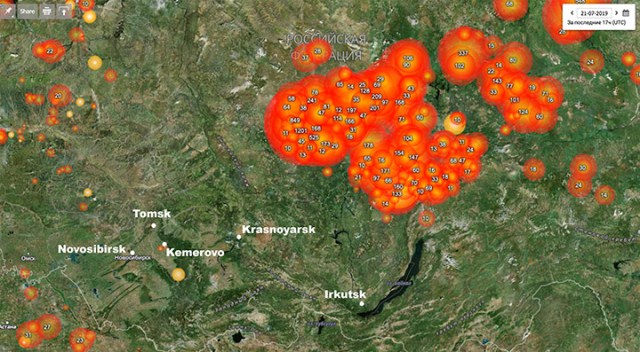
Pictures show the scale of the smoke in major population centres from the raging wildfires with the cause seen mainly as out-of-control forest fires in Krasnoyarsk region, the second largest in Russia.

In Krasnoyarsk city, residents have been told by health officials to go outside only if really necessary.

Here watchdog Rospotrebnadzor confirmed the hygienic standard  in the air of the PM 2.5 particles is exceeded by between 1.2  and 2.3 times.

Sensors installed by activists on Saturday showed a ‘dangerous excess of the maximum permissible concentrations’.

Dust, soot and other small particles are shown as present in the air.

On Saturday morning, the MPC values ranged from 42 to 74, with the safe value of 25 units.

Later the sensors showed readings from 221 to 344.

The limited visibility and smell of burning is observed in all districts of Krasnoyarsk, and in villages and towns in the vast region, for example, Lesosibirsk and Achinsk.

The regional government in Krasnoyarsk blamed lightning for starting most fires.

They reported: ‘An emergency regime is introduced in the region, (and) people have limited access to forests.’

inside_map

The pollution from wildfires in Krasnoyarsk has spread with air flows over a huge geographical area to other regions.

A strong smell of burning and thick haze covered Tomsk city on Saturday.

Experts explain this was caused by high humidity in the city plus air masses blowing from regions where the wildfires are raging.

A representative of the Russian Ministry of Emergencies in the Tomsk region explained: ‘Forest fires in Krasnoyarsk region caused the smell of burning and haze over Tomsk.

‘There are currently no forest fires in (our) region.

According to the observations of the Tomsk Centre for Hydrometeorology and Environmental Monitoring, the excess of maximum permissible concentrations of pollutants has not been observed in the atmospheric air.’

Residents in Kemerovo complained in social networks about the smell of burning and the smoke that stands over the city.

A local weather expert said: ‘We are in the centre of a cyclone.

’It pumps in the air and directs it from the north to us.

‘Tomorrow the north wind is also expected… but rains may clear the area, which will purify the atmosphere.’

Siberia’s largest city Novosibirsk was also hit by a smell of burning and there was light haze.

In the morning of July 21 smog appeared and the smell significantly increased.

The CityAir service estimates air pollution at 8 points out of 10, the situation began to deteriorate at about 2 am.

This was despite the Ministry of Emergency Situations in Novosibirsk region stating their were no fires on its territory

‘Krasnoyarsk firesafe giving us the smoke,’ said a spokesman. ’The wind is northeasterly.’

According to the Federal Service Avialesokhrana on 21 July, some 492,750 hectares of forests are ablaze in Krasnoyarsk region and only 28,366 are being extinguished.

Smoke from wildfires is observed in several districts of the Irkutsk region, further to the east.

Smoke covered Bratsky, Chunsky, Ust-Ilimsky, Nizhneilimsky and Ust-Kut districts.

As of the morning of 21 July, 86 forest fires are registered in Irkutsk region.

The total area of burning forests is 217,418 hectares.

Fire extinguishing is carried out by forest protection troops.
via Major Siberian cities choking from strong wildfires

Posted in Air Quality, Asia | Tagged , , , , , , | Leave a comment

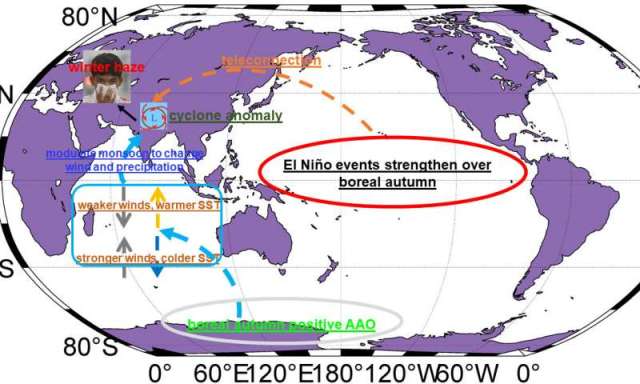
Using El Niño and Antarctic Oscillation data to predict air pollution levels in northern India

5d303ea2aa49e

A team of researchers affiliated with several institutions in China and the U.S. has found that data from El Niño and Antarctic Oscillation events can be used to predict air pollution levels in northern India. In their paper published in the journal Science Advances, the group describes their study of the historical impact of El Niño and Antarctic Oscillation events on weather in northern India and what they found.

In recent years, northern India has experienced poor air quality, particularly in the winter months, to the extent that the country has some of the worst air quality in the world—surpassing even China. Researchers have also noted that in some years, pollution levels seem worse than normal due to weather conditions. In this new effort, the researchers looked at two natural weather events that are known to have a clear impact on winter weather in northern India—El Niño and the Antarctic Oscillation.

El Niño is, of course, an event that involves a large band of warm water forming in the Pacific Ocean—such events have widespread weather impacts across multiple parts of the world. And the Antarctic Oscillation is a wind event caused by a low-pressure belt forming over Antarctica.

To better understand what impact either or both weather events might have on India’s air pollution, the researchers collected data on both, covering the years 2003 to 2018. They then used the data to conduct statistical modeling as a way to assess their impacts on northern India. They report that El Niño events tend to result in reduced wind speeds in the region, which prevented airborne pollutants from moving out of heavily populated areas. They also found that Antarctic Oscillation events create stronger winds in some parts of northern India and weaken them in others, resulting in uneven impacts on pollution levels.

The researchers suggest that it is possible to use weather data collected for El Niño and Antarctic Oscillation events to provide government officials with a means of gauging pollution levels in northern India each year.

via Using El Niño and Antarctic Oscillation data to predict air pollution levels in northern India

Posted in Air Quality, Asia, India | Tagged , , , | 1 Comment

Public health warning for Hong Kong as Air Quality Health Index reaches ‘serious’ category, the highest pollution level in city

  • Avoid or reduce outdoor exercise and spend more time indoors, says environment department
  • Top alert level recorded in parts of the city on Wednesday, with children, elderly and those with certain illnesses in built-up areas most at risk

Air pollution reached its highest alert level in parts of Hong Kong on Wednesday after the government warned of a “serious” risk to public health and advised people to avoid outdoor activity.

The Environmental Protection Department released a statement earlier on Wednesday afternoon saying pollutant levels had been rising since the morning, with the Air Quality Health Index expected to reach the worst category at some monitoring stations.

Later in the afternoon, two official sites in the New Territories recorded the risk to public health as “serious”, which is at the top of the five-tier scale.

“Under the influence of the outer subsiding air of tropical cyclone Danas, the weather in Hong Kong today is hazy with sunny periods and light wind,” the statement said.

“Hong Kong is being affected by an air mass with higher background pollutant concentrations. Higher than normal levels of ozone and particulates have been recorded in the territory since noon.”

It added high levels of ozone promoted the formation of nitrogen dioxide, particularly in urban areas and at the roadside.

At 2pm, 11 out of 16 monitoring stations, including general stations in 13 districts and three roadside sites on Hong Kong Island and Kowloon, reported the health risk from the pollution as “very high”, the second highest on the scale.

The areas affected included Central and Western district, Yuen Long, Kwai Chung, Tun Muen, Tung Chung and Tai Po.

At 4pm, two stations in Yuen Long and Tuen Mun recorded a “serious” health risk from pollution.

The department advised members of the public to reduce or avoid outdoor physical exertion to minimum levels and to cut the time they spent outside, especially in areas with heavy traffic, where the health risk is very high for children, the elderly and people with existing heart or respiratory illnesses.

Hong Kong Observatory forecast a southwesterly air stream to bring a few showers and thunderstorms to the south China coast and ease the pollution later in the week.

via Public health warning for Hong Kong as Air Quality Health Index reaches ‘serious’ category, the highest pollution level in city | South China Morning Post

Posted in Air Quality, Asia, China | Tagged , , | Leave a comment

Tourists more likely to be suspicious of local service providers when a destination has heavy air pollution, according to new study

A new study from Queen Mary University of London has found that levels of air pollution influence how tourists interact with local service providers.

The research, Tourists and Air Pollution: How and Why Air Pollution Magnifies Tourists’ Suspicion of Service Providers, was published in the Journal of Travel Research.

Service providers include hospitality outlets such as bars and restaurants, accommodation, transport and sightseeing services as well as shopping and entertainment. The research found that tourists were more likely to be suspicious of these providers when they visited destinations with high levels of air pollution.

Air pollution shapes emotions
The study also found that tourists’ emotional states are shaped by air pollution on arrival, where heavy air pollution at a destination can lead tourists to experience more pessimistic feelings.

60 per cent of respondents reported that they had a negative mood when describing their feelings and experiences in destinations with high levels of pollution. More than 40 per cent reported engaging with coping techniques including buying masks and increasing indoor activities.

The study also shows that air pollution is just as important as weather and climate when it comes to evaluating tourist destinations.

Long-haul travellers less likely to be impacted by air pollution

Tourists visiting long-haul destinations were less affected by air pollution and were generally found to be more intent on taking full advantage of their visits rather than shorten or cancel activities due to poor air quality. However these tourists may not realise that their psychological states and responses are shaped by pollution levels on arrival.

Dr Yuansi Hou, Senior Lecturer in Marketing at Queen Mary said: “Next time, when you visit a destination, if you find yourself more likely to be dissatisfied with and suspicious of the local services, it could be due to the poor air quality around you.”

via HSS – Tourists more likely to be suspicious of local service providers when a destination has heavy air pollution, according to new study – Queen Mary University of London

Posted in Air Quality | Tagged , | Leave a comment

Air Quality Advisory declared for Northeast Ohio

The Northeast Ohio Areawide Coordinating Agency declared an Air Quality Advisory for Northeast Ohio.

The advisory for ground-level ozone is in effect throughout the entire day on Monday.

Ashtabula, Cuyahoga, Geauga, Lake, Lorain, Medina, Portage and Summit Counties are affected by the advisory.

According to NOACA, air quality levels will be “unhealthy for sensitive groups” during this period.

“Sensitive Groups” include children, the elderly, and those with breathing difficulties, according to NOACA.

Here are NOACA’s recommendations for reducing air pollution:

Driving Less: bike, walk, use transit, work from home, combine trips
Don’t Idle: turn off your engine
Refill your tank after sunset
wait to mow

via Air Quality Advisory declared for Northeast Ohio

Posted in Air Quality, USA, USA & Canada | Tagged , , , | Leave a comment

Billions of air pollution particles found in hearts of city dwellers

Exclusive: Study shows associated damage to critical pumping muscles, even in children

The hearts of young city dwellers contain billions of toxic air pollution particles, research has revealed.

Even in the study’s youngest subject, who was three, damage could be seen in the cells of the organ’s critical pumping muscles that contained the tiny particles. The study suggests these iron-rich particles, produced by vehicles and industry, could be the underlying cause of the long-established statistical link between dirty air and heart disease.

The scientists said the abundance of the nanoparticles might represent a serious public health concern and that particle air pollution must be reduced urgently. More than 90% of the world’s population lives with toxic air, according to the World Health Organization, which has declared the issue a global “public health emergency”.

The scientists acknowledged some uncertainties in their research, but Prof Barbara Maher, of Lancaster University, said: “This is a preliminary study in a way, but the findings and implications were too important not to get the information out there.”

Maher and colleagues found in 2016 that the same nanoparticles were present in human brains and were associated with Alzheimers-like damage, another disease linked to air pollution.

While all ages were affected, Maher said she was particularly concerned about children.

“For really young people, the evidence is now of very early-stage damage both in the heart and the brain,” she said. “We have a likely candidate [particle] able to access both organs, with the pathological evidence to show damage is happening.”

A recent comprehensive review concluded that air pollution may be damaging every organ and virtually every cell in the human body, as tiny particles are inhaled, move into the blood stream and are transported around the body. Much of the evidence of harm, from diabetes to reduced intelligence to increased miscarriages, is epidemiological, as harmful experiments on people are unethical. But one study in 2018 found air pollution particles in the placentas of women who had given birth.

The new research is the first direct evidence that iron-rich nanoparticles may cause heart disease. Tiny particles were already known from laboratory tests to be seriously damaging to human cells and to be a significant component of roadside air pollution.

Maher said: “Putting an abundance of iron-rich nanoparticles right into the sub-cellular components of the heart’s muscle tissue, that’s not where you want them to be sitting. They are inside the mitochondria, which are damaged and appear abnormal. Mitochondria are your energy source, making sure your heart pumps effectively.”

Mark Miller, an expert on the cardiovascular effects of air pollution, from the University of Edinburgh but not part of the research, said: “While there are some uncertainties from the study, it highlights how important it is to better understand the way particles in air pollution may cause harm to different areas of the body.

“More effort is needed to reduce particle emissions from vehicles, especially to remove the number of vehicles on the road by encouraging people to walk and cycle for short journeys.”

The research, peer reviewed and published in the journal Environmental Research, analysed heart tissue taken from 63 young people who had died in road traffic accidents but had not suffered chest trauma. They lived in Mexico City, which has high air pollution, and had an average age of 25.

The research was conducted in two main parts: calculating the number of iron-rich nanoparticles present; and looking at their location within the tissue and the associated damage. The number of particles found was between 2bn and 22bn per gram of dried tissue; and their presence was two to 10 times higher in the Mexico City residents than in nine control subjects who had lived in less polluted places.

The medical scientists in the team reported that “exposure to [nanoparticles] appears to be directly associated with early and significant cardiac damage”.

Maher said the results were relevant for all countries: “There is absolutely no reason to expect this would be different in any other city.” Based on previous work, she said, the particles were also likely to carry additional contaminants. “We can imagine these nanoparticles come loaded with a toxic mix.”

Iron-rich nanoparticles begin as molten droplets produced by the combustion of fuel and then cool rapidly into spheres with fused surfaces. The particles in the heart tissue had these characteristics, rather than small iron-rich magnetite crystals that are known to occur naturally in at least one organ, the brain.

The technique used to locate the nanoparticles in the heart tissue could not be used to measure their composition. Instead, the scientists separated the particles from the tissues to determine their composition and magnetic content, and then used the average size and magnetism of the particles to estimate the total number.

They said they would like to confirm the particles’ composition in situ within the cells, but that would require the use of expensive equipment and Maher said they had received no funding for the work. “We are having to do this on a shoestring. It is madness.”

via Billions of air pollution particles found in hearts of city dwellers | Society | The Guardian

Posted in Air Quality, Health Effects of Air Pollution, Medical Studies | Tagged , , , , , | Leave a comment

Study finds association between air pollution, coronary atherosclerosis in Chinese population

studyfindsas

Spatial Distribution of Estimated Annual Pollution Concentrations in 2015 in China: A, Concentration of particulate matter with aerodynamic diameter less than 2.5 μm (PM2.5) per 1 × 1 km2. B, Concentration of nitrogen dioxide (NO2) per 1 × 1 km2. JAMA Netw Open. 2019;2(6):e196553. doi:10.1001/jamanetworkopen.2019.6553

New research from the University at Buffalo provides pathophysiologic evidence of the effect of air pollution on cardiovascular disease in China. The findings also suggests that China may need to revise its standard for one type of pollutant.

Researchers found that long-term exposure to particulate matter and nitrogen dioxide, as well as proximity to vehicular traffic, were associated with severity of coronary artery calcium, or the buildup of plaque in the artery walls. The study was conducted on 8,867 Chinese adults aged 25 to 92.

The findings, published in JAMA Open Network, are significant because, while similar studies have been conducted in the U.S. and Europe, this one is the first to investigate the connection between air pollution and coronary artery calcium in China. The country has focused more recently on reducing the extremely high levels of air pollution that exist in some regions, particularly northern China.

“This study may provide evidence that coronary atherosclerosis is a pathological pathway through which air pollution exposure increases risk of death from coronary heart disease,” said the paper’s first author, Meng Wang, assistant professor of epidemiology and environmental health in UB’s School of Public Health and Health Professions.

“This finding should contribute to an understanding of air pollutant effects worldwide, providing both much-needed, locally generated data and supportive evidence to inform the air pollution standard setting process on a global scale,” added Wang, Ph.D., who is also a faculty member in the UB RENEW (Research and Education in eNergy, Environment and Water) Institute.

Atherosclerosis refers to the build-up of plaque, or fatty deposits, in the artery walls, which, over time, restricts blood flow through the arteries. This can cause a blood clot resulting in a heart attack or stroke.

“Atherosclerosis is a lifelong process. As such, the effects of air pollution exposure on atherosclerosis are likely to be chronic,” Wang explained.

If an association between this condition and air pollution were established, Wang added, it could provide an opportunity for local-level efforts to control people’s exposure to pollution before it becomes harmful to health.

The study centered on levels of nitrogen dioxide and PM2.5, or fine particulate matter. PM2.5 are super tiny particles that can easily be inhaled, causing serious health problems, according to the U.S. Environmental Protection Agency.

The study also looked at proximity to traffic and used nitrogen dioxide as a more precise indicator of vehicular emissions. It showed that the risk of a higher coronary artery calcium score increased by 24.5 percent for every 20 micrograms per cubic meter of air increase in nitrogen dioxide.

Air pollution remains a significant issue in China. In 2015, more than 95 percent of the Chinese population was exposed to concentrations of PM2.5 and nitrogen dioxide greater than the minimum level of the study, according to Wang.

“Since more than 40 percent of all deaths are attributable to cardiovascular disease, the potential contribution of air pollutants to cardiovascular disease in China is very large,” he said.

Improving air quality to the Chinese national standards of 35 and 40 micrograms per cubic meter of air for PM2.5 and nitrogen dioxide, respectively, may help people live longer, Wang said.

Still, the effect of nitrogen dioxide exposure on coronary artery calcium persisted even when researchers restricted their analysis to concentrations below 40 micrograms per cubic meter of air.

“This suggests that the current air pollution standard may need to be re-evaluated,” Wang said.

via Study finds association between air pollution, coronary atherosclerosis in Chinese population

Posted in Air Quality, Asia, China, Health Effects of Air Pollution, Medical Studies | Tagged , , , , , | Leave a comment

Pollution warning over car tyre and brake dust

Dust from car brakes and tyres will still pollute city air even when the vehicle fleet has gone all-electric, a report has warned.

Fragments of microplastics from tyres, road surfaces and brakes will also flow into rivers, and ultimately into the sea, government advisers say.

Ministers say they want to pass standards to improve tyres and brakes.

But critics say they need to go further by developing policies to lure people out of private cars.

The government’s Air Quality Expert Group said particles from brake wear, tyre wear and road surface wear directly contribute to well over half of particle pollution from road transport.

They warn: “No legislation is currently in place specifically to limit or reduce [these] particles.

“So while legislation has driven down emissions of particles from exhausts, the non-exhaust proportion of road traffic emissions has increased.”

They say the percentage of pollutants will get proportionally higher as vehicle exhausts are cleaned up more.

Environment Minister Thérèse Coffey said : “The documents published today make clear that it is not just fumes from car exhaust pipes that have a detrimental impact on human health but also the tiny particles that are released from their brakes and tyres.

“Emissions from car exhausts have been decreasing through development of cleaner technologies – and there is now a need for the car industry to find innovative ways to address the challenges of air pollution from other sources”.

Mike Hawes, chief executive of the Society of Motor Manufacturers and Traders, said: “The industry is committed to improving air quality and has already all but eliminated particulate matter from tailpipe emissions.

“Brake, tyre and road wear is a recognised challenge as emissions from these sources are not easy to measure.”

Transport options

The document chimes with a recent report warning that electric cars won’t offer a complete solution to mobility.

It said even self-driving electric cars would produce pollution and congest the roads.

The key was to reduce the use of cars by getting people on to less-polluting forms of transport, said Prof Jillian Anable, one of the authors of the report.

She said: “For many years ministers have adopted the principle of trying to meet demand by increasing road space. They need to reduce demand instead.”

The UK transport department said it was spending £6bn on buses, walking and cycling – and £50bn on roads.

Supporters of electric cars say the report may be flawed because when you lift your throttle foot in an electric vehicle, the car slows itself and there is less need to brake.

via Pollution warning over car tyre and brake dust – BBC News

Posted in Air Quality, Europe, UK | Tagged , , , , | Leave a comment