Air Pollution Linked to Intellectual Disabilities in Children

A new study has found that British children with intellectual disabilities are more likely than their peers to live in areas with high outdoor air pollution.

Published in the Journal of Intellectual Disability Research, the study’s findings come from an analysis of data from the U.K.’s Millennium Cohort Study, a nationally representative sample of more than 18,000 children born in 2000 to 2002.

Researchers discovered that children with intellectual disabilities were 33 percent more likely to live in areas with high levels of diesel particulate matter, 30 percent more likely to live in areas with high levels of nitrogen dioxide, 30 percent more likely to live in areas with high levels of carbon monoxide, and 17 percent more likely to live in areas with high levels of sulfur dioxide.

The researchers noted that intellectual disability is more common among children living in more socioeconomically deprived areas, which tend to have higher levels of air pollution. However, they add that exposure to outdoor air pollution may impede cognitive development, increasing the risk of intellectual disability.

“We know that people with intellectual disabilities in the U.K. have poorer health and die earlier than they should,” said lead author Dr. Eric Emerson of the University of Sydney in Australia. “This research adds another piece to the jigsaw of understanding why that is the case and what needs to be done about it.”

via Air Pollution Linked to Intellectual Disabilities in Children

Posted in Air Quality, Health Effects of Air Pollution, Medical Studies | Tagged , , , , | Leave a comment

Breast Cancer Risk: New Study Says Long-Term Exposure To Vehicle Exhaust Fumes Results In Breast Cancer

Women working near busy roads are at high risk of developing breast cancer, due to air pollution

Air pollution is currently one of the worst problems that the world is facing. If a new study is to be believed, air pollution increases the risk of developing breast cancer in women.

According to a new study conducted by researchers from the University of Stirling in Scotland, women working near busy roads are at high risk of developing breast cancer, due to traffic-related air pollution.

For the purpose of the study, the researchers analyzed the case of a woman who developed breast cancer after spending 20 years working as a border guard at the Ambassador Bridge between Detroit, Michigan and Windsor, Ontario.

Surprisingly, the woman’s diagnosis came within 30 months of five other women working at the same border crossing. Another seven women working at the Detroit-Windsor tunnel were found developing the same disease alongside them.

The researchers Michael Gilbertson and Jim Brophy believe chemicals in the traffic fumes caused cancer. Vehicle exhaust fumes shut down the BRCA1 and BRCA2 genes in the body, which play a big role in repairing DNA to stop defects leading to uncontrolled tumors and breast cancer. Notably, BRCA2 gets rapidly degraded in the presence of aldehydes, which are also components of exhaust fumes.

Considering that the woman worked 40 hours a week, she could have been exposed to the fumes of up to 46.8 million vehicles.

The researchers claim that there is a one in 10,000 chance the cases were a coincidence as the cancers were all so similar and close together.

“These outbreaks of breast cancer represent a new occupational disease,” Dr. Gilbertson said, reported Daily Mail. “This new research indicates the role of traffic-related air pollution in contributing to the increasing incidence of breast cancer in the general population.”

The woman, whose case was revealed in the study, was denied any compensation.

The research study has been published in the journal New Solutions.

via Breast Cancer Risk: New Study Says Long-Term Exposure To Vehicle Exhaust Fumes Results In Breast Cancer – Chief Observer

Posted in Air Quality, Health Effects of Air Pollution, Medical Studies | Tagged , , , | Leave a comment

Living with air pollution

People wearing smoke masks, children going stir-crazy indoors, families driving hours to find fresh air. Alarming as it is to some, unhealthy air enveloping the San Francisco Bay Area in recent days is all too familiar to millions of people around the world (see global ranking and air pollution map).

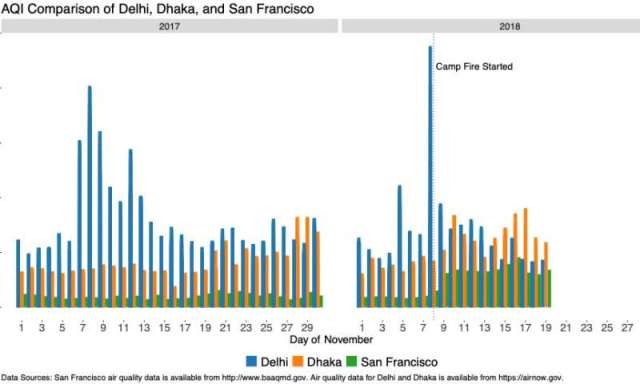
In fact, the air quality index (AQI) – a representation of pollutant concentration over a specified period of time – in San Francisco in recent days is on par with some of the most polluted cities in the world, according to Stanford researchers who study the effects of poor air quality.

“I don’t want to minimize how devastating the California fires have been or the current unusual state of air quality in the Bay Area, but these conditions are really the norm for people living in many other parts of the world,” said Nina Brooks, a doctoral candidate in the Emmett Interdisciplinary Program on Environment and Resources (E-IPER) in Stanford’s School of Earth, Energy & Environmental Sciences.

Brooks does field work in Dhaka, Bangladesh, for a Stanford-led project to make brick manufacturing cleaner. While air pollution in Dhaka is high year-round, it spikes dramatically in winter months when coal-burning brick kilns around the city operate. The AQI in Dhaka during the winter, where more than 1,000 brick kilns operate, typically hovers above 150 – a level considered unhealthy for all groups – but often spikes much higher.

Globally, long-term exposure to outdoor air pollution is responsible for 4.2 million deaths, according to the World Health Organization, and 9 out of 10 people breathe outdoor and/or indoor air containing high levels of pollutants.

1-livingwithai

“The poor, young and elderly are most vulnerable,” said Marshall Burke, an assistant professor of Earth system science in the School of Earth, Energy & Environmental Sciences. “Climate change can exacerbate the situation by driving meteorological conditions conducive to forming ozone and increasing the chance of wildfires, among other impacts.”Burke coauthored a study showing that exposure to particulate matter in sub-Saharan Africa led to 400,000 otherwise preventable infant deaths in a single year. By analyzing satellite measurements, Burke and his colleagues revealed that small improvements in air quality could be one of the most effective interventions to curb infant mortality rates in the region.

Children under age 5 in lower-income countries are more than 60 times as likely to die from exposure to air pollution as  in high-income countries, according to the World Bank. Regardless of age, people exposed to polluted air for long periods of time are more likely to suffer from diseases such as stroke, lung cancer and chronic obstructive pulmonary disease.

“It’s important for us to think about our health here, but we should also think about how we can use our creativity and resources to help people around the world,” said Alex Yu, a postdoctoral scholar in infectious disease who does research with Brooks in Bangladesh. “This is a big problem that is usually invisible to us. It’s a fact of daily life in many places, and has a lot of health consequences.”

Brooks compiled AQI data for Delhi, Dhaka and San Francisco that paint a stark picture. They show that air pollution in San Francisco spiked after the Camp Fire began on Nov. 8 and approached levels in Delhi and Dhaka. However, a comparison with previous weeks and the same month in 2017 show how much of an aberration poor air quality is in the Bay Area, while in cities such as Delhi and Dhaka it is just business as usual.

via Living with air pollution

Posted in Air Quality, Asia, Health Effects of Air Pollution, India, USA, USA & Canada, World News | Tagged , , , , , , | 2 Comments

Deadly air pollution shortens lives by nearly 2 years – researchers

Air pollution, caused largely by burning fossil fuels, is cutting global life expectancy by an average of 1.8 years per person, making it the world’s top killer, researchers said on Monday.

The tiny particles ingested from polluted air shorten life more than first-hand cigarette smoke, which can reduce it by 1.6 years, and are more dangerous than other public health threats such as war and HIV/AIDS, they said.

The University of Chicago’s Air Quality Life Index (AQLI) shows people in parts of India, the world’s second-largest country by population, could live 11 years less due to high levels of air pollution.

Life expectancy averages slightly below 69 in the South Asian nation of 1.3 billion, according to the World Bank.

The researchers launched a website that tells users how many years of life air pollution could cost them according to which region of a country they live in.

The index seeks to transform hard-to-comprehend data into “perhaps the most important metric that exists – life”, Michael Greenstone, director of the Energy Policy Institute at the University of Chicago (EPIC), said in a statement.

Particulate pollution is normally measured in micrograms per cubic meter.

“The fact that this AQLI tool quantifies the number of years I and you have lost to air pollution makes me worried,” Kalikesh Singh Deo, an Indian member of parliament, said in a statement shared by EPIC.

China and Indonesia are also among the countries where microscopic particles floating in the air hit residents the hardest, cutting their life expectancy by as much as seven years and five and a half years respectively, the website shows.

Other studies have previously looked into the number of people who may die prematurely because of air pollution.

But the EPIC scientists hope the website – the first of its kind, according to the institute – will make the consequences of policies that promote dirty energy more tangible, and encourage reforms that promote better air quality.

Only a handful of India’s 100 most polluted cities have drawn up plans to combat air pollution despite being asked to do so three years ago, a report from the World Health Organization said earlier this year.

via Deadly air pollution shortens lives by nearly 2 years – researchers

Posted in Health Effects of Air Pollution, Medical Studies | Tagged , , , , , , | Leave a comment

Fitting a Respro® Mask Strap

This short video demonstrates how to put a head strap on a Respro® Mask.

This head strap is an extra secure device for your mask. It is a fully adjustable, one size accessory that helps support and seal the mask.

Available from our website respro.com in black and white.

img_5548a_copy-2__zoom

Respro® Mask Strap (black) on Respro® Ultralight™ Mask (green)


Posted in Air Quality, Help & FAQs, Respro® How To Videos, Respro® Products | Tagged , , | Leave a comment

California air pollution due to wildfires exceeded world health standards by 60 times

The level of air pollution in California exceeded world “safe” levels by about 60 times last week after a series of deadly wildfires.

Particulates in the air in some areas of the state reached levels as high as 1,500 micrograms per cubic meter, according to Bloomberg. The World Health Organization-set healthy standard for such particulates is 25.

Rebecca Buchholz, from the National Center for Atmospheric Research, described the high levels as “just insane.”

“It is quite amazing how high these fine-particulate levels are,” Buchholz said to Bloomberg.

More than 70 people have died in the Camp Fire. The Northern California blaze is now the state’s deadliest wildfire and has destroyed vast swaths of land. There is also a wildfire doing severe damage in Southern California.

Buchholz warned that while the pollution levels have since lowered in many areas, it may linger long after the fires are extinguished, especially due to expected rain and the potential for smoldering, which keeps smoke in the air.

High levels of air particulates can lead to long-term respiratory issues, as well as irritation of lungs and eyes, according to Buchholz.

President Trump visited the damaged areas over the weekend, after initially blaming California’s forest management for the fires and threatening to withhold federal funding to the state.

The president signed a declaration to give funding to California but has continued to criticize state officials about forest management.

via California air pollution due to wildfires exceeded world health standards by 60 times | TheHill

Posted in Air Quality, USA, USA & Canada | Tagged , , , , , | Leave a comment

Deadly air pollution shortens lives by nearly two years: researchers

Air pollution, caused largely by burning fossil fuels, is cutting global life expectancy by an average of 1.8 years per person, making it the world’s top killer, researchers said on Monday.

The tiny particles ingested from polluted air shorten life more than first-hand cigarette smoke, which can reduce it by 1.6 years, and are more dangerous than other public health threats such as war and HIV/AIDS, they said.

The University of Chicago’s Air Quality Life Index (AQLI) shows people in parts of India, the world’s second-largest country by population, could live 11 years less due to high levels of air pollution.

Life expectancy averages slightly below 69 in the South Asian nation of 1.3 billion, according to the World Bank.

The researchers launched a website that tells users how many years of life air pollution could cost them according to which region of a country they live in.

The index seeks to transform hard-to-comprehend data into “perhaps the most important metric that exists – life”, Michael Greenstone, director of the Energy Policy Institute at the University of Chicago (EPIC), said in a statement.

Particulate pollution is normally measured in micrograms per cubic meter.

“The fact that this AQLI tool quantifies the number of years I and you have lost to air pollution makes me worried,” Kalikesh Singh Deo, an Indian member of parliament, said in a statement shared by EPIC.

China and Indonesia are also among the countries where microscopic particles floating in the air hit residents the hardest, cutting their life expectancy by as much as seven years and five and a half years respectively, the website shows.

Other studies have previously looked into the number of people who may die prematurely because of air pollution.

But the EPIC scientists hope the website – the first of its kind, according to the institute – will make the consequences of policies that promote dirty energy more tangible, and encourage reforms that promote better air quality.

Only a handful of India’s 100 most polluted cities have drawn up plans to combat air pollution despite being asked to do so three years ago, a report from the World Health Organization said earlier this year.

via Deadly air pollution shortens lives by nearly two years: researchers | Reuters

Posted in Air Quality, Health Effects of Air Pollution, Medical Studies | Tagged , , | Leave a comment

Air Pollution in cities damaging insects and ecosystems

High levels of pollution found in many of the world’s major cities are having negative effects on plants and insects, according to new research from the University of Sheffield.

The study, published in Nature Communications, reveals that plants exposed to high levels of nitrogen dioxide (NO2) — similar to levels recorded in major urban centres — are able to better defend themselves against herbivorous insects.

Led by Dr Stuart Campbell from the University’s Department of Animal and Plant Sciences, the research has discovered that plants exposed to increased levels of pollution produce more defensive chemicals in their leaves.

Results from the study show that insects feeding on these leaves grew poorly, which suggests high levels of air pollution may be having cascading negative effects on communities of herbivorous creatures.

Dr Campbell, who is also part of the P3 Centre — a centre of excellence for translational plant science at the University of Sheffield, said: “Nitrogen dioxide is a pollutant that causes severe health problems in humans, but our research has found that it may also be having a significant impact on plants and insects.

“Insects are a crucial part of nature and the world we live in. Insects are critical to the healthy functioning of ecosystems.

“Many people may be aware that insect pollinators, such as the thousands of species of bees, along with flies, moths and butterflies, are crucial for food production — but they also ensure the long-term survival of wildflowers, shrubs and trees.”

Dr Campbell added: “Insects that feed on plants (herbivorous insects) help return plant nutrients to the soil, and are themselves food for wild birds, reptiles, mammals, and yet more insects. Insects are also immensely important for decomposing decaying organic matter and maintaining healthy soils. Scientists are warning about massive declines in insect numbers, which should be incredibly alarming to anyone who values the natural world and our sources of food.

“Nitrogen dioxide is a major component of smog and is an example of pollution caused from human activity, particularly our reliance on fossil fuels. Levels of this pollutant in the atmosphere remain particularly high in cities, and especially in the UK. Our research shows another example of the dangers of pollution to our environments and the reasons why we need to make a united effort to tackle it.”

The international team of scientists, which includes a researcher now based at the US Environmental Protection Agency, also looked at whether insects have an effect on the ability of plants to absorb NO2 from the environment.

Plants that had been fed on by insects absorbed much less NO2, according to the study. The authors believe this indicates that insects could be influencing the amount of pollution removed from the air by urban green spaces. Urban trees can absorb gaseous pollutants like NO2, but the effects appear to vary between species and locations, and this may be due in part to the actions of leaf-feeding insects. Dr Campbell emphasised, however, that the primary concern would be for the insects themselves, and that further research is needed: “Research suggests that urban vegetation plays a modest role in taking up NO2. More work is needed, because many factors may influence the effect of urban plants on air quality, including herbivory. Plant feeding insects, however, face a number of different human threats, potentially including air pollution.”

The study, Plant defences mediate interactions between herbivory and the direct foliar uptake of atmospheric reactive nitrogen, is published in the journal Nature Communications.

The University of Sheffield’s Department of Animal and Plant Sciences is a leading department for whole organism biology, with the UK’s highest concentration of animal and plant researchers.

It is among the top five animal and plant research centres in the country for research excellence, according to the last Research Excellence Framework in 2014.

Animal and plant scientists at Sheffield study in locations from the Polar Regions to the tropics, at scales from within cells up to entire ecosystems. Their research aims both to understand the fundamental processes that drive biological systems and to solve pressing environmental problems.

via Pollution in cities damaging insects and ecosystems — ScienceDaily

Posted in Air Quality | Tagged , , | Leave a comment