World’s Worst Air Pollution Spikes as Indians Go Firecracker Crazy

Air pollution levels skyrocketed in New Delhi and left India’s capital shrouded in toxic smog as millions of Indians set off firecrackers on Wednesday evening for Diwali, the Hindu festival of lights.

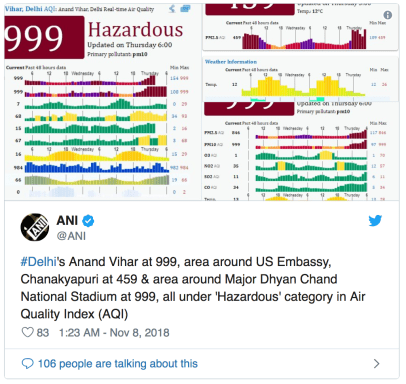
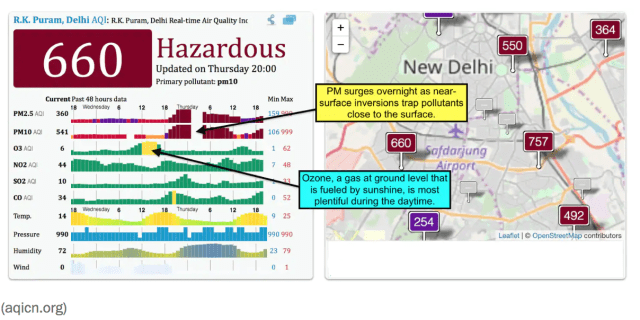
The air quality index, or AQI, hit 980 at 4:30 a.m. Thursday, according to website AirVisual, which monitors air pollution around the world. The levels surged as people violated an order of the Supreme Court and burst firecrackers before and after a two-hour window set for the purpose. Readings below 50 are considered safe, while anything above 300 is considered hazardous.

The air quality is just about as bad as it was in 2017 a day after Diwali, when levels exceeded 1,000, roughly ten times worse than the air pollution in Beijing. The levels on Thursday came down from their peak, with the gauge reading 622 as of 6:30 a.m. The smog last year led the capital’s chief minister to declare his city had become a “gas chamber.”

Toxic air is estimated to kill more than 1 million Indians each year, according to the nonprofit Health Effects Institute.

New Delhi was ranked the most polluted city in the world on Thursday, according to AirVisual’s global rankings. Lahore in Pakistan was at second place with AQI at 273 as of 8 a.m. local time. By comparison, New York had readings of just 29 as of 10 p.m. on Wednesday local time.

With different air quality monitors showing varied readings across the capital, it was still clear that New Delhi’s air was the worst in the world. Levels of dangerous PM 2.5 — the fine, inhalable particles that lodge deep in the lungs, where they can enter the bloodstream — were pushing close to 1,400 in some parts of the Indian capital early on Thursday morning, according to a website run by the Delhi Pollution Control Committee, a government agency.

Burning Crops

Delhi’s air pollution is a toxic mix of vehicular exhaust, smoke from burning crops in the nearby states of Punjab and Haryana, road dust and billowing sand from thousands of construction sites. The pollution is intensified by winter weather patterns and hemmed in by the towering Himalayas to the north.

Severe air pollution — which has been linked to serious ailments including lung cancer and heart disease — affects dozens of cities across South Asia.

Nearby Lahore, over the border in the Pakistani province of Punjab, has been one of the worst affected in recent weeks as agricultural crop burning intensified. Afghanistan’s Kabul and Nepal’s Kathmandu have also been near the top of the pollution rankings.

India alone, according to the World Health Organization’s 2016 rankings, accounted for the world’s 10 most-polluted cities as measured by PM 2.5.

The Lancet estimates that 6.5 million people die annually around the world because of air pollution, mostly in India and China.

via World’s Worst Air Pollution Spikes as Indians Go Firecracker Crazy – Bloomberg

Posted in Air Quality, Asia, India | Tagged , , , , , | Leave a comment

The when, where and what of air pollutant exposure

Scientists have linked air pollution with many health conditions including asthma, heart disease, lung cancer and premature death. Among air pollutants, fine particulate matter is especially harmful because the tiny particles (diameter of 2.5 ?m or less) can penetrate deep within the lungs. Now, researchers have integrated data from multiple sources to determine the personal exposure of people in peri-urban India to fine particulate matter. They report their results in Environmental Science & Technology.

According to the World Health Organization, 11 of the 12 cities with the world’s highest levels of fine particulate matter are located in India. Human sources of these air pollutants include factory emissions, car exhaust and cooking stoves. Countries with limited resources often have increased air pollution compared with other countries, and their sources of exposure are likely different. However, few studies have been conducted to measure personal exposure to air pollutants in these regions. Cathryn Tonne and colleagues wondered if they could use a combination of techniques to measure the contributions of time (when?), location (where?) and people’s activities (what?) to personal exposure to fine particulates in peri-urban India.

The team characterized the personal exposures of 50 study participants in South India over several 24-hour periods. To do so, they integrated data from GPS devices, wearable cameras, questionnaires, and ambient and personal measurements of fine particulate matter. The researchers found significant differences between men and women, with men showing higher levels of personal exposure throughout the day. For women, exposures were mostly related to cooking. For the men, who largely did not engage in cooking, higher exposures were linked to their presence near food preparation, smoking or industry.

The authors acknowledge funding from the European Research Council, the Wellcome Trust and the Spanish Ministry of Economy and Competitiveness.

via The when, where and what of air pollutant exposure — ScienceDaily

Posted in Air Quality, Asia, Health Effects of Air Pollution, India, Medical Studies | Tagged , , , , , | Leave a comment

Air pollution linked to autism

The study of children in Shanghai, from birth to three years, found that exposure to fine particles (PM2.5) from vehicle exhausts, industrial emissions and other sources of outdoor pollution increased the risk of developing autism spectrum disorder (ASD) by up to 78%. The study included 124 ASD children and 1240 healthy children (as control) in stages over a nine-year period, examining the association between air pollution and ASD.

The study, published today in Environment International, is first to examine the effects of long-term exposure of air pollution on ASD during the early life of children in a developing country, adding to previous studies that have already linked prenatal air pollution exposure to ASD in children.

“The causes of autism are complex and not fully understood, but environmental factors are increasingly recognised in addition to genetic and other factors,” Associate Professor Guo said.

“The developing brains of young children are more vulnerable to toxic exposures in the environment and several studies have suggested this could impact brain function and the immune system. These effects could explain the strong link we found between exposure to air pollutants and ASD, but further research is needed to explore the associations between air pollution and mental health more broadly.”

Air pollution is a major public concern and is estimated to cause up to 4.2 million deaths (WHO) every year globally. Outdoor pollutants contribute to a high burden of disease and pre-mature deaths in countries including China and India, especially in densely populated areas.

Even in Australia where concentrations are typically lower, air pollution from burning fossil fuels and industrial processes causes about 3,000 premature deaths a year — almost three times the national road toll and costing the economy up to $24 billion.

Associate Professor Yuming Guo, from Monash University’s School of Public Health and Preventive Medicine, says global air pollution is rapidly becoming worse and there is no safe level of exposure.

“The serious health effects of air pollution are well-documented, suggesting there is no safe level of exposure. Even exposure to very small amounts of fine particulate matter have been linked to preterm births, delayed learning, and a range of serious health conditions, including heart disease.”

The study examined the health effects of three types of particulate matter (PM1, PM2.5, PM10) — fine airborne particles that are the byproducts of emissions from factories, vehicular pollution, construction activities and road dust. The smaller the airborne particles, the more capable they are of penetrating the lungs and entering the bloodstream causing a range of serious health conditions.

PM1 is the smallest in particle size but few studies have been done on PM1 globally and agencies are yet to set safety standards for it.

“Despite the fact that smaller particles are more harmful, there is no global standard or policy for PM1 air pollution.”

“Given that PM1 accounts for about 80% of PM2.5 pollution in China alone, further studies on its health effects and toxicology are needed to inform policy makers to develop standards for the control of PM1 air pollution in the future.”

Story Source:

Materials provided by Monash University. Note: Content may be edited for style and length.

via Air pollution linked to autism — ScienceDaily

Posted in Air Quality, Asia, China, Health Effects of Air Pollution, Medical Studies | Tagged , , , , , , , | Leave a comment

Childhood obesity linked to air pollution from vehicles

Research suggests first year ‘critical window’ in which toxic air can increase weight gain

Early exposure to air pollution from vehicles increases the risk of children becoming obese, new research has found.

High levels of nitrogen dioxide, which is emitted by diesel engines, in the first year of life led to significantly faster weight gain later, the scientists found. Other pollutants produced by road traffic have also been linked to obesity in children by recent studies.

Nitrogen dioxide pollution is at illegal levels in most urban areas in the UK and the government has lost three times in the high court over the inadequacy of its plans. The pollutant also plagues many cities in Europe and around the world.

“We would urge parents to be mindful where their young children spend their time, especially considering if those areas are near major roads,” said Jeniffer Kim, at the University of Southern California, who led the new research. “The first year of life is a period of rapid development of various systems in the body [and] may prime the body’s future development.”

The World Health Organization (WHO) revealed last Monday that 90% of the world’s children are breathing unsafe air, a situation described as “inexcusable” by the WHO’s head. Concern over the impact of toxic air on children’s health is rising as research reveals serious long-term damage to both their physical and mental health.

A large recent study found toxic air significantly increases the risk of low birth weight, leading to lifelong damage to health. Others linked air pollution with birth defects, cot deaths and the first direct evidence of pollution particles in mothers’ placentas has also been revealed.

The new research, published in the journal Environmental Health, followed 2,318 children in southern California and built on earlier work which had identified traffic pollution as a major risk factor for the development of obesity in children.

The research investigated the impact of air pollution from busy main roads, where diesel trucks are common, in the crucial first year of life. They found that by age 10, children suffering high early exposure were almost 1kg heavier on average than those with low exposure. The scientists took a series of other factors into account, including gender, ethnicity and parental education, and think it is unlikely that variations in diet could explain the strong link found.

“Our study suggests that early life may represent a critical window of exposure where increased [air pollution] may result in increased risk for higher childhood [weight] trajectories, which in turn may lead to childhood obesity,” the researchers concluded.

Other pollutants emitted by vehicles have also been linked to childhood obesity. A 2017 study in Boston implicated particulate pollution, while a 2012 study in New York City found the same for children exposed to polyaromatic hydrocarbons while in the womb.

The new research was not able to examine how air pollution increases weight gain in the children, but Kim said inflammation was a possibility: “The most common thought is inflammation of body systems like the lungs which may spill over into the entire body – the brain which regulates appetite and changes in fat metabolism.”

“This study showing an association between increased body mass in children and exposure to air pollution from roads is important since it is compatible with previous studies showing an association between type 2 diabetes and air pollution in adults,” said Prof Jonathan Grigg, at Queen Mary University London and not involved in the research.

“However, more research is needed to explain how toxins inhaled into the lungs affect fat cells throughout the body,” he said. In mice experiments, brain inflammation caused by air pollution has been shown to result in anxiety-induced overeating.

A separate new study on asthma, a disease long linked to air pollution and that is the most common chronic respiratory disease in the world, has estimated that between 9m and 33m emergency visits to hospital result from dirty air every year.

The upper estimate represents almost a third of all emergency admissions suffered by the 358 million asthma sufferers in the world. “The findings estimate the magnitude of the global asthma burden that could be avoided by reducing [outdoor] air pollution,” the scientists said.

via Childhood obesity linked to air pollution from vehicles | Environment | The Guardian

Posted in Air Quality, Asthma, Health Effects of Air Pollution, Medical Studies, USA, USA & Canada | Tagged , , , , , , , | Leave a comment

Moor Lane: London’s first low-emission street

City of London authorities unveil first public details of plan to make city centre street a hub for clean air

Moor Lane, tucked behind Moorgate tube station in central London, is a narrow city street lined with glass and concrete. It’s probably most famous for hosting the £89m Heron Tower, a residential skyscraper in the heart of London’s financial district.

But Moor Lane is about to hit the headlines for a different reason – it is set to become London’s first low-emission street.

According to plans set out today by the City of London Corporation, the local authority for the capital’s Square Mile, Moor Lane will be the site of a pilot project that will see only the cleanest vehicles admitted access from April 2019.

The plans, released for consultation this morning, form part of the City of London’s Low Emissions Neighbourhood project, which is jointly funded by City Hall.

Only ultra-low emission vehicles (ULEVs) will be allowed to enter the southern end of Moor Lane under the trial. The City of London is consulting on whether to implement the rules all day, every day, or just during Monday to Friday.

If the trial goes well, the system could be rolled out to other streets in the Square Mile in a bid to encourage more drivers to switch to electric or hybrid technology, City of London said.

“This trial is an important step towards cleaner air,” said Jeremy Simons, chair of the City of London Corporation’s environment committee. “We are determined to see a major improvement in the City’s air quality.”

“It will deliver the results we need when considering radical targeted action to drastically reduce air pollution on our streets,” he added. “Nobody should have to breathe in dirty air, and we will continue to take bold and ambitious steps to ensure that the health of Londoners is protected.”

The City of London said it would put signs up for a month before the trial starts, to warn drivers of the impending restrictions. For the first four weeks of the trial, non-ULEVs which enter the trial zone will only receive a warning letter, but after that Penalty Charge Notices will be issued.

The City of London is currently considering a longer term ambition of turning parts of the Square Mile into zero-emission zones by 2022, and this summer unveiled emissions-based charges for on-street parking in the area.

via Moor Lane: London’s first low-emission street

Posted in Air Quality, Europe, London, UK | Tagged , , , , , | Leave a comment

WHO says air pollution kills 600,000 children every year

Air pollution kills an estimated 600,000 children every year and causing symptoms ranging from loss of intelligence to obesity and ear infections but there is a limited amount parents can do, a World Health Organization report said on Monday.

Parents should try to avoid household air pollution by using less polluting fuels for cooking and heating and not smoking but to reduce child exposure to ambient pollution they should need to lobby politicians to clean up the environment, WHO experts said.

“Polluted air is poisoning millions of children and ruining their lives,” WHO Director-General Tedros Adhanom Ghebreyesus said in a statement. Large parts of Asia, Africa and Latin America are among the worst affected.

“This is inexcusable. Every child should be able to breathe clean air so they can grow and fulfill their full potential.”The WHO report, “Prescribing clean air”, summarized the latest scientific knowledge on the effect on children of air pollution, which affects about 93 percent of children globally.

Maria Neira, WHO’s head of environmental determinants of health, said the worrying findings highlighted in the study, including evidence of pollution causing stillbirth and preterm birth, as well as diseases into adulthood, should lead to policy changes globally.

“Something that is critical as well is this issue of the neuro-development,” she said.

“Imagine that our children will have less cognitive IQ. We are talking about putting at risk a new generation of having a reduced IQ. This is not only new but terribly shocking.”

There was clear, consistent evidence of an association between ambient air pollution and otitis media, or ear infections, the study said, as well as some evidence of it causing obesity and insulin resistance in children.

Air pollution can also cause childhood cancers, asthma, poor lung function, pneumonia and other types of acute lower respiratory infection, the report said.

via WHO says air pollution kills 600,000 children every year

Posted in Africa, Air Quality, Asia, Health Effects of Air Pollution, Latin America, World News | Tagged , , | Leave a comment

World’s deadliest air pollution spot is in South Africa

One of the world’s most air-polluted regions is a province of green rolling hills and wild flowers in eastern South Africa. Mpumalanga has the largest single area infected by the deadly air pollutant nitrogen dioxide, according to an analysis of satellite imagery released by Greenpeace on Monday (Oct. 29).

Out of satellite data across six continents, the province in South Africa’s east emerged as “the world’s largest NO2 hotspot,” said Greenpeace Africa. The area is home to a dozen coal-fired power stations, owned and operated by South Africa’s national power supplier Eskom.

Greenpeace analyzed satellite images taken daily by the Copernicus Sentinel-5P from Jun. 1 to Aug. 31. Researchers measured the amount of trace gas in a vertical column the full height of the earth’s atmosphere. The sample period took place during the South African winter which may account for increased electricity generation.

Global-NO2-pollution1

China has the world’s highest number of individual hotspots, followed by the Middle East, the European Union, India, the United States and the Democratic Republic of Congo. Industrial areas, vehicle emissions and agricultural burning all led to nitrogen oxides in the air.

Nitrogen dioxide is formed when fuel is burned at high temperature or if the burned fuel already contains nitrogen. At low levels it irritates the eyes, nose, throat and lungs, while long exposure leads to respiratory diseases. Nitrogen oxides can also combine with atmospheric moisture to cause acid rain.

Nitrogen oxide is also found in tobacco smoke leading World Health Organization head Tedros Adhanom Ghebreyesus to declare air pollution as “the new tobacco,” killing seven million people each year.

South Africa’s reliance on coal influences its emissions policies, allowing 10 times more nitrogen oxide emissions than China and Japan, according to Greenpeace. Despite the country’s potential for renewable energy, Eskom is only now beginning to make good on its renewable energy goals.

One of Mpumalanga’s largest towns, eMalahleni (meaning place of coal) is known for having South Africa’s worst air pollution. In 2014, a study by environmental justice group GroundWork found that coal-fired electricity generation was responsible for more than half of hospital admissions and deaths due to respiratory illness in the region. Now, an analysis of weather patterns shows that wind carries the polluted air west to South Africa’s largest city Johannesburg, and the country’s capital Pretoria.

Mpumalanga-pollution-1

“Because South Africa’s coal-belts are hidden from view for the majority of South Africans, it can be easy to pretend that they don’t actually exist,” said Melita Steele, Greenpeace Africa’s climate and energy campaign manager “The reality is that coal extraction and burning has devastating impacts on the people living in the area.”

via World’s deadliest air pollution spot is in South Africa — Quartz Africa

Posted in Africa, Air Quality | Tagged , , , | Leave a comment

Air pollution is the ‘new tobacco’, warns WHO head

Simple act of breathing is killing 7 million people a year and harming billions more, but ‘a smog of complacency pervades the planet’, says Dr Tedros Adhanom

Air pollution is the “new tobacco”, the head of the World Health Organization has warned, saying the simple act of breathing is killing 7 million people a year and harming billions more.

Over 90% of the world’s population suffers toxic air and research is increasingly revealing the profound impacts on the health of people, especially children.

“The world has turned the corner on tobacco. Now it must do the same for the ‘new tobacco’ – the toxic air that billions breathe every day,” said Dr Tedros Adhanom Ghebreyesus, the WHO’s director general. “No one, rich or poor, can escape air pollution. It is a silent public health emergency.”

“Despite this epidemic of needless, preventable deaths and disability, a smog of complacency pervades the planet,” Tedros said, in an article for the Guardian. “This is a defining moment and we must scale up action to urgently respond to this challenge.”

The WHO is hosting its first global conference on air pollution and health in Geneva next week, including a high-level action day at which nations and cities are expected to make new commitments to cut air pollution.

Screen Shot 2018-10-29 at 08.48.09

Children and babies’ developing bodies are most at risk from toxic air, said Dr Maria Neira, WHO director for public health and the environment, with 300 million living in places where toxic fumes are six times above international guidelines.

“Air pollution is affecting all of us but children are the most vulnerable of all,” she said, noting the alarm among child health experts about the links between toxic air and respiratory diseases, cancer and damaged intelligence. “We have to ask what are we doing to our children, and the answer I am afraid is shockingly clear: we are polluting their future, and this is very worrying for all us.”

The WHO is working with health professionals not only to help their patients, but also to give them the skills and evidence to advocate for health in policy decisions such as moving away from fossil-fuel-powered energy and transport. “No person, group, city, country or region can solve the problem alone,” he said. “We need strong commitments and actions from everyone.”

In the UK, most urban areas have illegal levels of air pollution and ministers have lost three times in the high court after challenges over the inadequacy of their action. The latest government action plan, called “pitiful” by environmental lawyers, revealed air pollution was actually much worse than previously feared.

Globally, with smoking on the decline, air pollution now causes more deaths annually than tobacco. However, researchers think the harm known to be caused by air pollution, such as heart attacks and lung disease, is only “the tip of the iceberg”.

The figure of 7 million early deaths is certain to be an underestimate, as it only includes particle pollution and the five most firmly linked causes of death. Early estimates using improved models indicate a total figure of 9 million from particle pollution.

Daniel Krewski at the University of Ottawa, one of the team behind the newer estimate, said: “This suggests that outdoor air pollution is an even more important risk factor for health than previously thought.”

Each passing month sees new studies showing further harms of toxic air, with recent revelations including a “huge reduction” in intelligence, millions of diabetes cases and the first direct evidence of pollution particles in mothers’ placentas.

The cost of the lost lives and ill health caused is also a colossal economic burden: $5tn a year, according to a World Bank report. Tackling air pollution by closing polluting power plants and shifting to cleaner transport, such as cycling or electric cars, has a double benefit as it also tackles climate change.

Neira said that, given the overwhelming evidence of harm from air pollution, any politician who failed to tackle air pollution would be judged harshly by future generations – and the law.

“Politicians cannot say in 10 years from now, when citizens will start to take them to court for the harm they have suffered, that they didn’t know,” she said. “We all know pollution is causing major damage and we all know it is something we can avoid. Now we need to react collectively and in a very dramatic and urgent way.”

via Air pollution is the ‘new tobacco’, warns WHO head | Environment | The Guardian

Posted in Air Quality, Health Effects of Air Pollution, World News | Tagged , , | Leave a comment