Air pollution leads to millions of ER visits for asthma attacks worldwide: First study to quantify global burden of asthma linked to dirty air

Nine to 33 million visits to the emergency room (ER) for asthma worldwide may be triggered by breathing in air polluted by ozone or fine particulate matter — pollutants that can enter the lung’s deep airways, according to a study published today.

Scientists have long known that breathing in air sullied by car emissions and other pollutants could trigger asthma attacks. However, the new study is the first to quantify air pollution’s impact on asthma cases around the globe.

“Millions of people worldwide have to go to emergency rooms for asthma attacks every year because they are breathing dirty air,” said Susan C. Anenberg, PhD, MS, lead author of the study and an Associate Professor of Environmental and Occupational Health at the George Washington University Milken Institute School of Public Health (Milken Institute SPH). “Our findings suggest that policies aimed at cleaning up the air can reduce the global burden of asthma and improve respiratory health around the world.”

Asthma is the most prevalent chronic respiratory disease worldwide, affecting about 358 million people. The new findings, published in the journal Environmental Health Perspectives, suggests car emissions and other types of pollution may be a significant source of serious asthma attacks.

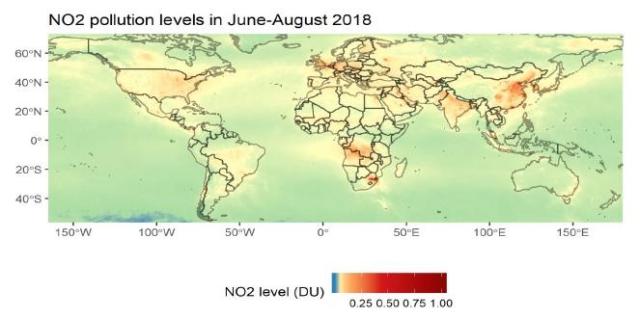
Anenberg and her team first looked at emergency room visits for asthma in 54 countries and Hong Kong, and then combined that information with epidemiological exposure-response relationships and global pollution levels derived from satellites orbiting the earth.

The new research suggests that:

Nine to 23 million annual asthma emergency room visits globally (8 to 20 percent of total global asthma ER visits) may be triggered by ozone, a pollutant generated when car, power plant and other types of emissions interact with sunlight.
Five to 10 million asthma emergency room visits every year (4 to 9 percent of total global asthma ER visits) were linked to fine particulate matter, small particles of pollution that can lodge deep in the lung’s airway tubes.
About half of the asthma emergency room visits attributed to dirty air were estimated to occur in South and East Asian countries, notably India and China.
Although the air in the United States is relatively clean compared to South and East Asian countries, ozone and particulate matter were estimated to contribute 8 to 21 percent and 3 to 11 percent of asthma ER visits in the United States, respectively.
To estimate the global levels of pollution for this study, the researchers turned to atmospheric models, ground monitors and satellites equipped with remote-sensing devices.

“The value of using satellites is that we were able to obtain a consistent measure of air pollution concentrations throughout the world,” said Daven Henze, who is the principal investigator on the project and an associate professor for the University of Colorado Boulder. “This information allowed us to link the asthma burden to air pollution even in parts of the world where ambient air quality measurements have not been available.”

Countries like India and China may be harder hit by the asthma burden because they have large populations and tend to have fewer restrictions on factories belching smoke and other sources of pollution, which can then trigger breathing difficulties, the authors said.

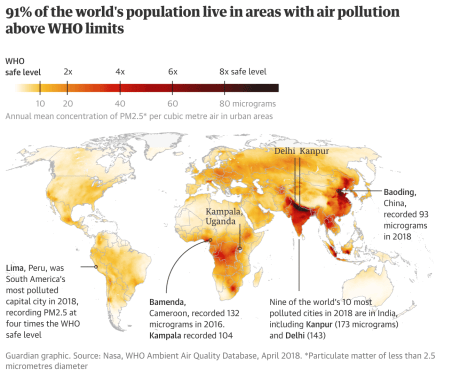
Approximately 95 percent of the world’s population lives in places with unsafe air. Previously, the Global Burden of Disease Study focused on quantifying the impacts of air pollution on heart disease, chronic respiratory disease, lung cancer, and lower respiratory infections — finding that fine particulate matter and ozone were associated with 4.1 million and 230,000 premature deaths in 2016, respectively.

“We know that air pollution is the leading environmental health risk factor globally,” Anenberg said. “Our results show that the range of global public health impacts from breathing dirty air are even more far reaching — and include millions of asthma attacks every year.”

To reduce the global burden caused by asthma, Anenberg suggests that policymakers aggressively target known sources of pollution such as ozone, fine particulate matter and nitrogen dioxide. She says policies that result in cleaner air might reduce not just the asthma burden but other health problems as well.

One way to reduce pollutants quickly would be to target emissions from cars, especially in big cities. Such policies would not only help people with asthma and other respiratory diseases but it would help everyone breathe a little easier, she said.

Support for the study was provided by the NASA Health and Air Quality Applied Science Team, NASA Aura ACMAP, the Stockholm Environment Institute Low Emissions Development Pathways Initiative, and the Global Environment Research Fund of the Japan Ministry of the Environment.

via Air pollution leads to millions of ER visits for asthma attacks worldwide: First study to quantify global burden of asthma linked to dirty air — ScienceDaily

Posted in Air Quality, Asthma, Health Effects of Air Pollution, Medical Studies | Tagged , , , , , , | Leave a comment

AHA: ozone pollution may be linked to a type of bleeding stroke

Exposure to the main ingredient in smog may be linked to a type of bleeding stroke, according to new research.

Studies have shown an association between clot-caused ischemic stroke, the most common type, and fine particulate matter such as air pollution from car exhaust. But few, if any, have investigated how air pollution like ground-level ozone impacts intracerebral hemorrhage, a bleeding type of stroke which accounts for about 10 percent of all strokes and happens when a weakened vessel ruptures into the surrounding brain.

An estimated 40,000 to 67,000 Americans have an intracerebral hemorrhage each year, with often devastating results. Between a third and half of patients die within a month—and only one in five survivors recovers fully within six months.

In the latest study, published Oct. 18 in the journal Stroke, researchers looked at 577 intracerebral hemorrhage patients who were treated between 1994 and 2011 at Massachusetts General Hospital in Boston and compared the patients’ health data with air pollution levels prior to their stroke.

While risk of intracerebral hemorrhage did not go up after increases in three types of air pollution—fine particulate matter, black carbon and nitrogen dioxide—the risk did rise in the wake of higher levels of ground-level ozone. The so-called “bad” ozone is created when sunlight combines with car exhaust, factory emissions and other pollutants.

“In some respects, that was a surprising finding,” said the study’s lead author, Dr. Elissa Wilker. “There is very little literature about the effects of ozone specifically on intracerebral hemorrhage. It may be an important factor, but it needs to be confirmed or refuted in future studies looking at other populations, in different places.”

Wilker, an assistant professor of epidemiology at Harvard University’s T.H. Chan School of Public Health, said the stroke risk in the study was particularly high among those with cerebral amyloid angiopathy, a condition in which protein deposits form in the walls of fragile small blood vessels in the brain.

“That could be important, because it suggests that ozone could have potential to have an impact on small vessels that are affected by cerebral amyloid angiopathy,” said Wilker, also an epidemiologist at Sanofi Genzyme, a biotechnology company. “We don’t know a lot about these risk factors, and this could tell us more about what could be going on.”

Dr. Sanjay Rajagopalan, who was not involved in the study, said more research is needed. “I wouldn’t sound the alarm bells yet but air pollution components and their link to stroke is something the public should probably pay attention to.”

Rajagopalan, who co-authored a 2010 American Heart Association report on air pollution and cardiovascular disease, said people with high-risk pre-existing conditions, including previous heart attacks or strokes, should avoid exposure to high levels of ozone and other air pollutants.

“Use your car filtration system to reduce exposure to ambient pollution levels when you’re commuting, for example. If you happen to visit a heavily polluted country, use face masks and indoor air purifiers,” said Rajagopalan, chief of cardiovascular medicine at University Hospitals’ Harrington Heart and Vascular Institute in Cleveland.

He said the study adds to a growing body of evidence linking air pollution with heart disease. “It was previously thought that air pollution primarily affected the lungs, but now we understand that the vast preponderance of morbidity that air pollution confers is through cardiovascular events, including heart attacks, strokes and mortality.”

via AHA: ozone pollution may be linked to a type of bleeding stroke

Posted in Air Quality, Health Effects of Air Pollution, Medical Studies | Tagged , , , , , , , | Leave a comment

Firecrackers definitely contribute to air pollution, though they are not the only reason: Supreme Court

The Bench acknowledges that there is a necessity to tackle the other contributory factors for air pollution.
Bursting of firecrackers during Deepavali may not be the only reason for air pollution, but the Supreme Court cannot become a mute spectator and allow the deterioration of air quality caused by the bursting during the festival.

This is how the Supreme Court’s judgment, declaring a ban on toxic and loud crackers, explained itself.

The Bench acknowledges that there is a necessity to tackle the other contributory factors for air pollution. Unregulated construction activity which generates a lot of dust and crop burning in the neighbouring States are the two other major reasons. Vehicular pollution is also another cause.

“But the moot question is whether the menace due to fireworks during Deepavali or other festivals/occasions should be left untouched… should the court allow the situation to prevail only because it is not the sole reason for causing air pollution? Answer has to be in the negative,” Justice Sikri held.

It held that “though bursting of crackers during Diwali is not the only reason for worsening air quality, at the same time, it definitely contributes to air pollution in a significant way.”

It referred to studies by the Central Pollution Control Board (CPCB) to show that post-Diwali pollution was lesser in 2017, after the Supreme Court imposed some restrictions on sale and manufacture of crackers, than in 2016.

It said bursting of firecrackers has seen a substantial increase in PM 2.5 level, which is a “very serious health hazard.” The effects of severe noise pollution are not restricted to humans but also cause trauma to animals and birds.

via Firecrackers definitely contribute to air pollution, though they are not the only reason: Supreme Court – The Hindu

Posted in Air Quality, Asia, India | Tagged , , , | Leave a comment

Will Germany’s diesel bans just push its pollution problem to Poland?

Rich countries are exporting their air pollution problems to poorer states in central and eastern Europe, new figures show.

More than 350,000 ‘dirty diesel’ vehicles were exported to Poland last year, according to data from NGO Transport & Environment.

Another 30,000 such cars ended up in Bulgaria.

Campaigners fear this trend will worsen in the future as more cities in western Europe introduce diesel bans.

The majority of polluting vehicles going to Poland came from neighbouring Germany, which has seen several of its cities consider diesel bans. The other supply countries were Belgium, the Netherlands and Italy.

In May, Hamburg became the first German city to introduce one, while similar orders are being touted in Berlin and Frankfurt.

Paris, Madrid, Oslo, Amsterdam and Athens have announced similar measures.

“In the absence of EU-wide fixes or similar restrictions on polluting diesels in central and eastern Europe, dirty secondhand cars from western and northern Europe will flood in as citizens there try and get rid of them,” Julia Poliscanova, an air quality expert at T&E, told Euronews.

Poland already has some of the worst air pollution in Europe, according to T&E, and it causes more than 43,000 premature deaths each year.

“Governments must stop exporting air pollution,” said Jens Müller, T&E’s diesel and air quality coordinator.

“Problems caused by a mass manipulation of emission tests by car makers must be fixed, not brushed under the carpet.

“All EU citizens have equal right to clean air.”

via Will Germany’s diesel bans just push its pollution problem to Poland? | Euronews

Posted in Air Quality, Europe, Germany, Poland | Tagged , , , , , | Leave a comment

Polluted city neighborhoods are bad news for asthmatic children: Study shows that children with asthma react differently to changes in air pollution depending on the environment they grow up in

Children with asthma who grow up in a New York City neighborhood where air pollution is prevalent need emergency medical treatment more often than asthmatics in less polluted areas. This is according to researchers from Columbia University in the US in a new study published in the Springer Nature-branded journal Pediatric Research. Lead author, Stephanie Lovinsky-Desir, warns however that neighborhoods where asthma cases in children are less common should not be excluded from efforts to improve air quality. This is because children that live in neighborhoods where asthma is less common may be more vulnerable to the effects of air pollution.

For this study, 190 participants aged seven and eight were recruited between 2008 and 2011. All participants were part of the New York City Neighborhood Asthma and Allergy Study and had previously been diagnosed as having asthma. They all grew up in middle-income families in neighborhoods in the Bronx, Brooklyn, Queens, and Manhattan.

The participants were grouped as belonging to neighborhoods with high numbers of asthma cases or neighborhoods with low instances of asthma. There was no significant difference between the household incomes and access to health care (private insurance) enjoyed by the families of the participants. However, those growing up in areas where asthma was more common tended to live in apartment buildings or on higher floors. They were also more likely to live in crowded environments and be raised by single mothers.

Lovinsky-Desir and her colleagues found that children living in neighborhoods where asthma was more common needed emergency care more often and tended to suffer more from exercise-induced wheezing. Also, the concentrations of ambient pollutants in these neighborhoods were higher. Over the course of a year, concentrations of known air pollutants such as nitrogen dioxide, small airborne particles and elemental carbon were much higher in these neighbourhoods than in those with fewer asthma cases.

An interesting finding was that children living in neighborhoods where asthma was less common were effected most by pollution, even though pollution levels were higher in the more common asthma neighborhoods.

“In neighborhoods with less poverty, children exposed to air pollution were more likely to be taken for emergency asthma treatment. However, in neighborhoods with more poverty, it’s likely that other things in the environment, such as stress and violence, have a stronger effect on urgent asthma treatment than air pollution,” explains Lovinsky-Desir.

via Polluted city neighborhoods are bad news for asthmatic children: Study shows that children with asthma react differently to changes in air pollution depending on the environment they grow up in — ScienceDaily

Posted in Air Quality, Asthma, Health Effects of Air Pollution, USA, USA & Canada, World News | Tagged , , , , , , , , , , | Leave a comment

RESPRO® TUBULAR ALL PURPOSE SCARF

This limited edition tubular ‘Talking Heads’ scarf, has a black and white print, created especially for Respro® by artist Margo of Margate. It is the perfect accompaniment to any Respro® mask. It can be used as a cover for our Street Smart or EV mask range, or simply as a head or neck scarf while out in the windy weather. Our print makes a ’ Clean Air For All’ statement while making you look and feel cool.

Talking Heads scarf


Posted in Respro® Products | Leave a comment

Delhi chokes: Air quality dips to ‘very poor’; will deteriorate further, says pollution board

The overall Air Quality Index (AQI) of Delhi was recorded at 315 and the overall air quality has dipped to ‘very poor’ category. As per the Pollution Control Board, the worst was recorded from Dwarka Sector-8.

Once again the national capital is soon to become a gas chamber, the air quality deteriorates to ‘very poor’ category for the first time in the season on Wednesday. The overall Air Quality Index (AQI) of Delhi was recorded at 315. An AQI between 0 and 50 is considered ‘good’, 51 and 100 ‘satisfactory’, 101 and 200 ‘moderate’, 201 and 300 ‘poor’, 301 and 400 ‘very poor’ and 401 and 500 ‘severe’.

As per the Central Pollution Control Board (CPCB), the worst was recorded from Dwarka Sector-8, 376, followed by Anand Vihar at 358, Jahangirpuri 333, Rohini 330 and ITO at 295. According to news agency PTI, the air quality will deteriorate further as the forecast mentioned that in coming days the PM10 level will reach 341 and the PM2.5 level 159.

via Delhi chokes: Air quality dips to ‘very poor’; will deteriorate further, says pollution board

Posted in Air Quality, Asia, India | Tagged , , | Leave a comment

Moss rapidly detects, tracks air pollutants in real time

Moss, one of the world’s oldest plants, is surprisingly in tune with the atmosphere around it. Now in a study appearing in ACS’ journal Analytical Chemistry, scientists report that they have found a simple and inexpensive way to detect air pollutants, specifically sulfur dioxide, in real time based on subtle changes in moss leaves. The discovery could rapidly alert authorities to potentially dangerous alterations in air quality using a sustainable, natural plant sensor.

Plants have evolved the ability to sense light, touch, gravity and chemicals in the air and soil, allowing them to adapt and survive in changing environments. Thus, plants have been used in studies to assess the long-term damage caused by accumulated air pollution worldwide. However, this type of study requires skilled personnel and expensive instrumentation. Xingcai Qin, Nongjian Tao and colleagues wanted to develop an easier way to use moss, a particularly good indicator of sulfur dioxide pollution, as a rapid, real-time sensor.

The researchers gathered wild moss and exposed it to various concentrations of sulfur dioxide in a chamber. Using a highly sensitive, inexpensive webcam, the research team found that moss leaves exposed to sulfur dioxide slightly shrank or curled and changed color from green to yellow. Some of these changes, analyzed with an imaging algorithm, began within 10 seconds of exposure to the pollutant. However, once the sulfur dioxide was removed from the chamber, the moss leaves gradually recovered. This result suggests that the plant, unlike traditional colorimetric sensors, can regenerate its chemical sensing capacity. The researchers conclude that combining remote webcams or drones with moss or other plant-based sensors could lead to cheaper, faster and more precise monitoring of the air for sulfur dioxide and other pollutants over vast regions.

via Moss rapidly detects, tracks air pollutants in real time — ScienceDaily

Posted in Air Quality, World News | Tagged , , , | Leave a comment